Author Archive
 Programming again
 September 12th, 2012 |
  Author:
 Recently I downloaded the latest version of Lazarus, the rapid application development tool that uses Free Pascal. It’s a clone of Delphi but open source and cross platform. I’ve used it for hobby program development for the last few years, when I was no longer able to get free copies of Delphi. But now I actually prefer Lazarus to Delphi. It’s like how Delphi used to be.
 |
| The Lazarus IDE |
In Lazarus I have been making a few changes to my logging program for Elecraft transceivers, KComm. Programming again marks another milestone in my return to normality, though in all honesty the time it takes and the number of stupid mistakes I make show that my brain still isn’t firing on all cylinders.
Why write my own logging program when there are so many good alternatives available? For one thing it is the same motivation that makes people build their own gear. For another, it allows me to use a program that works the way I want. If I want a certain feature then I get on and implement it. By limiting its use to the Elecraft community I avoid the troubles encountered by, say, the developers of Ham Radio Deluxe: the problem of dealing with thousands of users. There are probably only a handful of users of KComm, but that’s all right because I’m mainly developing it for my own use.
 |
| KComm can speak Russian |
An example of what writing my own software allows me to do can be seen in the screenshot above. KComm supports user choice of character set for digital modes. So that if someone sends me a message in Russian (for instance) I can see what they sent (and copy and paste it into Google Translate, since I don’t speak Russian.)
This should not be taken as a sign that I will start writing new programs again. I’m just making a few changes to programs I use myself. I have downloaded the source code to the last released version of JT65-HF (which happens to have been developed in Lazarus too.) Perhaps one day I’ll see if I can make a few tweaks to that!

Which ham sites would you really miss?
This morning I received an email to warn me my subscription to eQSL.cc will run out next month. Forgetful as I am becoming, I thought that this time I’d better get on and renew it right away before I forget.
The amount asked for Bronze membership is $20.00 US. But if you think that’s too much you can pay any amount, even as little as $5. You could probably get away with $1 but surely nobody is that cheap?
Bronze membership is really worth it because it allows you to use your own QSL design. Free members only get a plain text card which is pretty boring.
I’m glad eQSL allows free membership because it’s better to have as many hams as possible registered with the system (and hopefully take the steps needed to become Authenticity Guaranteed) even if they don’t pay a cent. According to eQSL nearly 90% of members never donate any money. I’m not very good at mental arithmetic but if every user paid something then the minimum membership fee would be about $2 a year I think.
It’s always tempting to freeload, to put off donating until another day, but I think everyone should donate to help keep running the sites they use most.
Here’s my list of sites I use most every day and would really miss:
There are a couple of omissions that may surprise you. But those big sites you’re thinking of must make enough from advertising to get along without my help. I probably visit them less than once a week, so I wouldn’t miss them as much as the sites in my list.
Which ham radio sites would you really miss if they closed tomorrow?

Icom launches a new handy
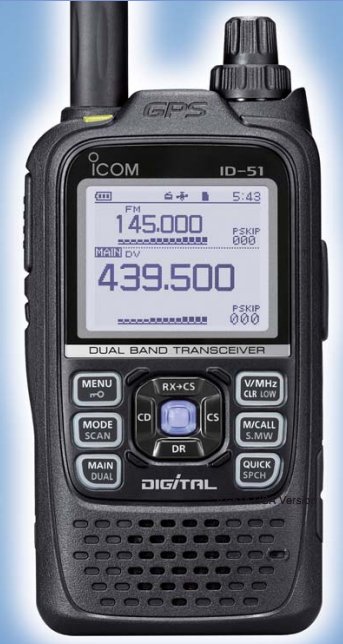 |
| Icom ID-51 |
Icom has demonstrated a prototype of its latest dual-band handheld transceiver – the ID-51A. (The European version will be the ID-51E.)
Covering 2m and 70cm, the ID-51 can also receive FM broadcasts and AM short wave radio. It supports D-Star (of course) as well as FM mode, and boasts a large 128×104 pixels display, the largest yet seen on an amateur radio handheld rig.
Like its smaller sibling the UHF-only ID-31, the ID-51A/E has a built-in GPS which can be used for track logging to a micro-SD card. The storage card can also be used to record incoming and outgoing voice traffic. Very useful – not!
Disappointingly though not unexpectedly, this new Icom does not support APRS, though it presumably supports D-Star’s rather lame version, D-PRS.
The ID-51 is being billed as the most technically advanced handheld, though it looks like you will be paying a lot for features – like the GPS and short wave receiver – for which most hams will have little use. I doubt that the large display – never mind the GPS – will do much to extend battery life, though Icom will offer an extended battery pack (at the usual inflated Icom prices no doubt.) However it is nice to see a manufacturer breaking the mould for HT user interfaces which have changed little for the last 20 years.

Tuning up an NA-666
The Nagoya VHF/UHF antennas made in China and available from sellers like 409Shop are popular and cheap, but I think they leave a lot to be desired in the quality control department.
 A couple of years ago I bought a Nagoya NA-666 with a regular male SMA connector for use with my Kenwood and Yaesu rigs. I was impressed with the performance of this antenna, and with the fact that it achieved a true 1:1 SWR at bang on 145MHz.
So when I ordered another antenna of the same model but with a BNC connector to work with all my HTs (which have now all been fitted, where needed, with SMA to BNC adapters) I was surprised to find that its performance was a disappointment.
I am well aware of the existence of fake antennas on eBay and have bought more than my fair share of them, but this looked to all intents and purposes to be a genuine Nagoya (silver on black label on the base and a serial numbered Nagoya hologram on the pack.) It had been purchased from 409Shop, a reputable seller. However, when tested on my RigExpert AA-200 antenna analyzer the nice sharp SWR curve dipped to a minimum at 135MHz – 10MHz too low. The SWR at 145MHz was off the scale. Ho hum.
As any ham knows, if an antenna tunes too low in frequency the solution is to cut bits off. After a bit of a struggle the rubber end cap came off and I gingerly pruned about a tenth of an inch . The antenna analyzer showed the minimum SWR point had moved up 1MHz. So I carried on with the cycle of cut, test, cut, test until I had achieved a much more reasonable SWR at 145MHz.
 |
| Final SWR curve of the shortened antenna |
As I approached 145MHz the antenna was now quite noticeably shorter and I was concerned that I may have passed the point at which the improvement due to a better match was counteracted by the reduced size of the radiating element. I may have passed that point but it is very difficult to make reliable and repeatable field strength measurements. Therefore I didn’t make the final cut which would have brought the SWR (shown above) to 1.0:1 at exactly 145MHz.
Field strength measurements and on-air tests led me to the conclusion that the 7-inch shortened NA-666 performed 2-3dB better than my 8.5 inch long NA-701. It beat all the stock rubber ducks by another 2 or 3 dB. The only antennas that outperformed it were a quarter wave telescopic (19 in long) an even longer Nagoya NA-767, a nicely made but unbranded “RH-770” and a “Diamond” RH-205 5/8 wave telescopic, all of which are really too long and cumbersome to use with a small radio like the Baofeng.
Using the shortened NA-666 I have had solid simplex contacts with 5 and 9 reports over distances of several miles and can even access a repeater 50 miles away from inside the shack. So I’m pretty pleased with the result.

Our Jubilee
I’m not doing much radio today as Olga and I celebrate our 10th wedding anniversary.

Some of you might like to see a picture of us taken today in our present to each other – a new kitchen!
Thank you, Olga, for a wonderful ten years. I hope the next ten will be even better!

Buzz off
Ever since I received the Elecraft KX3 it has suffered from poor loudspeaker audio. It buzzed and distorted at any but the lowest volume level. Various suggestions were made and considered but the culprit seemed to be the loudspeaker itself. Elecraft spotted my description of the problem on the KX3 Yahoo group and offered to send a new speaker. After confirming to my satisfaction that the speaker was indeed the culprit I accepted the offer. The replacement came in the post this morning.
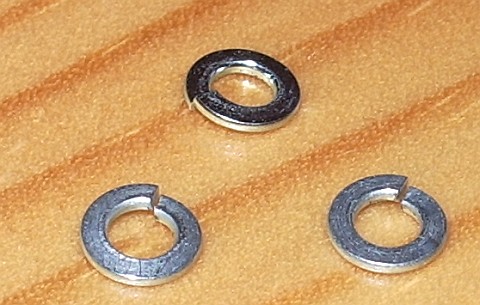 |
| The culprit(s) revealed |
It didn’t take long to plug the new speaker into the KX3. To my dismay, that buzzed and distorted too. It didn’t seem to be quite as bad as the original, though, so I decided to install it. That was when I hit a snag: the holes in the speaker chassis had not been tapped to take the mounting screws. I was stymied.
Thinking I would have to put the old speaker back, I had a good look at it. That’s when I noticed a split ring lock washer stuck to the magnet where it joined the speaker cone. Aha! I thought. The culprit! As I was soldering the speaker leads back on I noticed something else that should not have been there. A second lock washer! I fished it out with the end of a jeweller’s screwdriver and put it with the other one.
I hoped that would be the solution and prepared to reinstall the original speaker. While I was thinking about that I was examining the replacement I had been sent and I noticed what looked like the edge of another split ring lock washer. After a bit of fiddling with the jeweller’s screwdriver I managed to fish it out. Yes. it was a split ring lock washer, stuck to the magnet of the replacement speaker!
I’m sure some of you are thinking that my shack must be a tip with bits of hardware strewn all over the place, but I assure you that isn’t. I can easily see how a small part could get dropped inside the KX3 during assembly and migrate to the speaker’s powerful magnet. But how one came to be stuck to the inside of the replacement in a sealed envelope straight from Elecraft will probably forever be a mystery.
I’m happy to report that the audio from the KX3 is now perfect at any reasonable volume, with the original speaker reinstalled in it. If any UK KX3 owner needs a replacement speaker then it’s yours for the asking. But you’ll have to tap threads for the mounting screws into it.

UHF DVAP Dongle on the way?

Rumour has it that a 70cm version of the DVAP Dongle is on the way. Rumour also suggests that the price will be the same as for the 2m dongle. For those who would like to use Icom’s new ID-31 D-Star handie and have no UHF D-Star repeaters in range, the wait may soon be over.














