Author Archive
 W5OLF WSPR kit?
 October 19th, 2014 |
  Author:
 My soldering skills are rather “challenged” since my brain bleed 13 months ago. I have an un-built Ultimate 3 kit waiting for my better health. Several kind people have offered me help to build and test it: you know who you are and thank you! The kindness of fellow QRPers knows no bounds. It is so lovely to find how many really kind people there are around. There are far more good people in the world than bad ones.
Some years ago W5OLF sold a very simple, single board, few parts, WSPR TX which I think I could manage to build. I could not find it advertised. Anyone know if it is it still available?

Extra SAQ 17.2kHz VLF CW transmission on Oct 24th?
Message from SAQ (sic). There appears to be some confusion over the time. If I get clarification I’ll let you know later. The transmissions are CW from the World Heritage transmitter that dates from about 90 years ago. It is run up on special occasions only.
There will hopefully be a transmission with the Alexanderson alternator on 17.2 kHz on “United Nations Day” October 24, 2014 at 10:00 UTC. Start up and tuning from about 11:30 UTC.
There will be a message written by students in Denmark.
We are not hundred percent sure we have access to the antenna this day because of other organization using it.

472kHz WSPR using earth-electrode antenna
As an experiment this afternoon and evening I am using the (short baseline) earth-electrode antenna. I am being copied by G0LRD (25km) and G3ZJO (79km) so far. It is now 1620z. Initial results suggest G0LRD is getting me very slightly better on the earth electrodes, whereas G3ZJO is getting me slightly weaker. This is comparing the earth-electrode “antenna” with the HF /VHF antennas with strapped feeders tuned against mains earth. In the latter case I resonate the antenna with a 110mm diameter coil with many taps.
One end of the earth-electrode is tied to mains earth. The “far” earth is a 1m long earth rod driven into the soil. The connection to the far electrode is 32 x 0.16mm PVC covered wire running along the fence at a height of about 2m. This wire dog-legs and is about 15m long. The spacing between the “far” electrode and mains ground in the shack is about 12m max. At the old QTH the baseline was more like 20m.
I think the earth-electrode antenna acts a bit like a loop so best results tend to be in the line of the loop. It also means there is not a huge difference between the two systems. You could say they are both equally bad, but the earth-electrode system needs no matching coil. I have optimised the resistive match using a 3C90 toroid (step up) between the transverter and earth-electrode antenna. At the old QTH it looked close to 50 ohms so the toroid was not needed.
When fitter, I’d like to try an earth-electrode system with a much bigger baseline.
There is no doubt that my 472kHz antennas can be much improved. The question is, “how seriously do I want to try?”

Para-saki all diode QRP transceiver
This looks like a design by Michael Rainey AA1TJ, but this one was on a German blog site of Peter DL3PB. I was very annoyed by the Facebook pop-up that kept appearing. I kept closing the pop-up but it is really annoying. Website owner – PLEASE get rid of it!
See http://streampowers.blogspot.co.uk/2013/08/para-saki-qrp-transceiver-fact-diodes.html .
The design makes extensive use of tunnel diodes, a Michael Rainey favourite.

Solar Cycle 25 Predictions
It has been notoriously hard to predict future solar cycles, but the science is improving all the time. Right now, the experts are predicting that solar cycle 25 will be very small indeed. Some think we are moving towards another Maunder Minimum when solar sunspots all but vanish for around 50 years. If so, most of us alive now will never experience “good” HF conditions ever again in our lifetimes. Experts can be wrong!
On a positive note, poor solar activity often means the lower frequency bands are better. With some luck, we may have a new international contiguous band at 60m in a few years’ time. This depends on WRC2015.
Regarding cycle 24, it looks like the peak was Feb 2014.
See http://www.solen.info/solar/ .

Simple 10m rigs
As 10m slides to the “quieter years” of the solar cycle it will soon be time to look again at using this band for local communications. It makes an ideal band to natter across town and I still think a 10m Fredbox is worth a go. The receiver, a simple super-regen is extremely simple, very sensitive with a simple RF amplifier, but lacking in selectivity so would NOT be useful when the band is busy. At night time in the quieter years it would be perfectly fine. The alternative is a simple 10m DSB rig, which would be compatible with SSB transceivers.
At the moment, my poor health is stopping me doing both of these projects.
See https://sites.google.com/site/g3xbmqrp3/hf/10m_op?pli=1 .
See https://sites.google.com/site/g3xbmqrp3/hf/tenbox .
See https://sites.google.com/site/g3xbmqrp3/hf/10msimple_sb .

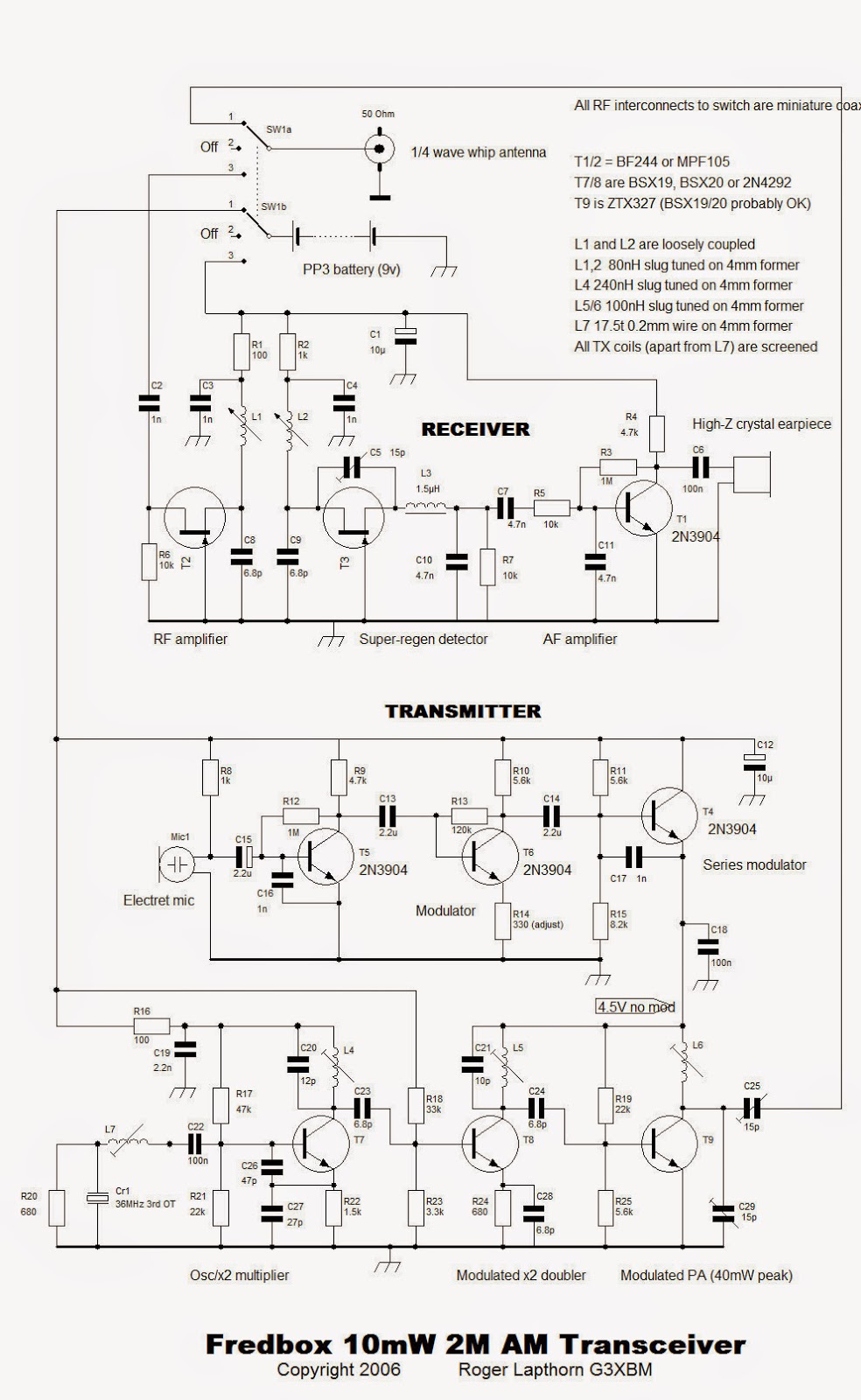
Fredbox schematic
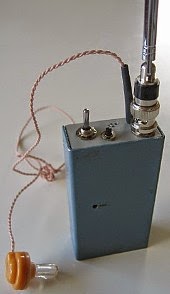 |
| Fredbox 2m AM transceiver |
The Fredbox was my design for a 10mW AM transceiver for 2m use back in the 1970s. It was rebuilt a few years ago and a 6m version was spun off. The same basic approach would work on 10m and 4m too, but I have not completed versions for these bands.
Even 2m 10mW AM was enough to work across the English Channel handheld on 2m and the 2m Fredbox made several 60 mile handheld QSOs . For quite a while it was used to natter across town in Cambridge. The Fredbox was named in honour of local Fred G8BWI back in the 1970s.
The Fredbox and Sixbox have appeared in G-QRP SPRAT and in Practical Wireless mags. The schematics also appeared in several foreign language magazines too. The circuits are basic and certainly capable of being improved.
See https://sites.google.com/site/g3xbmqrp3/vuhf/fredbox.
See https://sites.google.com/site/g3xbmqrp3/vuhf/sixbox .