Author Archive
 Final Assault (Part Three): Mission Accomplished
 March 9th, 2015 |
  Author:
 Today, March 8, 2015 at 1732z, I made my fourth QSO from Peak 9431, W5N/PW-019 with N4EX. That QSO qualified the activation and thus earned me my SOTA Mountain Goat award. After 2 years and 2 days my point total is now 1,007, hallelujah!!
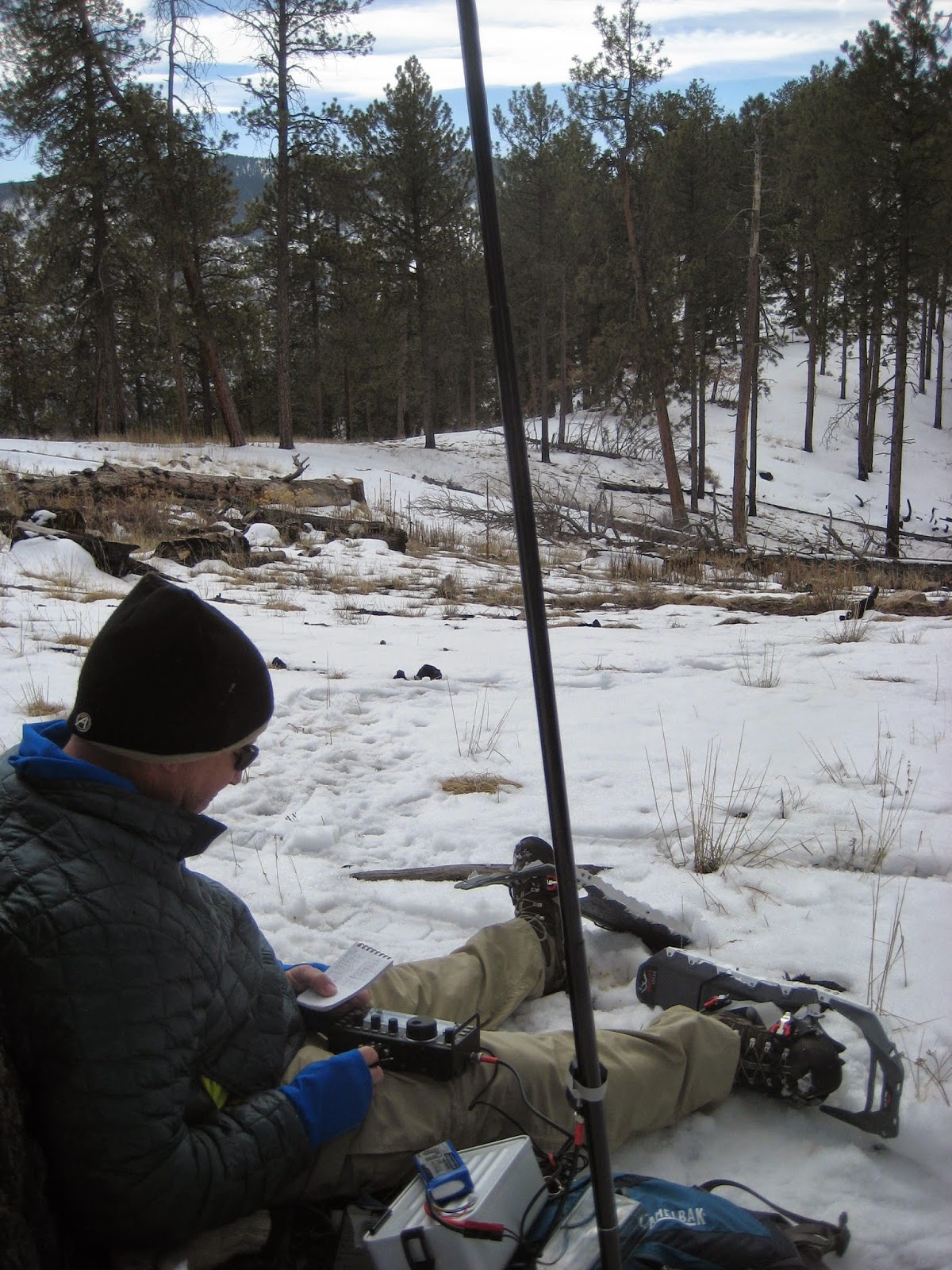
Peak 9431 was also the second activation I ever made and I activated it with Fred, KT5X and John K1JD, both of which were with me today. Also this was my first activation using snow shoes the entire way, which actually was sort of fun. I made 37 QSO's and had a nice run of Europeans on 15m. It was a great day. Below is a video and a couple of pictures of today's activation.
Peak 9431 was also the second activation I ever made and I activated it with Fred, KT5X and John K1JD, both of which were with me today. Also this was my first activation using snow shoes the entire way, which actually was sort of fun. I made 37 QSO's and had a nice run of Europeans on 15m. It was a great day. Below is a video and a couple of pictures of today's activation.
Ascent
Activation (I left my snow shoes on)
Departing the Summit with K1JD and KT5X
More summits to activate. Thanks to the chasers who make this possible.
Final Assualt (Part 2), Not Today
There was a tentative plan to do two peaks today to finish of my SOTA Goat quest. However it was not to be. We did activate Viejos Mesa, W5N/CC-020, but evidently I had yet to do a hike through snow and mud on a beautiful sunny day. I can now check that box.
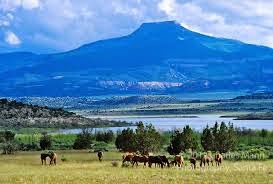
I did the activation with Fred, KT5X and John K1JD. It was a lovely day and the views were simply magnificent, in fact these views captured the imagination of Georgia O'Keefe, and which she immortalized in her paintings. Of all days to forget my camera it was today, but in the picture below, everything in it plus a lot more was what we got to look at while doing this summit. Of course we were a lot higher, 8,000ft ASL, while enjoying the beauty.
As previously mentioned the trail was too wet and too muddy, with some almost knee deep drifts in places, to keep a decent pace, So we didn't' have time to do the second peak. So, I sit at 996 points.
Hopefully tomorrow.
I did the activation with Fred, KT5X and John K1JD. It was a lovely day and the views were simply magnificent, in fact these views captured the imagination of Georgia O'Keefe, and which she immortalized in her paintings. Of all days to forget my camera it was today, but in the picture below, everything in it plus a lot more was what we got to look at while doing this summit. Of course we were a lot higher, 8,000ft ASL, while enjoying the beauty.
As previously mentioned the trail was too wet and too muddy, with some almost knee deep drifts in places, to keep a decent pace, So we didn't' have time to do the second peak. So, I sit at 996 points.
Hopefully tomorrow.
Final Assault (Part 1)
The last I wrote I had 965 SOTA Activator points. The goal is 1,000 Activator points to achieve Mountain Goat status. I'm almost there. I did two summits today, Palomas Peak (W5N/SI-010) and Peak 6860 (W5/SI-022), to move my total to 985 points, almost there. Below are some video clips from my activations today.
It was a beautiful day to be in the mountains of New Mexico. Both of these summits are near Albuquerque, but very different environments. Palomas Peak is in an alpine forest and 6860, more or less in the desert. Al within about 25 miles of each other.
It was a beautiful day to be in the mountains of New Mexico. Both of these summits are near Albuquerque, but very different environments. Palomas Peak is in an alpine forest and 6860, more or less in the desert. Al within about 25 miles of each other.
The Trail to Palomas Peak
Palomas Operating Position
Palomas Descent
Taking a Break During 6860 Ascent
Arrival on 6860
6860 Summit
It was a beautiful day with two very different mountains. Lots of fun. Only 15 points to go. Stay Tuned for Part II.
Chew the Rag a Little
Most of us these days are very busy. Especially for those who are working, raising kids and trying to do the best we can to meet our obligations, there doesn't seem to be enough hours in the day. Today's world is fast moving, with smart phones, iPads and other forms of technology it's hard to have any spare time. And so for many that translates to our beloved hobby, Amateur Radio, we just rush through our routine, work the station, 599, and get back to the hustle and bustle of life.
We use the spotting networks to save time turning the dial looking for DX, or that needed whatever, we may be chasing. Even the rare times that we may call CQ, it's a quick report and on to the next one. Because of our rush to get through our days, we miss a lot of the hidden treasures available to us in Amateur Radio if just take the time.
I'm as guilty as the next guy of all of the above, that's why I can write about it so easily. However in the last few months I've been taking the time to have real chats or "ragchews" with my fellow amateurs. CW is my preferred mode, and so I have set aside 20 -30 minutes in an evening, rather than watch some TV show I will forget about in a weeks' time, to just sit down and have a chat. I've met some really cool people and had many very satisfying QSO's. I have re-sharpened my CW skills and met some new friends.
So, call CQ instead of watching the spots and see what you get. Talk about your rig, the weather, your paddle or bug and enjoy a relaxing time in your shack. You will feel refreshed to meet others who share this great hobby.
We use the spotting networks to save time turning the dial looking for DX, or that needed whatever, we may be chasing. Even the rare times that we may call CQ, it's a quick report and on to the next one. Because of our rush to get through our days, we miss a lot of the hidden treasures available to us in Amateur Radio if just take the time.
I'm as guilty as the next guy of all of the above, that's why I can write about it so easily. However in the last few months I've been taking the time to have real chats or "ragchews" with my fellow amateurs. CW is my preferred mode, and so I have set aside 20 -30 minutes in an evening, rather than watch some TV show I will forget about in a weeks' time, to just sit down and have a chat. I've met some really cool people and had many very satisfying QSO's. I have re-sharpened my CW skills and met some new friends.
So, call CQ instead of watching the spots and see what you get. Talk about your rig, the weather, your paddle or bug and enjoy a relaxing time in your shack. You will feel refreshed to meet others who share this great hobby.
Closing in on Mountain Goat
It has been a busy year on several fronts. My day job has kept me extremely busy, my band competed in the International Blues Challenge (IBC), getting to play two nights in BB Kings on Beale St. in Memphis, TN to packed houses and I've been accumulating a lot of SOTA points.
Sometimes my busy schedule gives me opportunities to activate summits that I wouldn't otherwise get to activate. A case in point was travelling to the IBC in Memphis. My drive from San Antonio took me through eastern Oklahoma and western Arkansas. Both areas are target rich environments for SOTA activators so I was able to accumulate a lot of points. So many points in fact that, when added to a recent trip to Santa Fe, NM and the Davis Mountains in Texas I am knocking on the door of the SOTA Mountain Goat award which requires 1,000 activator points. I am now at 965 points.
Not just because I am getting close to earning MG status, but I believe this is one of the toughest awards in ham radio if you factor in the physical side of it. Nearly all awards in the amateur radio world require you sit on your derriere for hours or even days at a time. You will never mistake a ham convention for a gathering of tri-athletes. Staying fit enough to do these climbs has me in the best shape I've been in years. That said, you don't have to be in fantastic shape to participate in SOTA. There are mountains or hills that qualify that can be driven up or just a short walk will get you there. But it does require that you get outside, which is a good thing. And I promise, the more you do it, the more you will want to do.
I've learned some much about portable QRP operating while working toward this award. It's been said that when you achieve MG status, you have a Ph.D in portable radio operation. When I think about my first activation versus the way I operate now, it's night and day. I travel so much lighter and my station is much more efficient. I can be operating within 10 minutes of arriving on the summit with a station that will generate a pile-up and make DX contacts on multiple bands.
So I am anxious to get the 1,000th point, which hopefully will be within the next couple of weeks. Below is a video and picture from a couple of summits I activated last weekend in the Davis Mountains of Texas. The Davis Mountains are the home of the McDonald Observatory which, as you will see below, is a dominant feature on the horizon in that area. BTW, Mount Locke, where the observatory sits, is a 10 pointer that you drive up, however you have to get of the house to get there. The picture is from Mt. Arabella, a fairly steep 8 pointer that will take the average person 30 -45 minutes to ascend. The video is from Peak 6411 outside of Ft. Davis. It also is a drive-up. I use the Alex Loop on drive up mountains, but End Fed Half Wave (EFHW) on hikes of any distance.
Since beginning my chase for MG my longest hike was doing Santa Fe Baldy, in Santa Fe, NM. A 15 mile roundtrip up to 12,000+ ft. ASL. The tallest mountain I've done is Mt. Sherman in Colorado at 14,036 ft. ASL.
I 'm sure I will make another posting to the Blog when I get the 1,000th point. I can't wait to become a certified Old Goat!
Sometimes my busy schedule gives me opportunities to activate summits that I wouldn't otherwise get to activate. A case in point was travelling to the IBC in Memphis. My drive from San Antonio took me through eastern Oklahoma and western Arkansas. Both areas are target rich environments for SOTA activators so I was able to accumulate a lot of points. So many points in fact that, when added to a recent trip to Santa Fe, NM and the Davis Mountains in Texas I am knocking on the door of the SOTA Mountain Goat award which requires 1,000 activator points. I am now at 965 points.
Not just because I am getting close to earning MG status, but I believe this is one of the toughest awards in ham radio if you factor in the physical side of it. Nearly all awards in the amateur radio world require you sit on your derriere for hours or even days at a time. You will never mistake a ham convention for a gathering of tri-athletes. Staying fit enough to do these climbs has me in the best shape I've been in years. That said, you don't have to be in fantastic shape to participate in SOTA. There are mountains or hills that qualify that can be driven up or just a short walk will get you there. But it does require that you get outside, which is a good thing. And I promise, the more you do it, the more you will want to do.
I've learned some much about portable QRP operating while working toward this award. It's been said that when you achieve MG status, you have a Ph.D in portable radio operation. When I think about my first activation versus the way I operate now, it's night and day. I travel so much lighter and my station is much more efficient. I can be operating within 10 minutes of arriving on the summit with a station that will generate a pile-up and make DX contacts on multiple bands.
So I am anxious to get the 1,000th point, which hopefully will be within the next couple of weeks. Below is a video and picture from a couple of summits I activated last weekend in the Davis Mountains of Texas. The Davis Mountains are the home of the McDonald Observatory which, as you will see below, is a dominant feature on the horizon in that area. BTW, Mount Locke, where the observatory sits, is a 10 pointer that you drive up, however you have to get of the house to get there. The picture is from Mt. Arabella, a fairly steep 8 pointer that will take the average person 30 -45 minutes to ascend. The video is from Peak 6411 outside of Ft. Davis. It also is a drive-up. I use the Alex Loop on drive up mountains, but End Fed Half Wave (EFHW) on hikes of any distance.
Since beginning my chase for MG my longest hike was doing Santa Fe Baldy, in Santa Fe, NM. A 15 mile roundtrip up to 12,000+ ft. ASL. The tallest mountain I've done is Mt. Sherman in Colorado at 14,036 ft. ASL.
I 'm sure I will make another posting to the Blog when I get the 1,000th point. I can't wait to become a certified Old Goat!
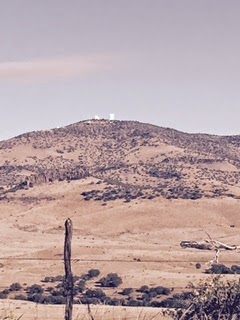 |
| McDonald Observatory from Mt. Arabella |
My Plan for K1N
It's been said that if you don't know where you are going, any road will take you there. Said another way, it's always good to have a plan. As the K1N expedition was approaching, I had a look at my log to see what bands I would need them on. I was fortunate to work Navassa in 1992, so I didn't need this one for and all-time new one (ATNO), but I did need to fill a few band slots. But what did I need? Oddly enough I needed them on 20m. Navassa and North Korea are the only countries I need on 20m to have 'em all on that band. I also needed them on 160m, 17m, 12m and RTTY for a new mode.
My plan would've been relatively simple however I've been on a business trip the past week which has prevented me from chasing K1N. What's worse the trip was to Europe which is six hours ahead of Central Standard time, where I live. When I arrived back at my QTH at 7:00 Friday night, I was worn out. It was 2:00 am on my body clock and my body was ready for bed.
Ah, but I had a plan. However, to make the plan a little more complicated, my wife had foot surgery just seven days before and was basically confined to bed except for the very basic needs. So when I arrived home I relieved some of our family who had filled in during my absence. So, before I dare turn on the radio, I got her squared away and comfortable then immediately checked the K1N spots. They were on 20m SSB and 160m CW. I figured I would try 20m as I assumed that demand had been worked down during the week. After just a few calls I had them in the log. Next, QSY to 160m for what I would figure to be an extended period. I quickly checked on my wife, all was good, back to the pile. After about 10 minutes of calling I had him in the log. 160m contacts are special to me. I only have an Alpha Delta DX-A attached to my tower at 50 feet. K1N was my 179th country with this set-up. So two bands down, 12m, 17m and RTTY would have to wait until the next day.
The next day dawned. First things first. Get some breakfast for my wife. Not hard, cereal and fruit. Make a cup of coffee, check the spots. K1N was on 17m RTTY and if I could log them there, that would be a two-fer, that is it would satisfy the need for the 17m band and the need for RTTY. I called for about 5 minutes and then the operator called for Europe. He would then work Europe for the next 6 hours. I would check back regularly, hoping he would come back to the states, but it wasn't to be.
During the late morning, there was a spot for 12m CW. I pounced on the spot and called for probably two hours off and on. I would periodically check on my wife, retrieve something she needed and then get back to it. The pile-up 20 kc wide and it was hard to find where he was consistently. Finally I found him and followed him up the band and got a QSO. Cool, now the 17m RTTY QSO would close the book on Navassa for me I could just manage that QSO.
Mid-afternoon sometime, K1N started working stateside again, but for the next hour would have software problems and they QRT'ed to fix that. When they got it fixed, worked stateside for about 10 minutes and then listened for JA. This was a little frustrating as most of the stateside QSO time had been used up by the software repairs. Finally. at 7:04 pm local time, 0104z, I was able to get the 17m RTTY QSO....Mission accomplished, all in less than 24 hours.
I haven't followed the entire K1N expedition, but, at least from a stateside view, the pile-ups are fairly orderly. They are still very large however. Whoever predicted the demise of ham radio, missed the boat. DXing seems to be as strong as ever.
One thing I like about the K1N expedition is that they seem to always have a station on 20m. I think that is a must to help calm the crowds who need a country for an ATNO. I also don't believe that it's imperative to have every mode on every band. I believe a major expedition should work the three main modes and operate on all bands, but not necessarily all modes on all bands. If in the final days the pile-up diminish then start adding band modes. As I mentioned above, the 17 meter RTTY QSO checked two boxes for me, new band, new mode. More thought should be given to this approach.
So I still need them on 6m, but that's asking too much:-)
My plan would've been relatively simple however I've been on a business trip the past week which has prevented me from chasing K1N. What's worse the trip was to Europe which is six hours ahead of Central Standard time, where I live. When I arrived back at my QTH at 7:00 Friday night, I was worn out. It was 2:00 am on my body clock and my body was ready for bed.
Ah, but I had a plan. However, to make the plan a little more complicated, my wife had foot surgery just seven days before and was basically confined to bed except for the very basic needs. So when I arrived home I relieved some of our family who had filled in during my absence. So, before I dare turn on the radio, I got her squared away and comfortable then immediately checked the K1N spots. They were on 20m SSB and 160m CW. I figured I would try 20m as I assumed that demand had been worked down during the week. After just a few calls I had them in the log. Next, QSY to 160m for what I would figure to be an extended period. I quickly checked on my wife, all was good, back to the pile. After about 10 minutes of calling I had him in the log. 160m contacts are special to me. I only have an Alpha Delta DX-A attached to my tower at 50 feet. K1N was my 179th country with this set-up. So two bands down, 12m, 17m and RTTY would have to wait until the next day.
The next day dawned. First things first. Get some breakfast for my wife. Not hard, cereal and fruit. Make a cup of coffee, check the spots. K1N was on 17m RTTY and if I could log them there, that would be a two-fer, that is it would satisfy the need for the 17m band and the need for RTTY. I called for about 5 minutes and then the operator called for Europe. He would then work Europe for the next 6 hours. I would check back regularly, hoping he would come back to the states, but it wasn't to be.
During the late morning, there was a spot for 12m CW. I pounced on the spot and called for probably two hours off and on. I would periodically check on my wife, retrieve something she needed and then get back to it. The pile-up 20 kc wide and it was hard to find where he was consistently. Finally I found him and followed him up the band and got a QSO. Cool, now the 17m RTTY QSO would close the book on Navassa for me I could just manage that QSO.
Mid-afternoon sometime, K1N started working stateside again, but for the next hour would have software problems and they QRT'ed to fix that. When they got it fixed, worked stateside for about 10 minutes and then listened for JA. This was a little frustrating as most of the stateside QSO time had been used up by the software repairs. Finally. at 7:04 pm local time, 0104z, I was able to get the 17m RTTY QSO....Mission accomplished, all in less than 24 hours.
I haven't followed the entire K1N expedition, but, at least from a stateside view, the pile-ups are fairly orderly. They are still very large however. Whoever predicted the demise of ham radio, missed the boat. DXing seems to be as strong as ever.
One thing I like about the K1N expedition is that they seem to always have a station on 20m. I think that is a must to help calm the crowds who need a country for an ATNO. I also don't believe that it's imperative to have every mode on every band. I believe a major expedition should work the three main modes and operate on all bands, but not necessarily all modes on all bands. If in the final days the pile-up diminish then start adding band modes. As I mentioned above, the 17 meter RTTY QSO checked two boxes for me, new band, new mode. More thought should be given to this approach.
So I still need them on 6m, but that's asking too much:-)
Bugs: My New Fascination
As many QRP'ers, I'm a CW enthuisiast. Before I earned my license, CW was an imagined barrier. I imagined how difficult it would be to learn and that it would the ulitmate reason for me failing to get my license. However, for me, after I tried it it came to me relatively easy. I went from 5 wpm to 20 wpm in 11 months as I advanced to Extra Class. As most of us do, I started with a straight key and moved on to paddle and electonic keyer.
During my process of learning code, I had read about, and seen at hamfests, these telegraphy devices called "bugs". Interesting looking contraptions these bugs, but could a person really master one of these things. As I was intimidated by the code initially, so I was intimidated by sending code with a bug. You must understand, of course, that I never attempted to send even a dit with a bug, because I was certain it was difficult.
The past Straight Key Night I was in Santa Fe, NM having a New Years Eve dinner at the QTH of Fred, KT5X, and in the company of John, K1JD. It was assumed by both of these experience bug users that I too was proficient with that instrument. As we retired to the radio shack after a fine dinner with our wives, I was introduced to the bug. I was actually able to send my call after a brief tutorial from Fred, although he forbade me to send actual code over the air after a few of my awkward attempts. but I was able to manipulate the bug. How about that, not as hard as thought. Fred also collects and restores bugs and has a lot of knowledge of the time frame of manufacture and the rarity and nuances of collectible bugs. To get to the point, I was quite enthuisiastic about learning this part of the craft and the history of the bugs was quite interesting to me.
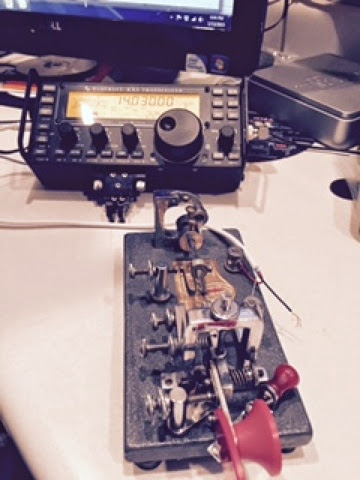
So after a trip (or two) to EBay, I am now the proud owner of a Vibroplex Original from 1944. I've gotten to the point that I'm not afraid to call CQ and have a QSO with the bug. I have, however, been calling all my CQ's to date on my KX3 at 5 watts. I want to keep the damage to my CW reputation to a minimum:-) It's quite fun and leaves you with a sense of accomplishment.
As you see from the picture, the bug is almost as big as the KX3, but its lots of fun. I am now certain that using bugs will always be a part of my CW repertoire. If you don't want to get hooked, don't try it.
One word of advice, find someone to coach you on how to set up the bug. As you can see above, there are lots of knobs to turn to get to that feel that you like.













