Author Archive
 The Cost of a Summit Activation
 March 12th, 2013 |
  Author:
 For those of us that chase awards, be it DX, Summits, Islands, etc... we have all heard about the costs of expeditions and in many cases we individually choose to support those that interest us the most. Costs for expeditions to rare places like Bouvet or Peter I can approach $400,000 or more. Those expeditions require ice class ships, helicopters and tons of equipment. Even a jaunt to rare IOTA qualifying island can run into the tens of thousands of dollars. Major expeditions have found ways, other than greenstamps in envelopes, to fund their adventures, e.g, by offering online QSL requests for a fee and by just making it easy to contribute by accepting PayPal. Often times we will read what the cost per QSO was as the expeditions try to recoup their costs.
This brings me to the costs of my recent trek to the top of East End Summit in Arizona which qualifies for the Summit on the Air (SOTA) award. I was able to fit this into a business trip so it's hard to allocate travel costs to the expedition. I did rent a car to get to the trailhead and some food to eat on the trek and water to drink, none of these costs were outrageous. However, there was a huge expenditure that is worthy of mention and that is burned calories.. Using my "Lose It" app, I burned approximately 2,500 calories on my trip up and down the mountain. Given that this activiation took place on a weekday, the QSO's were limited with 18 QSO's made. So I propose a new measure of expedition economics, and that is, calories per QSO or C/QSO. With the numbers above my C/QSO ratio for this trip was 138.9 to 1. So to help reimburse me for my costs, it might be more appropriate to send me a pastry with the QSL request rather than a green stamp.
So the next time you need to drop a few pounds, maybe you should try the SOTA activation diet, it can burn a lot of calories.
This brings me to the costs of my recent trek to the top of East End Summit in Arizona which qualifies for the Summit on the Air (SOTA) award. I was able to fit this into a business trip so it's hard to allocate travel costs to the expedition. I did rent a car to get to the trailhead and some food to eat on the trek and water to drink, none of these costs were outrageous. However, there was a huge expenditure that is worthy of mention and that is burned calories.. Using my "Lose It" app, I burned approximately 2,500 calories on my trip up and down the mountain. Given that this activiation took place on a weekday, the QSO's were limited with 18 QSO's made. So I propose a new measure of expedition economics, and that is, calories per QSO or C/QSO. With the numbers above my C/QSO ratio for this trip was 138.9 to 1. So to help reimburse me for my costs, it might be more appropriate to send me a pastry with the QSL request rather than a green stamp.
So the next time you need to drop a few pounds, maybe you should try the SOTA activation diet, it can burn a lot of calories.
East End Peak Activation SOTA ref. W7A/MN-038
As previously written in this blog, I enjoy chasing mountain summits for the Summits on the Air (SOTA) program. Until now, all I have done is chase peaks activated by others. The attraction of the program to me is based on my love of the mountains as I have done many miles of backpacking and climbed 6 of Colorado's 14,000 peaks. Both of my sons are Eagle Scouts and hams, AB5EB and KB5SKN, and we used to take yearly trips to the Rockies. However they are both married with children now, so my time in the mountains has diminished considerably, that is, until this week.
Since joining the SOTA chase, I have been looking for summits to activate, but the problem is that the closest accessible peak that counts for the program is several hundred miles away from my QTH. So, I had to look for opportunities. As I checked my business calendar I had a two day meeting in Scottsdale, AZ. Ah, there are mountains there. So I did a little research and contacted another SOTA activator from the Phoenix area, Jim Davies, K7JFD. Jim was kind enough to offer a few suggestions of both easier peaks and some good candidates that had yet to be activated. As my schedule developed I was able to have most of day free and so I planned use that time activating a summit.
Based on the results of my research, I settled on East End Peak, a summit that had not been activated. It is located in the northern region of the McDowell Mountans outside of Phoenix, AZ. It is the highest peak in the range, at 4,057 ft (1,237 m). East End is mainly covered in rocky boulders and is accessible from the Tom Thumb Trailhead in the McDowell Sonoran Conservancy. From the trailhead East End Peak is 1.82 miles, one way, and 1,405 feet vertical assent.
My wife of 37 years accompanied me on the trip and is also experienced in the mountains, so we saw this as a challenge and renewal of our love of the mountains.
The packing for the trip took some thinking, but to keep this story from getting too long, my station consisted of a Buddistick vertical mounted to the top of my hiking stick, an Elecraft KX3 and a 4 amp/hour battery for my power supply. The hike up the mountain was pretty tough as the last 400 feet were without a trail. There were a lot of boulders, cactus and thorny bushes to navigate, however, we found our way to the summit to set up the station. Since this trip occurred on a Wednesday, the number of summit chasers would be limited, but I had announced the activation, so I knew there would be a few folks waiting on me.
We first set the station up a few feet below the summit and the path to the east coast was blocked by some boulders, so after I worked a few W6's and W7's we moved the station up to the absolute summit where I was able to work some of the guys on the east coast. After switching bands a few times and several unanswered CQ's I shut down and packed up. I put 18 stations in the log, coast to coast, with my QRP set up and my wife and I enjoyed a lovely day in the mountains. The calories burned per QSO was pretty high, but we had a lot of fun and we slept extremely well that night. I can't wait to do it again.
Since joining the SOTA chase, I have been looking for summits to activate, but the problem is that the closest accessible peak that counts for the program is several hundred miles away from my QTH. So, I had to look for opportunities. As I checked my business calendar I had a two day meeting in Scottsdale, AZ. Ah, there are mountains there. So I did a little research and contacted another SOTA activator from the Phoenix area, Jim Davies, K7JFD. Jim was kind enough to offer a few suggestions of both easier peaks and some good candidates that had yet to be activated. As my schedule developed I was able to have most of day free and so I planned use that time activating a summit.
Based on the results of my research, I settled on East End Peak, a summit that had not been activated. It is located in the northern region of the McDowell Mountans outside of Phoenix, AZ. It is the highest peak in the range, at 4,057 ft (1,237 m). East End is mainly covered in rocky boulders and is accessible from the Tom Thumb Trailhead in the McDowell Sonoran Conservancy. From the trailhead East End Peak is 1.82 miles, one way, and 1,405 feet vertical assent.
My wife of 37 years accompanied me on the trip and is also experienced in the mountains, so we saw this as a challenge and renewal of our love of the mountains.
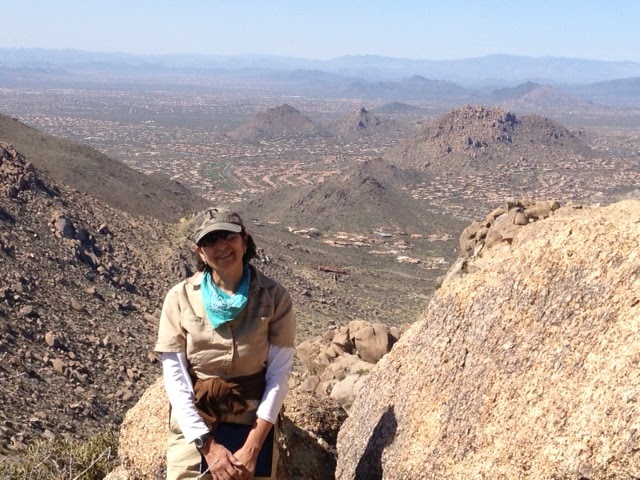 |
| My lovely wife Cris, KC5HZQ |
The packing for the trip took some thinking, but to keep this story from getting too long, my station consisted of a Buddistick vertical mounted to the top of my hiking stick, an Elecraft KX3 and a 4 amp/hour battery for my power supply. The hike up the mountain was pretty tough as the last 400 feet were without a trail. There were a lot of boulders, cactus and thorny bushes to navigate, however, we found our way to the summit to set up the station. Since this trip occurred on a Wednesday, the number of summit chasers would be limited, but I had announced the activation, so I knew there would be a few folks waiting on me.
We first set the station up a few feet below the summit and the path to the east coast was blocked by some boulders, so after I worked a few W6's and W7's we moved the station up to the absolute summit where I was able to work some of the guys on the east coast. After switching bands a few times and several unanswered CQ's I shut down and packed up. I put 18 stations in the log, coast to coast, with my QRP set up and my wife and I enjoyed a lovely day in the mountains. The calories burned per QSO was pretty high, but we had a lot of fun and we slept extremely well that night. I can't wait to do it again.
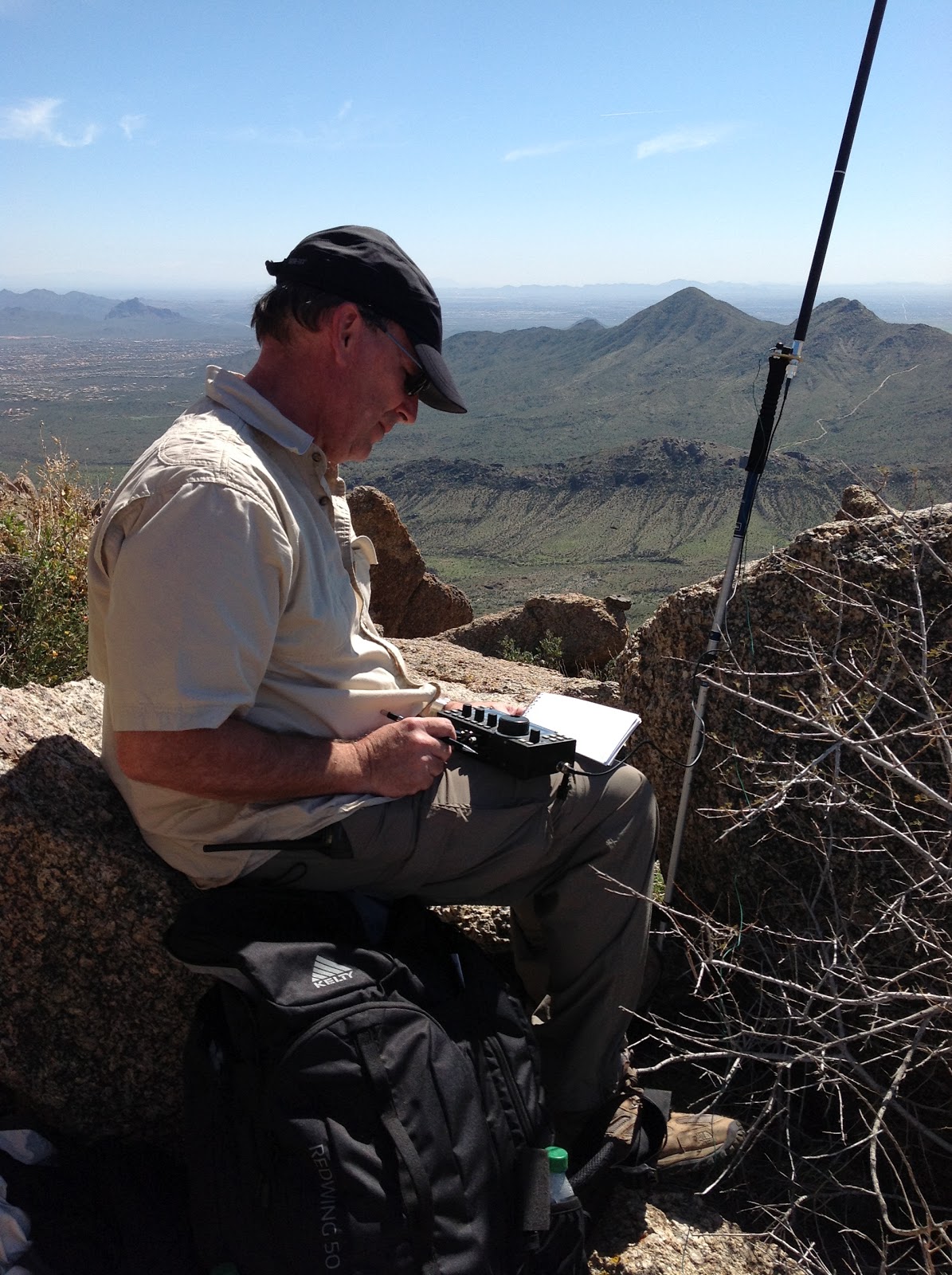 |
| Making QSO's from East End Peak in Arizona |
QRP Tactics and XT2TT
It is always an interesting discussion among QRP'ers when the conversation rolls around to just "how" a contact was made with a significant DX station with 5 watts or less. Significant is a relative term of course, but suffice it to say a station that you are willing to endure a pile-up to work is by definition significant DX. My previous post on my QRP contact with 9U4U was such a story. I was in position when the opportunity for QSO presented itself, that is, no callers, late in the expedition and I had a path to 9U.
However, as they say, there is more than one way to skin a cat, so are there many ways to work big DX-peditions QRP. I did not need XT for a new QRP country, however I did need them on 160m. (before you say I know what's coming, I did not work XT2TT on 160m QRP). So after the IOTA Bash festivities on Saturday night I went to the shack to see if the XT was up on 160m. Not only did I need them for a new one on Top Band, but a friend of mine has already worked him on that band, so I was doubly motivated. As luck would have it, they were not on 160m, but on 20m CW. So rather than fire up the QRO rig, I thought I would give the KX3 a workout to see if I could get a QRP QSO with Burkina Faso.
So I turned the beam to Africa, found the split and started calling. The Op was working primarily Russian stations that I could not hear so I had trouble knowing exactly were to call. He work several in succesion, leading me to believe that band was much louder to Eastern EU. My hopes of a QSO weren't very high. Finally he worked a W4 that I could hear, I moved the VFO to the W4's frequency and called, "AD5A/QRP" after which he came right back to me. In fact the online log has AD5A/QRP in it.
I'll admit that I was a little surprised to make the QSO, so I sat there thinking why was this relatively easy. After evaluating the scenario and remembering that the ARRL DX Phone contest was in full swing, it was a late night opening on 20m that isn't used that much, the situation made more sense. For both reasons above, the competition was much lighter and therefore a QSO was much more probable.
I guess the moral of this story is to look for QRP workable DX on a major phone contest weekend on the CW bands and I suppose the reverse would be true as well.
By the way, I managed a QRO QSO with XT2TT on 160m last night so I have a new band country in the log, but more importantly, my buddy no longer has bragging rights:-)
However, as they say, there is more than one way to skin a cat, so are there many ways to work big DX-peditions QRP. I did not need XT for a new QRP country, however I did need them on 160m. (before you say I know what's coming, I did not work XT2TT on 160m QRP). So after the IOTA Bash festivities on Saturday night I went to the shack to see if the XT was up on 160m. Not only did I need them for a new one on Top Band, but a friend of mine has already worked him on that band, so I was doubly motivated. As luck would have it, they were not on 160m, but on 20m CW. So rather than fire up the QRO rig, I thought I would give the KX3 a workout to see if I could get a QRP QSO with Burkina Faso.
So I turned the beam to Africa, found the split and started calling. The Op was working primarily Russian stations that I could not hear so I had trouble knowing exactly were to call. He work several in succesion, leading me to believe that band was much louder to Eastern EU. My hopes of a QSO weren't very high. Finally he worked a W4 that I could hear, I moved the VFO to the W4's frequency and called, "AD5A/QRP" after which he came right back to me. In fact the online log has AD5A/QRP in it.
I'll admit that I was a little surprised to make the QSO, so I sat there thinking why was this relatively easy. After evaluating the scenario and remembering that the ARRL DX Phone contest was in full swing, it was a late night opening on 20m that isn't used that much, the situation made more sense. For both reasons above, the competition was much lighter and therefore a QSO was much more probable.
I guess the moral of this story is to look for QRP workable DX on a major phone contest weekend on the CW bands and I suppose the reverse would be true as well.
By the way, I managed a QRO QSO with XT2TT on 160m last night so I have a new band country in the log, but more importantly, my buddy no longer has bragging rights:-)













