Author Archive
 Golf and Rock n Roll
 April 9th, 2013 |
  Author:
 I'll have to admit that I didn't spend much time on the radio these past few days. I have too many hobbies, so there, I have confessed. This past week, I was fortunate enough to get to play in the Texas Open Pro-Am tournament on the Wednesday of tournament week. I played with Martin Laird during that tournament, who was the eventual winner of the PGA Tour event, so it was a busy week filled with golf. I also have my own rock/blues band called, The No Refund Band, www.norefundband.com . We are the real deal, we released a CD last September that is getting worldwide play. You can find it on iTunes or Amazon. I play rhythm/lead guitar. We had a show last Friday, that further reduced my radio time, but it was fun and a great time was had by all.
So things have calmed down a little and I will get back to the radio thing as soon as I recover from last week.
So things have calmed down a little and I will get back to the radio thing as soon as I recover from last week.
Travelling Lighter
As written here before, as a backpacker and ham operator, the Summits on the Air program had become a passion of mine. And, as written here before, I have a passion for traveling light. Every extra ounce in a backpack is important and seems to be multiplied by some unknown factor derived from the vertical gain of your trek. Backpacking for backpacking's sake is bad enough, but throw radios into the pack and the challenge is amplified. One of my standard practices is to take a small backpack and make decisions on what not to take as opposed to taking a big pack with room for more gear, because you will fill it up.
So with this thought in mind I saw where LNR has come out with a more "trail friendly" 40/20/10 EFHW antenna, lighter than their current version, total weight, 3.5 oz. So I bought one. As I pondered my efforts to save weight in my pack, I had a thought and it went something like this, "Mike, the thing that you carry on the trail that weighs the most isn't your antenna or even your pack, it's you". I am obsessing on ozs. in my pack and I am more than a few pounds over weight. On average your pack, plus or minus, should be around 16% of our body weight, so by far the largest impact I can have on my total weight is to drop a few pounds myself. Now I will admit, losing weight is not as much fun as buying lighter and more efficient gear, but it will probably have a much more significant impact on the weight I take up the hill..
One thing you will never confuse a hamfest with is a Triathlete convention. We have a hobby that is usually performed sitting down. So having a niche in the hobby that requires us to exercise a little is a good thing. I ran five marathons in the '80's, including the New York Marathon in 1982, so I know what it feels like to be in shape. I don't feel that way now, so I am making a commitment to drop a few pounds.
However, I will still obsess about lighter gear.
So with this thought in mind I saw where LNR has come out with a more "trail friendly" 40/20/10 EFHW antenna, lighter than their current version, total weight, 3.5 oz. So I bought one. As I pondered my efforts to save weight in my pack, I had a thought and it went something like this, "Mike, the thing that you carry on the trail that weighs the most isn't your antenna or even your pack, it's you". I am obsessing on ozs. in my pack and I am more than a few pounds over weight. On average your pack, plus or minus, should be around 16% of our body weight, so by far the largest impact I can have on my total weight is to drop a few pounds myself. Now I will admit, losing weight is not as much fun as buying lighter and more efficient gear, but it will probably have a much more significant impact on the weight I take up the hill..
One thing you will never confuse a hamfest with is a Triathlete convention. We have a hobby that is usually performed sitting down. So having a niche in the hobby that requires us to exercise a little is a good thing. I ran five marathons in the '80's, including the New York Marathon in 1982, so I know what it feels like to be in shape. I don't feel that way now, so I am making a commitment to drop a few pounds.
However, I will still obsess about lighter gear.
What Key Will You Use
Some of you may be on the AT-Sprint Yahoo group that is a place to hang out if you are an afficianado of Steve Weber's, KD1JV, QRP radio designs. After the recent re-release of his popular 2 Band, Mountain Top Rig (MTR), a thread broke out on what types of morse key operators would use with these portable QRP rigs. The results were intereresting.
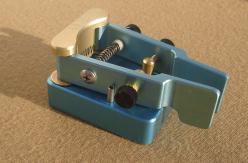
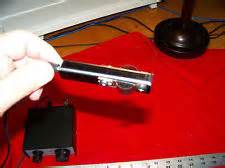
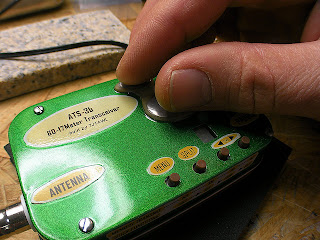


PortaPaddle from American Morse
The PortaPaddle seemed to be the most popular. These keys come in a kit and can be deployed in many different ways. They seem to be popular anchored to the top of a RockMite rig
Te Ne Ke
The Te Ne Ke also received several endorsments. This key is very light and can used in a varied of ways. You can actually hold it in you hand with the paddles pointing away from or you can order it with a base that holds the key pretty firmly.
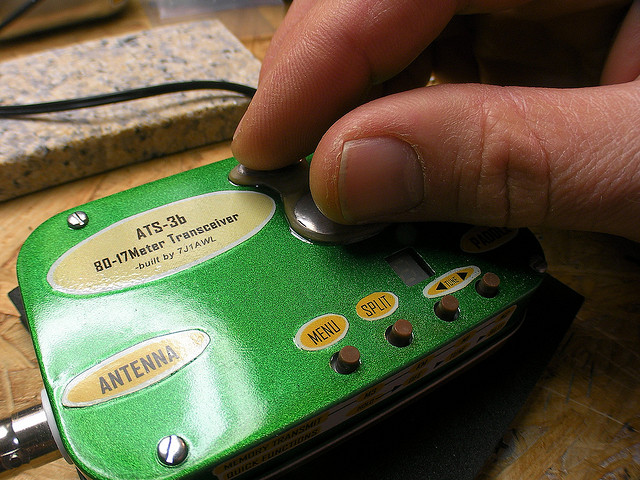
P3W Touchkeyer
This key comes is a key and takes some soldering, but is very compact if built into the rig you are using.

WG0AT Home Brew Goat Paddle
This is Steve's ergonomic paddle made from wood found on one of his SOTA Activations.
KT5X Home Brew, Te Ne Ke Type Keys
Note the bolt that hold the key down on the logging clipboard
The top key is made of very light wood.
Obviously there are as many key configurations as there are hams with imaginations. I thought you might be interested in looking at these different keying options for you next QRP adventure.
Antenna Maintenance and other things
It's that time of year, at least in Texas where I live, the flowers start to bloom, the temperatures start to rise and antennas need some work. This past weekend a friend of mine, Hector, AD6D/XE2K, came to help me (he did most of the work) with some tower climbing, element straightening, rotor fixing and antenna building. In a addition to the antenna/tower work we completely reorganized my shack, so it was a busy weekend. I am now greased and gassed and ready to go for while. I found some things in the shack that I hadn't seen in a while, so I will be getting reaquainted with some of my toys.
I also received my new Yaesu VX8-GR with the build in APRS/GPS capability. I was up on APRS in a matter of minutes, pretty cool. There are various applications of APRS, but for a hiker/climber it is a nice safety device so that you location is known in case of emergency and if you are activating a summit, chaser can follow your progress up the mountain.
I also managed a QRP QSO with EY8MM, so the new restored antennas are working great.
After I recover from the weekend, I will write about some more interesting topics.
I also received my new Yaesu VX8-GR with the build in APRS/GPS capability. I was up on APRS in a matter of minutes, pretty cool. There are various applications of APRS, but for a hiker/climber it is a nice safety device so that you location is known in case of emergency and if you are activating a summit, chaser can follow your progress up the mountain.
I also managed a QRP QSO with EY8MM, so the new restored antennas are working great.
After I recover from the weekend, I will write about some more interesting topics.
QRP Gear: The Temptations
Can you ever have enough radios? I suppose that is the question. As technology advances, it is hard for me to resist upgrading the QRO rig every few years. Better filtering, more sensitive receivers and many other bells and whistles that come with today's new radios. One limiting factor for the big rigs however is that as functionality grows so does the price, which for most of us necessitates that we hold on to what we have for a while before trading. After all, you can't just to drop $3,000- -$5,000 casually to try out the new stuff. Usually the life cycle of my main QRO rig is 5 - 10 years and I know for many its 10 -20 years depending on your interests and activity level. The same with the rest of my QRO station, it usually changes slowly over the years.
QRP rigs however are quite a different story. As a general rule they are more affordable and this introduces a dilemma to me. Currently I own a K1, KX1, FT-817, ATS-3, ATS-4 and a KX3. This begs the question of how many different ways do I need to cover 20m with a QRP radio? The answer to that question, at least for now, must be six!!
However, operating QRP portable is not limited to transceivers. Unlike a home station that usually has resonant antennas that are at least semi-permanent, QRP/P deals with temporary poles, various antenna configurations, tuners, batteries, backpacks, logging, raingear and on and on. Oh the combinations one can come up with to operate portable. As I have written, I am a backpacker and there is something in my genes that is attracted to the smallest, lightest and most efficient way to be functional when traveling, either with a suitcase in my hand or a pack on my back. So I am always on the lookout for lighter more efficient gear. As I process all the possiblities I find myself driven to eBay searching for any little gadget that I don't have, kit providers for a new piece of equipment and backpacking stores for lighter ways to travel. A good is example of my compulsive behavior was just the other day I was looking at the Ten-Tec QRP transceivers. To their credit, Ten-Tec had put together a nice package, to tempt people like me, that included either a 2- band or 4- band radio, with a portable mulit-band wire antenna and a very cool shoulder bag to carry it in. All of this for a reasonable price. It was almost more than I could take and just before I hit the buy button, I came to my senses and realized I didn't need a seventh radio to cover 20M with QRP. I was also looking at a cool portable tuner to add to the three portable tuners that I already have. I just received in the mail another version of the end fed dipole antenna with a 9 to 1 balun to compliment my Alex-Loop, Buddistick, center fed doublet and my End Fedz multiband antenna. Oh the shame of such excess. But, you never know what the situation will call for, right?
This QRP equipment thing is an addiction and I have to re-commit on a daily basis to be rational, the temptations are beyond calculation. But one small success is that I still don't own a Ten-Tec QRP radio, yet.
QRP rigs however are quite a different story. As a general rule they are more affordable and this introduces a dilemma to me. Currently I own a K1, KX1, FT-817, ATS-3, ATS-4 and a KX3. This begs the question of how many different ways do I need to cover 20m with a QRP radio? The answer to that question, at least for now, must be six!!
However, operating QRP portable is not limited to transceivers. Unlike a home station that usually has resonant antennas that are at least semi-permanent, QRP/P deals with temporary poles, various antenna configurations, tuners, batteries, backpacks, logging, raingear and on and on. Oh the combinations one can come up with to operate portable. As I have written, I am a backpacker and there is something in my genes that is attracted to the smallest, lightest and most efficient way to be functional when traveling, either with a suitcase in my hand or a pack on my back. So I am always on the lookout for lighter more efficient gear. As I process all the possiblities I find myself driven to eBay searching for any little gadget that I don't have, kit providers for a new piece of equipment and backpacking stores for lighter ways to travel. A good is example of my compulsive behavior was just the other day I was looking at the Ten-Tec QRP transceivers. To their credit, Ten-Tec had put together a nice package, to tempt people like me, that included either a 2- band or 4- band radio, with a portable mulit-band wire antenna and a very cool shoulder bag to carry it in. All of this for a reasonable price. It was almost more than I could take and just before I hit the buy button, I came to my senses and realized I didn't need a seventh radio to cover 20M with QRP. I was also looking at a cool portable tuner to add to the three portable tuners that I already have. I just received in the mail another version of the end fed dipole antenna with a 9 to 1 balun to compliment my Alex-Loop, Buddistick, center fed doublet and my End Fedz multiband antenna. Oh the shame of such excess. But, you never know what the situation will call for, right?
This QRP equipment thing is an addiction and I have to re-commit on a daily basis to be rational, the temptations are beyond calculation. But one small success is that I still don't own a Ten-Tec QRP radio, yet.
A Good SOTA/DXCC Weekend
For those of you who haven't tried the Summits on the Air program, you are missing a great time. As previously reported, no QSL's are required, awards are based on a point system, and you can work a summit for points once per day. So there is always someone to work and the challenge of working these portable summit operations makes for a worthy challenge. The link for the program is on my Blog page under Links.
Starting Friday, UTC, time I managed to work 16 summits for a total of 94 points. Summits range in point value from 1 to 10. It would be possible to work 16 summits and get 16 points, but this weekend the activators were putting some quality summits on the air, which meant they were working extra hard to make it to these summits to activate them. To make earning the points all the more fun I worked summits in OE, DL and OK as well as across the US. So thank you activators for putting in the effort.
On the DXCC front, creating my separate QRP log paid dividends this weekend. In an earlier post I talked about my decision to create a separate QRP log on my DX4WIN logging software that would highlight needed countries on the DX Cluster. In the past I was hit and miss, having to take time to query my total log to see if I had worked a station QRP. Since there was a lot of contest activity this weekend, I decided to look around for needed QRP countries. I hit a gold mine. This weekend, thanks to my logging software I worked many relatively easy countries that I hadn't taken the time to work before. I was able to log HR, C6, J3, KP2, PJ7, KH2 (as mentioned in my previous post) for new ones and the catch of the day was 9M4SLL (1S). I worked the 9M4 on 17 CW, when no-one was calling. So my QRP DXCC count is now up to 126. I have worked 15 new DXCC countries on QRP since creating the log about 6 weeks ago.
So it was a good weekend, now back to work:-)
Starting Friday, UTC, time I managed to work 16 summits for a total of 94 points. Summits range in point value from 1 to 10. It would be possible to work 16 summits and get 16 points, but this weekend the activators were putting some quality summits on the air, which meant they were working extra hard to make it to these summits to activate them. To make earning the points all the more fun I worked summits in OE, DL and OK as well as across the US. So thank you activators for putting in the effort.
On the DXCC front, creating my separate QRP log paid dividends this weekend. In an earlier post I talked about my decision to create a separate QRP log on my DX4WIN logging software that would highlight needed countries on the DX Cluster. In the past I was hit and miss, having to take time to query my total log to see if I had worked a station QRP. Since there was a lot of contest activity this weekend, I decided to look around for needed QRP countries. I hit a gold mine. This weekend, thanks to my logging software I worked many relatively easy countries that I hadn't taken the time to work before. I was able to log HR, C6, J3, KP2, PJ7, KH2 (as mentioned in my previous post) for new ones and the catch of the day was 9M4SLL (1S). I worked the 9M4 on 17 CW, when no-one was calling. So my QRP DXCC count is now up to 126. I have worked 15 new DXCC countries on QRP since creating the log about 6 weeks ago.
So it was a good weekend, now back to work:-)
Little Victories
There is a song I like by Chris Knight, one of my favorite musical artists, called Little Victories. The chorus goes,"little victories, there alright with me, these days that's all I need". And so it is with QRP operating. Working state side with QRO and a beam is no victory at all, but you cut your power to 5 watts and its cause for a small celebration, work a good DX station and there might be some victory dances in the shack.
I've had a couple of little victories in the last 24 hours. The first was working KH2L on 10m CW for country #121 on QRP. I was reminded during the QSO that a QRP operators have to use all the tools at our disposal to make QSO's more probable. This time I was calling with no success and noticed on the KX3 display that I wasn't quite centered on the KH2's transmitting frequency, for those with a KX3, its the CWT display. I zero beat his signal and bingo, in the log.
My other little victory was this morning. I was chasing a SOTA peak, Gespitzer Riegal, in Austria on 17m SSB. Mike, OE4MXB, was QRP on this mountain top. I was using my QRO rig and beam for this one, as I really wanted the QSO and I'm sure that Mike wanted it also. There was a lot of QRM on adjacent frequecies and Mike was in and out. Finally, the window opened and Mike was a solid 44, heard me and we made the QSO. A little QRP rig on a mountaintop in Austria worked Texas with 5 watts and a portable antenna. Oh the joy of little victories.
I've had a couple of little victories in the last 24 hours. The first was working KH2L on 10m CW for country #121 on QRP. I was reminded during the QSO that a QRP operators have to use all the tools at our disposal to make QSO's more probable. This time I was calling with no success and noticed on the KX3 display that I wasn't quite centered on the KH2's transmitting frequency, for those with a KX3, its the CWT display. I zero beat his signal and bingo, in the log.
My other little victory was this morning. I was chasing a SOTA peak, Gespitzer Riegal, in Austria on 17m SSB. Mike, OE4MXB, was QRP on this mountain top. I was using my QRO rig and beam for this one, as I really wanted the QSO and I'm sure that Mike wanted it also. There was a lot of QRM on adjacent frequecies and Mike was in and out. Finally, the window opened and Mike was a solid 44, heard me and we made the QSO. A little QRP rig on a mountaintop in Austria worked Texas with 5 watts and a portable antenna. Oh the joy of little victories.













