Author Archive
 Four SOTA Summit Activation’s in W1
 June 11th, 2013 |
  Author:
 On my vacation I took the opportunity to activate several SOTA (Summits on the Air) summits. This post deals with four that I activated in the W1 call area this past week. The references below are the SOTA references and the points are what each summit is rated. The points are on a scale of 10
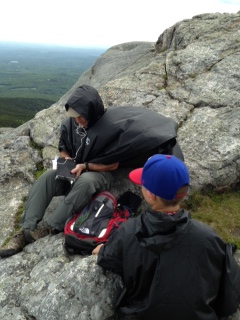
W1/HA-009 Mount Monadnock (4 pts) June 6, 2013, New Hampshire
This is a tough 4 pointer. With over 2,000 feet of prominence I under estimated the mountain and made a few mistakes as well. First I counted on my grandson to carry the Buddi-stick, he forgot it and I didn't double check. Thankfully I had an EFHW with me, but only a 13 foot pole to run it from. There are no trees on the summit. Accordingly I think my signal suffered a little. It was very windy and cool on the summit and relatively crowded, which ultimately shortened our stay. I used an FT-817 on this activation because the original plan was for my two grandsons, KF5GYD and KF5GYE to operate some SSB, however conditions were marginal for CW, so we weren't able to execute that part of the plan.
The trail up is one granite rock after another. I had envisioned a wide, sodden trail to the summit, but that is not the case, lots of scrambling up granite slopes on a trail that goes straight up. For those familiar with the mountain, we took the White Dot Trail up, the more direct, and the White Cross Trail down. Coming down is tough because its like descending on a path of uneven steps and no real opportunity to enjoy the downhill slope and some relatively steep pitches down granite slabs. Two hours up and 1.5hrs down. I was able to make 7 QSO's from here (it only takes 4 QSO's to qualify for the points). I did work G4ELZ and S58AL to spice up the day.
W1/AM-381 Mount Agamenticus (1 pt) June 7, 2013, Maine
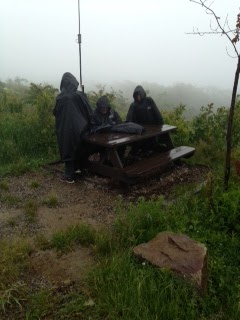
The morning dawned with steady rain and the forecast called for more. Not a good day for a hike. We decided to travel to the southern coast of Maine. A quick check of the SOTA database revealed a drive-up one pointer, Mt. Agamenticus. Easy, right. Wrong. My grandsons and I set up, after the ceremonial climb up the last few feet, on a picnic table in the blowing rain and zero visibility. Let's get four quick QSO's and get out of here. What I didn't know was that the A-index was 34 and the K was 4. Over an hour later I made the fourth QSO, way too much work for one point. This day was our 38th anniversary and Boogies 11th birthday.
W1/GM-003 Equinox Mountain (8 pts) June 8, 2013 Vermont
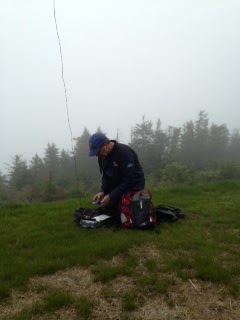
Equinox Mountain is near the town of Manchester, VT. It is an 8 Pointer, with a road to the top. I decided to make the most of my remaining time in the region and a drive up would save some time and give me a shot at getting another summit in. There is a toll road to the top and there is actually a functioning monastery on the mountain. Again visibility was near zero on the summit and misting rain. I first set- up with the vertical and had some success but it was noisy as conditions still weren't very good, so I was able to get some height on the EFHW, lashing my telescopic pole to the balcony of the visitor center on the summit, and made a few more QSO's finishing with 10. I started with the FT-817, but finished with my MTR which I discovered has a better receiver in noisy conditions. No real DX from here, NS7P from Oregon was my most distant contact.
W1/GM-032 Mount Snow (6 pts) June 8, 2013 Vermont
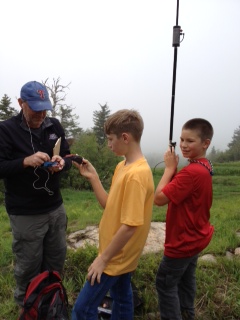
Mount Snow is a ski mountain with a lift most of the way up the mountain leaving a relative short but steep hike to the summit. The question was whether I could get the QSO's I needed in the time I had. We arrived at the mountain at 3:00 and the lift closed at 4:00. We summited at 3:25, set up the vertical with one grandson holding the trekking pole mounted vertical, the other holding my battery and me with the MTR, micro key and log and we were on the air by 3:30. DJ5AV was the first in the log and CT1BQH followed a couple of minutes later. By 3:40 I had 6 QSO's in the log. A quick tear down and back to the lift by 3:55. Made it. This one was the most satisfying, six points I didn't think I would get.
W1/HA-009 Mount Monadnock (4 pts) June 6, 2013, New Hampshire
This is a tough 4 pointer. With over 2,000 feet of prominence I under estimated the mountain and made a few mistakes as well. First I counted on my grandson to carry the Buddi-stick, he forgot it and I didn't double check. Thankfully I had an EFHW with me, but only a 13 foot pole to run it from. There are no trees on the summit. Accordingly I think my signal suffered a little. It was very windy and cool on the summit and relatively crowded, which ultimately shortened our stay. I used an FT-817 on this activation because the original plan was for my two grandsons, KF5GYD and KF5GYE to operate some SSB, however conditions were marginal for CW, so we weren't able to execute that part of the plan.
The trail up is one granite rock after another. I had envisioned a wide, sodden trail to the summit, but that is not the case, lots of scrambling up granite slopes on a trail that goes straight up. For those familiar with the mountain, we took the White Dot Trail up, the more direct, and the White Cross Trail down. Coming down is tough because its like descending on a path of uneven steps and no real opportunity to enjoy the downhill slope and some relatively steep pitches down granite slabs. Two hours up and 1.5hrs down. I was able to make 7 QSO's from here (it only takes 4 QSO's to qualify for the points). I did work G4ELZ and S58AL to spice up the day.
Operating from Mt. Monadnock with
KF5GYD (Boogie) assisting
W1/AM-381 Mount Agamenticus (1 pt) June 7, 2013, Maine
The morning dawned with steady rain and the forecast called for more. Not a good day for a hike. We decided to travel to the southern coast of Maine. A quick check of the SOTA database revealed a drive-up one pointer, Mt. Agamenticus. Easy, right. Wrong. My grandsons and I set up, after the ceremonial climb up the last few feet, on a picnic table in the blowing rain and zero visibility. Let's get four quick QSO's and get out of here. What I didn't know was that the A-index was 34 and the K was 4. Over an hour later I made the fourth QSO, way too much work for one point. This day was our 38th anniversary and Boogies 11th birthday.
The station on Mt. Agamenticus with
KF5GYD and KF5GYE (Reid)
W1/GM-003 Equinox Mountain (8 pts) June 8, 2013 Vermont
Equinox Mountain is near the town of Manchester, VT. It is an 8 Pointer, with a road to the top. I decided to make the most of my remaining time in the region and a drive up would save some time and give me a shot at getting another summit in. There is a toll road to the top and there is actually a functioning monastery on the mountain. Again visibility was near zero on the summit and misting rain. I first set- up with the vertical and had some success but it was noisy as conditions still weren't very good, so I was able to get some height on the EFHW, lashing my telescopic pole to the balcony of the visitor center on the summit, and made a few more QSO's finishing with 10. I started with the FT-817, but finished with my MTR which I discovered has a better receiver in noisy conditions. No real DX from here, NS7P from Oregon was my most distant contact.
Operating on Equinox Mountain with an
EFHW and the MTR
Mount Snow is a ski mountain with a lift most of the way up the mountain leaving a relative short but steep hike to the summit. The question was whether I could get the QSO's I needed in the time I had. We arrived at the mountain at 3:00 and the lift closed at 4:00. We summited at 3:25, set up the vertical with one grandson holding the trekking pole mounted vertical, the other holding my battery and me with the MTR, micro key and log and we were on the air by 3:30. DJ5AV was the first in the log and CT1BQH followed a couple of minutes later. By 3:40 I had 6 QSO's in the log. A quick tear down and back to the lift by 3:55. Made it. This one was the most satisfying, six points I didn't think I would get.
The Crew on Mt. Snow
AD5A, KF5GYE and KF5GYD
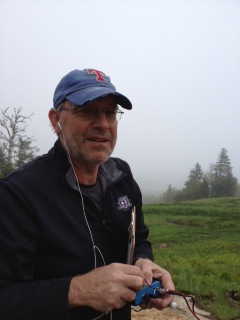
Me calling CQ with my Micro Key and MTR
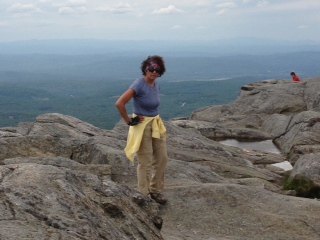
My wife of course accompanied us on this trip and was a real trooper. She came along on every activation and was there to lend a helping hand when she could. Her name is Cris and her call sign is KC5HZQ, but she only has a couple of contacts in her ham career. Below is a picture of her on Mount Monadnock.
Cris KC5HZQ
The day before our 38th Anniversary
This was a fun trip and I learned a lot. I will be making some changes to my operating strategy that I will be writing about in the near future.
On Vacation
I have so much write about and so little time. I am currently on a vacation that includes several radio activities. I was in Santa Fe, NM over the last weekend and activated two 8 point SOTA summits. I was accompanied on the first one by Fred KT5X and John K1JD and learned a lot about portable operation and I mean portable. Fred's total weight for his rig, antenna, power supply, etc... comes in at 1.5 pounds. Needless to say, I felt a little over-dressed. I will tell you more later.
I am currently in the NE and am scheduled to try to activate a few summits in Thursday - Saturday in New Hampshire and Vermont, however the weather forecast doesn't look favorable. I will probably give it a try anyway. I am accompanied by my two grandsons, KF5GYD and KF5GYE, who have their general tickets. They are 11 and 13 respectively, so I will have factor them into the weather equation.
When I return, I will try to document these exploits more completely.
I am currently in the NE and am scheduled to try to activate a few summits in Thursday - Saturday in New Hampshire and Vermont, however the weather forecast doesn't look favorable. I will probably give it a try anyway. I am accompanied by my two grandsons, KF5GYD and KF5GYE, who have their general tickets. They are 11 and 13 respectively, so I will have factor them into the weather equation.
When I return, I will try to document these exploits more completely.
Big or Small: Radio, Key and Antenna
When deciding what to take on a QRP field trip any number of variables must be considered and planned for; will you unload it from the car or carry it on your back, will you operate inside or out, use an antenna already in place or put one up yourself? I guess it is these variables and our finding solutions for the circumstance of the day that keeps QRP interesting. As one QRP'er put it, QRO is just too easy. Of course there isn't necessarily any one answer to any of these situations, it usually is a matter of personal preference and/or how strong your back is. This post is not intended to present any grand solution but simply to capture some of the alternatives.
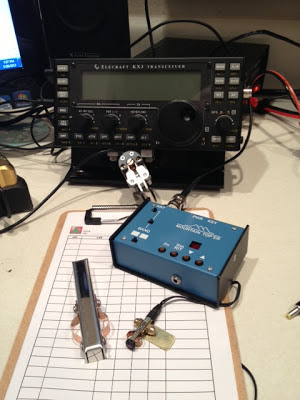
In the picture below there are two keys, actually three if you count the Begali Adventure key on the KX3. Also in the picture, on the left side, is the Te Ne Ke and next to it is the Micro Key. Clearly a size difference, but also a weight difference. Also in the picture is the KX3 (160 - 6m)and the KD1JV designed Mountain Top'er Rig (MTR), (40m/20m CW only). Again, the bigger radio brings more options, the smaller one easier to carry.
Of course you must have an antenna support. Below are three telescoping poles to choose from, a 33ft. MFJ Telecsoping Pole, a 20ft Black Widow and a 13ft Spirit of Air. Again, size, weight and optionality.
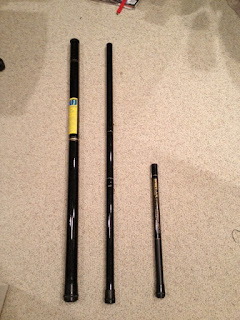
So many options and so little time. As WA0ITP says, "I like this radio stuff".
In the picture below there are two keys, actually three if you count the Begali Adventure key on the KX3. Also in the picture, on the left side, is the Te Ne Ke and next to it is the Micro Key. Clearly a size difference, but also a weight difference. Also in the picture is the KX3 (160 - 6m)and the KD1JV designed Mountain Top'er Rig (MTR), (40m/20m CW only). Again, the bigger radio brings more options, the smaller one easier to carry.

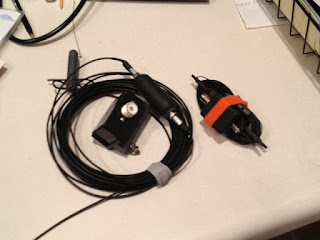
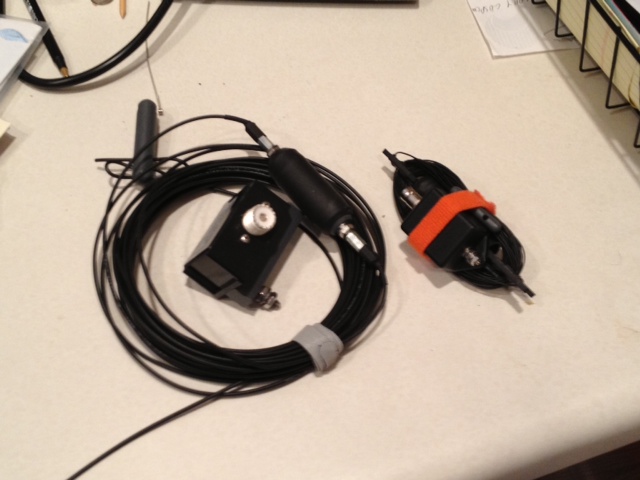
Below is a picture of the two versions of the LNR Precision 40/20/10 EFHW. The larger one to the left is the MKII model and the one on the right is the "Trail Friendly" model which uses the 40m coil as a wire winder (brilliant). I've used both and the perform identically as far as I can tell.
Of course you must have an antenna support. Below are three telescoping poles to choose from, a 33ft. MFJ Telecsoping Pole, a 20ft Black Widow and a 13ft Spirit of Air. Again, size, weight and optionality.
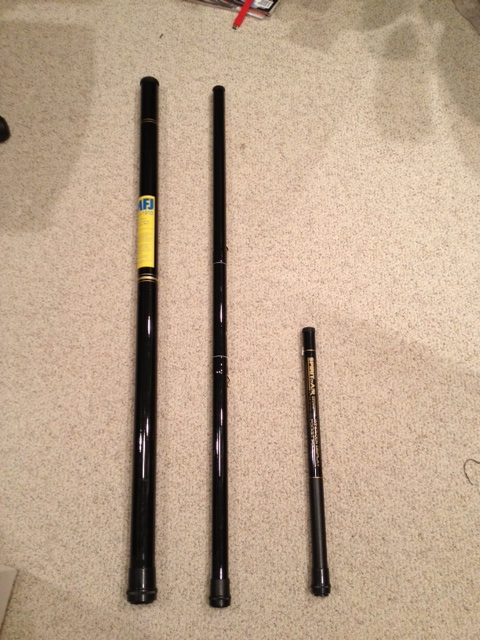
So many options and so little time. As WA0ITP says, "I like this radio stuff".
SOTA Sloth Award

 Today I qualified for the SOTA Sloth award, working W6UB on 40m from Black Balsam Knob in North Carolina to put me over the 1,000 point level. It has been a lot of fun to get to this point and honestly the program is quite addicting. A synonym for the award is SOTAholic, which is very appropriate. Since peaks can be worked once each day for points there is no worrying if you need it or not and you always have something to work.
The SOTA community are usually well versed not only in QRP operation, but also in hiking and backpacking. There is a Yahoo group (nasota) that has many knowledgeable members on the best way to get to the top of the mountain and put out a good signal. So if you are inclined toward such things, you would enjoy the program.
So I suppose my slothfulness has be officially certified and I can no longer deny it. I can't wait go get the award.
More information on SOTA can be found at http://www.sota.org.uk/
Backpacking Your Radio
There are always questions about what is the best way to pack a radio to insure that it is protected and gets to and from the remote location in the same condition that it left home. I suppose the function for the answer to that question would be:
R = # of Radios
C = # of Containers
H = # of Hams
R x C x H = the number of ways to pack a portable radio.
Translation = a lot of ways to pack a radio
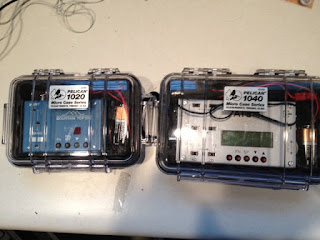
So here is my solution for carrying an ATS4B and an MTR to the top of the mountain, complete with power supply, ear phones and key.
R = # of Radios
C = # of Containers
H = # of Hams
R x C x H = the number of ways to pack a portable radio.
Translation = a lot of ways to pack a radio
So here is my solution for carrying an ATS4B and an MTR to the top of the mountain, complete with power supply, ear phones and key.
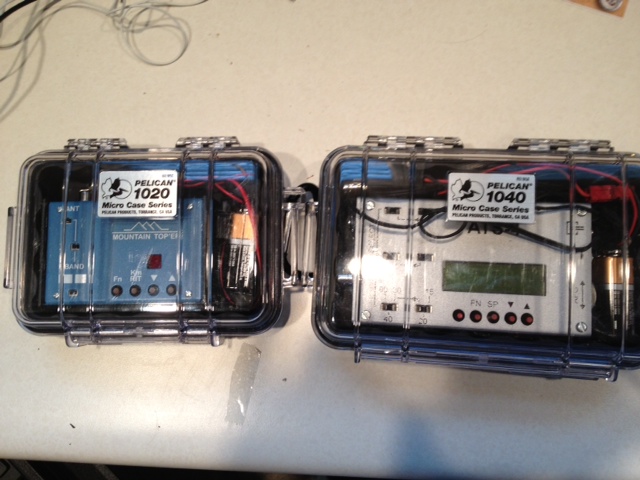
Pelican 1020 and 1040 Case
I put a thin layer of spongy material on top to keep the radios from moving around in the box. So there you go, my main rig and a back-up.
Field Trip
I've been slowly getting back into backpacking shape. Not only physically, (I recently had my annual physical and lasted 16 minutes on the treadmill test(faster and steeper every 3minutes), not bad for an old man), but also getting my equipment, both radio and packs, etc.., updated. So it was time for a real test to see what works and what doesn't as well as what I forgot to include.
So a few days ago, my son AB5EB, invited me on a backpacking trip with he and my two grandsons, Reid, KF5GYE and Boogie, KF5GYD, ages, 10 and 12 respectively. Well, of course I could go. Our destination was Lost Maples State Park in the Texas Hill Country. What a beautiful spot. We would hike 4 miles to one of the high points in the park, ~2,300 ft. elev., making a 550 vertical climb and camp for the night. The last 330 feet of the climb come in the last quarter mile of the hike, so it's pretty pedestrian until that point.
From the backpacking perspective, I planned pretty well. A lightweight MSR Nook tent served me well, however, my old 20 degree sleeping bag and Thermarest pad need updating, lighter versions exist. My titanium alcohol cook stove and titanium cook pot worked great. One omission, I didn't bring any thing to sit on, so I need to get a Thermarest chair set-up that allows me to make a seat out of my sleeping pad, sitting on the ground gets old. I used to have one, but I have no idea where it is. One lesson that I haved learned when carrying everything you need on your back is to dual purpose your gear as much as you can. An example, for eating, I carry a plastic spoon and a coffee cup. If I don't eat the backpacking meal from the bag, I use the coffee cup to eat from and I have very little clean up. While I didn't bring a trekking pole on this trip, I could easily use one to mount the 13' pole on, after I figure out the adaptor issue. A trekking pole also works well as a base for the Buddi-stick vertical.
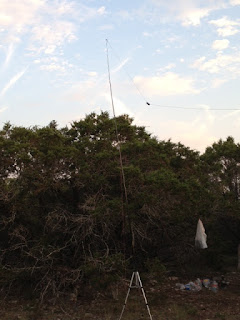
I would also say the radio set up worked as well. My main goal was to test the new 13' telescoping pole that I bought from SOTA Beams. I like this pole because it is much easier to pack in a backpack and it fits easily into a suitcase. Of course it's only 13'. I set it up on the $10 tripod that I use with my AlexLoop, that gives it another 4 feet or so. Both the telescoping pole and small tripod slide easily into the slot behind the sidepockets on most backpacks.
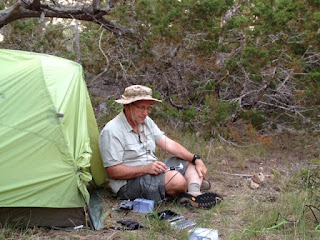
So a few days ago, my son AB5EB, invited me on a backpacking trip with he and my two grandsons, Reid, KF5GYE and Boogie, KF5GYD, ages, 10 and 12 respectively. Well, of course I could go. Our destination was Lost Maples State Park in the Texas Hill Country. What a beautiful spot. We would hike 4 miles to one of the high points in the park, ~2,300 ft. elev., making a 550 vertical climb and camp for the night. The last 330 feet of the climb come in the last quarter mile of the hike, so it's pretty pedestrian until that point.
From the backpacking perspective, I planned pretty well. A lightweight MSR Nook tent served me well, however, my old 20 degree sleeping bag and Thermarest pad need updating, lighter versions exist. My titanium alcohol cook stove and titanium cook pot worked great. One omission, I didn't bring any thing to sit on, so I need to get a Thermarest chair set-up that allows me to make a seat out of my sleeping pad, sitting on the ground gets old. I used to have one, but I have no idea where it is. One lesson that I haved learned when carrying everything you need on your back is to dual purpose your gear as much as you can. An example, for eating, I carry a plastic spoon and a coffee cup. If I don't eat the backpacking meal from the bag, I use the coffee cup to eat from and I have very little clean up. While I didn't bring a trekking pole on this trip, I could easily use one to mount the 13' pole on, after I figure out the adaptor issue. A trekking pole also works well as a base for the Buddi-stick vertical.
I would also say the radio set up worked as well. My main goal was to test the new 13' telescoping pole that I bought from SOTA Beams. I like this pole because it is much easier to pack in a backpack and it fits easily into a suitcase. Of course it's only 13'. I set it up on the $10 tripod that I use with my AlexLoop, that gives it another 4 feet or so. Both the telescoping pole and small tripod slide easily into the slot behind the sidepockets on most backpacks.
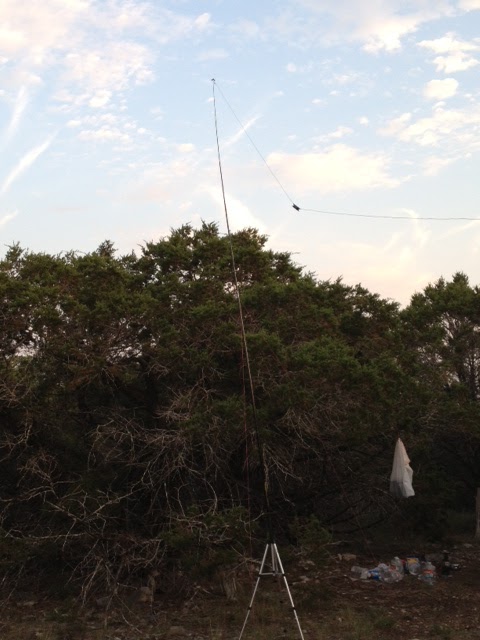
Telescoping Pole and Tripod
w/LNR Trail Friendly 10/20/40
I used two antenna configurations, the 40 -6 End Fed antenna from the Emergency Amateur Radio Club (EARC) in Hawaii, using the 31' wire they provide with the kit and the LNR 40/20/10 Trail Friendly Antenna. The results were hard to compare as I used each during different parts of the day and only on 20 meters. I did tune the EARC antenna on 15 meters, but the band was basically dead to me. I used the Elecraft T-1 tuner and the ATS-4B so matches were easy to find. I would say that the LNR had louder signals as you would expect from a resonant antenna. The trade off of course is that that EARC can be tuned on most any band. I managed to work both coasts with both antenna's so they both work. I will probably stick with the LNR for a short term SOTA activation, but the EARC might be good if I wanted to try the higher bands for a little DX.
BTW, from a backpacking perspective, when carrying tent, sleeping bag, food and water, etc..., I deemed the AlexLoop to be too big to pack, at least for long hikes. I would have had to go to a bigger back pack to accommodate it. Day hikes, of course, are a different story. Now, if I had a goat or pack mule, that would create some opportunities to carry more as well.
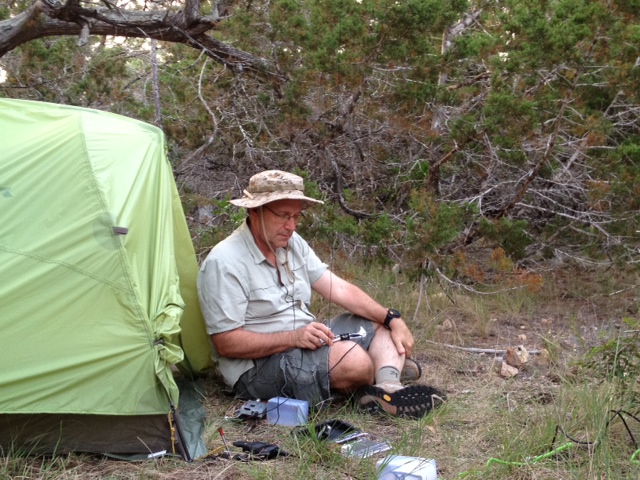
Operating Position (No Chair)
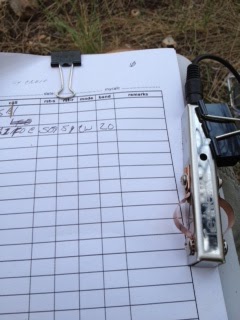
I also employed my rigged up operating desk. I used a backpacking style cutting board and a couple of bulldog clips. I printed the log pages from a template found on-line and have some waterproof ink jet paper on order.
Operating Desk
It was a fun trip. Backpacking, enjoying the outdoors with my son and grandsons and playing radio. It doesn't get much better than that.
The Electric Bill
Some of you 'not so old timers" may have never heard of Hugh Cassidy, WA6AUD. Cass, as he was referred to, wrote humorous stories about DXing for the West Coast DX Bulletin that featured the QRP'er who went "up the hill" to discuss and get counsel on the Mysteries of the Ages and the Eternal Enigmas of DXing. If you haven't read any of Cass's work, you really should read a couple before you read my story below. His stories can be found on the this website, www.oocities.org/k2cddx/dxstories.html
So in the vein of Cass, I submit another story of the DXer and the QRP'er
So in the vein of Cass, I submit another story of the DXer and the QRP'er
The Electric Bill
The DX’er came up the hill the other day with a stern look on his face. “What’s wrong with you” we said, just trying to start a conversation. “I just received my electric bill and I’m going to have to tell my XYL that we just can’t keep the house as warm as she wants it”. We were very careful not to get too involved in a domestic squabble, but we thought we should explore the situation a little further. “How warm does she want it?” we asked. He ranted, “Not only does it cost a lot of money to keep the house warm, but I break into a sweat when I’m in the shack trying to work a little DX, I don’t know why the thermostat has to be so high” The situation was starting to become clear to us now because we knew that the DX’er had a least one Alpha in his shack plus a mysterious black switch on the wall that he clicked “on” when he didn’t work the DX on the first call.
“Did you ever think that it’s all the tubes in your shack that keep you warm and that maybe it’s cooler in other parts of the house, perhaps where your XYL sits in the living room”, we suggested. He stopped to think for a minute, we knew that the situation was getting clearer for him. He then got an indignant look on his face, “You QRP’ers are always picking on me because I run a little power, I think that you are just jealous”. “Run a little power”, we said, “Last week the power company had 5 complaints in your neighborhood of dimming lights and a loud hum. Wasn’t Bouvet on last week?” “I don’t know what you are talking about” he said, looking away, “but yes Bouvet was on and I bet none of you QRP’ers worked him” he said with an arrogant grin. “On the contrary” we replied, “we all worked them”. “That’s impossible, none of you run more than 5 watts and the pile-ups were huge, I had to fire up both….I mean I had to use my amp or I would have never gotten through on the first day”. We let him have his fun as he bragged of nabbing Bouvet on 6 bands and then we reminded him that it was a three week expedition and that the pileups on the last days were much more manageable and that each of the QRP’ers had contacts on multiple bands with just 5 watts. He was speechless, as he confronted one of the eternal enigmas of ham radio. He was a little deflated and it seemed to us that in his own eyes his accomplishments had been diminished. “You mean each of you guys worked Bouvet?” he said quietly. “Yes” we said in unison “and our electric bills are much less than yours because we don’t need to run two, I mean we don’t need to run an amplifier”. The DX’er was humbled as he headed back down the hill, electric bill in hand, much slower than he came up. He was heard to say, “They worked Bouvet and have a lower electric bill”. Working rare DX with QRP; truly one of the Mysteries of the Ages.













