Posts Tagged ‘WSPR’
 10m WSPR yesterday
 June 10th, 2014 |
  Author:
 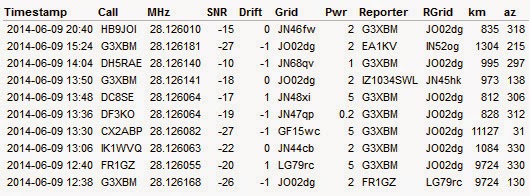 |
| 10m unique WSPR spots yesterday |
Quite a productive day on 10m yesterday with both Es and F-layer DX about. Best DX spot of my 2W was from FR1GZ on Reunion Is. and my best spot was of CX2ABP (11127km) in Montevideo, S.America who uses 5W.
This morning I have returned to 6m but G4IKZ, my faithful local reporter is not on!

Why I like WSPR
These are some of the reasons I like WSPR mode:
- About 100 stations (or more) can co-habit in a 200Hz wide WSPR sub-band on each band, time and frequency sharing. In reality, usually far fewer stations on worldwide per band.
- Low power is all you need 1mW to 5W is quite fine. I tend to use 1-2W, but have been spotted at DX distances with a few mW. Some even use uW power levels!
- If there is an opening everyone has a fair chance (anyone can be spotted at great ranges)
- Simple antennas work. No need for beams on HF.
- Can monitor activity (your own and that of others) in the lounge by visiting website www.WSPRnet.org on any PC or tablet.
- Speaking not needed (saves my stroke damaged voice).
- Highly sensitive (12-14dB better than 12wpm CW?).
- Can do other things whilst WSPRing.
- Automatic – requires no manual intervention once running.
- Ideal for accurate comparative measurements (e.g antennas, rigs).
- Ideal for propagation experiments.
- About QRSS10 equivalent.
- Works from VLF to UHF (watch stability on higher bands).
- A QRP man’s dream mode.
- For 2-way QSOs use JT9-1 (about 2dB worse than WSPR).
Disadvantages:
- Needs accurate timing (usually sync’d to internet time).
- Need good frequency accuracy.
- Usually needs a PC (not always e.g Hans Summers Ultimate 3 and similar kits).
- Needs careful interfacing to rig to avoid loops and 50, 100Hz sidebands.
Download WSPR software at http://physics.princeton.edu/pulsar/K1JT/wspr.html .

Late return to 6m tonight
After 10m, I have returned to 6m hoping for some GDX or even very late Es. However, it looks like I am the only G station transmitting WSPR so I am unlikely to copy any GDX unless a few more G stations come on. I shall leave the kit running so we’ll see who copies me. In some evenings I have copied Gs to around 200km away by a mix of tropo and aircraft reflection when Doppler is favourable.
UPDATE 2214z: G4IKZ copying me still, but no-one else so far.
UPDATE 1135z (next day): G4IKZ(18km) and G4KPX (14km) only spotting me this morning. No GDX, No Es.

Back on 10m again for an evening look
CX2ABP(11127km) in Montevideo (GF15wc) has just been spotted here at -25dB S/N on 10m WSPR even though propagation is supposed to be “poor” and he is using 5w.
10m really is my favorite band of all. Propagation supposed to be “poor” yet here is a South Anerican 11127km away on QRP! Now he is -21dB S/N and getting better!
UPDATE 2015z: Weak highly Doppler shifted signals near the bottom of the WSPR band suggest there is some 10m GDX about too. With luck, this may decode before too long? It needs a period with low Doppler.
UPDATE 2050z: CX2ABP has now been spotted 4 times in the last 38 minutes and he is now -18dB S/N which is 7dB stronger than at first. Again, it may be just co-incidence but his best signal corresponds with when Doppler on his signal is lowest. It is as if ALL stations with any drift or Doppler are best when Doppler (or is it drift?) is lowest.
UPDATE 2111z:: Nothing seen since 2038z, so I suspect the band has died out for the day (or the software has ceased working again!). Maybe I should go back on 6m looking for GDX again? I’ll leave it on 10m for another 20 minutes just in case.
UPDATE 2132z: Gone back to 6m GDX hunting. All quiet here so far this evening.

Back on 6m
After most of the day on 10m (lots of Es around Europe) it has been back on 6m since about 1708z. So far only G4IKZ (18km) spotting me.
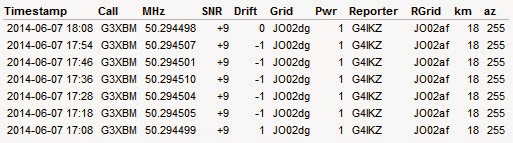 |
| 6m early evening WSPR spots 1W ERP |
Last night there were some new 6m GDX WSPR spots including G3ZJO (79km) so I am hopeful of some more GDX and maybe Es this evening on 6m. Eddie G3ZJO is more often seen on 472kHz running 1mW ERP. I have not tried 472kHz for some months now because of my health issues (stroke). Sticking to the higher HF bands and VHF (6m and 2m) have been easier. I need a better antenna for MF.
UPDATE 1950z: Been on 6m for over an hour and a half and not even the briefest hint of a signal seen yet. Just the spots from G4IKZ proving the kit is on and working. Very disappointing so far this evening. No Es or GDX at all.
UPDATE 2000z: Decided to go back to 10m even though 20-30MHz propagation is now forecast to be “poor”.

A morning on 10m
For a change, this morning I went on 10m rather than 6m. I had to disconnect the antennas early on because of a passing thunderstorm, but these are the results up to now with 2W out. Basically a fair scatter of 10m Es WSPR spots given and received from across Europe. No DX from outside Europe seen (yet). Hopefully will see some South Americans later.
Sunspot count today is 132 (quite respectable) and 20-30MHz propagation is “normal”.
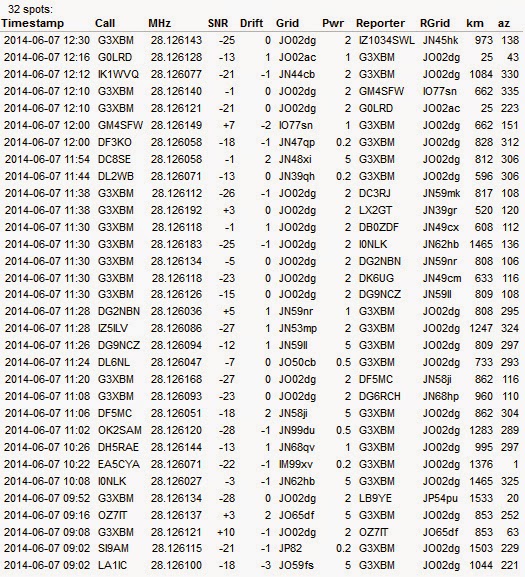 | |||
| 10m unique WSPR spots (2W) this morning |
Southern Europeans are exchanging WSPR spots with S.Africa (TEP?) at around 8400-8500km, but N.Europeans are missing out.

Stateside 6m stations – where are they on WSPR?
Forgetting F-layer propagation – now unlikely this autumn on 6m – the best chances of 6m transatlantic propagation are the next 6 weeks by multi-hop Es.
For a decent chance we need lots of stations active on 6m WSPR on both sides of the Atlantic. Generally there are quite a few active stations in Europe (including the UK) but very few in the eastern USA. I find this hard to fathom.
Not much power should be necessary. Even a few watts ERP should be enough. 6m is a fascinating band and WSPR the ideal mode to “sniff out” short-lived openings.
Please, if you are in the Eastern USA or Canada , come on to 6m WSPR for June and July to help us see if the 6m band opens “across the pond”. Without stations in the right place we are wasting our time.














