Posts Tagged ‘SARC’
 CW or Morse code?
 March 16th, 2026 |
  Author:
Unpacking the FAA's Boeing 787 Transponder Directive
As SARC Communicator editor I read a lot of blogs, club websites and other sources of amateur radio news. This one particularly caught my eye.
The source
The ‘click-bait’ headline:
Ham Radio Enthusiasts Land US Airlines With 8 Million Bill To Fix Faulty Equipment On Boeing 787s
Ham radio enthusiasts could be partly responsible for landing U.S. airlines with an $8 million bill to fix faulty equipment on Boeing 787 Dreamliner airplanes after it was discovered that simple radio signals can knock out a faulty transponder on the popular widebody plane used by American, United, and Alaska Airlines.
The issue came to light after the Federal Aviation Administration (FAA) reported “multiple instances of loss of transponder for airplanes entering airspace in the presence of CW interference.”

CW interference refers to continuous-wave radio signals like Morse code, military transmitters, and even amateur ham radio signals, which could interfere with the transponder on some Boeing 787s...
When I saw this story it didn’t seem to add up. After all, Amateurs have been sending CW for a century and there has never been an allegation such as this. Although my own and other readers’ feedback has resulted in an adjustment of the original deceptive headline, the underlying story deserved further investigation.
The actual facts
When the FAA warns of "CW interference," hams think of Morse code. Aviation engineers think of something far more dangerous—a silent, invisible wall of noise that can blind a Dreamliner to oncoming traffic.
In the world of amateur radio, "CW" is a beloved mode—the rhythmic cadence of Morse code cutting through the static, a testament to communication's simplest form. But when the Federal Aviation Administration (FAA) uses the same two-letter abbreviation in an airworthiness directive, it is describing something far more insidious and utterly unrelated to the operator in the shack.
For an avionics engineer, "Continuous Wave (CW) interference" refers to a pure, unmodulated, single-frequency carrier signal that has no business being where it is. It is a rogue tone, a sustained note of radio energy that can overwhelm sensitive aircraft receivers. And according to a new Notice of Proposed Rulemaking (NPRM) from the FAA, this type of interference is posing a direct threat to the Boeing 787 Dreamliner's ability to see and be seen by other aircraft.
The proposed directive, https://www.federalregister.gov/documents/2025/06/13/2025-10759/airworthiness-directives-the-boeing-company-airplanes which would affect 150 U.S.-registered 787-8, -9, and -10 aircraft, mandates a costly hardware replacement to fix a vulnerability that could, quite literally, render an aircraft invisible in busy airspace. But what exactly is this interference, and why is a simple hardware swap estimated to cost U.S. operators nearly $8 million?
The Problem: A Transponder That Won't Talk Back
At the heart of the issue is the 787's Integrated Surveillance System Processor Unit (ISSPU), a critical component that manages the aircraft's transponder. The transponder's job is to listen for interrogations from Air Traffic Control radar and other aircraft's Traffic Alert and Collision Avoidance Systems (TCAS) on 1030 MHz, and reply on 1090 MHz. Note that this is far from the usual HF frequencies that Amateurs normally operate at.
According to the FAA directive (Docket No. FAA-2025-0924), multiple reports have surfaced of 787s entering airspace with active "CW interference" and suffering a specific, dangerous failure: the transponder stops meeting its Minimum Operational Performance Standards (MOPS). Instead of correctly replying to at least 90% of interrogations, the unit becomes desensitized, failing to respond.
This is not a gradual degradation. It is an "unannunciated" loss, meaning the pilots receive no warning light, no aural alert, no indication that their aircraft is no longer replying to ground radar or TCAS inquiries. The first sign of trouble could be a gap in the sky where an airliner used to be, visible to everyone except the pilots of the aircraft that just went silent.
"CW" for the Layman: Not Morse Code, But a Wall of Noise
This is where clarification for the broader technical community is essential. For the amateur radio operator, "CW" (Continuous Wave) is synonymous with Morse code—a carrier wave that is turned on and off to form characters. It is intermittent, intentional, and communicative.
The "CW interference" cited by the FAA is something else entirely. In engineering terms, a "continuous wave" simply means a steady, unmodulated carrier signal. Think of it less as a conversation and more as a sustained, single-frequency tone—a pure, unbroken note of radio energy. If a pulsed radar signal is like a strobe light, CW interference is a laser pointer held steadily on a sensor, blinding it.
For a transponder receiver trying to pick out weak interrogation pulses from the sky, a powerful CW signal on or near its operating frequency (1030 or 1090 MHz) acts as a "jammer." It raises the noise floor, drowning out the very signals it needs to hear.
The Hunt for the Source: Who Is Generating This Noise?
The FAA directive is notably silent on the source of this interference, focusing instead on fixing the aircraft's vulnerability to it. So, who or what is generating these rogue continuous wave signals? The answer is complex and points to a crowded, modern radio spectrum. While the public document does not specify frequencies, the affected systems point squarely at the 1030/1090 MHz bands. Likely culprits for high-power CW interference in or near these frequencies include:
- Ground-Based Military and Civilian Radars: Some radar systems, particularly those used for long-range surveillance or specific military applications, can produce strong continuous or quasi-continuous output that generates harmonics or spurious emissions.
- High-Power Data Links: Terrestrial microwave data links, used for point-to-point communication by telecom companies and utilities, operate in frequency bands that can, with faulty equipment, generate out-of-band emissions that bleed into the aviation surveillance bands.
- The 5G Debate, Revisited: The recent spectrum battles between aviation and 5G carriers centered on the potential for signals from powerful ground-based transmitters to cause interference with radar altimeters. While that specific fight involved different frequencies (3.7-3.98 GHz), it perfectly illustrates the principle: a powerful, continuous transmission on a nearby frequency can overwhelm aircraft receivers if filtering and shielding are insufficient.
The $7.95 Million Fix
Because the sources of interference are myriad and largely outside an airframer's control, Boeing and the FAA have chosen to harden the aircraft itself. The proposed solution is not a software tweak, but a physical replacement of the vulnerable hardware.
While then issue is a worldwide problem, the directive would require US based operators to replace the left and right ISSPU units, swapping out current part numbers (822-2120-101 and -102) with a new, presumably better-shielded or more selective unit (part number 822-2120-113) .
The FAA estimates the parts alone will cost $52,661 per aircraft. With labor, each of the 150 affected U.S. planes will incur a $53,001 expense, bringing the total for U.S. carriers to $7,950,150 .
This is a significant investment for a problem that many in the industry suspect is not going away. As the radio spectrum grows ever more congested with diverse signals, the threat of "CW interference"—in its true engineering sense—will only increase. For the pilots of the Dreamliner, this hardware upgrade can't come soon enough. For the amateur radio operator tuning up on 40 meters, rest assured: your key is not the culprit. The real threat is coming from elsewhere in the increasingly noisy radio spectrum we all share.
73,
~John VE7TI
It’s our 50th Anniversary!
Commemorative VHF Net check-in
Tuesday 7 October at 8 pm (PST)
SARC will be hosting its usual net at 8 pm (Pacific time) on Tuesday, October 7 on frequency 147.360 MHz +600 KHz, tone 110.9 Hz for a special commemoration of the society’s founding on Tuesday, October 7, 1975.
Members and non-members are invited to check in. We'll also be connecting to IRLP reflector 9005 for any stations who wish to join from outside our repeater’s footprint. You can connect a repeater or your personal device by dialing node 9005.
You can read about SARC's history at The Communicator Digital Edition: The Communicator July - August 2025
We encourage SARC members, past students, non-members, and readers of The Communicator to check in on this historic net and we hope to commemorate our 50th anniversary with a record number of check ins.

~
Tomorrow starts Manna/Chowhound Weekend
Manna@80!
Operations Manna and Chowhound were lifesaving food drops to Northwest Holland 80 years ago, just prior to the end of World War Two. Over 20,000 people had died from starvation and a colder than normal winter. Allied pilots and support staff from the UK, the US, Canada, Poland, and Australia dropped over 7,000 tons of food behind enemy lines.
There are 10 special event stations operating in these countries Friday, April 25 through Sunday, April 27. If you contact 4 or more, a special event certificate will be issued. Check QRZ.com for any of the following callsigns or Manna80.radio on the web where the stations’ current operating frequencies are available via HamAlert.

Participating stations:
The UK
2. GB80MAN: International Bomber Command Centre
3. GB8MAN: Royal Air Force Station Binbrook
4. GB80CHO: 100th Bomb Group Museum in Thorpe Abbots
The United States
5. W4C: Boca Raton Amateur Radio Assn
Canada
6. VB7MAN: Surrey Amateur Radio Communications in Surrey, BC
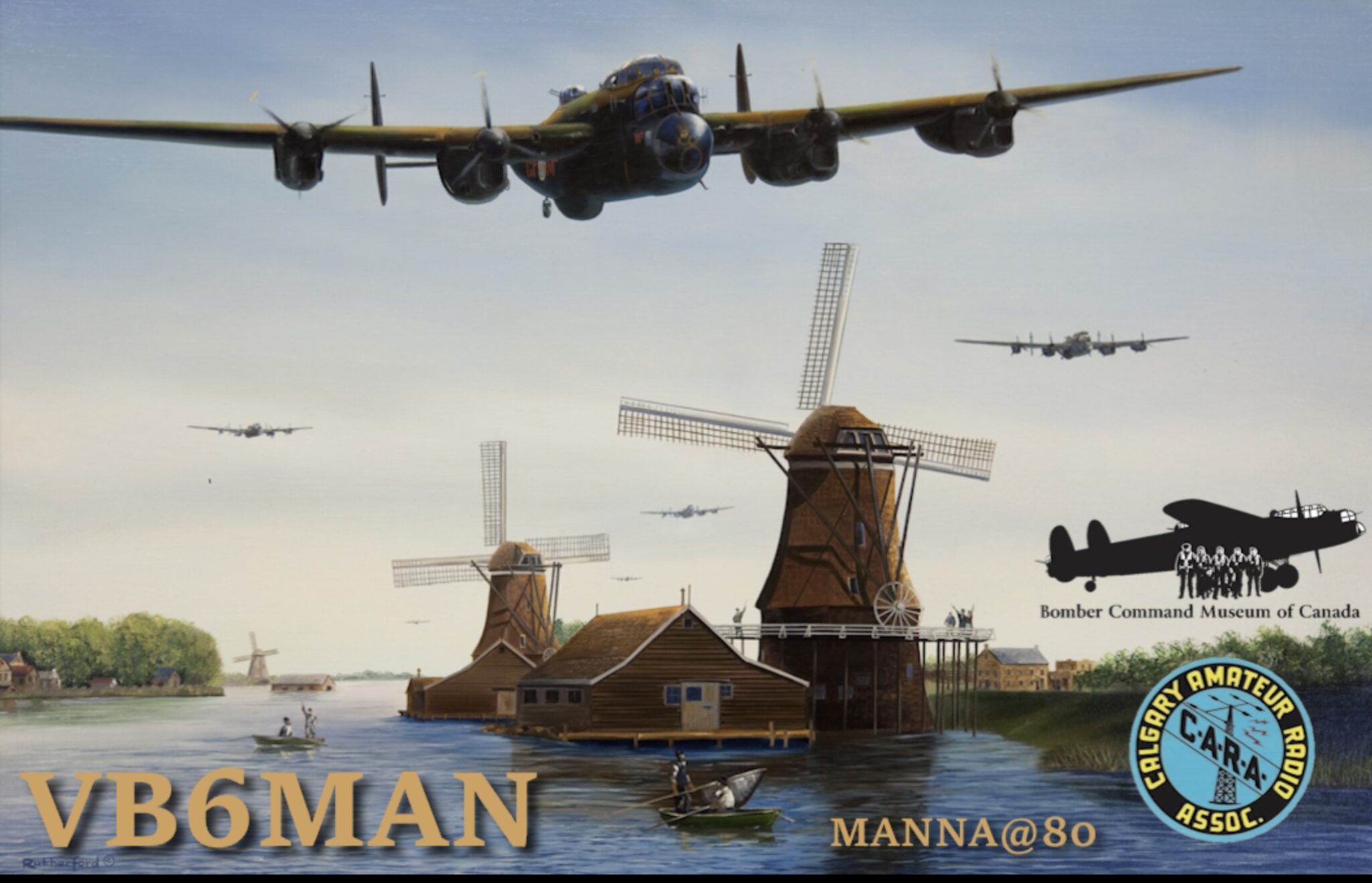
7. VB6MAN: Calgary Amateur Radio Club at the Bomber Command Museum of Canada in Nanton, Alberta
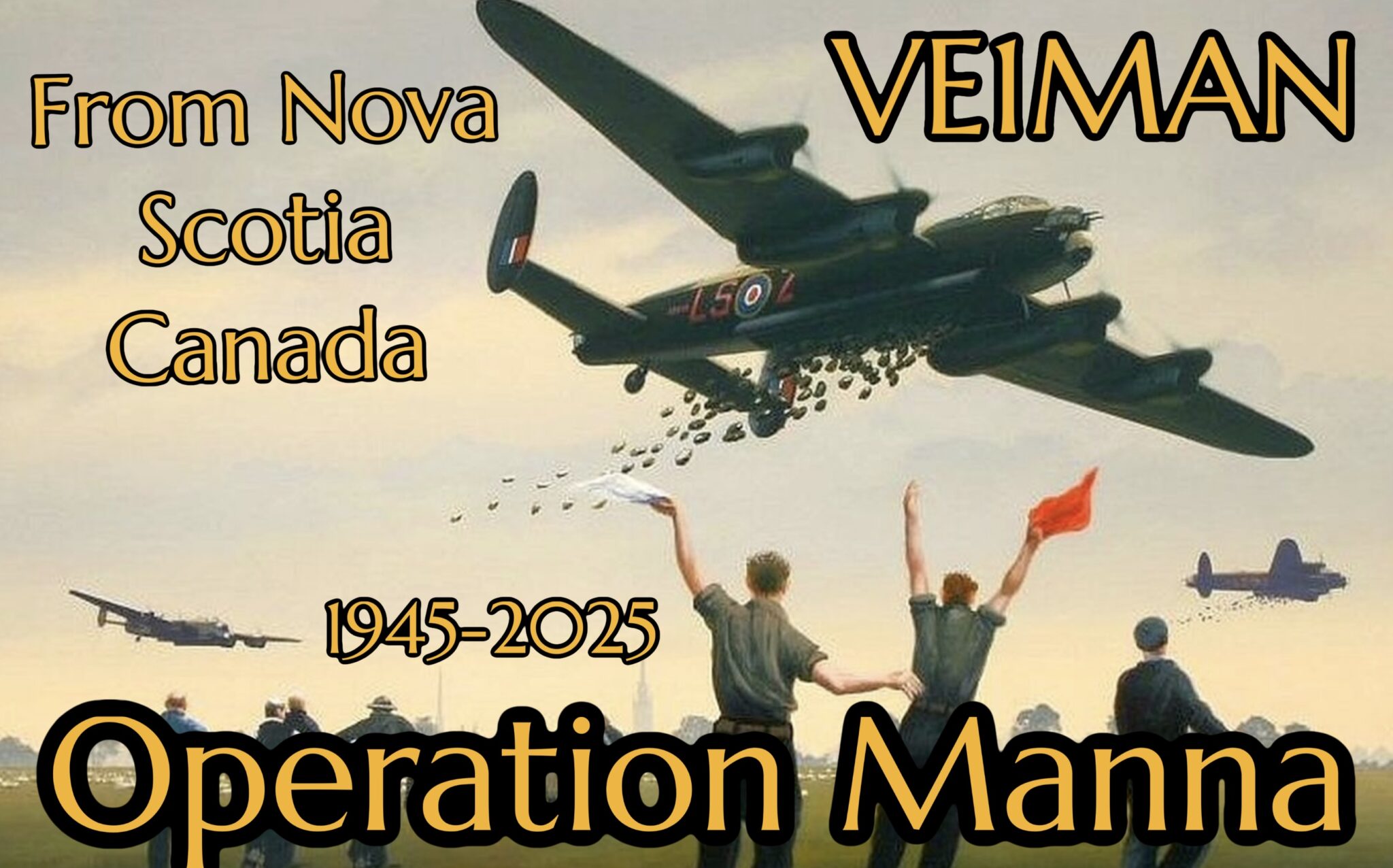
8. VE1MAN: Pictou County ARC in Picton, Nova Scotia
Australia
9. VK80MAN: Bull Creek Aviation Heritage Centre Perth, Australia
Poland
10. SN80MAN: The SP5KAB Radio Club
We hope to make contact with you.
![[IMG]](https://manna80.radio/wp-content/uploads/2025/03/IMG_1100-768x494.jpeg)
The Planning for MANNA@80 Continues…
Planning for the special event stations commemorating the life-saving food drops to NW Netherlands near the end of World War II is now in full swing. 62 nationalities were part of Bomber Command in WW2.
Please visit Operation Manna @ 80 for a full list of stations around the globe. Here are the Canadian stations participating:
VB7MAN Surrey Amateur Radio Communications
In Canada, Surrey Amateur Radio Communications (SARC) has been granted special event callsign VB7MAN from April 1st to May 10th. We will be on the air from our training station and elsewhere prior to, during, and after the event and will seek involvement of the high school students from our RF Communications class. Contacts with Europe can be sporadic from our location but we are generally able to contact North and South America, Asia, and Oceania. We have created a QSL card to commemorate the event. The card bears the $100 Royal Canadian Mint gold and silver coin struck in 2020 for the 75th anniversary.

We will update this page as plans progress but hope to make a QSO with you in April or May. Any certified amateur in BC may operate the special event callsign, as long as it is only used in one location at a time. If you wish to use the call on any band or mode, a Google calendar has been set up to reserve the call for your use between April 1st and May 10th. If you wish to book an operating time for VB7MAN, please contact [email protected].
John VE7TI
Coordinator [email protected]
>
VB6MAN Calgary Amateur Radio Association
CARA will be operating from the Bomber Command Museum of Canada in Nanton, Alberta. They will activate on April 25, 26, and 27th and May 9 and 10. The final dates and hours of operations will depend on the radio amateur operators participating.
>
VE1MAN Nova Scotia
The Canadian teams closest to Europe will be operating from their club station as VE1MAN. They may be activating from a former WW2 air base or another location of significance to tie in with the event.
Radio Amateurs of Canada published an article about MANNA@80 in the March-April issue of The Canadian Amateur, as did the Radio Society of Great Britain in their national magazine RADCOM.
~

Operation Manna 80
A very special, special event station
SARC has been asked to participate in a large-scale special event late in April commemorating the relief efforts of the winter of 1944-45 to drop tons of food to the starving population of NW Holland. It is well described at: Operation Manna @ 80 and in the video https://youtu.be/0PwhYFdzY_Q. Amateur stations from the drop zones in Holland, air force bases in Britain, plus the Allied forces that provided aircraft and pilots, including the UK, Canada, The US, Poland and Australia will be represented by special event stations in those countries.
Three UK Teams, one at the International Bomber Command Centre, another at former RAF Binbrook (an Operation Manna Airfield in the UK) and another at the 100th Bomb Group Museum Thorpe Abbots representing the US operation Chowhound from a former Chowhound airfield.
The national Radio Scouting team (Plusscouts PA3EFR/J) will be operating from an Operation Manna drop zone near The Hague, The Netherlands. Read on for further details on this team and their radio station location at The Team in the Netherlands – Operation Manna @ 80
The stations will be active April 25-27 (Friday through Sunday) using variations of the xx80MAN callsign. Here in Canada, we will be applying for VE80MAN.
Children and youth activities will also be included and there will be activity on HF, DMR and VHF

https://manna80.radio/w p-content/uploads/2024/12/Award_new.jpg
There will be a full article in the next Communicator (March 1st)
SARC-SEPAR Winter Field Day
Winter FD was pretty good!
Five of us set up in three sites at Derby reach including Paul VE7VP and 3 newer hams (Carl, Barbara, and Elaine from the last class). John VE7TI and Summer School graduate Grace VA7LZT came out and Grace was able to work 20m for a while which was great. We only made around 60 or 70 contacts, but we were operating more casually. We had a fair number of visitors, both Ham and non-Ham.
A full report will follow in the next Communicator.
















