Posts Tagged ‘ndb’
 Hunting For NDBs in CLE 228
 January 24th, 2018 |
  Author:
 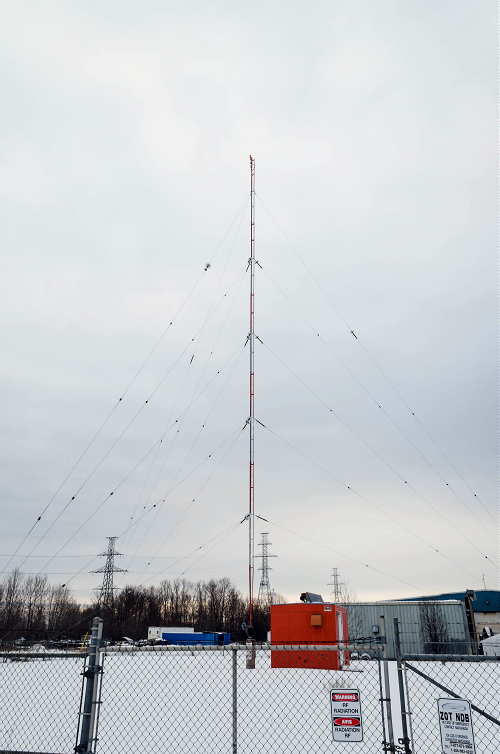 |
| ZQT-263 courtesy: http://www.ve3gop.com/ |
This coming weekend will see another monthly CLE challenge. This time the hunting grounds will be: 260 - 269.9 kHz and 440 - 1740 kHz.
For those unfamiliar with this monthly activity, a 'CLE' is a 'Co-ordinated Listening Event', as NDB DXers around the world focus their listening time on one small slice of the NDB spectrum.
A nice challenge in this one is to hear the Thunder Bay (ONT) NDB, 'ZQT', on 263 kHz. It seems to be well-heard throughout most of North America as its reported 50W does a good job into a very high vertical. Listen for its upper-sideband CW identifier (with your receiver in the CW mode) on 263.384 kHz.
If last month's great MF propagation continues into the weekend, we should see some great logs. Conditions are still very good at the moment.
If you are interested in building a system for the new (U.S.) 630m band, the CLE will give you the chance to test out your MF receiving capabilities and compare against what others in your area might be hearing.
When tuning for NDBs, put your receiver in the CW mode and listen for the NDB's CW identifier, repeated every few seconds. Listen for U.S. NDB identifiers approximately 1 kHz higher or lower than the published transmitted frequency since these beacons are modulated with a 1020 Hz tone approximately.
For example, 'AA' in Fargo transmits on 365 kHz and its upper sideband CW identifier is tuned at 366.025 kHz while its lower sideband CW ident can be tuned at 363.946 kHz. Its USB tone is actually 1025 Hz while its LSB tone is 1054 Hz.
Often, one sideband will be much stronger than the other so if you don't hear the first one, try listening on the other sideband.
Canadian NDBs normally have an USB tone only, usually very close to 400 Hz. They also have a long dash (keydown) following the CW identifier.
All NDBs heard in North America will be listed in the RNA database (updated daily) while those heard in Europe may be found in the REU database. Beacons heard outside of these regions will be found in the RWW database.
From CLE organizer Brian Keyte, G3SIA, comes the details:
CLE228 - FINAL DETAILS
Hi all,
Here are the final details for this weekend's Co-ordinated Listening Event.
This one uses some challenging frequencies and the possibility of hearing
some experimental amateur beacons. Any first-time CLE logs will also
be very welcome, however modest - it is not a contest!
Days: Friday 26 January - Monday 29 January
Times: Start and end at midday, your local time
Targets: Normal NDBs and Amateur beacons
QRG: 260.0 - 269.9 kHz
plus: 440.0 - 1740.0 kHz
Please log the beacons you can identify that are listed in those ranges
(not NAVTEX signals) plus any UNIDs that you come across there.
The range from 440 kHz gives some relaxing listening - it has wide
open spaces where you can often detect the carrier signals before
identifying them it from an offset. For Europe listeners most of the
targets are in the eastern countries where listeners will have a real
BONANZA - that's a lot! The CLE will be much more of a challenge
for those of us in Western Europe and in the rest of the World.
You can find details of the beacons in these ranges, lists and maps,
by clicking on the 'SEEKLIST' link in the CLE page
( http://www.ndblist.info/cle.htm )
We ask operators of the amateur beacons mainly around 474-478 kHz
to be on air during the CLE using a simple Morse mode which requires
no software to decode it. We are interested in anything operating IN
BEACON MODE in the range (no reports of any QSOs).
If possible, please include the amateur beacons' 6-character Locators
in your log - they are normally transmitted as part of the message.
Send your final CLE log to the List, preferably as a plain text email,
not in an attachment, with CLE228 and FINAL at the start of its title.
Please show on EVERY LINE of your log:
# The full Date (or Day no.) and UTC (the day changes at 00:00 UTC).
# kHz (show the beacon's nominal published frequency if you know it)
# The Call Ident.
Other optional details, Location, Distance, etc., go LATER in the same
line (or in footnotes). Any extra details about UNIDs, especially strong
ones that may be near to you (maybe their approximate direction, etc.)
will help us to discover more about them. Please make your log useful
to old and new members alike by ALWAYS including your own location
and brief details of the equipment and aerial(s) that you were using.
We will send an 'Any More Logs?' email at about 18:00 UTC on Tuesday
evening. From it you can check that your log has been found OK.
Do make sure that your log has arrived at the very latest by 09:00 UTC
on Wednesday 31 January.
The Combined Results should be finished soon after that.
Good listening
Brian
---------------------------------------------------------------------
From: Brian Keyte G3SIA ndbcle'at'gmail.com
Location: Surrey, SE England (CLE co-ordinator)
---------------------------------------------------------------------
If you are interested in some remote listening - maybe due to local
difficulties - you could use any one remote receiver for your loggings,
stating its location and with the owner’s permission if required.
A remote listener may NOT also use another receiver, local or remote,
to make further loggings for the same CLE.
-------------------------------------------------------------------
These listening events serve several purposes. They:
- determine, worldwide, which beacons are actually in service and on-the-air so the online database can be kept up-to-date
- determine, worldwide, which beacons are out-of-service or have gone silent since the last CLE covering this range
- will indicate the state of propagation conditions at the various participant locations
- will give you an indication of how well your LF/MF receiving system is working
- give participants a fun yet challenging activity to keep their listening skills honed
Final details can be found at the NDB List website, and worldwide results, for every participant, will be posted there a few days after the event. If you are a member of the ndblist Group, results will also be e-mailed and posted there.
The very active Yahoo ndblist Group is a great place to learn more about the 'Art of NDB DXing' or to meet other listeners in your region. There is a lot of good information available there and new members are always very welcome. As well, you can follow the results of other CLE participants from night to night as propagation is always an active topic of discussion.
You need not be an ndblist member to participate in the CLEs and all reports, no matter how small, are of much value to the organizers.
'First-time' logs are always VERY welcome!
Reports may be sent to the ndblist or e-mailed to either myself or CLE co-ordinator, Brian Keyte (G3SIA), whose address appears above.
Please ... give the CLE a try ... then let us know what NDB's can be heard from your location! Your report can then be added to the worldwide database to help keep it up-to-date.
Have fun and good hunting!
CLE 226 / CLE 227 NDB Listening Event Results
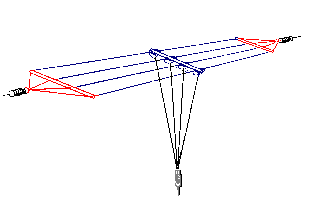
CLE 226 and CLE 227, both running during the Christmas to New Year period, produced some excellent propagation on the MF NDB band in most parts of the world.
With the Sun behaving itself and acting more as it should for this time of the cycle, even the high latitude prop-challenged southwestern region of British Columbia enjoyed unusually good propagation. In fact, the night of January 1st was probably the best propagation I have seen on the NDB band in several years!
That night was particularly good to the east resulting in my first logging of a New Jersey NDB ... 50 watt RNB at Millville, on 363kHz.
In keeping with the Christmas spirit, CLE 226 was a north 'polar' event, with NDB's within the Arctic Circle being the targets.
Being away from home for several days, I missed out on the first four nights and got started on December 29th, but over the next few nights heard the following polar stations:
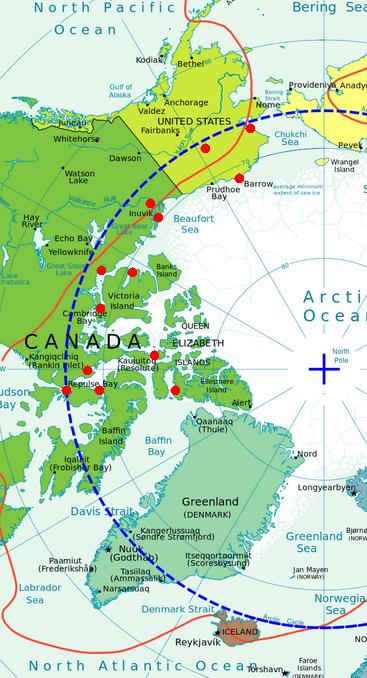 |
| Map courtesy: https://en.wikipedia.org/ |
02 14:00 281.0 VIR Barrow, ALS
02 15:00 356.0 HHM Kotzebue, ALS
02 15:30 391.0 EAV Bettles, ALS
30 03:00 254.0 EV Inuvik, NT, CAN
30 05:00 361.0 HI Holman, NT, CAN
30 10:00 380.0 YUB Tuktoyaktuk, NT, CAN
01 10:00 241.0 YGT Igloolik, NU, CAN
30 12:00 245.0 CB Cambridge Bay, NU, CAN
30 06:00 263.0 YBB Kugaaruk, NU, CAN
30 07:00 335.0 YUT Repulse Bay, NU, CAN
30 10:00 350.0 RB Resolute Bay, NU, CAN
01 10:00 365.0 YGZ Grise Fiord, NU, CAN
30 10:00 372.0 YCO Coppermine, NU, CAN
Here is the Cambridge Bay NDB (CB) on 245kHz. As well, the much weaker Gore Bay, Ontario NDB (YZE) can be heard underneath.
The second half of the event, CLE 227, was a 'bearing' event, where each listener picked one bearing from their location and logged NDBs (10 maximum) in countries or states that were located or touched on that bearing.
Since the normal propagation from my location favors the southeast, I chose a bearing of 107 degrees. This bearing passes through BC, WA, ID, MT, WY, NE, SD, KS, MO, AL, AR, TN, MS, GA, FL, BAH and BRAZIL, giving me a lot of possible coverage. As the propagation favored the east as well, I might just as well picked one that went through the Great Lakes and the eastern provinces. As it turned out, beacons were heard in most of my chosen regions except for the Bahamas.
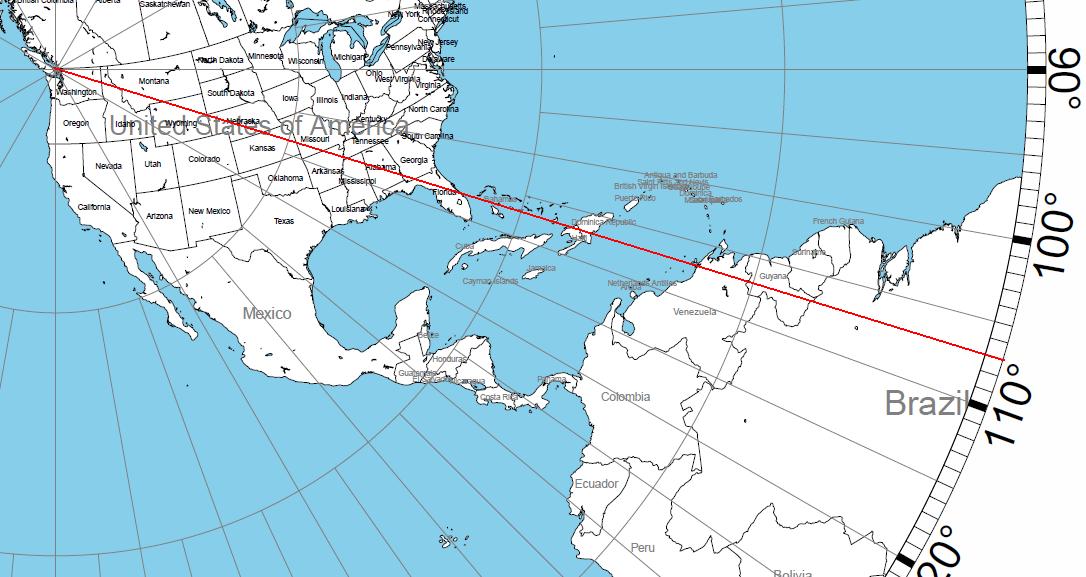 |
| Great Circle Map courtesy: https://ns6t.net/azimuth/azimuth.html |
02 07:00 220.0 TUI Tucurui (PA), BRA
02 07:00 360.0 JAC Jacare-a-Canga (PA), BRA
02 07:00 520.0 BHZ Belo Horizonte - Pampulha Apt, BRA
ALABAMA
02 07:00 224.0 BH Birmingham, AL, USA
ARKANSAS
30 07:00 335.0 BV Batesville, AR, USA
30 08:00 352.0 VM Board Camp, AR, USA
30 08:00 353.0 LI Little Rock, AR, USA
02 06:00 385.0 HO Hempwallace, AR, USA
BRITISH COLUMBIA
30 15:30 200.0 YJ Sidney Island, BC, CAN
30 15:30 203.0 YBL Campbell River, BC, CAN
01 08:00 230.0 YD Smithers, BC, CAN
30 15:30 242.0 ZT Port Hardy, BC, CAN
30 15:30 248.0 ZZP Queen Charlotte Is, BC, CAN
30 15:30 257.0 LW Kelowna, BC, CAN
30 10:00 261.0 D6 Fairmont Hot Springs, BC, CAN
30 15:30 278.0 1U Masset, BC, CAN
30 15:30 326.0 XJ Fort St. John, BC, CAN
30 15:30 378.0 AP Mayne Island, BC, CAN
FLORIDA
01 10:00 257.0 SQT Melbourne, FL, USA
02 07:00 260.0 MTH Marathon, FL, USA
29 09:00 326.0 PKZ Pensacola, FL, USA
29 09:00 332.0 FIS Key West, FL, USA
30 07:00 344.0 JA Dinnsmore, FL, USA
Here is something not often heard. See if you can copy the three beacons all on 333kHz ... FIS in Tampa, Florida, POA in Pahoa, Hawaii and VVV in Ortonville, Minnesota.
GEORGIA
02 07:00 362.0 SUR Fitzgerald, GA, USA
02 07:00 385.0 EMR Augusta, GA, USA
01 07:00 426.0 IZS Montezuma, GA, USA
IDAHO
02 07:00 211.0 HDG Gooding, ID, USA
02 07:00 220.0 HLE Hailey, ID, USA
02 07:00 264.0 SZT Sandpoint Apt, ID, USA
02 07:00 324.0 ID Ucon, ID, USA
02 07:00 350.0 SWU Id Falls, ID, USA
02 07:00 359.0 BO Ustick, ID, USA
02 08:00 383.0 PI Pocatello, ID, USA
02 07:00 389.0 TW Twin Falls, ID, USA
KANSAS
30 09:00 341.0 OIN Oberlin, KS, USA
30 07:00 356.0 PTT Pratt, KS, USA
02 08:00 377.0 EHA Elkhart, KS, USA
02 08:00 380.0 OEL Oakley, KS, USA
02 09:00 386.0 SYF St. Francis, KS, USA
02 09:00 395.0 ULS Ulysses, KS, USA
02 09:00 395.0 CA Newton, KS, USA
02 07:00 408.0 JDM Colby, KS, USA
02 07:00 419.0 GB Great Bend, KS, USA
02 10:00 420.0 PK Olathe, KS, USA
MISSOURI
01 07:00 281.0 DMO Sedalia, MO, USA
01 08:00 338.0 LM St Charles, MO, USA
01 08:00 344.0 JL Joplin, MO, USA
30 08:00 388.0 GLY Clinton, MO, USA
01 09:00 400.0 TRX Trenton, MO, USA
MISSISSIPPI
02 07:00 349.0 GW Greenwood, MS, USA
02 07:00 388.0 HAH Adams, MS, USA
02 07:00 420.0 TU Tupelo, MS, USA
02 07:00 426.0 UV Oxford, MS, USA
MONTANA
02 06:00 236.0 FOR Forsyth, MT, USA
02 07:00 266.0 BZ Bozeman, MT, USA
02 09:00 283.0 SCO Scobey, MT, USA
02 15:30 286.0 EKS Ennis, MT, USA
01 08:00 344.0 BKU Baker, MT, USA
01 10:00 347.0 SBX Shelby, MT, USA
02 09:00 386.0 HAU Helena, MT, USA
02 07:00 414.0 LYI Libby, MT, USA
NEBRASKA
30 07:00 275.0 HIN Chadron, NE, USA
30 07:00 329.0 PMV Plattsmouth, NE, USA
30 07:00 347.0 AFK Nebraska City, NE, USA
30 07:00 356.0 ODX Ord, NE, USA
30 07:00 362.0 CD Chadron, NE, USA
30 07:00 383.0 CNP Chappell, NE, USA
30 09:00 389.0 CSB Cambridge Muni, NE, USA
30 07:00 392.0 FMZ Fairmont, NE, USA
30 07:00 400.0 AHQ Wahoo, NE, USA
30 08:00 414.0 GRN Gordon, NE, USA
SOUTH DAKOTA
30 09:00 245.0 FS Sioux Falls, SD, USA
30 09:00 335.0 BK Brookings, SD, USA
TENNESSEE
02 10:00 263.0 DYQ Greeneville, TN, USA
02 07:00 335.0 CK Clarksville, TN, USA
02 07:00 341.0 CQN Chattanooga, TN, USA
02 08:00 371.0 FQW Murfreesboro, TN, USA
02 08:00 394.0 MK Jackson, TN, USA
WASHINGTON
01 15:30 216.0 GRF Fort Lewis, WA, USA
01 14:00 284.0 FHR Friday Harbor, WA, USA
01 08:00 328.0 LAC Fort Lewis, WA, USA
30 07:00 338.0 K Port Angeles, WA, USA
01 15:30 353.0 AL Dixie, WA, USA
30 07:00 362.0 BF Seattle, WA, USA
01 15:30 371.0 YK Yakima, WA, USA
01 15:30 382.0 AW Marysville, WA, USA
01 15:30 408.0 MW Moses Lake, WA, USA
01 15:30 515.0 CL Cresent Beach, WA, USA
WYOMING
01 10:00 257.0 HCY Cowley, WY, USA
30 08:00 280.0 GYZ Guernsey, WY, USA
02 06:00 344.0 POY Powell, WY, USA
30 08:00 375.0 CP Casper, WY, USA
02 09:00 380.0 GC Gillette, WY, USA
01 10:00 392.0 PNA Wenz, WY, USA
As usual, my receiver of choice was the Perseus SDR in combination with my MF inverted-L, tuned to 300kHz. After listening to many hours of NDB recordings during the event, I was hearing CW coming from all sorts of things in the house, including the ceiling fan and the washing machine for the next several days!
More information on this particular CLE as well as NDB listening in general can be found at the NDB List website.
The very active Yahoo ndblist Group is a great place to learn more about the 'Art of NDB DXing' or to meet other listeners in your region. There is a lot of good information available there and new members are always very welcome. As well, you can follow the results of other CLE participants from night to night as propagation is always an active topic of discussion.
Holiday Hunt For NDBs In CLE 226 & 227
The next CLE event will be the special Christmas holiday event and includes two challenges! CLE 226 covers any NDB north of the Arctic Circle, while CLE 227 is a 'bearing' event, with each listener chosing a particular bearing from their receiving location and seeing how many beacons can be heard from states, provinces or countries through which that bearing slices! You will have plenty of time to listen as well, since the event runs from Monday 25th December to Tuesday 2nd January.
For those unfamiliar with this monthly activity, a 'CLE' is a 'Co-ordinated Listening Event', as NDB DXers around the world focus their listening time (usually) on one small slice of the NDB spectrum.
Normally, December provides some excellent propagation but the planet continues to be bombarded with seemingly non-stop coronal hole streaming that can cause geomagnetic disturbances disruptive to MF propagation. However, often these 'disruptions' are not as dire as they first appear and MF propagation can remain robust or even be enhanced.
Listeners in Canada and the northern states as well as those in northern Europe will have a much better chance of logging the Arctic beacons. Most of these are large 'enroute' navigation markers with big antennas and plenty of erp ... they are heard very well.
A pdf list of all NDBs within the Arctic Circle can be downloaded from here.
If you are interested in building a system for the new (U.S.) 630m band, the CLE will give you the chance to test out your MF receiving capabilities and compare against what others in your area might be hearing.
When tuning for NDBs, put your receiver in the CW mode and listen for the NDB's CW identifier, repeated every few seconds. Listen for U.S. NDB identifiers approximately 1 kHz higher or lower than the published transmitted frequency since these beacons are modulated with a 1020 Hz tone approximately.
For example, 'AA' in Fargo transmits on 365 kHz and its upper sideband CW identifier is tuned at 366.025 kHz while its lower sideband CW ident can be tuned at 363.946 kHz.
Often, one sideband will be much stronger than the other so if you don't hear the first one, try listening on the other sideband.
Canadian NDBs normally have a USB tone only, usually very close to 400 Hz. They also have a long dash (keydown) following the CW identifier.
All NDBs heard in North America will be listed in the RNA database (updated daily) while those heard in Europe may be found in the REU database. Beacons heard outside of these regions will be found in the RWW database.
From CLE organizer Brian Keyte, G3SIA, comes the usual 'heads-up':
Hello all
Time to tell you about our Holiday CLEs.
Yes – we have two of them, running at the same time, something we have often done in the Christmas – New Year period.
The Early Advice for both CLEs is described here, but we shall treat them quite separately after this.
==================================
CLE226 - SANTA’S BEACONS
We'll be sharing Santa's attempts to use the NDBs north of the Arctic Circle (Latitude N67 degrees) as he navigates his weary reindeer on the last stages of their long flights back home.
Please tell us of any normal NDBs north of the Arctic Circle that you manage to log.
Days: Monday 25th December – Tuesday 2nd January
Times: Midday on 25th Dec to Midday on 2nd Jan, your local time
QRG: Normal LF/MF frequencies
Target: NDBs within the Arctic Circle, north of Latitude 67 degrees
That is similar to what we did way back in Holiday CLE059 (Christmas 2004).
There are about 130 qualifying ‘active’ NDBs currently recorded in RWW.
(You can see the old results from CLE059 in the CLE Archives Section,
http://www.ndblist.info/cledata/CLE59santa.pdf It only ran for 24 hours after midday on Christmas Day).
We do apologise to the listeners who are too far south to hear anything. (The further north listeners often miss out in normal CLEs, especially in the summertime when there is very little sky wave propagation for them).
The Final Details for the Santa CLE, CLE226, will follow in a few days.
===================================
CLE227 - BEARINGS CLE
Like CLE226, this is also a re-run, something that was very much enjoyed over 10 years ago - as CLE092 during a weekend in early June 2007.
Days: Monday 25th December – Tuesday 2nd January
Times: Midday on 25th Dec to Midday on 2nd Jan, your local time
QRG: Normal LF/MF frequencies
Target: Up to 10 NDBs in each Radio Country in your chosen direction
You choose a line in any one direction from you. Then try to log 'normal' NDBs in each of the radio countries crossed by that line - not more than 10 NDBs from each country.
Your line can be at any bearing of your choice - e.g. 123 degrees but NOT including the opposite direction (303 degrees).
Preferably use a Great Circle map to choose your line and to see which radio countries it cuts (a country is included if any part of it is crossed).
Remember that each USA and Australian State and each Canadian Province is a separate Radio Country. See http://www.ndblist.info/ndbinfo/countrylist.pdf
(If your line crosses the sea, any platforms roughly in that direction would also qualify as a radio country for the CLE).
The event will give you an opportunity to plan your own tactics. You could:
Try out a directional aerial
Include a favourite country or countries
Listen for NDBs which mostly have your favourite offset
Concentrate either on DX or more local reception
Exclude signals from the direction of your worst QRN
- any or all of those things, and more.
The aim is not to try and include as many countries or as many NDBs as possible, though you could do that if you wanted to!
TO CHOOSE YOUR BEARING, for non-dx loggings you could use an ordinary map (Mercator projection), especially if your location is near to its middle.
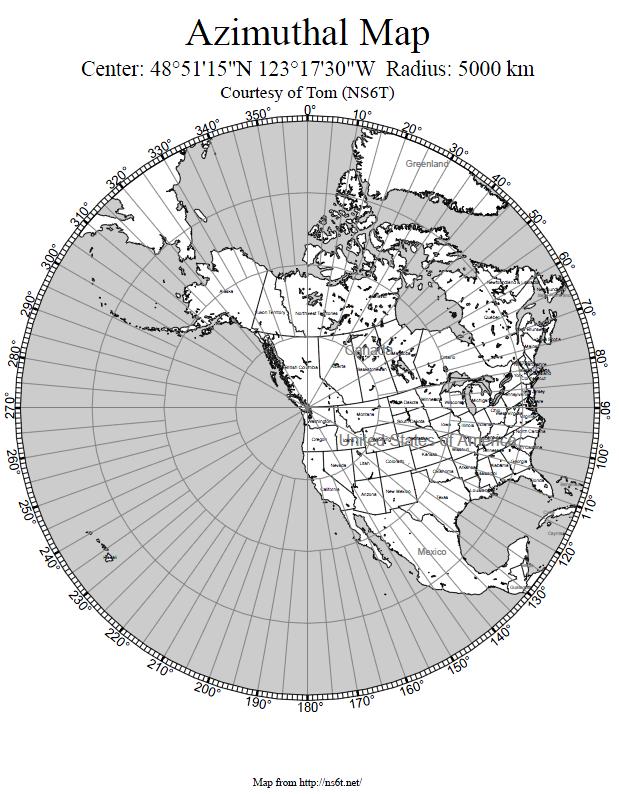
Better would be a Great Circle map centred on your location - you should find that https://ns6t.net/azimuth/azimuth.html is good and very easy to download and use. Just put in your location (e.g. Locator), choose a distance and click on ‘Create Map’. It misses out smaller countries, but reference also to a ‘normal’ map should cater for that.
Perhaps ideal would be Google Earth if you can download that (it is a powerful program for lots of purposes). Click on its Ruler icon and draw a line with the mouse. It tells you distance and Bearing ('Heading'). (Feel free to tell us about any other suitable Great Circle programs)
I can highly recommend the ns6t map generator as it produces a very nice great circle map, shown below for my location on Mayne Island.
 |
| courtesy: https://ns6t.net/azimuth/azimuth.html |
I have yet to decide which bearing I will choose but 81 degrees looks promising from here as it cuts across BC, Alberta, Saskatchewan, Manitoba and Ontario while catching the northern edges of Minnesota and North Dakota.
(If you wish you could use any one remote receiver for your loggings,
stating the location and owner – and with their permission if required.
A remote listener may NOT also use another receiver, local or remote,
to make further loggings for the same CLE.
These listening events serve several purposes. They:
- determine, worldwide, which beacons are actually in service and on-the-air so the online database can be kept up-to-date
- determine, worldwide, which beacons are out-of-service or have gone silent since the last CLE covering this range
- will indicate the state of propagation conditions at the various participant locations
- will give you an indication of how well your LF/MF receiving system is working
- give participants a fun yet challenging activity to keep their listening skills honed
Final details can be found at the NDB List website, and worldwide results, for every participant, will be posted there a few days after the event. If you are a member of the ndblist Group, results will also be e-mailed and posted there.
The very active Yahoo ndblist Group is a great place to learn more about the 'Art of NDB DXing' or to meet other listeners in your region. There is a lot of good information available there and new members are always very welcome. As well, you can follow the results of other CLE participants from night to night as propagation is always an active topic of discussion.
You need not be an ndblist member to participate in the CLEs and all reports, no matter how small, are of much value to the organizers.
'First-time' logs are always VERY welcome!
Reports may be sent to the ndblist or e-mailed to either myself or CLE co-ordinator, Brian Keyte (G3SIA), whose address appears above.
Please ... give the Holiday CLE a try ... then let us know what NDB's can be heard from your location! Your report can then be added to the worldwide database to help keep it up-to-date.
Have fun and Happy Holidays to everyone.
CLE 225 Results
The recent CLE activity saw mixed conditions throughout North America. The general consensus was that propagation was just 'OK' but lightning noise continued to be a problem for some beacon hunters.
Here in B.C., propagation was fairly flat on all three nights, with Sunday night providing the lowest noise levels. Signals were generally weak and somewhat 'mushy' at times, with propagation still being affected by high speed solar winds and an elevated 'K' index.
North America results show the following stats:
23 Reporters
184 Different NDBs heard
934 Reports
Most Heard NDBs:
Rprts QRG ID Name ITU
=============================================
18 216,0 CLB Wilmington / Carolina Beach USA
14 198,0 DIW Dixon USA
14 223,0 YYW Armstrong CAN
13 200,0 UAB Anahim Lake CAN
12 206,0 QI Yarmouth CAN
12 214,0 LU Cultus' Abbotsford CAN
12 218,0 RL Red Lake CAN
12 227,0 CG Castlegar CAN
12 233,0 QN Nakina CAN
11 235,0 CN Cochrane CAN
I was happy to see that 'LU' near Abbotsford, B.C. and pictured in the last blog, was well heard. Reports of the mountain-meadow beacon came from Hawaii in the west to Illinois in the east and everywhere in between.
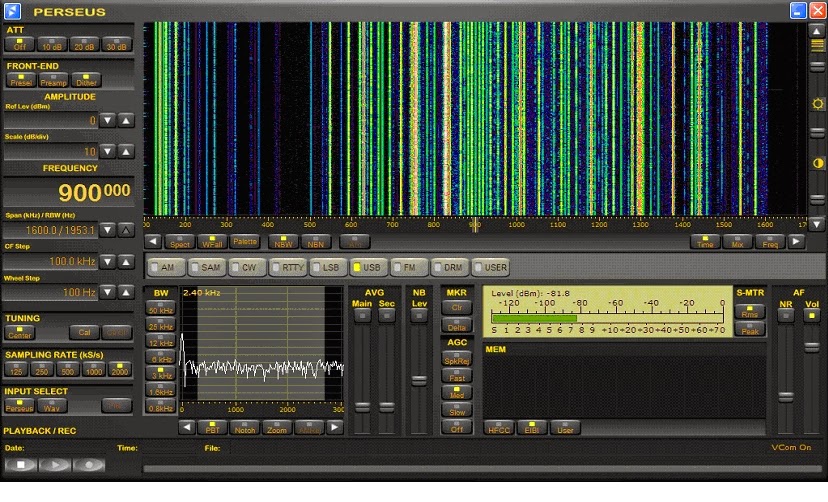
The following NDB's were heard here on Mayne Island, B.C., using the Perseus SDR feeding my low frequency inverted-L antenna, resonated to 200 KHz for the weekend event:
25 05:00 198.0 DIW Dixon, NC, USA
25 05:00 200.0 YJ Sidney Island, BC, CAN
26 10:00 200.0 UAB Anahim Lake, BC, CAN
25 07:00 201.0 ZWN Winnipeg, MB, CAN
26 09:00 201.0 YKX Kirkland Lake, ON, CAN
25 18:00 201.0 IP Y Mobile, AZ, USA
27 21:43 201.0 BV Bartlesville, OK, USA
25 07:00 203.0 ZKI Kitimat, BC, CAN
25 07:00 203.0 YBL Campbell River, BC, CAN
25 07:00 203.0 TCY Tracy, CA, USA
25 06:00 204.0 ZQR Regina, SK, CAN
25 10:00 204.0 YFY Iqaluit, NU, CAN
25 11:00 206.0 SOW Show Low, AZ, USA
26 06:00 206.0 IIB Independence, IA, USA
25 05:00 206.0 EF Castlegar, BC, CAN
25 10:00 207.0 YNE Norway House, MB, CAN
25 10:00 207.0 PY Fort Chipewyan, AB, CAN
25 09:00 208.0 YSK Sanikiluaq, NU, CAN
26 09:00 209.0 ITR Burlington, CO, USA
25 08:00 209.0 IB Atikokan, ON, CAN
25 09:00 209.0 HGT Jolon, CA, USA
25 06:00 209.0 CYT Yakataga, ALS
25 09:00 211.0 HDG Gooding, ID, USA
25 10:00 212.0 YGX Gillam, MB, CAN
25 10:00 212.0 CGL Juneau, ALS
26 13:00 212.0 CFV Coffeyville, KS, USA
25 05:00 214.0 LU Abbotsford, BC, CAN
27 06:00 214.0 CHX Choix, MEX
25 09:00 215.0 ZAB Edmonton, AB, CAN
25 08:00 216.0 GRF Fort Lewis, WA, USA
25 08:00 216.0 CLB Wilmington, NC, USA
25 06:00 218.0 RL Red Lake, ON, CAN
25 05:00 218.0 PR Prince Rupert, BC, CAN
26 08:00 218.0 AL Alton, IL, USA
25 06:00 219.0 ZRS Regina, SK, CAN
26 08:00 220.0 RBJ Tucson, AZ, USA
25 07:00 220.0 HLE Hailey, ID, USA
25 08:00 221.0 QU Grande Prairie, AB, CAN
25 08:00 222.0 WY Wrigley, NT, CAN
26 10:00 223.0 YYW Armstrong, ON, CAN
25 05:00 223.0 YKA Kamloops, BC, CAN
25 13:00 223.0 AFE Kake, ALS
25 05:00 224.0 DN Dauphin, MB, CAN
25 11:00 224.0 BK Baker Lake, NU, CAN
25 14:00 225.0 X5 Vegreville, AB, CAN
25 14:00 225.0 LWG Lewisburg, OR, USA
25 07:00 227.0 YAC Cat Lake, ON, CAN
27 09:00 227.0 FZ St. Louis, MO, USA
25 05:00 227.0 CG Castlegar, BC, CAN
25 05:00 227.0 9X Brooks Apt, AB, CAN
25 07:00 229.0 AKW Klawockt, ALS
25 06:00 230.0 YD Smithers, BC, CAN
25 09:00 230.0 VG Vermilion, AB, CAN
25 13:00 230.0 BI Bismarck, ND, USA
25 07:00 233.0 QN Nakina, ON, CAN
25 07:00 233.0 OKS Oshkosh, NE, USA
25 06:00 233.0 ALJ Hinchinbrook Island, ALS
25 11:00 236.0 YZA Ashcroft, BC, CAN
25 11:00 236.0 FOR Forsyth, MT, USA
26 11:00 238.0 K5 Maple Creek, SK, CAN
25 11:00 239.0 OJ High Level, AB, CAN
26 12:30 239.0 BBB Benson, MN, USA
The logs / reports from all participants may be viewed here on the NDB List website.
As luck would have it, the three nights following the CLE have been fantastic on MF which seems to happen all to often.
Hunting For NDBs In CLE 225
 |
| LU - 214 KHz |
This coming weekend will see another monthly CLE challenge. This time the hunting grounds will be: 190 - 239.9 kHz PLUS normal NDBs on 'half-way' frequencies nnn.5 kHz (from 190.5 - 999.5 kHz).
For those unfamiliar with this monthly activity, a 'CLE' is a 'Co-ordinated Listening Event', as NDB DXers around the world focus their listening time on one small slice of the NDB spectrum.
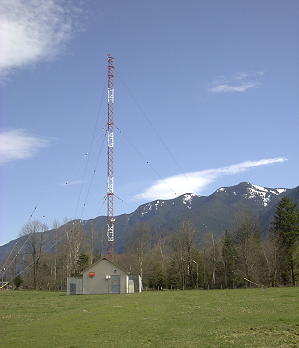
A nice challenge in this one is to hear the Abbotsford (BC) NDB, 'LU', on 214 kHz. This is the beacon associated with Abbotsford Int'l Airport, Vancouver International's alternate for foggy conditions. It is located in a breathtaking mountain meadow location at the foot of the North Cascade Mountains. It's 500W Nautel drives a 100' vertical and with all of that space, I suspect a very robust ground system.
'LU' gets out very well and has been heard from Hawaii to New England and should be a good propagation indicator for many North American participants. Look for 'LU's upper-sideband CW identifier, repeated every 10.4 seconds, on 214.404 kHz with your receiver in the CW mode.
Usually November provides some excellent propagation as the summer thunderstorms have pretty much run their course but the recent warning of upcoming geomagnetic activity may, once again, mean something else in store for us. Often these 'warnings' are not as dire as they might appear and MF propagation remains robust or even enhanced.
If you are interested in building a system for the new (U.S.) 630m band, the CLE will give you the chance to test out your MF receiving capabilities and compare against what others in your area might be hearing.
When tuning for NDBs, put your receiver in the CW mode and listen for the NDB's CW identifier, repeated every few seconds. Listen for U.S. NDB identifiers approximately 1 kHz higher or lower than the published transmitted frequency since these beacons are modulated with a 1020 Hz tone approximately.
For example, 'AA' in Fargo transmits on 365 kHz and its upper sideband CW identifier is tuned at 366.025 kHz while its lower sideband CW ident can be tuned at 363.946 kHz. Its USB tone is actually 1025 Hz while its LSB tone is 1054 Hz.
Often, one sideband will be much stronger than the other so if you don't hear the first one, try listening on the other sideband.
Canadian NDBs normally have an USB tone only, usually very close to 400 Hz. They also have a long dash (keydown) following the CW identifier.
All NDBs heard in North America will be listed in the RNA database (updated daily) while those heard in Europe may be found in the REU database. Beacons heard outside of these regions will be found in the RWW database.
From CLE organizer Brian Keyte, G3SIA, comes the usual 'heads-up':
Hello all,
Do try not to miss our 225th co-ordinated listening event - it starts this
Friday at midday. We can hope for good conditions, some comfortable
listening and opportunities to catch some good DX.
This should be ideal to try out a CLE for the first time.
Days: Fri. 24 - Mon. 27 November, Midday-Midday, your local time
Frequencies: 1) NDBs from 190 - 239.9 kHz
PLUS: 2) Normal NDBs on 'half-way' frequencies nnn.5 kHz
(from 190.5 - 999.5 kHz)
So for all of us it is a CLE in two parts - the first part is hunting for
the NDBs whose published frequencies are lower than 240 kHz.
The second part is hunting for the NDBs whose carrier frequencies
are 'half-way'. E.g. 284.5 DY, 333.5 VOG, 370.5 LB, 381.5 SJX (in MI),
390.5 ITR, 433.5 HEN ( Not nnn.6, etc. )
'Normal' NDBs - no DGPS, please.
(Most Europe listeners will hear few or none from part 1, while
listeners away from Europe will hear few or none from part 2)
The Seeklists from REU/RNA/RWW will help you – you will find them
from the link on the CLE page http://www.ndblist.info/cle.htm
Please send your CLE log to the List, if possible as a plain text email and
not in an attachment, showing 'CLE225' at the start of its title. (Loggings
from both parts can be shown together in the same list if you wish)
Please include on EVERY line of your log:
# The date (or just the day 'dd') and UTC (days change at 00:00 UTC).
# kHz - the beacon's nominal frequency.
# The Call Ident.
It is important to show those main items FIRST - any other optional
details such as Location, Distance, etc. go LATER in the same line.
Don't forget to give your OWN location and details of your receiver and
aerial(s), etc. Others will be interested to know, especially new members
- and old ones with memories like mine!
Also, please ALWAYS send your last log with ‘FINAL’ in the subject.
## That is important even if you send no interim logs ##
Listening on the 'half-way' frequencies means we might also catch some
interesting non-CLE beacons - please tell us about those too, but in a
separate list. If any of them are UNIDs whose carriers seem to be on
'half-way' frequencies include them in your main list of course.
Joachim and I will be processing the incoming logs – please look out for
our 'Any More Logs?' email at about 18:00 UTC on Tuesday evening,
with a list to let you check that your log has been found OK.
Joachim will again be making the combined results for us.
Do make sure that your log has arrived on the NDB List at the very latest
by 09:00 UTC on Wednesday 29 November.
Good listening
Brian
----------------------------------------------------------
From: Brian Keyte G3SIA ndbcle'at'gmail.com
Location: Surrey, SE England (CLE Coordinator)
----------------------------------------------------------
(If you wish you could use any one remote receiver for your loggings,
stating the location and owner – and with their permission if required.
A remote listener may NOT also use another receiver, local or remote,
to make further loggings for the same CLE.
These listening events serve several purposes. They:
- determine, worldwide, which beacons are actually in service and on-the-air so the online database can be kept up-to-date
- determine, worldwide, which beacons are out-of-service or have gone silent since the last CLE covering this range
- will indicate the state of propagation conditions at the various participant locations
- will give you an indication of how well your LF/MF receiving system is working
- give participants a fun yet challenging activity to keep their listening skills honed
Final details can be found at the NDB List website, and worldwide results, for every participant, will be posted there a few days after the event. If you are a member of the ndblist Group, results will also be e-mailed and posted there.
The very active Yahoo ndblist Group is a great place to learn more about the 'Art of NDB DXing' or to meet other listeners in your region. There is a lot of good information available there and new members are always very welcome. As well, you can follow the results of other CLE participants from night to night as propagation is always an active topic of discussion.
You need not be an ndblist member to participate in the CLEs and all reports, no matter how small, are of much value to the organizers.
'First-time' logs are always VERY welcome!
Reports may be sent to the ndblist or e-mailed to either myself or CLE co-ordinator, Brian Keyte (G3SIA), whose address appears above.
Please ... give the CLE a try ... then let us know what NDB's can be heard from your location! Your report can then be added to the worldwide database to help keep it up-to-date.
Have fun and good hunting!
__._,_.__
Hunting For NDBs In CLE 224
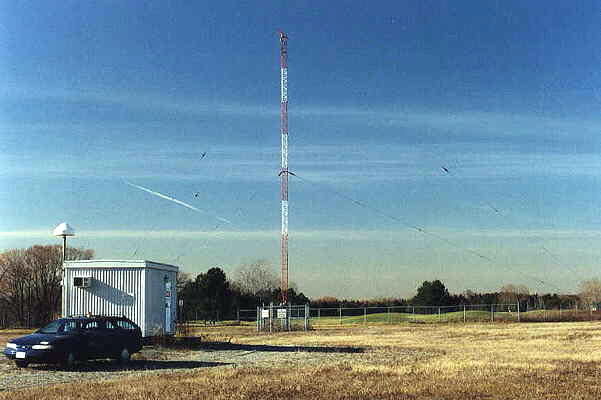 |
| "OO - 391" - Oshawa, Ontario |
It's hard to believe but this coming weekend will see another monthly CLE challenge. This time the hunting grounds will be: 385.0 - 399.9 kHz.
For those unfamiliar with this monthly activity, a 'CLE' is a 'Co-ordinated Listening Event', as NDB DXers around the world focus their listening time on one small slice of the NDB spectrum.
A nice challenge in this one is to hear the Ottawa (Ontario) NDB, 'OO', on 391 kHz. 'OO' is an amazing 7-watter that has been heard on both coasts as well as in Europe! Look for 'OO's CW identifier, repeated every 10.2 seconds, on 391.400 kHz with your receiver in the CW mode.
Usually the Fall season provides some excellent propagation as the summer thunderstorms quiet down but the recent warning of upcoming geomagnetic activity for the weekend may mean something else in store for us. Often these 'warnings' are not as dire as they might appear and MF propagation remains robust or even enhanced.
It's hard to believe but this coming weekend will see another monthly CLE challenge. This time the hunting grounds will be: 385.0 - 399.9 kHz.
For those unfamiliar with this monthly activity, a 'CLE' is a 'Co-ordinated Listening Event', as NDB DXers around the world focus their listening time on one small slice of the NDB spectrum.
A nice challenge in this one is to hear the Ottawa (Ontario) NDB, 'OO', on 391 kHz. 'OO' is an amazing 7-watter that has been heard on both coasts as well as in Europe! Look for 'OO's CW identifier, repeated every 10.2 seconds, on 391.400 kHz with your receiver in the CW mode.
Usually the Fall season provides some excellent propagation as the summer thunderstorms quiet down but the recent warning of upcoming geomagnetic activity for the weekend may mean something else in store for us. Often these 'warnings' are not as dire as they might appear and MF propagation remains robust or even enhanced.
If you are interested in building a system for the new (U.S.) 630m band, the CLE will give you the chance to test out your MF receiving capabilities.
When tuning for NDBs, put your receiver in the CW mode and listen for the NDB's CW identifier, repeated every few seconds. Listen for U.S. NDB identifiers approximately 1 kHz higher or lower than the published transmitted frequency since these beacons are modulated with a 1020 Hz tone approximately.
For example, 'AA' in Fargo transmits on 365 kHz and its upper sideband CW identifier is tuned at 366.025 kHz while its lower sideband CW ident can be tuned at 363.946 kHz. Its USB tone is actually 1025 Hz while its LSB tone is 1054 Hz.
Often, one sideband will be much stronger than the other so if you don't hear the first one, try listening on the other sideband.
Canadian NDBs normally have an USB tone only, usually very close to 400 Hz. They also have a long dash (keydown) following the CW identifier.
All NDBs heard in North America will be listed in the RNA database (updated daily) while those heard in Europe may be found in the REU database. Beacons heard outside of these regions will be found in the RWW database.
From CLE organizer Brian Keyte, G3SIA, comes the usual 'heads-up':
Hi all,
Our 224th Coordinated Listening Event is less than a week away.
The Northern Hemisphere summertime storms have subsided, the equinox
has passed and we can all hope for some good reception conditions.
Whether you are a keen propagation watcher or just a take-what-comes
listener, please join in.
Days: Friday 27 October - Monday 30 October
Please log all the NDBs you can identify that are listed in the range
(it includes 385 kHz but not 400 kHz) plus any UNIDs you find there.Please send your CLE log to the List in a plain text email if possible
(not in an attachment) with 'CLE224' at the start of its title.
Show on each log line:
# The date (e.g. 2017-10-29, etc., or just 29) and UTC.
(the date changes at 00:00 UTC)
# kHz (the nominal published frequency, if known)
# The Call Ident.
Show those main items FIRST - other optional details such as Location
and Distance go LATER in the same line.
If you send interim logs, please also send a 'Final' (complete) log.
As always, tell us your own location and brief details of the equipment
that you were using during the weekend.
To help your listening, seeklists and maps for your part of the World
are available via the CLE page http://www.ndblist.info/cle.htm
Good listening - enjoy the CLE
----------------------------------------------------------------------
From: Brian Keyte G3SIA ndbcle'at'gmail.com
Location: Surrey, SE England (CLE coordinator)
----------------------------------------------------------------------
Our 224th Coordinated Listening Event is less than a week away.
The Northern Hemisphere summertime storms have subsided, the equinox
has passed and we can all hope for some good reception conditions.
Whether you are a keen propagation watcher or just a take-what-comes
listener, please join in.
Days: Friday 27 October - Monday 30 October
Times: Start and end at midday, your LOCAL TIME
Range: 385.0 - 399.9 kHz
Range: 385.0 - 399.9 kHz
(Most of us in Europe, will be altering our clocks this weekend – UTC time continues unaffected)
Please log all the NDBs you can identify that are listed in the range
(it includes 385 kHz but not 400 kHz) plus any UNIDs you find there.Please send your CLE log to the List in a plain text email if possible
(not in an attachment) with 'CLE224' at the start of its title.
Show on each log line:
# The date (e.g. 2017-10-29, etc., or just 29) and UTC.
(the date changes at 00:00 UTC)
# kHz (the nominal published frequency, if known)
# The Call Ident.
Show those main items FIRST - other optional details such as Location
and Distance go LATER in the same line.
If you send interim logs, please also send a 'Final' (complete) log.
As always, tell us your own location and brief details of the equipment
that you were using during the weekend.
To help your listening, seeklists and maps for your part of the World
are available via the CLE page http://www.ndblist.info/cle.htm
Good listening - enjoy the CLE
----------------------------------------------------------------------
From: Brian Keyte G3SIA ndbcle'at'gmail.com
Location: Surrey, SE England (CLE coordinator)
----------------------------------------------------------------------
These listening events serve several purposes. They:
- determine, worldwide, which beacons are actually in service and on-the-air so the online database can be kept up-to-date
- determine, worldwide, which beacons are out-of-service or have gone silent since the last CLE covering this range
- will indicate the state of propagation conditions at the various participant locations
- will give you an indication of how well your LF/MF receiving system is working
- give participants a fun yet challenging activity to keep their listening skills honed
Final details can be found at the NDB List website, and worldwide results, for every participant, will be posted there a few days after the event. If you are a member of the ndblist Group, results will also be e-mailed and posted there.
The very active Yahoo ndblist Group is a great place to learn more about the 'Art of NDB DXing' or to meet other listeners in your region. There is a lot of good information available there and new members are always very welcome. As well, you can follow the results of other CLE participants from night to night as propagation is always an active topic of discussion.
You need not be an ndblist member to participate in the CLEs and all reports, no matter how small, are of much value to the organizers.
'First-time' logs are always VERY welcome!
Reports may be sent to the ndblist or e-mailed to either myself or CLE co-ordinator, Brian Keyte (G3SIA), whose address appears above.
Please ... give the CLE a try ... then let us know what NDB's can be heard from your location! Your report can then be added to the worldwide database to help keep it up-to-date.
Have fun and good hunting!
Hunting For NDBs In CLE 223
 |
| SN-408 courtesy: www.ve3gop.com |
This coming weekend will see another CLE challenge. This time the hunting grounds will be: 400.0 - 419.9 kHz.
For those unfamiliar with this monthly activity, a 'CLE' is a 'Co-ordinated Listening Event', as NDB DXers around the world focus their listening time on one small slice of the NDB spectrum.
A nice challenge in this one is to hear the Saint Catharines (Ontario) NDB, 'SN', on 408 kHz. 'SN' is a 15-watter and is well heard, having been logged from coast-to-coast. Look for 'SN's CW identifier, repeated every 10.5 seconds, on 408.398 kHz with your receiver in the CW mode.
Late summer CLEs can often be challenging, not because of poor propagation but more likely, lingering summer lightning storms ... hopefully it will be quiet for your location.
When tuning for NDBs, put your receiver in the CW mode and listen for the NDB's CW identifier, repeated every few seconds. Listen for U.S. NDB identifiers approximately 1 kHz higher or lower than the published transmitted frequency since these beacons are modulated with a 1020 Hz tone approximately.
For example, 'AA' in Fargo transmits on 365 kHz and its upper sideband CW identifier is tuned at 366.025 kHz while its lower sideband CW ident can be tuned at 363.946 kHz. Its USB tone is actually 1025 Hz while its LSB tone is 1054 Hz.
Often, one sideband will be much stronger than the other so if you don't hear the first one, try listening on the other sideband.
Canadian NDBs normally have an USB tone only, usually very close to 400 Hz. They also have a long dash (keydown) following the CW identifier.
All NDBs heard in North America will be listed in the RNA database (updated daily) while those heard in Europe may be found in the REU database. Beacons heard outside of these regions will be found in the RWW database.
From CLE organizer Brian Keyte, G3SIA, comes the usual 'heads-up':
Hi all,
Here is your Early Advice of our next Co-ordinated Listening Event.
We are back to a normal event looking for the NDBs in a narrow
frequency range - and celebrating the equinox on 22nd Sept.
All beginners, occasionals and regulars are very welcome to join in.
Days: Friday 22 Sept - Monday 25 Sept 2017
Times: Start and end at midday your LOCAL time
Range: 400 - 419.9 kHz
Just log all NDBs you can identify that are listed in the range (it includes
400 kHz but not 420 kHz) plus any UNIDs that you come across there.
We last had a close look at this frequency range in CLE208 at the
start of July 2016.
From the Ministry of Useless Information comes the advice that in CLE208
Europe listeners and Rest of the World listeners each heard 107 different
NDBs.
Please look out for the Final Details on Wednesday.
73
Brian
----------------------------------------------------------
From: Brian Keyte G3SIA ndbcle'at'gmail.com
Location: Surrey, SE England (CLE coordinator)
----------------------------------------------------------
These listening events serve several purposes. They:Here is your Early Advice of our next Co-ordinated Listening Event.
We are back to a normal event looking for the NDBs in a narrow
frequency range - and celebrating the equinox on 22nd Sept.
All beginners, occasionals and regulars are very welcome to join in.
Days: Friday 22 Sept - Monday 25 Sept 2017
Times: Start and end at midday your LOCAL time
Range: 400 - 419.9 kHz
Just log all NDBs you can identify that are listed in the range (it includes
400 kHz but not 420 kHz) plus any UNIDs that you come across there.
We last had a close look at this frequency range in CLE208 at the
start of July 2016.
From the Ministry of Useless Information comes the advice that in CLE208
Europe listeners and Rest of the World listeners each heard 107 different
NDBs.
Please look out for the Final Details on Wednesday.
73
Brian
----------------------------------------------------------
From: Brian Keyte G3SIA ndbcle'at'gmail.com
Location: Surrey, SE England (CLE coordinator)
----------------------------------------------------------
- determine, worldwide, which beacons are actually in service and on-the-air so the online database can be kept up-to-date
- determine, worldwide, which beacons are out-of-service or have gone silent since the last CLE covering this range
- will indicate the state of propagation conditions at the various participant locations
- will give you an indication of how well your LF/MF receiving system is working
- give participants a fun yet challenging activity to keep their listening skills honed
Final details can be found at the NDB List website, and worldwide results, for every participant, will be posted there a few days after the event. If you are a member of the ndblist Group, results will also be e-mailed and posted there.
The very active Yahoo ndblist Group is a great place to learn more about the 'Art of NDB DXing' or to meet other listeners in your region. There is a lot of good information available there and new members are always very welcome. As well, you can follow the results of other CLE participants from night to night as propagation is always an active topic of discussion.
If you are contemplating getting started on 630m, listening for NDBs is an excellent way to test out your receive capabilities as there are several NDBs located near this part of the spectrum.
You need not be an ndblist member to participate in the CLEs and all reports, no matter how small, are of much value to the organizers.
'First-time' logs are always VERY welcome!
Reports may be sent to the ndblist or e-mailed to either myself or CLE co-ordinator, Brian Keyte (G3SIA), whose address appears above.
Please ... give the CLE a try ... then let us know what NDB's can be heard from your location! Your report can then be added to the worldwide database to help keep it up-to-date.
Have fun and good hunting!













