Posts Tagged ‘ndb’
 Tuggle-Style LF Regens
 September 5th, 2014 |
  Author:
  If the name sounds familiar, you may recognize it from reading about the DX crystal radios that Mike Tuggle has created over the past several years. Some might even say that his state-of-the-art and very elegant "Lyonodyne 17" crystal radio re-kindled the modern day interest in crystal radio DXing, once the mainstay of all radio adventures.
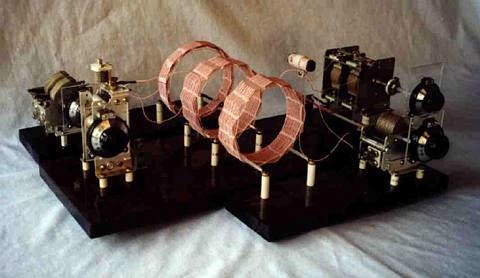 |
| Mike Tuggle's Lyonodyne 17 Crystal DX Tuner |
I'm not sure what sparked Mike's interest in building regens but it may go back several years to the "1AD" contest sponsored by the Birmingham Crystal Radio Group. This was a DX contest challenge that allowed a receiver to use only "1 Active Device", as explained in the rules:
"Only one active device is allowed to be counted to get the 1AD bonus points. The device can be a bipolar, FET, tunnel diode or tube (triode, tetrode, pentode, or heptode), but only one device may be used. If a tube envelope has more than one tube in it, use only one of those active devices to be counted as a 1AD. Crystal sets may be used if one active device is added either inboard or outboard. Totally passive crystal sets are not allowed. In the active set, any number of diodes (either solid state or tube diodes) may be used; however, a tunnel diode or similar active device counts as the 1AD for the contest.
The use of integrated circuits can be interesting in that one IC can be used to build a full superhet. The use of an IC means that the set will not qualify for the 1AD nor for the 2AD bonus points."The challenge was too hard to resist for many and the contest was popular for several years running. Some of the inventive entries for individual years may be seen here. The contest logbooks also make for interesting reading and demonstrate the capability of some of these simple radios.
Although the contest has not been run for the past few years, there is still much interest and discussion of "1AD" radios on Dave Schmarder's "RadioBoard" forum.
Mike's LF tuner is a prime example as he uses it daily and continues to post some amazing DX to the Yahoo "ndblist" Group. His furthest ndb catch in North America with the regen has been "YY" in Mont Joli, Quebec.
Now, "YY" is a good catch for me, from B.C., but Mike is listening from Kaneohe, Hawaii !
You can read about Mike's original design here, while his latest version shown below, incorporates a dedicated LF antenna tuner.
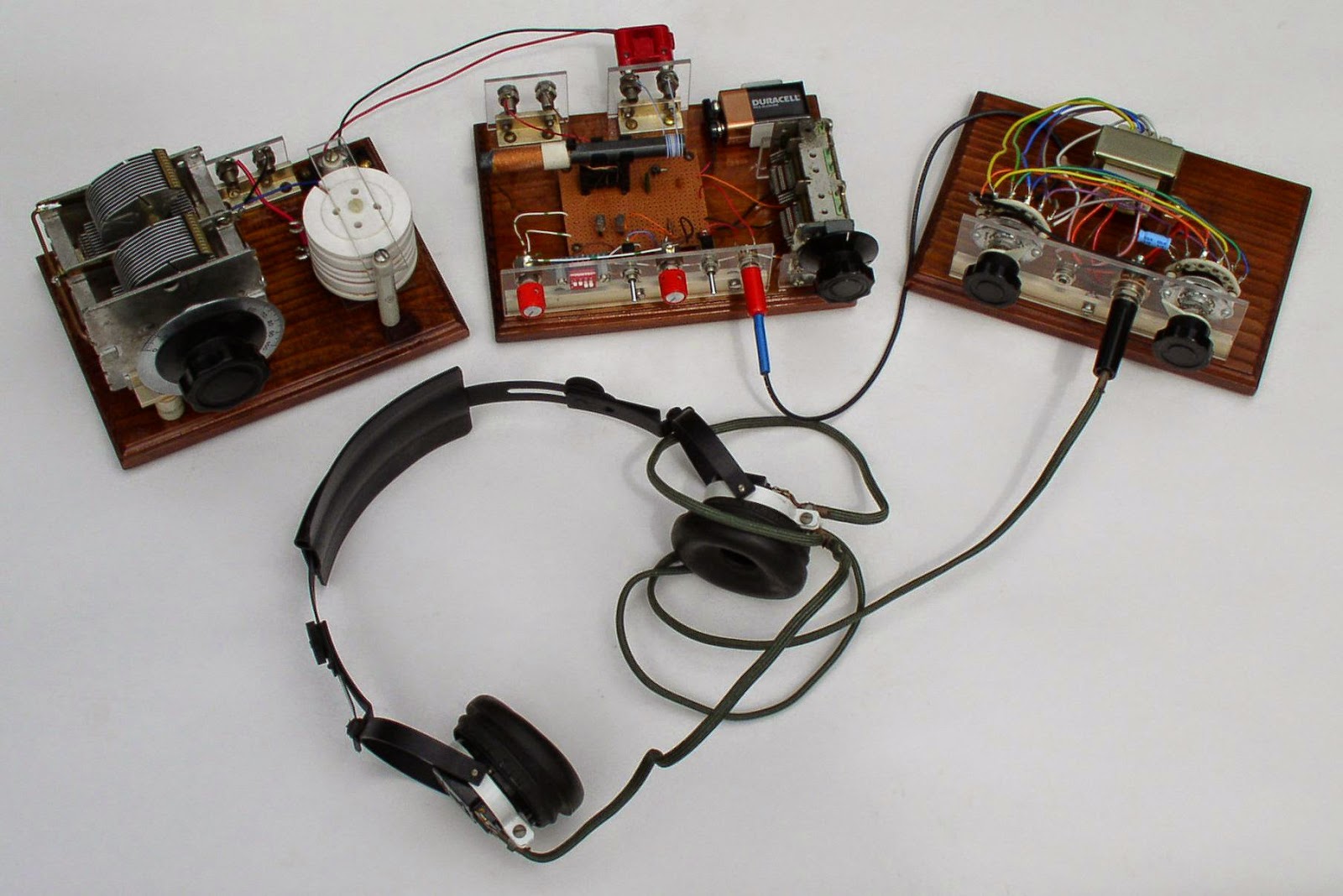 |
| LF Regen (Courtesy Mike Tuggle) |
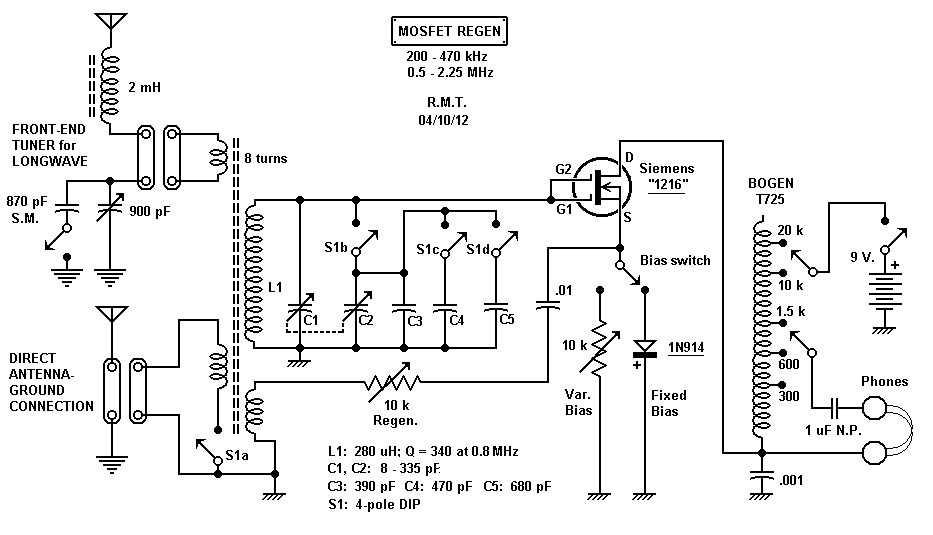 |
| LF Regen Schematic (courtesy Mike Tuggle) |
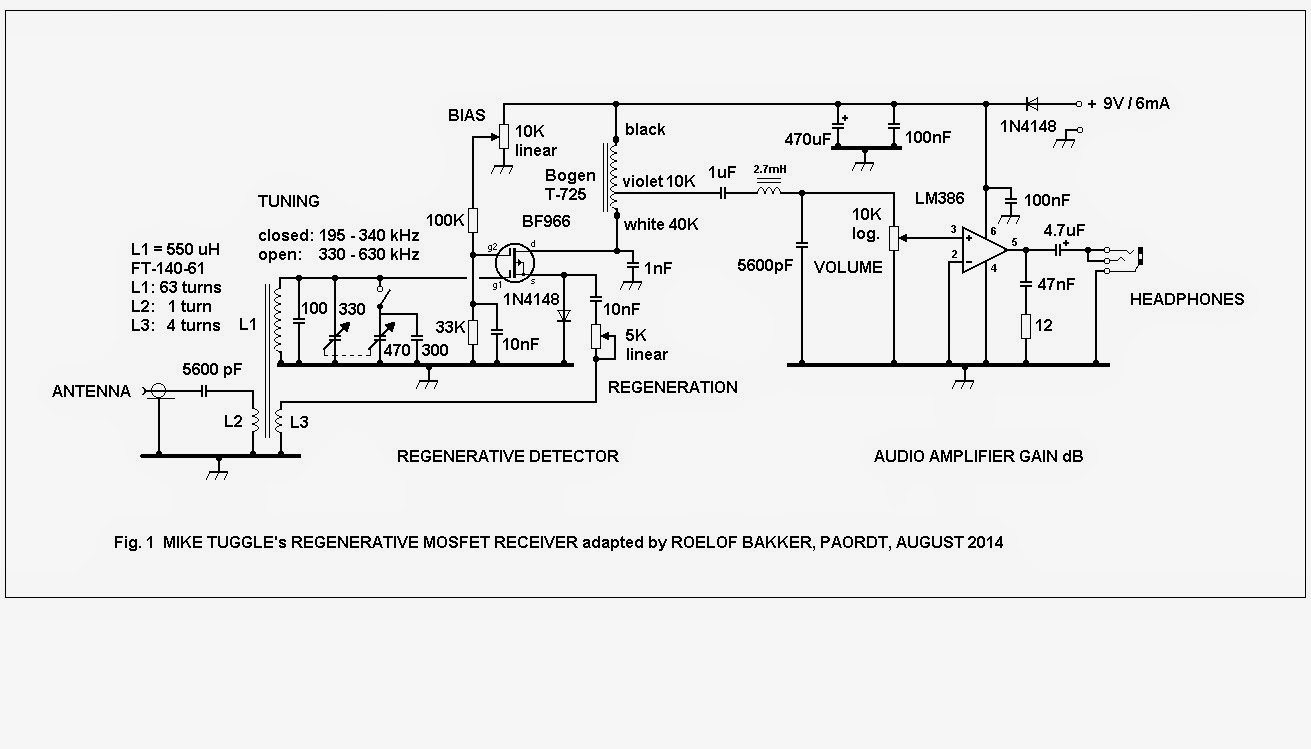 |
| Courtesy: Roelof Bakker, PAØRDT |
Roelof has also published a nice write-up describing the project which sparked a lot of "must build" discussion within the group.....even enough to make Mike get out his soldering iron and build the European-version!
As old and as simple as they are, regenerative receivers still hold much fascination amongst radio builders and dollar-for-dollar are amazingly good performers, especially on LF.
Alaska’s NDBs Awaken!
 |
| Courtesy: http://www.alaskacooling.com |
This past weekend saw another of the monthly "Co-ordinated Listening Event" (CLE) activities sponsored by the Yahoo ndblist Group and organized by Brian Keyte, G3SIA. This is a group of dedicated low frequency NDB DXers that enjoy hunting down new catches as well as keeping track of NDB activity in general. These low powered beacons make excellent propagation indicators and are always a good measure of one's LF receive capability.
As often happens, the monthly events seem to coincide with poor propagation periods for some unexplainable reason, as was the case once again. As well as the generally poor propagation, North America was plagued with high levels of lightning activity making any weak signals very difficult to hear through the steady din of QRN.
In spite of the poor conditions, two nice catches from Alaska (ELF and TNC) heralded the fast receding midnight-sun in the 49th state and the start of another Alaskan NDB DX season!
The NDB at Cold Bay is 'ELF' and transmits on 341kHz. Cold Bay is located on the Alaskan Peninsula, at the top of the Aleutian chain.
 |
| Courtesy: http://pics3.city-data.com |
Built as a military airfield in WWII, Cold Bay's traffic is now mostly cargo and its long runway serves as an emergency 'alternate' for flights in the north Pacific.
A search of Google Maps shows the NDB itself is located several miles north of the airport and appears to use a large vertical and an extensive ground system. With the transmitter power listed as 1000W, ELF makes an excellent target for DXers looking for their first Alaskan NDB.
 |
| Source: https://maps.google.ca |
 |
| Source: https://maps.google.ca |
Like 'ELF', the antenna appears to be a vertical but possibly of smaller size.
 |
| Source: https://maps.google.ca |
For ELF, listen on 342.030kHz or 339.968kHz. The carrier will be on 341.0kHz.
For TNC, listen on 348.034kHz or 345.968kHz. The carrier will be on 347.0kHz.
For a list of all active NDB's in Alaska, complete with accurate frequency-spotting information, visit the beacon-reporting RNA website. Put 'AK' in the 'States' window and pick 'All Results' in the 'Show' window. There are presently at least 60 or more NDBs known to be operational in Alaska.
As mentioned before, please exercise caution should you decide to jump-in...chasing NDBs can quickly become addictive as anyone in the 'ndblist' Yahoo Group will tell you.
On the other hand...Alaska is waiting!
NDB DXing & The CLE183 Results
 |
| WC - 332KHz White Rock, B.C. |
 |
| source:http://www.spc.noaa.gov |
One of the beacons in my log this weekend is pictured above - 'WC' in White Rock, B.C. The beacon is located in a residential neighborhood, with homes on both sides...not a typical NDB location.
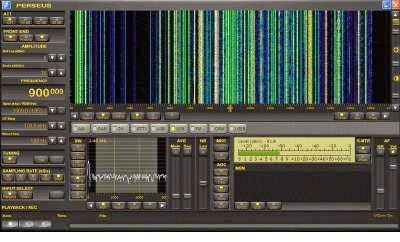
Here is my short log, all captured using Perseus:
06 21 0600 323 W4 Jenpeg, MB
06 21 0600 325 YJQ Bella Bella, BC
06 21 0500 326 DC Princeton, BC
06 21 0600 326 XJ Fort St. John, BC
06 21 0500 328 5J Coronation, AB
06 21 0600 328 LAC Fort Lewis, WA
06 21 0701 328 YTL Big Trout Lake, ON
06 22 0846 329 PJ Whitehorse, YT
06 21 0600 329 TAD Trinidad, CO
06 21 0600 329 X2 Athabasca, AB
06 21 0600 329 YEK Arviat, NU
06 21 0500 329 YHN Hornepayne, ON
06 21 0600 330 3G Peggo, BC
06 21 0600 332 LBH Portland, OR
06 23 1130 332 POA Pahoa, HI
06 21 0600 332 VT Buffalo Narrows, SK
06 21 0500 332 WC White Rock, BC
06 21 0500 332 XH Medicine Hat, AB
06 21 0700 332 XT Terrace, BC
06 21 0600 333 STI Mountain Home, ID
06 21 0600 334 P2 Wetaskiwin, AB
06 21 0700 334 YER Fort Severn, ON
Some might wonder why listening for NDB's would be of any interest. For me, there are a number of reasons:
- the challenge of hearing distant low-powered transmitters below the broadcast band, particularly from one region...for me it is Alaskan NDBs
- the necessity to develop an efficient receiving antenna has led to numerous antenna trials using loops and wires in various configurations
- learning about LF propagation and how it compares with HF
- the ability to compare what is being heard at my location with what is heard just a few hundred miles away can often be surprising (and humbling)
If you are planning a 630m station, listening for NDB's is a good way to test your system's receive capability as there are hundreds of signals to be heard, many of them very close to our new 472KHz band.
An informative Introduction To Beacon DXing by Alan Gale may be found here. To find the location of any NDB's that have been heard in North America, check the always accurate RNA database by Martin Francis.













