Posts Tagged ‘magicband’
 The ‘Snowman’ Pays A Summer Visit – VYØSNO That Is!
 August 2nd, 2014 |
  Author:
If it seems like I'm talking a lot these days about 6m, that's probably because it's my main operating interest during the summer sporadic-e (Es) season, which is already starting to wind down. In a couple of weeks it will all be over for another year, allowing me to focus on other radio activities.
But, should you plan to venture forth into the magicband's world, proceed with every caution....there are powerful forces at work there!
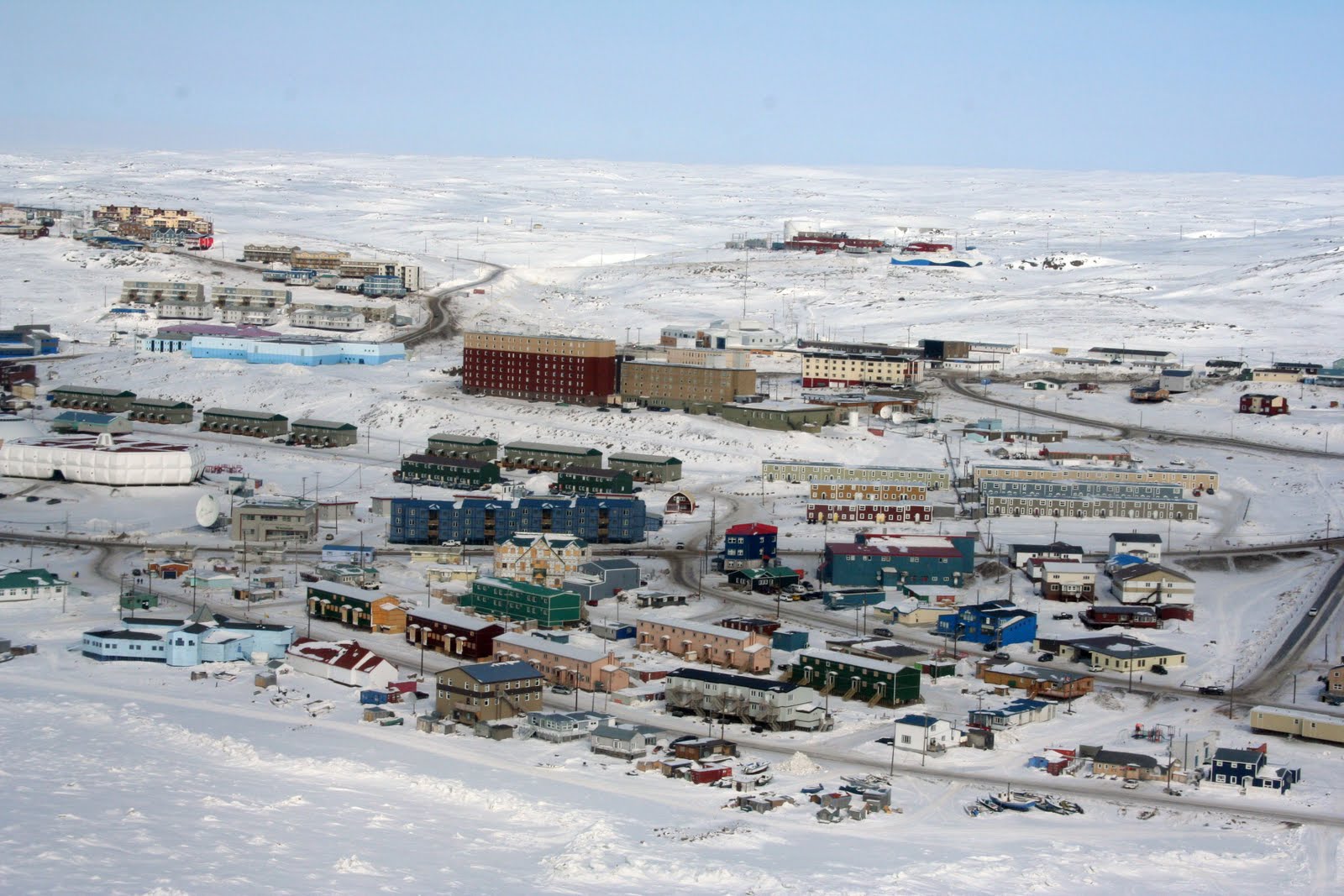
Before this week I had never heard the VYØSNO 25 watt 6m beacon. The 'snowman' is 2,250 miles away and located in the Canadian Arctic town of Iqaluit, Nunavut, the coldest city in Canada....talk about the ideal call!
 | |
| Courtesy: Google Maps |
The beacon has shown up briefly here, twice this week, with both events in the evening and lasting for only 10-15 minutes. Although there are no longer any active 6m hams in VYØ, it is still thrilling to hear these summertime signals from the Arctic....and in this case, directly in line with Europe and better than halfway there!
At one time the beacon had a different call, VE8BY, which I usually heard once or twice each summer. Since the change to a new transmitter and to a new call, for some reason it remained unheard for several seasons...until this week.
The old VE8BY beacon was unique in that its transmitter was frequency-shift-keyed (FSK mode). The dots and dashes were a few hertz higher than the actual carrier frequency. Hearing the melodious keying in combination with the typical Arctic flutter always made the arrival of VE8BY something very special as can be heard in this capture by Kevin, VE3EN....
Unfortunately, Larry (VYØHL), the owner and operator of VYØSNO/b, has moved from Iqaluit and will no longer be able to maintain or repair the beacon should it have a future break down. Hopefully it will continue to run reliably for many more years as E-season would just never be the same without a summer visit from the 'snowman'.
Russian TV…6m’s Little Helpers
 |
| London's Crystal Palace TV Tower |
Parked conveniently close to 6m, the 49MHz multi-kilowatt transmitters combined with large high antennas to pump lots of ERP over the pole. Surprisingly, there are yet a few holdouts of the analog era that are still available as propagation indicators, with most of them being located in western Russia and the middle-east. Far eastern Russia also has a number of the analog relics in Siberia and in the Vladivostok / Kamchatka regions, all of which which make great indicators for possible openings to Japan, China and Taiwan. During good openings to Japan, it is not unusual to hear several different signals all on the same frequency but with different fade rates and tone / sync characteristics. During the past few strong solar cycle peak years, spurs from these Russian transmitters could often be heard at S9 levels well into the 6m band!
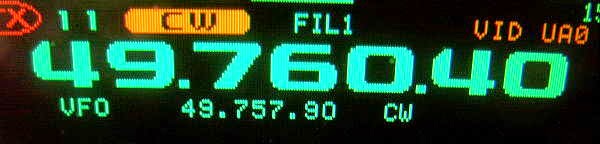
Although there are numerous others, from my own experience the best frequencies to monitor for both European and Asian transmitters have been:
- 49.750
- 49.757.8
- 49.760.4
During Sunday's VE6-Europe 6m opening, several of these signals were heard even though no Europeans were worked from the west coast. Video carriers on 49.750, 49.760 and 49.757 were heard for over an hour, peaking around 1800Z.
The two unique characteristics of these video markers has always been their rapid fade rate and their somewhat raspy video-sync pulses....both can be heard in this short video that I captured during Sunday morning's activity. The stronger 49.757 signal can be heard as well as the weaker 49.750 carrier, while the 49.760 signal has taken a deep fade. I suspect that the louder signal is coming from the Novosokolniki transmitter north of Moscow while the weaker ones may be further to the south. These locations are simply 'best guesses'.
This recording of eastern Russian video carriers, made by JM1SZY, provides a good idea of how these signals sound when they're much stronger. Note also, the number of different frequencies that the different transmitters are using.
It is very difficult to know exactly where the actual transmissions are coming from as there are dozens of transmitters assigned to the same frequency. Most signals do vary from their assigned frequency by measurable amounts and some avid DXers have tried to identify individual sites by accurate frequency measurements.
Since the digital switchover, interest in keeping track of the remaining signal data seems to be falling off and most frequency and location lists are now several years out of date. The most up-to-date lists can be found here on the GØCHE Website and on JB's DX Info site in Germany.
If you're anywhere east of the Great Lakes then you'll hear the European videos a lot more often than they are heard out west but it still astounds me that several times each summer, I am able to hear TV signals from Europe over the North Pole!
6m Polar Madness
In the wee hours of Wednesday morning, July 09, KL7KY (Kevin) had a massive over-the-pole European opening beginning about 1000Z. He worked at least six stations in Greece and a number of others in western Europe. One wonders how often this 'middle-of-the-night' path might actually be open as most west coast ops are sound asleep at this hour.
Looking at the path on DX Atlas shows an almost all-daylight path from VE7 to Europe, but for the first short hop out of the summer twilight.
Hoping to cash-in on any lingering Es, I ventured out to the shack last night at 1030Z (0330 local) to have a listen over-the-pole...knowing that the first hop into the daylight regions would be needed. Much to my surprise, this is what I first heard when turning the antenna north.
I was soon joined by John, VE7DAY, and we both began to CQ towards the sunlight after alerting several of the European operators via the ON4KST chat page. No 49MHz eastern Europe video signals were heard at all but this is often not a deal breaker. One beacon that always seems to be present when hearing Europe, the VA5MG/b in central Saskatchewan, was not heard either. After 90 minutes of no other indicators I headed back to bed.
In view of the high levels of summer Es in the sunlight-bathed Arctic / northern Canada regions, this crazy night time path might be worth exploring more closely during the last week of June and the first week of July. In view of the ungodly hour however, I fear that it may be some time before 6m reveals more of her secrets.
Looking at the path on DX Atlas shows an almost all-daylight path from VE7 to Europe, but for the first short hop out of the summer twilight.
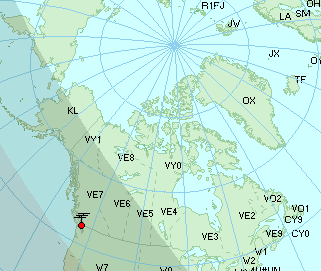 |
| VE7 - EU at 1100Z |
I was soon joined by John, VE7DAY, and we both began to CQ towards the sunlight after alerting several of the European operators via the ON4KST chat page. No 49MHz eastern Europe video signals were heard at all but this is often not a deal breaker. One beacon that always seems to be present when hearing Europe, the VA5MG/b in central Saskatchewan, was not heard either. After 90 minutes of no other indicators I headed back to bed.
In view of the high levels of summer Es in the sunlight-bathed Arctic / northern Canada regions, this crazy night time path might be worth exploring more closely during the last week of June and the first week of July. In view of the ungodly hour however, I fear that it may be some time before 6m reveals more of her secrets.
Wireless Headphone Hell
 For the past several years I have been aware of a very loud wideband FM signal just below the 6m band....about 49.8 MHz. Any time I listened to it, it seemed to be rebroadcasting TV audio so I assumed that it was a set of wireless headphones somewhere in the neighbourhood. I was thankful that it did not cause any problems to my 6m reception, being far enough down the band.
 About two weeks ago, during my normal early-morning band check, I noticed that the FM signal had suddenly shifted much higher and was now approaching the bottom edge of 6m. As the day got longer and the temperature climbed, so did the FM signal! Soon it was inside the band, but right at the bottom end. Within two days, its morning 'start' frequency climbed higher and higher and eventually the signal lodged itself smack dab into the working portion of the band, centering itself at around 50.090, depending on the temperature. Being such a wideband signal, it effectively wiped-out 6m operation for me when its wide raspy carrier was modulated....which was most of the time. Thankfully it would usually be just below the beacon portion of the band until the morning 'European window' time had past.
Two days ago I decided that it was not drifting any higher and had happily entrenched itself on 50.090. It needed to be eliminated.
Two days ago I decided that it was not drifting any higher and had happily entrenched itself on 50.090. It needed to be eliminated.
I constructed a 6m dipole (106") from some scrap aluminum tubing and dug out my Icom IC-R20 handheld scanner.
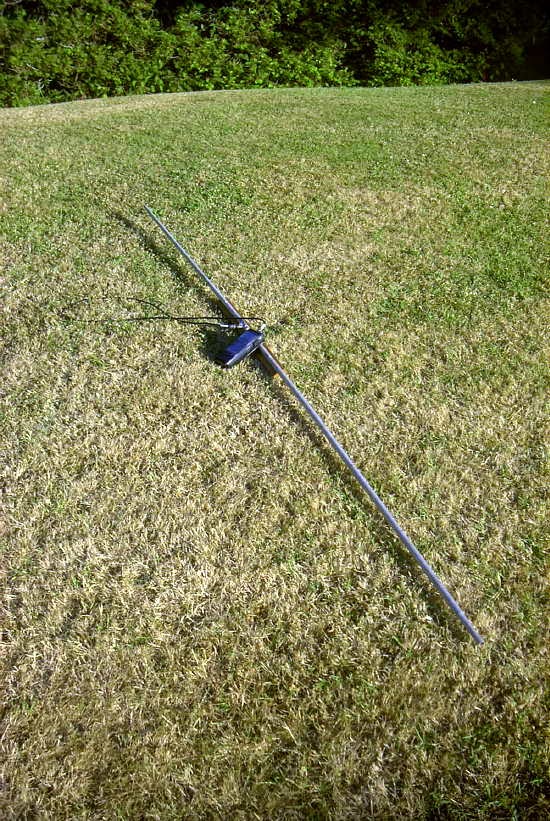
The next day I set about walking around the neighbourhood, taking bearings at various locations, as the signal was easily heard with the dipole. I had earlier determined the rough direction of the signal using my main 6m antenna, a 4 element homebrew Yagi at 55'.
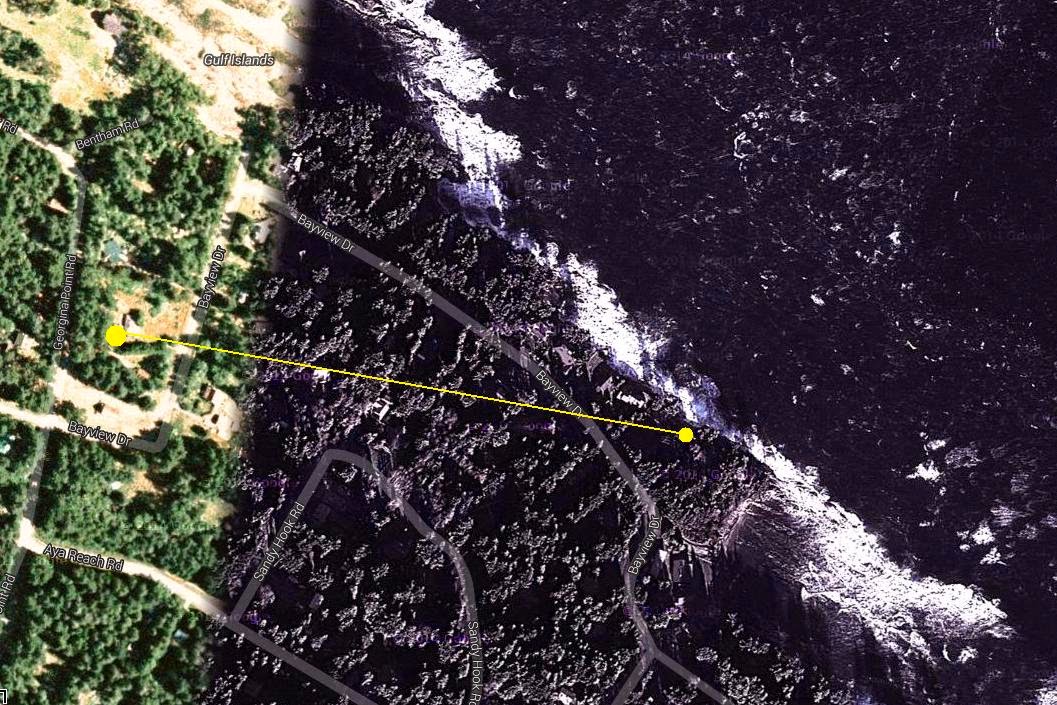 |
| Courtesy: Google Maps |
The band is wonderfully peaceful once again (except when the power lines start arcing at about noon) and within minutes of the headphone system shut down I was able to work a loud BV2DQ in Taiwan and several JA's, shortly before dinner time.
These amazing early July conditions continue on the magicband.
Great 6m Es Conditions Continue!
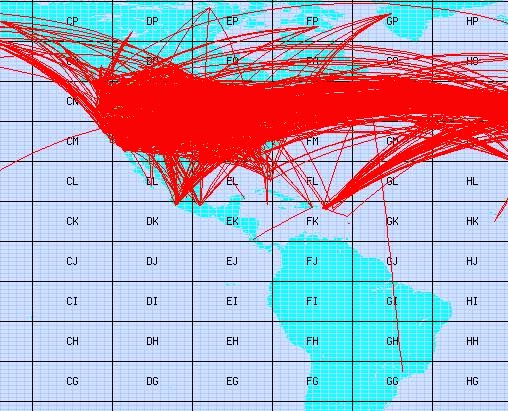 |
| 6m July 08 Courtesy: ON4KST.org |
Six meter operators in the western part of the continent exchanged signals with Japan, Taiwan, China and South Korea beginning at around sunset on the west coast and continuing until 0230 the next morning! Many stations on both ends of the path filled their logs during the heyday event.
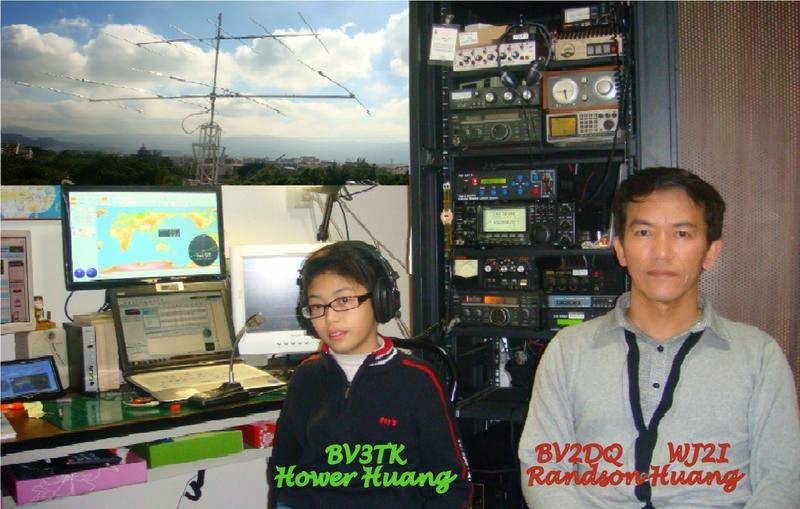
To add to the fun, BV2DQ (Ran) in Taiwan, was also active and gave several 6m ops a new country, working as far east as Colorado.
 |
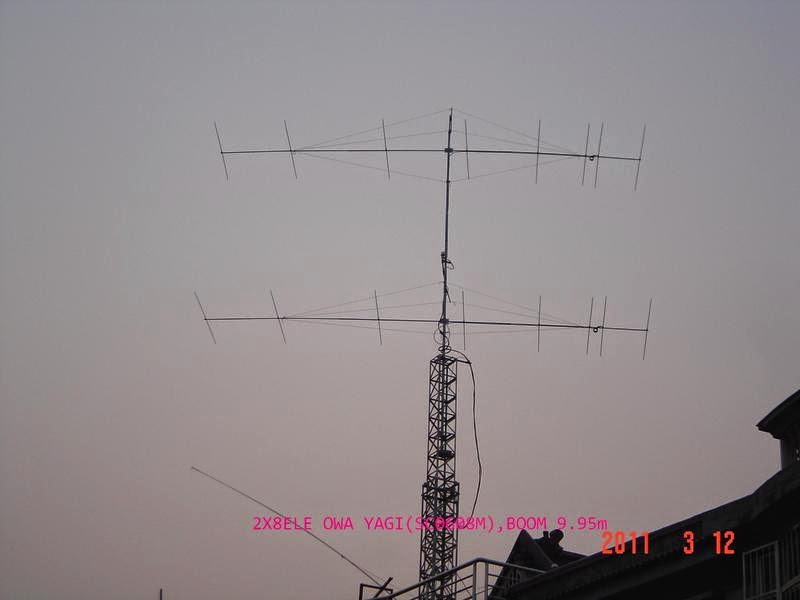 |
| BA4SI 6m stacked Yagis |
" W7FI Jim - That blows away my 113 JA last night, pile still calling when I qrt'd at 0800z. "
I was also present for the action, but worked only a few dozen of the strongest signals as I have been plagued with exceptionally high power line noise this summer, directly in line with Asia. Additionally, a new source of QRM has cropped-up in the form of an S9+ 49MHz wireless headset that has drifted up into the band. As the days get warmer, it has now drifted from below 50MHz up into the working part of the band and last night had settled itself smack on 50.090. Being a wide band FM signal, it effectively destroys any reception for about 50KHz of the band. As Murphy would have it, the crud is coming from the exact same direction as my beam heading to Asia. Yesterday I was able to roughly determine its location with a handheld Icom scanner and today I will use a quickly-built 6m dipole to zero-in on the offending source. Hopefully I can eliminate the problem soon.
West Coast Day For 6m
 |
| Courtesy DXMAPS.COM |
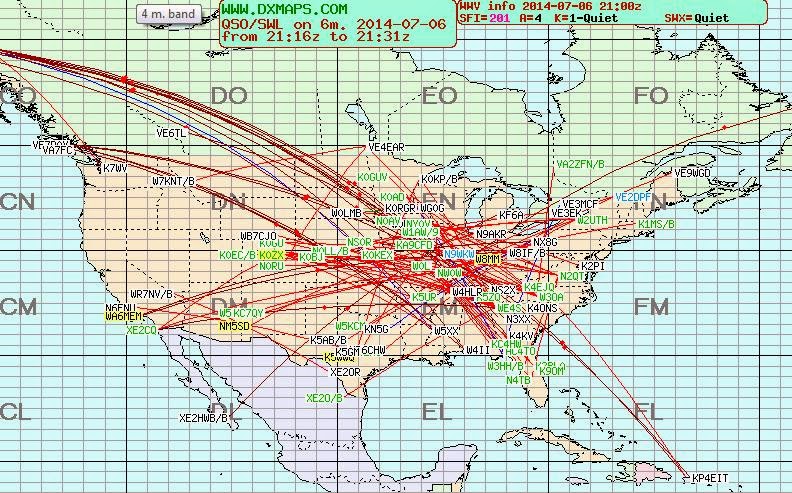
At 0700 I began to hear bits and pieces of CN8KD in Morocco while he was working 4's and 5's ...every once in a while his CQ's would briefly rise out of the noise but never long enough or loud enough for me to reply. He eventually faded and the band shifted to a more northerly path and at around 0900 local time, EA8DBM (Canary Islands, AF) showed up on SSB, while working into the SE U.S.A. He was much louder further to the south but at 1632z I was able to work him on phone and a few minutes later on CW, down the band. In over 40 years of being on 6m, this was only my second African QSO, with my other one also being into EA8.
The best part of the opening today was the number of west coast stations that were able to put rare Africa into the log....and, for a number of them, it was the completion of WAC on 50MHz....very tough from the left coast. VE7DAY, K7SS and NA6XX will all be celebrating today!
As I post this at 2130z, the KL7's are cashing-in on the magic while working across the U.S. as far south as Florida! I've always thought the first week of July to be the best of the season for 6m...lets hope it keeps going.
Cycle 24 Still Crackling
 |
| The Sun Today / July 03 Courtesy: nasa.gov |
 |
| Cycle 24 Prediction (courtesy: nasa.gov) |
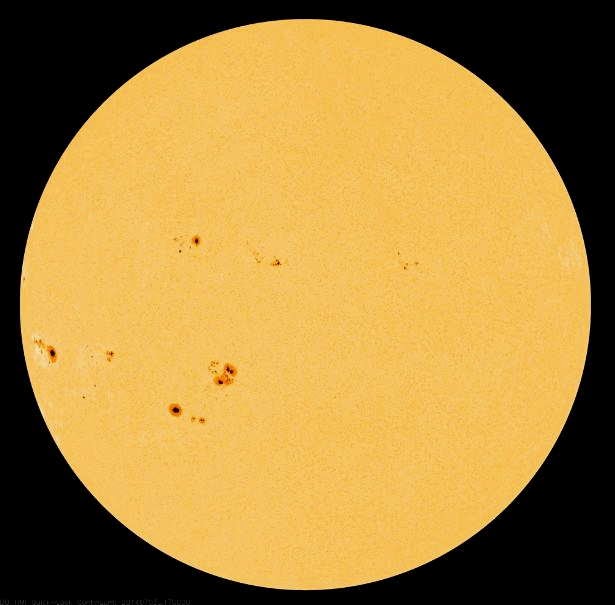
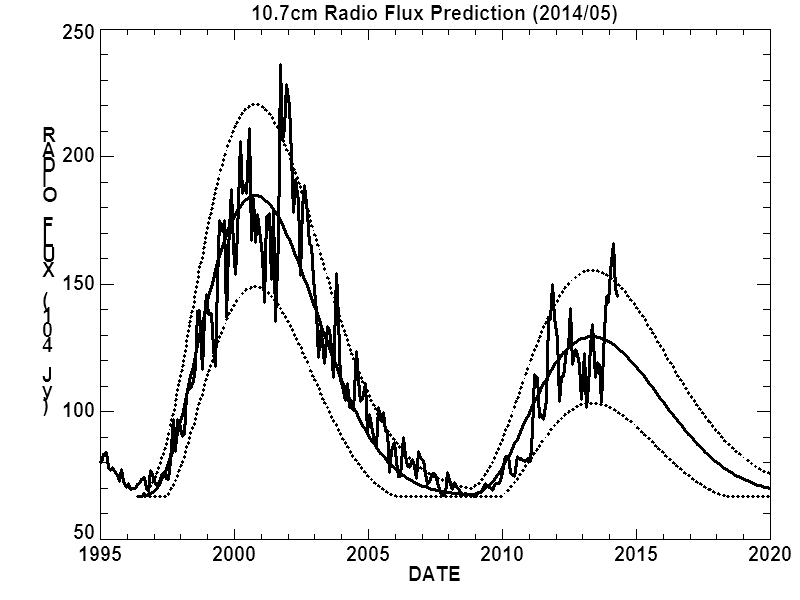
The present rotation has brought a number of active sunspot groups into view along with several small solar flares. The elevated solar flux has had an immediate effect on propagation, producing excellent F2 conditions on the higher bands. Today's solar flux is pushing 170 and on the rise! It makes one wonder what other strange tricks Cycle 24 might have up her sleeve for us yet?
Active flaring during the summer 50MHz sporadic-e season can often produce some odd long-haul paths along with the possibility of some transcontinental auroral-e propagation....so hold on, as it looks like the ride is not yet over!