Posts Tagged ‘kits’
 QRP kits retirement plan
 December 20th, 2010 |
  Author:
 Quite frankly I can’t think of anything worse than choosing QRP Kits to ‘lay down’ as an investment, rather than build. Mind you it doesn’t look like they need to be put in the cellar for very long!
Long distance QSO with the Warbler

Screenshot of Warbler contact to Alabama
Last night I used the Warbler I finished a few months ago and had a very nice 40 minute QSO on 80m with Ken, KI3N, in Oxford Alabama. First, it great that conditions were good enough for us to chat for 40 minutes using PSK31, but when you consider that the distance between us was about 970 miles then that made it quite an achievement given the band. I was using the Warbler, putting out 3W now after some slight changes, and the 88ft doublet tuned with the homebrew ATU. Ken was using 40W from an Icom IC-756 Pro into an 80m dipole. The screenshot above shows what I was receiving.
Even though the Warbler is rockbound and uses a direct conversion receiver its performance is very good and makes it fun to use. This was the furthest contact I have made so far with that transceiver.


Switched capacitive audio filter projects
 With W1AW practically in my back yard, I get to play with some expensive toys. I volunteer there from time to time….. and really get to play with some toys! One thing I’ve learned (and try to teach new hams in my classes) is….. spend more time listening than transmitting!
So, on all my non homebrewed rigs, I have spent tons of time learning how to use, or installing filters and figuring out not only how they work, but how they truly help me on the air. Software defined radio has also shown me some really neat things that can be done just playing with bandwidth and CW (especially trying to work a DXpedition!).
To that end, I finally got to play with a few switched capacitive audio filters that really had me thinking, why do I not have one!
Today I’m going to show you a few projects that can get you going. First, the image on the right is from the NEQRP Club and their NESCAF project. The theory of operation, I’ll quote from their website: http://newenglandqrp.org/nescaf
The integrated circuit at the heart of the NESCaf is made up of two CMOS active filters. These filters are extremely configurable (low pass, band pass, notch etc).
We have chosen to set up both filters as Butterworth band pass filters and to cascade the filters. Butterworth filters have the characteristic of constant amplitude in the band pass region, while the cutoff knee is not be as sharp as if the filter were configured as a Chebychev. We considered this an acceptable tradeoff, wanting constant volume out regardless of the bandwidth or center frequency setting of the filter.
There are two on-board trimmer pots. One is used to “calibrate” the center frequency pot. This allows you to adjust the frequency at which the center detent occurs. If you are using a rig with a transmit offset and sidetone of say, 700 Hz, you can use this trimmer to make that the center-detent frequency. The other on-board trimmer adjusts the audio level into the filters output amp. Using this pot, you can set the overall gain of the filter. This can be used to set the filter for unity gain, if desired. This way, the filter could be switched in and out, and still maintain a comparable volume level in the headphones.
Pretty neat! This is a relatively simple kit that the club has been offering for quite awhile. Out of stock now, but will be available again soon and priced really inexpensively – under $35.00. If you want, all the information is available int he schematic and documentation if you want to “roll your own”.
There are some commercial offerings as well, many we have seen advertised like the one from Idiom Press (http://www.idiompress.com/scaf-1.html). This one works VERY well, and comes as a complete kit with an enclosure. There is some good information on the Idiom Press site that shows the response curve as well as why the filter doesn’t use DSP. This kit is a bit more, but has an extremely high quality/professional looking enclosure and sells for $89.95. I can’t afford one now, but when I can, I plan to build one and post details here with audio files (there is an audio file that can be played on their website to demonstrate the audio characteristics).
Here is a great video of NG9D’s build of the SCAF-1:
But, I don’t want to make this just a CW project…… how about AM?
Stewart (“Stu”) Personick, AB2EZ is a ham that wanted to work a bit on his transmitted and received audio. He took the SCAF-1 and modified it in true ham spirit. From his online writeup of the project:
My original objective was to demonstrate, to the AM community, the use of a switched capacitor filter for “brick-wall” bandlimiting of the output of an AM audio chain… in order to limit the bandwidth of the r.f. output signal produced by a vintage high-level-modulated vacuum tube transmitter, or a modern FET-based “Class E” transmitter.
What’s really neat, is this is a relatively easy mod to build in and expand the already excellent capabilities of a great kit/filter! You can find full details of this modification at: http://mysite.verizon.net/sdp2/id14.html I think the Idiom Press site has copied this info on their site as well.
 A little more research on the topic led me to “An Adjustable Audio Filter System for the Receiver” by Lloyd Butler VK5BR (Originally Published in Amateur Radio, March 1995).
This is also a “roll your own” project, but gives some detail on the use of the filter in CW, RTTY, voice and other narrow bands. This article was originally published 15 years ago and is still VERY relevant today.
I took a look at the schematic and it’s not entirely too difficult to build this in an evening or two and looks like a very useful and educational shack accessory.
You can find the article and schematic at: http://www.qsl.net/vk5br/SwCapFilter.htm
Hopefully this will whet your appetite and make you want to fire up your soldering iron and build a useful filter for your operating needs. I know after using a few of these filters I’m left to wonder, “how did I NOT learn about switched capacitive audio filters!”.
KN-Q10 SSB/CW 5W kit – US$280
Recently there was an interesting discussion here on vk2rh.com about some of the barriers to a wider takeup of the new wave of Chinese QRP or DIY ham radio kitset activity. One of the hurdles of course is language and the current lack of an English language user base to grow and deliver email support for kit builders.
Overnight Adam, BD6CR has made available an English translation of the construction manual for the KN-Q10 QRP kit designed by Ke Shi BA6BF. The KN-Q10 is a four band (3.5, 7, 14 & 21MHz) 5W SSB/CW transceiver kit.

The KN-Q10 4 band SSB/CW QRP kit designed by Ke Shi BA6BF
Adam has also revived the Yahoo group China_QRP -
“I have made a decision to turn this yahoo group into a forum to support overseas Chinese kit builders and merchants. We will see more overseas kit builders and merchants joining.”
John AE5X posted a report about the manual translation earlier today. He also included a link to a discussion thread about the kit on the Chinese language HelloCQ forum. The photos here are sourced from the designer Ke Shi, BA6BF’s own postings and give some sense of the finish and quality of the project. There’s a large number of photos of the Q10 under construction on the thread.

A view of the BA6BF designed KN-Q10
John AE5X noticed the current lack of a schematic & parts placement diagrams and an operating manual for the kit even though this appears to be referenced in the translation. Certainly this version of the manual doesn’t offer the comprehensive ‘hand-holding’ guidance Elecraft, SWLabs or Softrock kit builders are used to. John sees no inherent problem with this – as long as prospective buyers are aware. I see this manual translation as an important first step towards opening up this exciting DIY/QRP activity to a wider audience.
Today on the China QRP Yahoogroup Adam has explained that he is selling the KN-Q10 kit for US$280 which includes air parcel delivery anywhere worldwide and that he accepts PayPal. If you’re keen to buy, it might be best to contact Adam via the Yahoogroup to identify the appropriate email address for that.
UPDATE 15 October: Adam BD6CR has already posted an updated version of the manual and it now also includes photos and links to the schematic diagram of the KN-Q10 and a Chinese language document with photos illustrating the modification to the encoder.

One of the photos from the currently Chinese language KN-Q10 encoder modification guide
Ham kits business models
Recent posts on this blog mentioning the Chinese DIY scene and the explosion of offerings have prompted a very interesting exchange of views and reflections on how best to nurture this business and make it accessible to the global ham market.
Most recently Sivan Toledo has posted thoughtful comments drawing possible inspiration for the emergent Chinese DIY industry from successful amateur kit operations like Tony Parks’ Softrock. And the secret appears to be finding the right balance between the great product and crowdsourcing the support and handholding that is as much part of the product and building experience as the device itself.
Elecraft clearly enjoy the best in solid detailed step-by-step documentation (reminiscent of Heathkit) and they have the added advantage of an amazing online community dedicated to solving any problems, assisted by the designers and principals of the company. Part of the success of their online presence is a well moderated space and volunteer heroes like Don Wilhelm W3FPR who don’t appear to need sleep!
Doug Hendricks’ QRP Kits shows you can fill a niche and still keep your day job. While many of Doug’s star attractions are designed by Steve Weber KD1JV, Steve has his own website which I visit frequently to see whether a new batch of ATS-4 Miniature 5 band CW / digital mode HF transceivers are available or not, knowing they’ll probably sell out in a matter of hours. Users of this and its predecessors rave about them. Steve WG0AT took an ATS3 on his latest adventure with Rooster and Peanut.
Dave Benson, K1SWL’s Small Wonder Labs also offers quality kits at really good prices and a very efficient service. (My SW-40+ arrived in Sydney in record time.) Hunt around his site for a minute and you’ll discover how how the SWLabs fit into his lifestyle on 4+ acres near Newport “(we get a lot of winter here)” NH.
K1SWL’s approach to support includes email – “If you run into trouble during alignment and test, I’ll guide you through the troubleshoot process as far as we can get by e-mail. If that doesn’t do the trick, my repair person offers prompt and reasonably-priced service- he’ll troubleshoot and repair the unit and let you know what he found.” And you have a fair sense of what Dave means by ‘reasonable’.
It’s not unlike the successful formula for a restaurant or café – to offer the number of dishes it can do consistently well rather than attempt to cater to everyone’s tastes.
Tony Parks KB9YIG seems to have achieved production numbers of SoftRock kits that would appeal to any business backer, even if they are only made available in batches of 20 or so depending on availability of components and time. The very reasonable prices charged – including international shipping – play a part in this success by attracting a broad base of committed supporters keen to share experiences and grow the platform and everyone’s skills.
And today I noticed Julian G4ILO wrote about a range of kits from Fox Delta Amateur Radio Projects and Kits in India. They have the advantage over Chinese offerings of the English language and they accept PayPal. The range of kits on offer is impressive. Julian had ordered a APRS Tracker Module.
And of course Australia has its own GenesisRadio with its amazing line of SDR Kits such as the G59.
What an amazingly exciting time to be involved in ham radio!
Speaking of global reach, a prominent link currently on eHam.net has helped boost traffic to this site as well! (Welcome to all new visitors to the blog! I hope you find something interesting here.)
The completed Warbler

Finished Warbler in box
A few weeks ago I finished the box to mount the Warbler. The connectors are all soldered directly to the pcb board so the alignment of holes had to be done carefully. When doing such layout and drilling I am always grateful of the ‘O’level in metalwork that I finished back in high school thirty years ago now. (As a sidenote I am currently reading ‘Shop Class as Soulcraft’ by Matthew Crawford which covers the recent decline of school shop classes).
The box is aluminium (showing my British origin with the spelling) and made by Hammond. To give it a nice finish I spray painted it with a couple of coats of Rustoleum Universal hammered spray paint and it came out rather well.

The painted surface showing the 'hammered' finish.
The box size is 4.5″×3.5″ so it makes quite a nice compact unit.
I need to look at the final output power of my Warbler as I think it is a little low, but it is performing well and I have made 80m PSK31 contacts out in Wisconsin, Illinois and North Carolina. As previously reported I have also used the Warbler for an Olivia contact. A great kit and I am looking forward to using it over the Winter when 80m conditions should be better than they are now. Unfortunately, it looks like Small Wonder Labs have dropped it from their current product line.


First Podcast – A conversation with Youkits
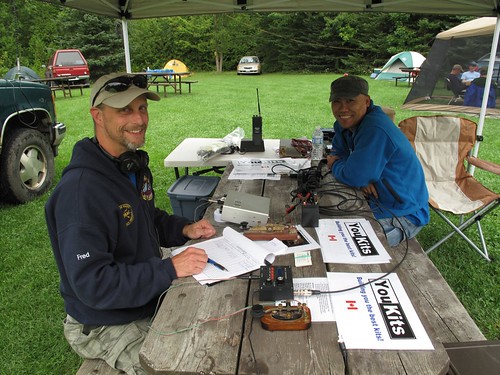
Fred and Yimin of Youkits
When I attended Maplecon I recorded at conversation I had with Yimin and Fred, VE3FAL, of Youkits. I have turned that recording into the first VA3STL podcast. I am making it only available here for the time being. If I make any more audio podcasts I will think about putting them on iTunes. Please click on the link that follows.
VA3STL Podcast#1 Conversation with Youkits
As the podcast is something new to me and an experiment, I would appreciate any feedback via a comment, or direct e-mail.
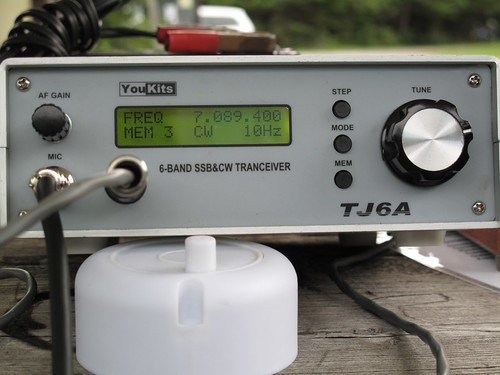
Youkits TJ6A transceiver















