Posts Tagged ‘ham radio’
 That downward “ham radio” trend line
 October 17th, 2012 |
  Author:
 There’s an interesting discussion ongoing on some of the amateur radio blogs (including this one) about how an analysis of the number of searches in Google using the term “ham radio” is trending. No doubt about it, if you simply look at the graph, it shows the hobby I love so much–and that I fully credit for getting me into a career in media–is trending more and more southward:
This could mean a number of things:
— People are getting their info about ham radio in other ways besides searching for that specific term on Google.
— They are searching for info on the hobby using other keywords, such as “amateur radio.”
— Nowadays, people search initially for information on a subject and then, if they find what they seek, they bookmark it/make it a favorite and don’t search anymore on Google.
— As we have gotten more sophisticated in how we use the search engines–often merely using the address bar in our browsers to type in odd terms that more closely match what we are seeking–the big, all-inclusive search terms are not used so often.
— Interest really is declining.
You know what my heart tells me. Licensing backs me up in that belief. We have more licensed amateurs in the country now than ever before in the 100-year history of the hobby. My sense is that the hobby is vibrant and growing, and, before you slap on me me that “rose-colored glasses” brand, be aware that I am pretty good at looking at things such as reliable research data realistically.
On the other hand, I still believe it behooves those of us active in the hobby, those who want to see it continue to grow, expand, and become even more exciting and diverse, to be evangelistic about it. We have to do what we can to recruit potential hams into our little “cult of the airwaves.”
That was one reason I wrote the book RIDING THE SHORTWAVES: EXPLORING THE MAGIC OF AMATEUR RADIO. I want people to understand that the hobby can be much more than sitting in a basement sending Morse code or trying futilely to hit repeaters with a handheld and a rubber-ducky antenna. As with most technology, our avocation has dramatically changed, and for the better. It offers so much to younger people who have grown up with cable, satellites, computers, and smart phones. True, those folks might think amateur radio is still what their weird uncle used to do in his back room with all that spittin’ and sparkin’ radio junk. We need to make them more aware of what the hobby is these days. And make sure they know that it absolutely can lead to a career in a technical field, including computers, communications, engineering, meteorology, media and more.
We won’t panic about that trend line. We will continue to do what we should be able to do best: COMMUNICATE!
Don Keith N4KC
www.n4kc.com
www.donkeith.com
Interesting opening on 10 meters

Magnum 257 (Radio Shack HTX-10)
I was sitting in the living room Saturday morning, turned my Magnum-257 10 meter rig on, and spun the dial to see if there was any activity. To my surprise, there was. Now, this is the older version of the 257, which makes it basically a RS HTX-10. 25 Watts on USB, and minimal features. Connected to the Magnum is a very simple wire antenna, thrown into a tree close to the apartment, and a counterpoise out on the roof. I heard IK6CWQ calling from Italy. I picked up the mic, and responded, not expecting to be heard, and was surprised when he acknowledged. Not bad for this meatball setup I have. I tried another Italian station I heard calling, but at that point news of the opening caused a bit of a pileup, which I just couldn’t dig my way through with the Magnum. Still, I was pleased with the one contact. The opening dropped out pretty soon after that.
My first HF contact ever was on that radio. Back in January, when I first bought it, I drove to the South Shore here on Long Island and parked near the ocean. Using the Magnum with a modified 11 meter whip, my first contact was with France, followed by a 10 minute rag-chew with a ham in New Mexico. I wish every other new ham such good luck! Since that day, I have made 30 additional contacts on that rig. Usually from near the highest point on Long Island (a whopping 400 feet AMSL!), or near the ocean. I’m definitely keeping the Magnum. No matter what else I invest in, it has sentimental value now.
OK, OK! I Will Write that Ham Radio Book!
Ever since I began writing articles about my hobby of choice–amateur or “ham” radio–for my ham radio web site and several others, people have been asking me when I was going to do an amateur radio book. The truth is, I have just been too darn busy to even think of such a thing. And I also knew, in my heart of hearts, that it be would difficult indeed to get any kind of decent book contract for such a niche book. I presented my idea of a half-fiction/half-nonfiction book to the ARRL and they passed, so that confirmed my feelings. If they had no interest, I doubted anyone else who published books would either.
Fast-forward to July 2012. Things have changed, both in my personal life and in the wild and woolly world of big-time book publishing.
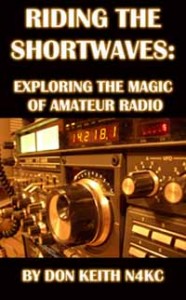
Don Keith N4KC has just published his new book of short stories, articles, advice, and more about ham radio.
First, I retired from my 60-hour-a-week day job back in May. And as I shuffled through the articles I had in the can, several more I was working on, and a few still in my head, I realized I was closer to a book than I had thought. And I truly believed I had something that would be different and could find a readership.
Secondly, as I investigated Kindle Direct Publishing at Amazon.com for the re-issue of a couple of my previous now-out-of-print books, I realized that I should absolutely pull the ham radio book together for that outlet–Kindle and some other e-book readers–at least. Amazon has become a real threat to traditional publishing companies–especially when it comes to e-books–as the old-line publishing houses struggle to figure this newfangled thing out. At the very least, it gives me the opportunity to make my book available at a very reasonable price to those interested in amateur radio. No, I don’t make much money at the price I set, even if I actually sell some downloads of the book, but that is not really the object anyway. As I have said many times, and not totally facetiously, if I wanted to make a fortune writing books, I would write pornography (See FIFTY SHADES OF GREY).
Then, as I considered other options, I realized that Amazon offers a truly unique opportunity for works like this one that allows me to offer the book in a traditional paperback format with minimal investment up front. Remember, I’m retired, on a fixed income these days! Amazon’s is a print-on-demand deal, but they seem to have it down to a science. I ordered some copies as soon as I got the book and cover uploaded and accepted for publication. The very next day I got the email that they were being shipped that day. Wow!
Again, this was with very little upfront cost and minimal hassle. Now, the paperback will be available not only via Amazon.com, but through major distributors, for order by libraries, and even in many European markets. We will see how good the print job is, but believe me on this: the major houses don’t necessarily produce the highest quality book any more either. They have to cut where they can to make a profit and printing, binding, and warehousing is a big drain on them.
Talk about rapid technological change and its effect on society and the media! Broadcast radio, TV, the Internet and telephone communications are not the only things evolving at a dizzying pace. Include the anachronistic business of book publishing in that mix, too!
Realistically, will tons of booksellers and all the Barnes & Noble stores order a box full of the books each? Or will hundreds of thousands of libraries order up a couple dozen copies each? Of course not. The big publishers do have sales staff to encourage that sort of thing. But a) no big publishing house was going to do a contract for RIDING THE SHORTWAVES: EXPLORING THE MAGIC OF AMATEUR RADIO and b) even if they did, it would be somewhere near the bottom of the sales staff’s sample case, so c) Amazon’s various self-publishing options are perfect for this kind of book.
By the way, if you have any interest in the dynamic and rapidly growing hobby of ham radio–believe me, it ain’t your weird uncle’s past-time any more!–then you may want to stop by Amazon.com and take a look “Inside the Book,” read the description, and maybe buy a copy or two…for yourself or someone you know and want to spark the interest in our amazing hobby.
See, right there in that last sentence, I did more publicity for RIDING THE SHORTWAVES than the big publishers do for most of the books they print up and ship out!
73,
Don Keith N4KC
www.donkeith.com www.n4kc.com
Bunny box woes
I belong to a small group of transmitter hunters here on Long Island. My Elmer originally got me involved by having me navigate for him, and as I learned the technique, I graduated to running my own vehicle along with my better half, KD2CHE. The last few hunts, she has been driving while I watch the signal strength and maps.
Most of the hunters use doppler equipment, from various vendors. Jill and I have had great luck just using our maps, and a good assortment of receivers. We watch the signal strength on my best receiver, a Kenwood TR-9000, and then keep two HTs set to different levels of sensitivity. I hang the HTs in locations so that I can hear them come on. One with no antenna at all, and the other with a mismatched stubby antenna. This combination has gotten us to the bunny box before many of the doppler-equipped cars.
Friday night we had a hunt. The box was to be hidden within 3.5 miles from the Republic Airport in Farmingdale, NY. The box itself is managed by my Elmer, WA2CDL. It’s an old Radio Shack HTX-202, controlled by a custom PIC controller, powered by an external rechargeable battery, all contained in a surplus ammo box. We set out in our new Kia Soul, with me in the back seat. I folded half the back seat so as to have a kind of desk next to me. There I had the TR-9000 and a Dell laptop with the RTL-SDR setup, and Google Maps. Internet was provided by a hotspot on my T-Mobile HD7. We waited.
Unfortunately no one could hear the transmitter. It was mentioned that it might be operating on low power, since it had not been charged. So we drove around till we heard it. Each time it transmitted (30 seconds on, 30 seconds off), we would get a signal, and as we drove in the direction I though it would be in, the signal got weaker. As I plotted all of the vectors around the area where we heard the signal, it seemed that it was simply nowhere. Every time we chased the signal, it got weaker.
Eventually we were given a hint, and once found, I have to admire the location (about 15 feet off of a trail, in a nature preserve, up in a tree). Only some of the doppler-equipped cars were able to locate the box. As it turned out, my eternally fading signal was caused by the low battery. WA2CDL did some measuring after the hunt and told me that it was starting out transmitting just over a Watt, and finishing the 30 second transmission with about 250 Milliwatts. That explained why we always seemed to be heading away from it.
In practical use, what does this mean? If we were trying to find a lost hiker, for example, who had a radio with a dying battery, we would need to take the fading signal into account. I think if I had known that the signal was fading out each time we heard it due to the battery running low, I would have altered my technique. I think if we had simply moved at one minute intervals and marked the signal strength at each location just for the beginning of the transmission, I would have been able to plot the location. I guess I need to ask what the charge on the bunny box battery is in advance next time, or stay put for a couple of transmissions, and see if the signal fades.
How did the RTL-SDR do? Well, if we had steady signal, or if I had known to compensate, it would have been fantastic. I could see the signal before we could hear it, and signal strength was more visual. The battery quit before the end of the hunt though, because of the difficulty in finding the box. I hope to try it again.
Where did I find those other 60 hours a week?
So I finally pulled the plug on the day job six weeks ago. For the first time since I was 18 years old, I don’t have a regular pay check coming in. Unless you count that Social Security thing, which is hardly enough to call a “paycheck.” I had big plans for all the new spare time I was going to have in retirement, including actually getting on the air more, seeking out long, rambling ragchews, working more PSK31 and RTTY, doing some QRP, maybe even building a kit or two and trying out an antenna idea I’ve been contemplating. Contemplating for a dozen years.
Truth is, I only retired from one of my several jobs. For some reason, I quit the only one that actually paid me a regular wage, which automatically brings my sanity into question. But like a gas occupying a vacuum, the other things I do quickly expanded to take up all my available time, including what the day job once took. I have no idea how I was able to work those sixty hours a week at the old vocation!
Some of you may be aware that I am a writer, too, and just published my 24th book. I’ve also finally gotten around to putting one of my novels–my second book, published way back in 1997–up on Amazon.com as an eBook. (I hope it finds a bigger audience this time because it is near to my heart, the story of a young man who falls in love with the magic of radio, goes on to a career in broadcasting as a deejay, and eventually his best friend, who just happens to be a ham, saves his bacon…using a trick many of you will recognize. It’s titled WIZARD OF THE WIND and, yes, there is a lot of me in that story!)
I’m also finishing up an amateur radio book, one that has been in the works for a while, too. It will include some of the articles and short stories I’ve put up on eHam.net and more. I want it to not only entice those who develop an interest in ham radio to go ahead and take the plunge but to also encourage those already in the hobby to explore other aspects and become true evangelists for it.
When I was writing WIZARD OF THE WIND, I actually took a weekend job at an oldies radio station for a year, working a weekend deejay shift, just to get that old feeling back. It really helped me put it into words as I worked on the novel. Maybe now is the time that I should be getting on the ham bands more, broadening my own horizons so I can capture the magic of the hobby as I work on the new book.
I think I just talked myself into getting off this blog and seeing what the DX clusters are saying. Or watching the waterfall for a bit on 20M PSK31. Time’s wasting!
Don Keith N4KC
(A blog about rapid technological change and its
effect on society, media, and ham radio)
Is the Baofeng UV-3R Mark II really modifiable to 220 Mhz?
The answer is yes, and no. Using the software utility available here you can stretch the coverage of your UV-3R Mark II. This

UV-3R Mark II
only works on the Mark II (dual watch display) and the new Plus model. There are two options for changing the coverage. You can stretch up from VHF or down from UHF. Only the UHF option seems to work. Now, before you run off and do this, let me pass a few warnings. First of all, the UV-3R is NOT designed to do this, so transmitting at full power on a band your radio was not designed to work on has the potential to fry something. Second of all, most users have put the output power between 1 and 16 milliwatts (yes, milli), and my tests concur with this. It does receive OK on 220, but not as well as it does on 2M or 440. The procedure can be a little complicated, but there is plenty of help at the UV-3R Yahoo Group.
So, does it really work? During my morning commute, my train passes south of my club’s main repeater site. Now this is on a rather high building, in one of the highest points on western Long Island, and is pretty much line-of-site for a 4-5 mile stretch of my train ride. I tested to see if I could key up our 220 machine, and it seems that the effective range was about 4 miles this morning. Now that was just keying the repeater up. I’ll have to check to see if I can actually be HEARD on it. For listening to the 2 or 3 220 repeaters near my office though, it works fine. Also, keep in mind that this was all done with the stock antenna, which is most likely far from optimal at 220 Mhz.
Once again, I can’t stress enough that if you don’t want to risk breaking your radio permanently, don’t try this. So far, my little radio has suffered no ill-effects, but your mileage may vary.
-Neil W2NDG
Soft66LC4 SDR – initial impressions
I received a Soft66LC4 SDR receiver for evaluation. The review of this radio will be in 3 parts, initial impressions, usage test, and full technical test. Here are my initial impressions.
The Soft66LC4 is the newest SDR receiver from Kazunori Miura JA7TDO. There have been several revisions of this inexpensive

Soft66LC4
SDR over the last couple of years. The evaluation unit came in about a week from Japan in a plain envelope with no documentation or software. You are expected to refer back to JA7DTO’s website for help. Although the setup is a bit complicated, it wasn’t too bad for me since I deal with a lot of control software that uses USB-to-serial connectivity. I was pleasantly surprised to find out that my Dell laptop’s internal sound card can process at 192khz, giving me a full 192khz of visible bandwidth.
The Soft66 is a bit larger than an Altoids tin. JA7TDO’s eBay store states that you have to finish the case yourself and drill holes, but it seems that he is doing this for you now. There is an SMA antenna connector, a mini USB port, and an indicator light on one end. On the other end is a 3.5mm audio jack, and a hole for access to an adjustment pot for RF gain. I found that my sample needed a slightly longer mini USB plug as the first one I tried did not stay in well.
Driver installation can be quite complicated but I intend to help him with this by writing up some easy-to-follow instructions. One issue that exists with this SDR for now, but will probably be resolved soon, is that there isn’t a way to control the SDR with WinRAD yet. You have to use the separate control application which makes the process a bit clunky. I believe that once more of these newer LC4 models are out there there will be support for WinRAD and other SDR Applications, as there were for the previous Soft66 radios.
Initial usage tests at my location were favorable, considering my lack of a decent antenna (about 10M of wire in a tree outside my window), and excessive RFI at my location. I hope to get out to a more remote site to perform the detailed usage review in a more interference-free environment. Coverage is from 500 khz to 70 Mhz. For now, the control app does not warn you if you enter a frequency outside that range, but simply crashes. Luckily, this does not lockup the controller, and you simply need to relaunch the application. I was able to receive MW AM stations, CW, SSB, data, and AM on the amateur bands, and plenty of SW BC. I did not try WinRAD’s DRM feature yet.
I’ll try to get this set up for remote access if possible, but for now, with no way to control it other than with the supplied application, I will hold off. Special thanks to Kazunori Miura for supplying the test sample so quickly, and to my friend WA2CDL, who offered to perform the technical testing.
On JA7TDO’s eBay store these radios sell for $108 plus shipping, and are fully assembled. Well worth the money as long as the proper DLL files are made available for using it with WinRAD. A more extensive test will follow.
eBay store link: http://stores.ebay.com/HAMShopJapan?_rdc=1
Soft66 page: http://zao.jp/radio/soft66lc/
–Neil W2NDG













