Posts Tagged ‘CW’
 iOS CW app recommendations?
 April 25th, 2012 |
  Author:
App Store search: "learn morse code"
I would like to use an iPhone app to learn CW. I think that most of my learning and practice will take place on the train each day, so listening to live CW is out of the question. For those of you that may have already done this, I was wondering if you have a favorite CW app. Post your recommendations in the comments.
–Neil W2NDG
The further adventures of the Heathkit AT-1
Work has been conspiring to eliminate my spare time but I was able to spend a few hours over the Easter holiday to clean up the shack and make space to put the Heathkit AT-1 on the desk again. I have been able to spend a little time going over parts that need to be replaced and making a list.
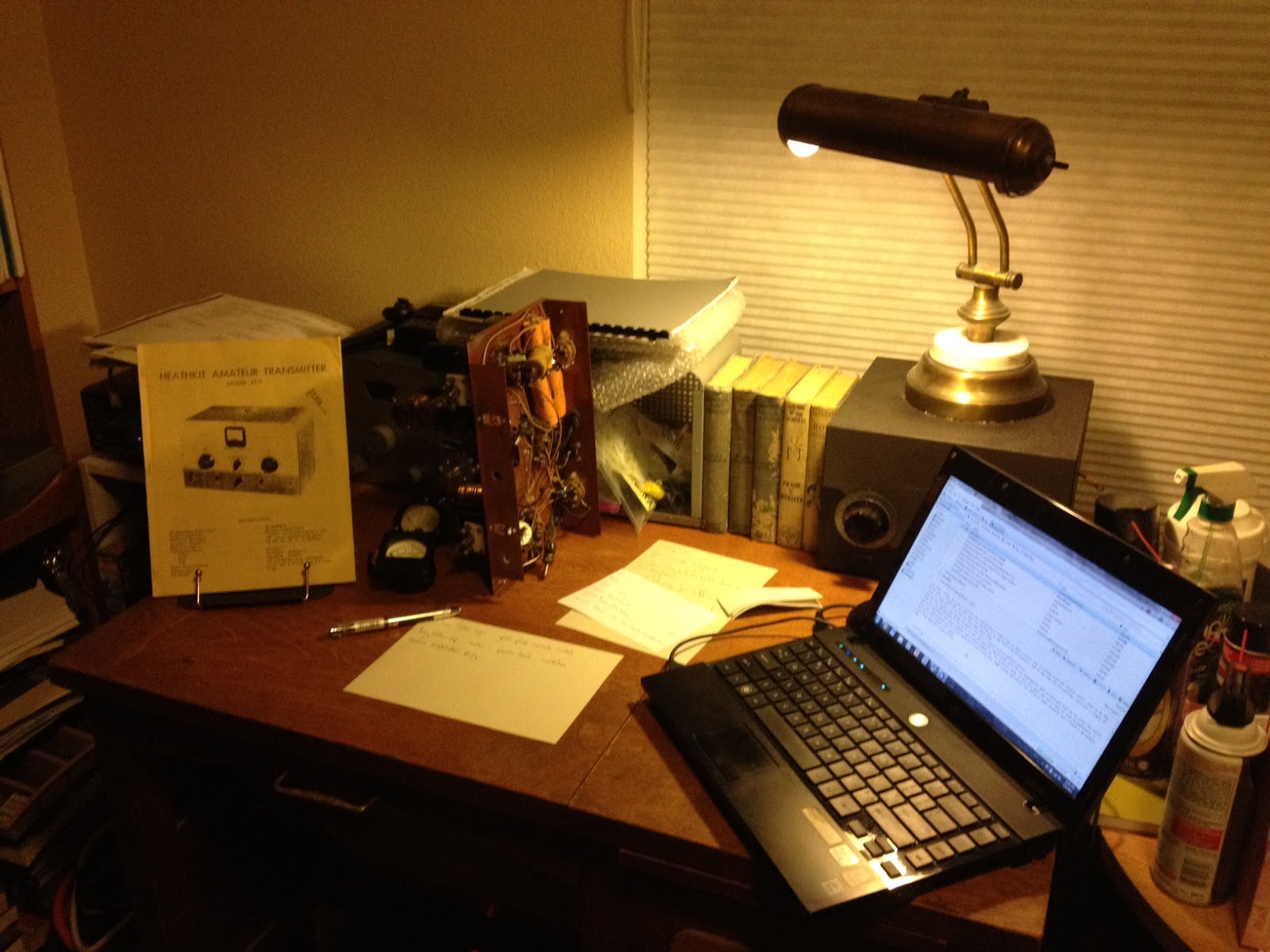 |
| The Heathkit AT-1 chassis with case and VFO-1 behind. |
There doesn’t seem to be any show stoppers although the wafer of the meter switch has broken in two and will need to be repaired. If I’m not able to repair it then thankfully it is fairly simple and replacement rotary switch can be substituted.
This isn’t going to be a museum quality restoration but the changes that were made to this transmitter in the past were sensible and if left in place are representative of period modifications. The original meter for example was not the highest quality and a Western or Simpson replacement would be an improvement. The original slide switches have been replaced with period snap-toggle switches which are also an improvement over the original.
The Heathkit VFO-1 however has been modified for grid-block keying which is a significant departure from the original and I plan to revert it back to cathode keying. Although a technical improvement it is not in keeping with the original design and needs to be undone. Everyone will have their own opinion but I think if I wanted modern circuits I’d get a more modern rig, so the VFO-1 will be returned to stock.
Hopefully I can carve out a bit of time here and there to work on this and slowly return it to working condition.
Morsemail and LCWO.net
The time has come when I can’t put off learning Morse code any longer, With an interest in vintage amateur radio and the impending restoration of a Heathkit AT-1 I’m going to need to use CW sooner or later.
So I have been checking out resources for learning Morse code and stumbled across two that really intrigue me.
The first is LCWO.net, a web browser based Morse code learning tool that is usable on any internet connected computer. It is available free of charge and there is no software to install. LCWO.net keeps track of where you are in your lessons and where you need to concentrate your effort. The Koch method is the primary tool available but they also offer code group practice, callsign and plain text training modes along with a service to convert text to Morse MP3s for download and use offline.
Once you are on the way to CW proficiency and want to communicate with others you can always fire up a rig and get on the air … What if you don’t have a rig or need a confidence boost before ‘going live’?
Well, you could always send Morsemail using the Morsemail client from http://brasspounder.com:8873/.
Morsemail is, “A simple text format that encodes mark and space times to make it possible to send Morse coded messages via email” but a recently added feature allows for QSOs using a internet repeater hosted on brasspounder.com. You can use a mouse or actual key wired to the mouse or joystick buttons to send CW which can be emailed or sent through the repeater live.
Now I just have to carve out the time to sit down and use these resources!
My Morse Journey
As I’ve mentioned many, many times. My attempts at learning Morse code or CW as a teenager were unsuccessful. While I’ve mentioned my excuse was too many distractions (cars, sports, girls). I also believe my failure was a learning block which I couldn’t overcome. Perhaps another way to word this was a learning block I didn’t know how to overcome.
Since getting my license in 2007, CW has been a mode I’ve wanted to operate. I will admit that I’ve fiddled around in Ham Radio Deluxe DM780 and have also downloaded and installed other software applications to decode via the computers soundcard to text translation. I’ve decoded many times, but have never actually attempted to send via these mechanisms.
Please understand that what I’m going to say next is my opinion and only my opinion. But if I have to use computer software to send and receive CW signals, I might as well stay away from that mode. Again…this is my opinion for my own operational style and my own way of thinking.
So having said that, I am in the process of researching methods of learning Morse code. I’ve spent some time talking to some friends and researching information on the internet. I plan to wrap up this discovery phase and get started in the next few days.
While I know many learned CW from simply studying the dots and dashes which make up each letter or from listening to code tapes. I’m looking for alternative methods as I’ve tried the code tapes and studying an A is .- with not much success. Of course, I also understand I’m a much different person now than I was 30 years or so ago. Most of this will be similar to overcoming my obstacles with earning extra last summer. Meaning, I just need to focus and get it done but at the same time not setting unnecessary pressures on myself.
Morse code is very much alive on the bands and it is a mode I dearly want to enjoy. I’ll be certain to most frequent updates to share both my successes and frustrations along my Morse journey.
Until next time…
73 de KD0BIK
Heathkit’s first amateur transmitter – Heathkit AT-1
The Heathkit AT-1 represents the commercial embodiment of the simple Master Oscillator Power Amplifier (MOPA) transmitter using a crystal controlled 6AG7 oscillator plus a 6L6 final output tube.
Although it was possible to design and build a simpler transmitter, the goals of output power and stability could become mutually exclusive when trying to operate with only one tube. For a novice class license holder of 1951 the Heathkit AT-1 represented a solid performing rig that would be relatively easy to construct and operate.
The Novice remained the primary entry license until the Morse code requirement was eliminated for Technician licenses in 1990. On HF it permitted code transmissions only, with a maximum power of 75 watts, (input to the transmitter’s final amplifier stage) on limited segments of the 80, 40 and 15 meter bands.
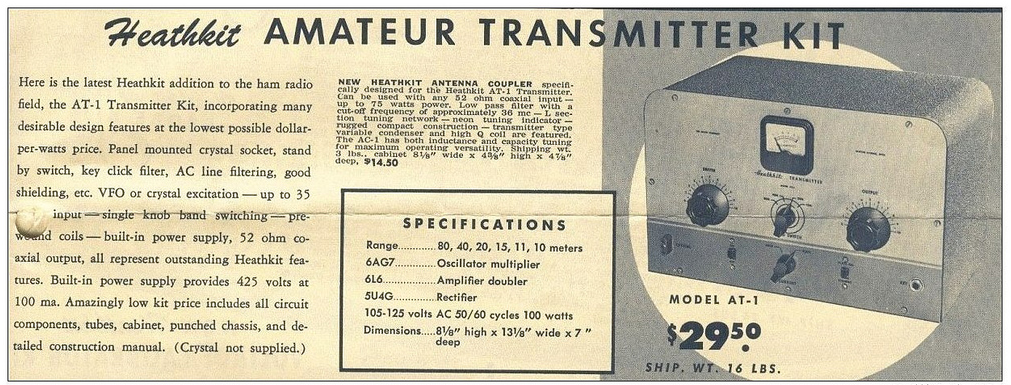 |
| For $29.50 and the loan of a few tools you could get some use out of that new novice license |
The earlier MOPA circuit from the ARRL handbook of 1941 below shows a layout remarkably similar to the circuit of the AT-1 although it is designed for plug in coils rather than the band-switching arrangement of the later Heathkit transmitter.
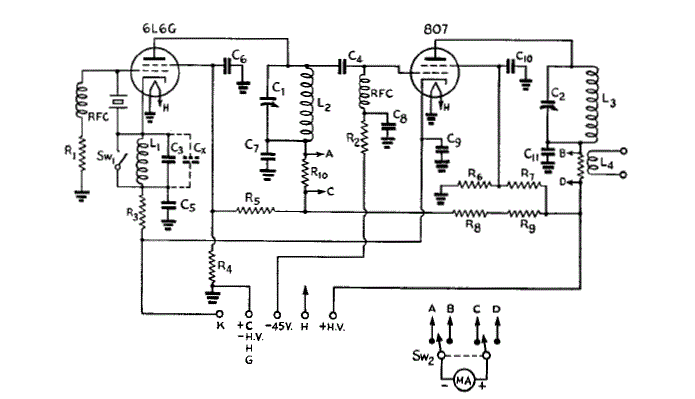 |
| MOPA transmitter using a 6L6 and an 807 as the power amplifier (ARRL Handbook 1941) |
For a little added complexity MOPA transmitters generally offered better stability of frequency and keying waveform than single tube crystal controlled or self exited rigs. The straight forward design of the AT-1 should have looked familiar to novice class hams after studying the ARRL handbook or other radio publications.
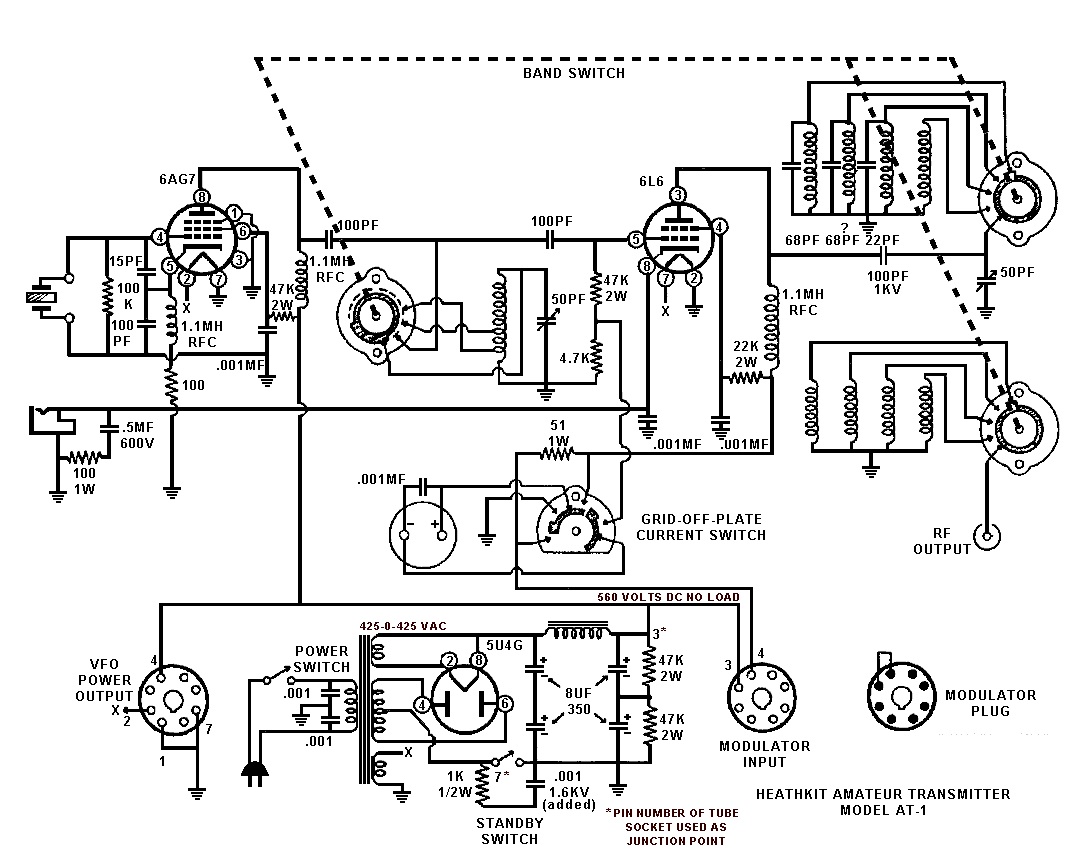 |
| Heathkit AT-1 Circuit diagram showing band-switching arrangement and link coupled output |
Once the novice had upgraded his license the AT-1 could be expanded by the addition of the Heathkit VF-1 variable frequency oscillator to allow transmission on any frequency within the allowed band.
 |
| The Heathkit VF-1 Variable Frequency Oscillator |
The VF-1 covered 160-80-40-20-15-11-10 meters and used an OA2 voltage regulator tube to provide a stable voltage for the oscillator. Ceramic coil forms, solid construction and high quality components were used to help increase stability.
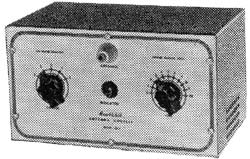 |
| The Heathkit AC-1 Antenna Coupler. Designed to attach to a single wire by the insulated post on the front panel. |
 |
| Heathkit AC-1 Antenna Coupler circuit diagram |
Although Heathkit did not produce a AM modulator for the AC-1 there is provision for modulator connection on the rear panel. The earlier ARRL manuals have several suitable circuits for modulators that would work with the AC-1. Most functioned by driving a modulation transformer with the output from an audio power amplifier. The secondary of the modulation transformer would be carrying the DC plate supply for the power amplifier tube plus or minus the instantaneous voltage of the audio waveform. By changing the plate voltage to the final amplifier tube the radio frequency output would be controlled by the amplified audio frequency resulting in amplitude modulation.
Hellschreiber and microprocessors – Bridging more than 80 years
ZL1HIT (Bryan Rentoul) has bridged a gap of more than 80 years by combining the text transmission system developed by Rudolf Hell in the late 1920’s with current microprocessor technology.
 |
| A sample of received Hellschreiber test from Bryan’s beacon |
Hellschreiber sends a line of text as a series of vertical columns. Each column is broken down vertically into a series of pixels, normally using a 7 by 7 pixel grid to represent characters. The data for a line is then sent as a series of on-off signals to the receiver, using a variety of formats depending on the medium, but normally at a rate of 112.5 baud.
This process was historically accomplished with mechanical equipment but there are very few examples of this equipment still in operation and it is now sent and received by computer. Hellschreiber is very tolerant of noise and interference and requires only simple transmitters and receivers to work effectively.
 |
| German Hellschreiber unit in operation |
With a microprocessor generating the digital on-off signals a simple crystal oscillator transmitter can be used to form a beacon station, one that transmits a call sign and perhaps some other information over and over. Changing the transmitted message is as simple as reprogramming the microprocessor or having it respond to a connected input, for Eg. A thermometer, light sensor, switch, etc.
Receiving the signal and decoding requires a radio receiver capable of CW reception and a computer running any of several free software packages like FLdigi or Digital Master 780.
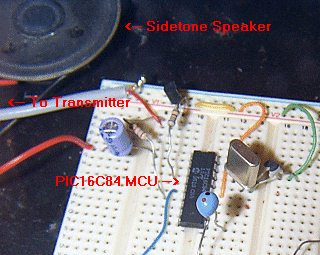 |
| The ZL1HIT beacon using a PIC microprocessor and a simple crystal oscillator transmitter. |
For more information and the PIC microprocessor source code please visit the web page of Bryan Rentoul here : ZL1HIT Hellschreiber / PIC Beacon
Simple keyer complete
At last, I finally got the QRP keyer using KD1JV’s Simple Keyer Chip boxed and working.
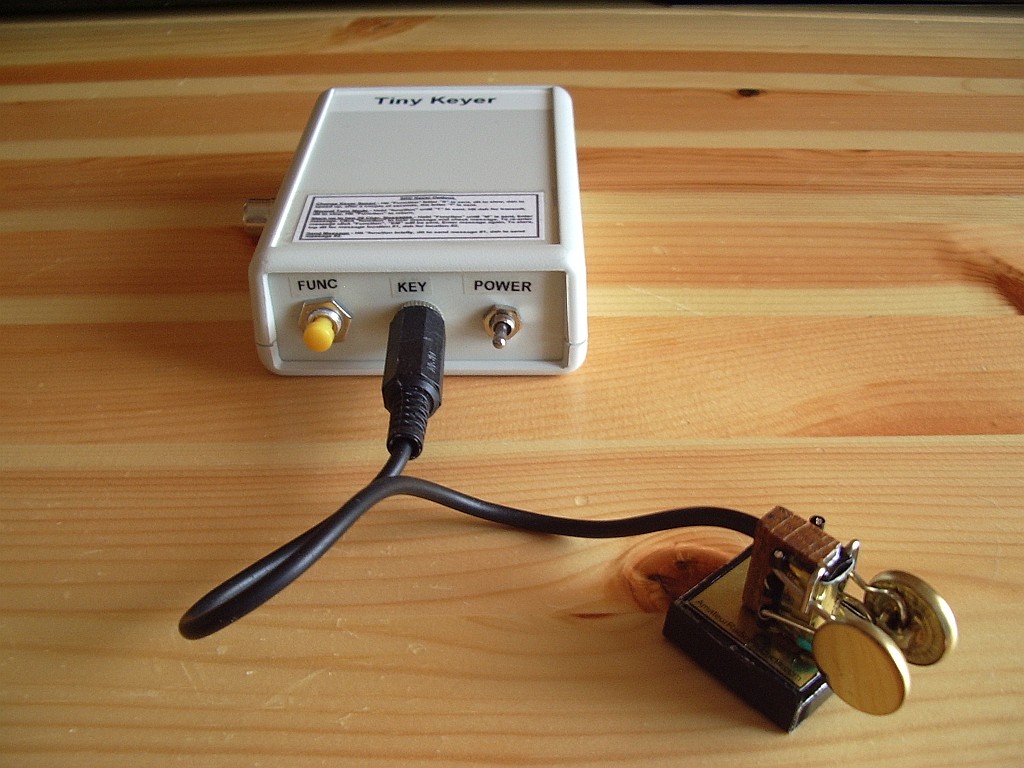 |
| The completed keyer |
As usual, nothing went according to plan. There must be some relative to Murphy’s Law that states for any homebrew project the case will be just too small for comfort. A related rule is the one which guarantees that after you have drilled the case, the position of one of the switches or sockets will be in just the place where it fouls one of the components.
After my first attempt at getting it into the box the keyer was dead as a dodo. This turned out to be because I had forgotten to break one of the tracks on the Veroboard.
After the second attempt the keyer responded to the function button but there was no keying. That turned out to be because one of the connecting wires had broken at just the point where it was soldered. With my eyes as they currently are that took a while to spot.
When I had resoldered the connection and put the board into the case for a third time I noticed that another connecting wire was hanging on by one strand of copper. Lesson: don’t use hookup wire from China, it is made from inferior grade copper.
 |
| View from the front |
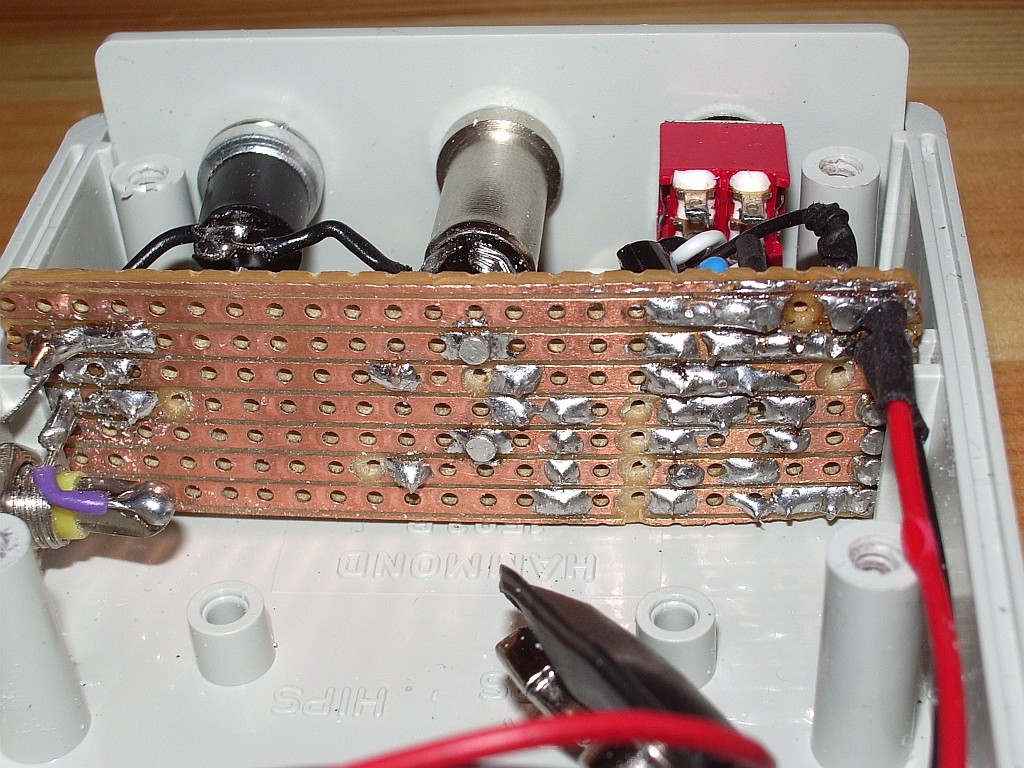 |
| View from the back |
This had taken me a day, so I decided to put the project aside until I felt calmer. The next day I re-made all the connections using new wire, put the board into the case one last time and it actually worked! But Murphy had one last laugh: Now I couldn’t find the four screws for the Hammond case I was using. We searched everywhere. Fortunately my parts box had another Hammond case which sacrificed its screws for the benefit of the keyer. Later, Olga and I managed to find suitable replacements in the local DIY emporium so the other case won’t be wasted.
This Simple Keyer is just what I need for the simple QRP rigs that only work with a straight key. The code speed is easily adjustable and there are two memories, one of which can be repeated as a beacon. I don’t need more sophistication than that for QRP work.














