Posts Tagged ‘amateur radio’
 Handiham World for 2 June 2010
 June 2nd, 2010 |
  Author:
 Welcome to Handiham World!
June is here, and that means Field Day planning

As you know, we have been at Handiham radio camp last week, and because the camp session ended just as the long Memorial Day holiday weekend began, today is our first day back for routine office duties. We hope you had a pleasant and thoughtful Memorial Day weekend and were able to set some time aside to remember those who have gone before us, serving to protect our freedom.
Memorial Day seems to be the unofficial start to the summer season here in North America. Yes, I know that the official beginning of the season begins later this month at the summer solstice on June 21. In fact, in the Northern Hemisphere, summer solstice begins on Jun 21 2010 at 7:28 AM EDT. Nonetheless, nothing flips the switch to summer quite as well as a long holiday weekend, and once people get into the mood of summer, they tend to forget about spending time with indoor activities and look to the great outdoors for fun in the sun.
That doesn’t mean that ham radio will not be an important part of the summer. To the contrary, June is an excellent month for ham radio. Amateur Radio Field Day is coming up on the first full weekend in June, as it always does. ARRL Field Day is June 26-27, 2010. If you have never operated during a Field Day, you are in for a pleasant surprise: Field Day is the largest on-the-air operating event in Amateur Radio. Combining elements of a contest with setting up portable stations is a brilliant strategy. Field Day provides an opportunity to practice setting up for emergency situations, learning new and better operating skills, participating in a competitive event as a group or as an individual operator, really learning how your equipment works, and — in the case of a radio club Field Day event — being able to socialize with your friends and just have a lot of fun sharing this operating event. Some radio clubs have a family picnic to make sure that spouses and children can share in the fun. Others are in it for the contest and run stations day and night, focusing on that all-important point count.
If you are a person with a disability, you can participate in Field Day, but you may have to do just a little advance planning to make sure that you are able to operate effectively and safely, either as an individual or in a group. Here are some things to consider:
Field Day has many different options. You can operate from your home station without setting up any portable antennas and portable radios. You do not need to operate using power from a generator or batteries. In fact, you can operate your existing station just as you always do and still participate and have a great deal of fun on Field Day. The object of the exercise is to work as many stations as possible on any amateur radio band except 60, 30, 17, and 12 m. If your disability requires that you stick close to home, you may want to simply participate using your own station.
You don’t have to operate during the entire Field Day exercise. Even if you participate for a couple of hours, you can have fun and gain experience. So, even if your disability makes it inconvenient to be away from home for long periods of time, you will be welcome at most radio club Field Day sites during the time it is practical for you to be part of the group effort.
Check out the Field Day site in advance for accessibility, especially if you are using a wheelchair or electric scooter to get around. Some sites are truly rugged and not accessible. Others may be the ultimate in accessibility, with wheelchair ramps and accessible restrooms. Since several radio clubs in your area may be participating in Field Day, now is the time to start shopping around for an accessible site. Don’t be afraid to call the contact person listed on the club website and discuss accessibility. It is better to find out in advance what is and what is not available.
Sometimes special needs can be accommodated at the operating positions of a club Field Day site. For example, if it is known in advance that a blind operator will be participating, a radio or radios equipped with voice frequency output might be made available. Again, this is something that needs to be planned in advance, so now is the time to speak up.
If you are a ham radio operator with a disability, I certainly hope that you are part of a local radio club already. But if you aren’t, a club Field Day is sometimes the perfect opportunity to meet club members and find out if a particular club will meet your needs. Don’t forget that as a club member you will be expected to participate and take on some club duties as well.
Sometimes we concentrate on accessible radios and wheelchair ramps when we think about Field Day, forgetting that it will be necessary to take care of life’s normal requirements. Since the contest goes on for at least 24 hours, if you expect to stay at the Field Day site for long periods of time or even for the entire length of the contest, you will have to consider whether the restrooms are accessible, if the food and beverages meet your dietary needs, whether it will be possible for you to stay on your medication schedule if you must take medicine on a daily basis, and what kind of shelter is available on site in the event of inclement weather.
If you stay overnight, you will need to determine where you will sleep and how you will stay warm since it can get quite cool in the night and early morning. Generally speaking, if you are comfortable with camping and already do so on a regular basis, you will have no problem managing a Field Day where the crew is “roughing it”. On the other hand, if you would rather fill out 100 tax forms than go camping, you should look for a club that has its Field Day indoors with lots of amenities. Either one will be a great experience, but you have to be sure you pick the right one for you!
Field Day rules change a bit from year to year as new ideas take shape and technology changes. If you have never been to a Field Day or if you have been away from Field Day for a number of years, take some time to check out the ARRL website and find out more about this excellent operating event.
My radio club, the Handiham-affiliated Stillwater Amateur Radio Association, is holding its Field Day indoors in a completely accessible modern city park building. SARA goes the extra mile to serve Handiham members and is an ARRL Special Service Club.
I hope to hear you on the air during Field Day 2010.
Patrick Tice, Handiham Manager
[email protected]

Report on my QRSS signal from Michigan

QRSS report from AJ8T
Thad, AJ8T, sent me a nice report on my 30m 160mW QRSS signal. A screenshot of what he received is above and clearly shows the ‘a3stl’ part of my signal. In his e-mail he reported
It was received about 20:40Z on May 26,2010 using Spectran, a Signalink interface, a Yaesu FT-897d and an 80m horizontal loop up about 10m fed by ladder line. I’m located in Sturgis, Michigan (grid EN71hs) half way between Chicago and Detroit.
My transmitter has been running continuously now for a few weeks and it is good to see how stable it is. For those readers unfamiliar with QRSS those frequency changes that give the CW are about 5 or 6 Hz steps. Which gives an idea of the stability, as well as the challenge to detect these signals (the 30m QRSS ‘band’ is just 100Hz wide).
He also reported that he too will be putting a QRSS transmitter on the air soon. I look forward to seeing AJ8T’s signal on the grabbers.
Thanks for the report Thad!


Letter from Handiham Radio Camp
Dear Family & Friends,
Here I am at Handiham Radio Camp, and I’ve been having a great time. It’s hard to believe that we are already leaving camp tomorrow morning. The week has gone by so fast!
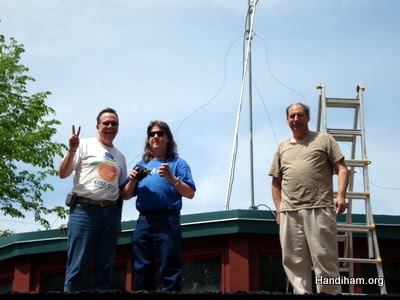
Several of us arrived a day early to begin setup of antennas and stations. The photo I’ve included here shows Phil, K9HI, Matt, KA0PQW, and Don, N0BVE, posing midway between antenna projects and smiling for the camera. The volunteers who help us through the week are really the experts at making things happen – whether it is setting up computer networks, running coax, stringing up Field Day antennas, setting up and testing station gear, teaching licensing classes, teaching operating skills, getting campers out onto the lake to operate marine mobile, and all of the other things that happen during the week.
Nancy, our Handiham Secretary, met the campers for the first time this week. She had never been at a radio camp session before and was quite a celebrity, since everyone knew her voice from talking with her on the phone. When the radio camp was at Courage North, it was too far for Nancy to drive. Now that we are at Camp Courage, we are close enough to Minneapolis to make the drive practical.
This morning we met the V.E. team for breakfast, then the campers who were taking exams gave it their best shot. Those who got the good news were really happy, and those who didn’t quite make it – well, they were happy to have an excuse to come back to camp next year. After lunch, we started taking down the antennas, at least the temporary ones, and packing up the station gear. It seemed as if we had just gotten that stuff out of the boxes and set it up, but that’s the way it goes: Time really does go fast when you are having fun.
The afternoon weather is perfect today, and we are having a pool party. The campers and staff are enjoying our swimming pool while I am packing boxes. Poor me. Oh, heck, I really didn’t want to go swimming anyway. While I was packing, I was listening to Jerry, N0VOE, conducting a mini-net connecting a group of our campers with an elementary school class studying geography. Arlene, KE7KNM, teaches school in Salt Lake City, UT, and invited us to speak with her students, who would locate our home QTHs on a map.
Joe, N3AIN, agreed to share a few thoughts about radio camp week with you, so keep listening, and have a great Memorial Day weekend.
The Handiham office will be closed through Tuesday, opening again on June 2.
73,
Patrick Tice, Handiham Manager
[email protected]

Handiham World for 19 May 2010
Welcome to Handiham World!
Getting ready for Radio Camp: Sniffing out problems in the station equipment

Handiham Radio Camp begins on Friday, May 21. We have to make sure that our radio gear is ready to go so that it can be deployed when we do camp setup later this week – and that means doing a few preliminary checks that include connecting the transceivers to a power supply and testing the receive and transmit functions, making sure that there is modulation, and checking to make sure that the speech modules are speaking the frequency for our blind users.
George LaValle, N0SBU, and his dog PJ pose for the camera as they sniff out any potential problems, while Avery, K0HLA, looks on approvingly. Every project needs a supervisor, a sniffer, and a guy who pushes the transmit button!
If you listen for us on the bands during camp week, which is Friday, May 21 through Friday, May 28, 2010, give us a shout and you may earn a QSL card, providing that you send us one. We do plan to be on the Handiham Echolink net every day, including Sunday during camp week, but remember that because Fridays are camper travel days, those days are not going to be the best for making contact with the camp. You may be able to contact campers or volunteers on the road as they travel.
We are often asked, “What frequencies will you be on?” and “Can we make a scheduled contact with the camp?”
I know from years of experience trying to figure out frequencies and schedules that it is best not to promise anything. However, I can say that we will make a good effort to be on the air at Echolink net time, and if you want, you can ask the folks at camp if they are willing to get on the HF bands for a schedule. Be sure to route any requests through the net control station, whoever that might be.
Thanks to Don Rice, N0BVE, we will have Echolink repeater access at Radio Camp. Our repeater will be connected to the HANDIHAM Conference Server, node 494492. This high capacity node, sponsored by N0VZC, can accept 200 connections. The camp repeater will be on all the time, so you can always try a call even outside regular net times. You never know when someone will be listening.
The best times to contact us are:
Early morning before 08:00 CDT (Before breakfast)
Between 13:00 and 15:00 CDT (Camper recreation time)
After 18:30 (Following dinner)
As I said, you can try calling anytime and the call will go out all over camp on the camp repeater system. We do have people listening most of the time, especially those who are in Operating Skills or Extra Seminar.
We hope to hear you on the air soon!
Patrick Tice
[email protected]
Handiham Manager

New DVAP dongle
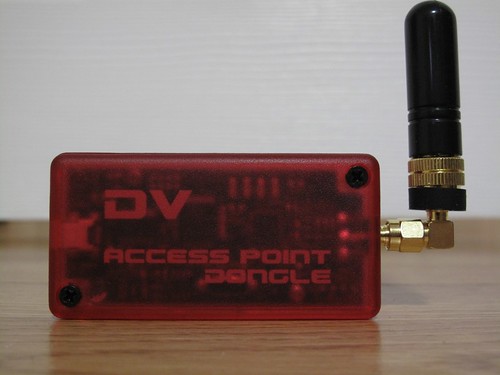
I recently acquired a DV access point (DVAP) dongle from HRO. This is a very interesting piece of D-STAR equipment. It is a 2m transceiver that is connected via a USB 2.0 port to a computer, which has to be connected to the internet. This then allows the dongle to be effectively a simplex repeater passing D-STAR signals on and off the D-STAR network. So using my IC-91AD HT I can link to either D-STAR gateway repeaters or reflectors and talk to other operators. The audio quality is very good. I have heard other operators using theirs and I have had good reports when using mine. Output power is 10mW (but can be lower) and I can link to the dongle from around the house. So I can make contacts around the World on the D-STAR network from the comfort of an armchair or whilst sitting outside on the deck.
The device is made in the USA and it is very well put together and packaged. Even the supplied USB cable was a quality molex brand cable. (Please note you must own a 2m D-STAR radio to use a DVAP, it will not convert FM to D-STAR. If you do not have a D-STAR radio consider the DV Dongle.)
Here are a few videos that talk about the DVAP dongle.
First an overview from the US National Capital Radio D-Star Association. They talk about the DVAP dongle for about the first 2 minutes then go on to talk about other equipment.
Next a detailed DVAP demonstration by Tim, G4VXE,
Finally HRO has them in stock!


Handiham World for 12 May 2010
Welcome to Handiham World!
Courage Center Development Officer Walt Seibert Passes Ham Radio Exam

Photo: Walt Seibert, left, gets congrats from Pat, WA0TDA.
Another New Ham
Congratulations to Walt Seibert, who passed his Technician licensing exam at the Handiham-affiliated Stillwater Amateur Radio Association VE session last Thursday. Walt works with me at Courage Center, and we have known each other for many years. As one of his duties in the Courage Center Development Department, Walt traveled with me one year to Dayton HAMVENTION and with the help of our colleague Tom Olson put on a “meet and greet” development event in support of the Handiham program.
So Walt is no stranger to ham radio, and when he decided to pursue his Technician Class amateur radio license, we were thrilled. There is nothing like being able to “walk the walk and talk the talk”, and if you are going to ask potential donors to support an amateur radio education program for people with disabilities, it certainly helps to have an amateur radio license yourself. I know that Walt was amazed at the size and scope of Dayton HAMVENTION. The amazing technology, the friendly folks who visited the Handiham booth, the fun and fellowship — I guess it isn’t surprising that amateur radio looked pretty good.
Of course Walt is always busy at work, helping Courage Center to earn the trust and support of those who believe in our mission to help people with disabilities. For a time he was interested in amateur radio but couldn’t take the time to pursue it because of his other professional development studies and the demands of work. However, the stars finally aligned for Walt, and he decided to earn his Technician. We helped with study materials and links to amateur radio practice exam websites. Soon Walt was reporting back to us that he was passing practice exams on a regular basis, and then every time he tried. We set up Walt with an upcoming VE session and crossed our fingers.
I am a member of the Stillwater Amateur Radio Association VE Team, so I was pleased to see that Walt showed up at our Thursday evening testing session, which meant that I would be able to personally give him the good news when he passed the test. As expected, Walt did a great job on the examination and I was able to perform one of my favorite duties as a volunteer examiner: giving a successful candidate the good news!
Congratulations to Walt, who is now waiting for his callsign to appear in the database.
Guide Dog Trawler passes away quietly

Folks, it is with much sadness that I report the passing of guide Trawler. He gave no indication of any health issues. He guided at church last Sunday, and we went to the Plymouth Senior Center yesterday, where he worked well as usual, steps and all. All was normal the rest of Monday. This morning, Tuesday, Pam found him on his sleeping mat next to our computer. He was in his normal sleep position, no sign of any trauma. Pam feels it was his heart. Trawler would have been ten years old July 4 of this year.
I would like to have my ham radio friends on the net and camp staff know of this, so could you forward the information?
Jerry Kloss, N0VOE
Editor’s note: Trawler guided Jerry, Handiham Volunteer & Student Coordinator, through years of Radio Camps and Handiham activities. A true team, they worked so well together that it was fun to watch them travel with confidence and poise. Our hearts go out to Jerry and his wife Pam in their time of loss, for losing a treasured animal and guide leaves a hole in your heart.

Handiham World for 5 May 2010
Welcome to Handiham World!
A new antenna goes up at Handiham headquarters


By Patrick Tice
[email protected]
As most of our regular readers and listeners know, the Handiham headquarters has moved from its long-time Golden Valley offices to a new location at Camp Courage near Maple Lake, Minnesota. We already had a vertical antenna at the new location, but we really felt that we needed a more versatile wire antenna that would be able to tune a variety of different frequencies. We settled on a 300 foot dipole fed with 450 ohm ladder line and a current balun. Coaxial cable from the balun takes the signal to the antenna tuner and to the TS-570 transceiver currently in place at our operating location.
As you can imagine, getting an antenna of that length up into the air can be quite a challenge. We had the advantage of some pretty tall trees from which we could support the antenna, and with some careful planning we were able to run the legs of the antenna out into some fairly clear spaces while still using these tall trees as supports.
Volunteers Dave Glas, W0OXB, and John Harvard, KC0UHY, had put up these “OXB Special” antennas before, so all I really had to do was follow directions and do as I was told. Dave directed the operation, as he is the real wire antenna expert. Not only had he ordered the materials and did some assembly ahead of time, he also procured the materials by getting the support of the Handiham affiliated Stillwater Amateur Radio Association, which paid for everything we needed. Dave also drove and brought the necessary tools. You could certainly tell that he had done this kind of antenna work many times before!
The weatherman cooperated on Tuesday, May 4. The sun was shining and the temperature was in the mid-70s. Although we had some wind, it wasn’t really more than a modest breeze and we were able to use the wind to our advantage in launching a tennis ball loaded with a couple of heavy lead sinkers as a lead for our fishing line. The tennis ball is launched using a slingshot like device that was donated to the Handiham program by volunteer and donor Bill Rouch, N6HBO. In order to get the tennis ball over some really tall trees, Dave cut a small slit in it and slipped in a couple of lead fishing weights. This gave the tennis ball enough mass to easily fly over the tallest branches. When all was said and done, the average height of this 300 foot antenna was probably close to 45 feet. That is really pretty good for an antenna of this length held up by trees.
We did some preliminary tests and then had to head back home to avoid getting stuck in rush-hour traffic. We will do some of the final work on the station later on when we receive the expected donation of an automatic antenna tuner from Eliot, KE0N. Do you see how volunteers, donors, and staff all work together to make a project like this possible? We are so grateful for everyone’s assistance. We couldn’t do it without you!
Eventually, we plan to use this new antenna on a second Internet remote base station. This will increase the operating capability by adding not only the second station but the ability to operate on the 160 m band and on the 6 m band. If this new antenna system works as well as expected, we may even consider upgrading the antenna system at the Courage North location, also adding 160 m and 6 m there.
Remote base operation will be an important part of our services in the years to come. Thank you for your support.














