Posts Tagged ‘amateur radio’
 More Lessons from the Birds
 October 5th, 2010 |
  Author:
The Biggest Bird in the Pond
On my morning walk yesterday, I had quite a treat. Sure wish I had taken the camera along. On the shore of the flood control pond that flows out into the golf course, were 4 fine Florida water birds. It is not common to see them bunched together like this. A Great Blue Heron, a Little Blue Heron, a Great Egret and a Comorant were lined up in a space of about 8-10 feet. There was a good bit of shoving and jockeying for position and they were working down the bank fishing in the same small spot.

Cormorant is like a living submarine or scuba diver
Made me think of the pileups a DX station creates… The comorant had a distinct advantage as the only real swimmer and diver of the bunch. It ranged up and down the bank picking off small fingerlings and bullying the other birds by swimming right up to their skinny legs and surfacing. Reminded me of some of the pileup busters I’ve observed from time to time.
At the same time, the little guy, the Little Blue Heron, and the regal looking, very white and tall Great Heron were left to glean around the edges and pick off the fish that were panic striken and confused by the other birds fishing in the midst. This reminded me of all the contests where I have to dodge the big birds and pick off what I can around the edges.
Funny thing is there are tens of thousands of fish all along the bank, not just where these birds were bunched up. What is it about us that piles us up and forces such fierce competition? Hmmm?
Yep, I am a devoted CPG (Contest Point Giver), who had a nice morning walk and got to see a great outdoors show for free. That is why I love operating QRP portable. Being outside and enjoying the free shows only adds to the enjoyment of the hobby and the friendships made on the air.
72,
Kelly K4UPG PB #173

Tall White Bird is really quite skittish

This little Blue Heron really gets around fast
QRPSPOTS.COM and IHAB Do it Again!
Wow! Great way to bring together a lot of ham radio ops on a Saturday using all sorts of technology! Way to go! QRPSPOTS.COM is normally used by QRP ops to spot each other when we are out operating portable or to alert others of band openings. It was ALIVE with reports and updates from all over the USA and even a few DX ops adding input too! In addition, several QRP reflectors were buzzing with updates and info. What a great community effort this turned out! Congrats to all and thanks to QRP ARCI for helping get the word out.

Iowa High Altitude Balloon Project
One of the 4 States QRP bunch, Terry WA0ITP, provided the 20m beacon again and has some great info on his informative website.
But for me, the coolest thing was listening in on the streaming webcast of VE3EN and his wonderful IC-7700. Sure wish I had thought of recording a bit or doing a screenshot to share here. But what a treat to listen in and hear the beacon’s signal right up until touchdown. Thanks Kevin for a fun way to eavesdrop on this event since the lawn mowing crew took over my condo’s yard and didn’t allow me to put an antenna out today. There is a ton of info and creative website construction on Kevin’s website and it is worth spending some time looking at the solar cycle data.
Congrats to the team for a successful event today and for bringing so many hams together for a good learning experience and something out of the ordinary. Well done W0OTM, well done indeed!
Handiham World for 29 September 2010
Welcome to Handiham World!
At this time of year I am always taken by surprise at how quickly the daylight hours fade every day here in the northern hemisphere. That means more hours of darkness and more HF radio fun in the evenings, as we mentioned last week when we extolled the virtues of 160, 80, and 40 m for long-distance communications. Things are also looking up in the daytime communications department, because my Windows sidebar gadget, “Full Sun 2.1” by John Stephen, shows me the face of the sun becoming more regularly dotted with sunspots. More sunspot activity means that the shorter wavelength HF bands like 10 and 15 meters will soon become much more reliable for very long distance daytime contacts.
If you have a Technician Class license, now is the time to consider an upgrade to General Class so that you can really use and appreciate all of these HF bands at a time when conditions favor some really great operating.
What makes me think about this upgrade business today of all days, when I am busy with your weekly E-letter and podcast is that tonight I will be teaching a two hour General Class course on rules and regulations. The course is open to anyone, but of course Technician Class license holders would probably be the most interested since they have already completed their first license and are familiar with ham radio terminology and operations, at least on the VHF and UHF bands. While some HF frequencies are open to Technician Class licensees, pretty much everyone realizes that an upgrade to General is a necessity if one is really going to enjoy shortwave operation.
One advantage that I feel that I have in teaching rules and regulations is that those who have passed the Technician are already familiar with the fact that we are regulated by the Federal Communications Commission and that the section of the rules governing the Amateur Radio Service are called Part 97. Anyone with a license should already know about frequency charts and about how the various levels of license allow for operation in different band segments. Everyone is already familiar with the fact that transmit power levels are regulated and that examinations are given by a VE team. Starting with this foundation of basic knowledge makes the General Class study regimen that much easier. I always start out the course by assuring my students that the examination for General Class will be 35 multiple-choice questions without any Morse code testing. Yes, I know that the code requirement has been gone for quite awhile now, but I still encounter students who either don’t quite believe it or simply haven’t gotten the news. One thing I have learned over years and years of teaching is that one cannot assume that the students know all of these basics on the first day of class!
Although I am very familiar with teaching into a microphone for our blind Handiham students, these courses taught in front of a class of students from the general public will only occasionally have a blind participant. This is going to sound a little bit odd, but I have to remind myself that I will now be expected to provide some visual learning cues as I speak and answer questions. For a traditional teacher of amateur radio at a typical radio club course the situation is reversed and that teacher may have considerable difficulty working with blind students. It all serves to remind me that the first time I meet my students I am going to have to assess them to find out how they learn and be flexible enough to adapt my teaching style accordingly. In teaching amateur radio courses, flexibility is the key. Your students will help guide you if you are open-minded enough to listen to them – just as we always tell new operators to listen on the bands before transmitting.
When I see a classroom full of students who are interested in amateur radio, I know that they are motivated to learn. After all, amateur radio classes are completely voluntary and these people could be doing something else instead of sitting in a ham radio class. This is a tremendous advantage and opportunity for me – and you – as teachers in amateur radio. Our students want to learn. We need to make sure that we are prepared to teach by having our teaching materials and any audiovisual equipment ready to go at the beginning of class so that we can move right into the topic at hand and make sure that we use the time as efficiently as possible.
Today we have the Internet and all of its amateur radio resources as study aids for post-class reinforcement of each week’s classroom topic. Since I am teaching rules and regulations and the radio club has chosen the ARRL General Class License Manual as the official study guide, I will be referring my students to the section of the ARRL website that provides further information about that particular book, including extra study material, any corrections that might need to be made in the text, and – most importantly – a question pool organized to follow the book. Not everyone knows about this special question pool, so I never assume that my students have discovered it on their own. Believe me, it makes quite a difference to be able to follow the question pool in the same order as the chapters in your textbook. I also freely recommend other amateur radio websites that might help with either studying or practice examinations.
One disadvantage of having to teach the chapter about rules and regulations is that it is not considered a “fun” topic. When one thinks about rules and regulations, it brings to mind memorizing really dull legal-sounding rules and lots of frequency limits. I won’t deny that there is some of that, but your job as an instructor is to help the students learn how to learn. That might mean pulling out the US Amateur Radio Bands frequency chart and helping the students to make sense of a page full of data that might otherwise seem overwhelming. One trick is to divide the frequency bands into the ones where there are no special General Class subsections and those that do have subsections. Breaking the frequency chart down in this manner can help your students remember which bands they may get questions on regarding frequency limits. Of course there is going to be some memory work no matter what you do in the classroom to help the students organize their thinking. I tell my students in no uncertain terms that they will have to sit down and do some memorization and that they will do it as homework. My volunteer instructors at Handiham Radio Camp have told me for years that studying at home is vital to ultimately passing the examination during the VE session at camp. Fortunately most radio club classes meet weekly for 8 to 10 weeks, giving your students much more time to study at home. Just be sure that they understand what to study and help them develop good study habits.
My classes are always interactive. I don’t prefer to lecture from a podium for an hour and then have a question-and-answer session. Most people learn best if their questions are answered the instant they pop into their heads. If you wait to have a question and answer session you will find that many of your students have forgotten questions that might’ve come up during the lecture. A better way to conduct the class will be as a discussion that can be interrupted to answer questions. Time will be a factor, so a good teacher learns to manage this kind of interactive classroom experience in order to keep the class moving along while still allowing the students to participate actively during the entire class period.
Since my class is going to be in a two hour time frame, I am going to plan for a mid-class break. Your students will be more alert if they can attend to personal needs and walk around a bit instead of having to sit for an extended period of time.
Finally, when you are wrapping up your class, your students may feel overwhelmed with all of the material that you have managed to cram into the evening’s session. Once they return home and think about what they have learned, which may even take the rest of the week, they may have other questions that they wish they had asked during the class. That’s why I always provide my e-mail address and invite my students to ask questions whenever they think of them. My radio club teaches classes in Technician and General, offering the first license in the spring of the year in conjunction with an emergency weather spotter course. The upgrade class to General is offered in the autumn. All of the classes are taught by a team of volunteer instructors so that no one instructor will be tasked with many classes to prepare for over the course of 8 to 10 weeks.
I hope your radio club is offering classes as well. Over the years I have received the sad news from time to time that a radio club is dissolving and distributing its assets to worthy causes like the Handiham System. While I am always glad to receive support for our program, I really hate to see an amateur radio club closing its doors. I suspect that one of the biggest factors in the demise of these clubs was the absence of an education program to teach amateur radio classes. A club without an educational program is a club that is not building a base of new amateur radio operators in their community. This is a recipe for an aging club membership that will eventually diminish to a few members and eventually the plug will be pulled on the club. Don’t let that happen to your club. Volunteer to help with an education program. If you have never been an amateur radio instructor, you may want to sit in on a class taught by one of your other club members or even a neighboring radio club’s class. The idea is to learn how to teach and then get out there and do it. Rest assured that your efforts will be rewarded by the new members you will bring into the amateur radio community. You will have more members in your club, and these new members will have new ideas. Eventually they will become instructors themselves and they will also serve in leadership positions and provide new club programs. They will be the ones who will take up the mantle of “Elmers” who will be able to keep amateur radio healthy and growing into the future.
I always feel honored when I am asked to teach one of our classes. I hope you will feel that way, too.
I hope to hear you on the air soon.
73,
Patrick Tice, WA0TDA
Handiham Manager
[email protected]

A dip in the pool
No one told you there was going to be a quiz, right? I thought it would be fun to pick a question out of the question pool and see how many of us can remember the right answer. Ready? Here we go:
G1A01 [97.301(d)]
On which of the following bands is a General Class license holder granted all amateur
frequency privileges?
A. 20, 17, and 12 meters
B. 160, 80, 40, and 10 meters
C. 160, 30, 17, 12, and 10 meters
D. 160, 30, 17, 15, 12, and 10 meters
Do see how sneaky I can be? In my opening remarks I specifically referred to teaching my students about dividing the frequency chart into bands where General Class licensees have full privileges and bands that have frequency restrictions. Think about which one of these is the correct answer and we will provide it at the end of this newsletter and podcast.

New Open Source Rig Project? Dah Mini-Pig+
The QRP-L reflector has been buzzin’ with the news and chatter (positive and some negative btw) about a new project to design and build a new transceiver for QRP HF use. YAHOO!

K8IQY Style Test Setup
What I love the most about this is that the QRP community is able to contribute ideas, resources and participate much like the Open Source software community operates. This could really be a fun project for our Central Florida QRP group. After all, we are not that far from Diz W8DIZ who is facilitating and coordinating this project.
If you like to build, experiment and try some QRP operation with a new rig… you should tune in and join the fun.
This is the last week to vote in the poll on my blog for the best US QTH for ham radio… Here’s the standings as of Sunday at 2100 EDT:
- West Virginia (17%, 10 Votes)
- Kansas (16%, 9 Votes)
- Hawaii (7%, 4 Votes)
- Texas (7%, 4 Votes)
- New Hampshire (5%, 3 Votes)
You can cast your vote by following this link!
72,
Kelly K4UPG PB #173
Duh: Learning Curve #5 Old Lessons Remembered
POLL RESULTS SO FAR: West Virginia is in the lead for best Ham Radio QTH in the USA… One more week of voting… Have you voted yet? Here’s the link to vote!
Last weekend I played in the QRP Afield event and had fun with fellow Polar Bear QRP Club members on the air. It was a great time. Once again, the antenna tweak won out and under the influence of a great blog post by Polar Bear #20 VA3SIE, Martin in Ontario about the 88ft Doublet, I caved in and put one together the night before the event. Oops, I did it again! But this time I had excellent results and the antenna worked as advertised. LESSON: Sometimes it pays to follow your heart and not your head.

Civil Defense Logo
I also remembered how I learned a lot as a young teen aged ham via the Civil Defense program. Remember that time?
Watching a weather report about tornadoes reminded me of a great learning experience. The Palm Sunday Tornadoes of 1965 hit the counties north and east of my home in Elwood, IN. At only 15 yrs old, I was the assistant emergency coordinator and ran the 6 meter emergency communications net on Sundays. Our county and city Civil Defense teams had setup equipment and were ready for disasters and those tornadoes reeked havoc on our area.

Path of the Palm Sunday Tornadoes
Our teams rolled out the emergency vans, and the adults helped this young ham handle traffic for the state police and other government emergency responders. The old yellow CD Gonset Goonie Bird rig is still something I remember fondly. I loved running that thing!
LESSON: Give the young hams some responsibility and empower them. They will be there when the time comes and will never forget how older folks treated them as peers and gave them an opportunity to do something important. I bet that kind of opportunity will still attract young people to our great hobby. We need them! They need us!

The Yellow Goonie Bird
Handiham World for 22 September 2010
Welcome to Handiham World!
Happy Autumn!
Now that autumn has returned and the equinox is upon us, conditions on the amateur radio bands begin to favor some of the longer wavelength parts of the HF spectrum like 160, 80, and 40 m. True, there is still a great deal of interference from thunderstorms that pop up in the warmer climates, but the interference isn’t nearly so bad as it had been during the height of summer. The longer nights also mean less ionospheric D-layer absorption on those bands, which translates into more opportunities for long-distance contacts. In short, from this point forward we will see rapidly changing conditions on some of the bands where regional HF nets typically meet on a daily basis. This, as you might expect, can lead to potential interference as skywave propagation begins to move out from a few hundred miles to over 1000!
With more and more of our Handiham members earning their General Class tickets and becoming more involved with HF operation, we now have an opportunity to learn how the HF bands change from season to season. As always, we recommend doing plenty of tuning around and listening on the various bands to learn when there are band openings and how the more experienced operators are taking advantage of them.
One of my favorite bands has always been the 75 m band, and I have made plenty of random contacts but also enjoy checking into my favorite regional net, PICONET, on 3.925 MHz Monday through Saturday. Interestingly enough, this net has long been associated with Handihams — way longer then I have been with the Handiham program. Propagation on 3.925 MHz during the 9 AM to 11 AM central time “morning net” is generally the best, because during the previous overnight hours thunderstorms have quieted down and the bands are generally less noisy. As the day wears on, D-layer absorption increases and signal levels drop. There is also an afternoon session, from 4 PM to 5 PM, in the summer. In the winter, the PICONET expands its afternoon session to 3 PM to 5 PM, since conditions for sky wave propagation are better. But this can pose a problem: Skywave is so good that a New York net on the same frequency can now be heard in the Upper Midwest. No doubt the New York stations are also hearing us. Generally this overlap of nets isn’t a problem, but sky wave can work against you when the band “goes long” and stations from over 1000 miles away begin to sound as loud as the stations a hundred miles away. This situation calls for flexibility on the parts of net participants. If it is possible to use a directional antenna, a rarity on 75 m, interference can be mitigated by turning the antenna to favor only the stations in your area. Switching between wire antennas that favor particular directions might also help, as well as using a wire antenna instead of a vertical antenna. The wire antenna will most likely have a higher angle of radiation that will favor closer stations, while the vertical will have a lower angle of radiation that will favor the stations over 1000 miles away. Flexibility on the part of the net control stations is also called for. If interference is a problem, a net control station should consider cutting the net a little short or changing frequency just a bit. Of course this is not always easy when you have a net running and if you, as the net control station, want to change frequency everyone will have to understand the plan and change with you. It can be a challenging job for a net control station to herd everyone to another nearby frequency without having some strays!
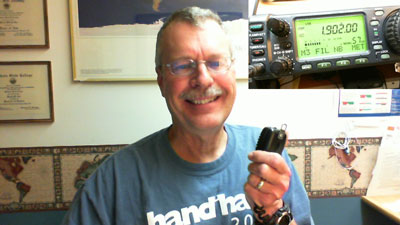
160 m is especially useful over the winter months. While there are not as many structured nets on that band, you can run into “regulars” — stations that often get together on the same frequency about the same time every evening. In the summer 160 m is good for propagation in a regional area during the nighttime hours. In the winter, like the 75 m band, 160 m lengthens out and long-distance contacts are possible. If you are planning to try to earn a certificate like Worked All States on 160 m, winter conditions are your friend. Most evenings at 8 PM Central Time there is an informal get-together on 1.902 MHz. Most net participants are members of the Handiham affiliated Stillwater Amateur Radio Association.
40 m is a good band summer and winter and during sunspot lows and sunspot highs. It benefits by reduced thunderstorm interference during the winter months. You can work DX on the 40 m band, and an advantage it has over 160 m and 75 m is that a wire antenna for 40 m will be able to fit into most suburban lots. Furthermore, a vertical antenna for 40 m can be quite efficient and requires less inductive reactance to make it tune, as compared to a 75 or 160 m vertical. As always, cutting ground losses through an extensive radial system will yield good results.
Of course the sunspot cycle is on the way up and we can expect more DX to appear on 14 MHz and higher frequencies, but please don’t forget about 160 through 40 m. With winter conditions approaching here in the northern hemisphere, opportunities for fun on these bands are not to be missed!
I hope to hear you on the air soon.

Duh: Learning Curve #4 Oops I did it again!
Ever see one of those tie bars or pins that say, “IYKDWYBDYKGWYBG” My dad had one back in the days when men wore ties. The thing used to bug me cause he didn’t tell us what it meant right away. We tried guessing for a few days before he got tired of 7 kids all ganging up on him.
It is the famous “If You Keep Doing What You’ve Been Doing, You’ll Keep Getting What You’ve Been Getting!” Not sure who gets the credit for that one, but it sure stuck with me all these years. Of course, I’ve heard my bosses recite it a few times along the way too.

It only hurts when I laugh, or think, or move, or…use a new antenna in a contest!
That’s what this series of posts is about. Not repeating mistakes I’ve made. Maybe you can learn from my mistakes and save a bit of time. Or maybe you’ll just get a laugh and some relief from knowing someone else made the same mistake you’ve made. HA!
Well, last night, I did not follow my own advice. I put together a new antenna a few hours before the NAQCC Sprint and set it up. LESSON: As previously mentioned, don’t try to use a brand new antenna in a contest.
Ooops I did it again. Strike TWO! It was a disappointing night and too late to try to get another antenna up before the 2 hour sprint was over. So no contacts for me, I’m still scratching my head. Was it the antenna, me, or the band conditions? BUT… I don’t think I’ll pull that one again. Unless I have a hole in my head…
72,
Kelly K4UPG
p.s. Don’t forget to take the poll on my blog for the best ham radio QTH in the USA! It is on the left side column.













