Posts Tagged ‘amateur radio’
 North America’s Summits On The Air Day with K2FR
 October 24th, 2011 |
  Author:
 I can’t believe I missed this. I’ve written about Summits on The Air before, but Andrew, K2FR hiked up Hunter mountain in the Catskills for S.O.T.A., Summits on The Air and made some contacts when he reached the top. While hiking up, he made a video. This is of course that video. Andrew talks about what he has in his pack and how he slimmed it down considerably, for this hike to save on weight. On the way up, Andrew stops stops and, we get a view of the valley below. Sadly, it’s past peak for the leafs so no bright autumn colors. And because of fog at the summit, no view of the mountains and area. Andrew also has a bunch more videos on his YouTube channel. Some are S.O.T.A. videos. The description from this video says..
Cool weather, turned into cold weather at the top. A completely fogged in summit made for no views or any cool photos. My new battery pack worked great, Im quite happy I dropped over 10 pounds of weight from my pack by using that instead of the SLA ones, well worth the investment.
73.
Rich also writes a Tech blog and posts stories every Tuesday and Thursday on Q103, Albany’s #1 Rock Station website, as well as Amateur Radio stories every Monday thru Friday on AmiZed Studios and hosts a podcast called The Kim & Rich Show with his fiance’ Kim Dunne.
Another First–T32C DXpedition
With the bands heating up like they are, several new “Firsts” for me have been flying into the logbook. Something I’ve never been able to accomplish was working a major DXpedition. I tried many, many times to work K5D from Desecheo Island back in 2009. I could hear them and so could all the other hams trying to bust the pile up. I guess this is a good problem to have for a successful DXpedition.
I first learned about what a DXpedition was all about soon after getting my ticket in 2007. At a club meeting they showed the DVD from the 3Y0X DXpedition to Peter I Island. I think I was just as fascinated with the logistical efforts of getting all the gear and the people onto the island as I was with the radio operations.
Anyway, I learned of the T32C DXpedition a few months ago and I put the dates in my calendar. The dates were 28 September through 26 October. While I didn’t intend to wait until almost the last moment, it is just how it ended up. The first part of the month I had family in town and this led to some long days in the office and other activities.
Last week I began to get serious about trying to work T32C. After trying and not finding success with K5D, I figured if I could work T32C just once I would be pleased. So I began what I recently blogged about called “The Thrill of the Hunt” to locate T32C. The bands have recently been performing really well and fingers crossed the hunt would go well.
I checked DX Cluster and saw a few US stations reporting T32C on 17 meters SSB. I went down to the shack, turned on the HF rig, the computer and tuned to where the cluster indicated I might find them. Low and behold, I could hear T32C and I could hear the pile up trying to work them. I gave my call sign a few times and within about 5 minutes I had been heard. The T32C operator confirmed my callsign and I logged them in my HRD logbook. I was excited….I had worked my first DXpedition.
The next morning I checked their online logbook and was disappointed to find when I entered my callsign it returned no results. I wasn’t 100% certain of just how long it should or would take for their logbook to get updated. However, I read on Tim Kirby’s, G4VXE blog that he had worked them the same day and he was able to confirm his QSO. While I knew I worked them, I also wanted the confirmation via their website and also I wanted their QSL card to document this special occasion. By the way, the T32C website indicated that if you didn’t see you callsign on their online logbook to try them again. This is exactly what I planned to do.
The next day was Wednesday and I routinely work from home on Wednesday and Fridays. Between the conference calls and a few other urgent tasks I needed to complete, I kept an eye on the DX Clusters and saw them being reported on several bands, but not on 17 meters. I took a short break in the afternoon and found them on 12 meters with very few takers. They heard me on the first call and once again T32C was in my log, but on 12 meters.
Later that evening I went back downstairs and quickly worked T32C on 15, 10 and 20 meters. I was excited and pleased to have worked this DXpedition four times on four different bands in one day. But one thing didn’t feel right..I wanted to get them on 17 meters. I still had several days and would just have to keep trying.
Friday afternoon between conference calls I managed to work Italy and a new DX entity of Netherlands on JT65. Then when spinning the dial on 17 meters, I heard T32C calling CQ. Once I worked out the split frequencies, I replied to their CQ and heard them answer me. I carefully listened to make sure he heard my callsign correctly. QSL….he had.
On Saturday morning I checked and YES….the 17m QSO was showing. As you can see below, I successfully worked T32C on 10, 12, 15, 17 and 20 meters. I’ll call this the T32C Sweep. I’ve gotta admit that I’m somewhat glad my first 17m QSO didn’t end up in their log. I’m afraid I might not have been as motivated to keep trying.

A long story short, I’m really delighted to have worked the T32C Sweep and I look forward to working more DXpeditions. My next goal is to work TX7M. Will you join me? Now I need to go so I can try to find TX7M on the bands.
Until next time,
73 de KD0BIK
SSTV on an iOS Device
From the “Oh, How Cool is That?!” department, is a video to round out a week’s worth of Ham Radio videos, showing an iOS device, (iPhone,iPod Touch,iPad) decoding an SSTV signal. I have seen a bunch of Ham Radio apps on the iTunes App store, but I seemed to miss this one. According to the link in the video’s description, the SSTV Decoder app is made by Black Cat Systems, who also make a few other Ham Radio programs for Macs. The webpage says “.. Just connect it to an HF radio (or even set it next to the radio’s speaker), tune in an SSTV frequency, and watch the pictures.” From the video I didn’t see a directly connected cable from the iPod Touch, so I’m guessing that they are using a 4th Generation iPod Touch with a built in microphone and have it sitting close to the radio to hear the SSTV tones. Still, it looks like it received a nice picture. But they could also have been replaying pre-recorded picture on the device too. Either way, it’s cool!
73.
Rich also writes a Tech blog and posts stories every Tuesday and Thursday on Q103, Albany’s #1 Rock Station website, as well as Amateur Radio stories every Monday thru Friday on AmiZed Studios and hosts a podcast called The Kim & Rich Show with his fiance’ Kim Dunne.
A 1st Contact on Amateur Radio
So I was trolling YouTube again, (I know, it’s getting to be a habit..) and came across a nice video of a 20 something woman named Angelica, in Springfield, M.A. making her first Amateur Radio contact. Remember the first time you cracked a mic? Were you nervous or scared or excited? All three, or calm or just business as usual? Watch this video and you can see how she did on her first go of it. I think she did pretty well myself. And hopefully she enjoyed it enough that she’ll be getting a license of her own some day. I’m still trying to get the YL a little interested, but it’s a no go so far. The daughter though, she just likes to talk. Hope the duty cycle on my radios will be able to keep up with her. And without further ado, the lovely YL making her first contact.
73.
Rich also writes a Tech blog and posts stories every Tuesday and Thursday on Q103, Albany’s #1 Rock Station website, as well as Amateur Radio stories every Monday thru Friday on AmiZed Studios and hosts a podcast called The Kim & Rich Show with his fiance’ Kim Dunne.
Handiham World for 19 October 2011
Welcome to Handiham World.
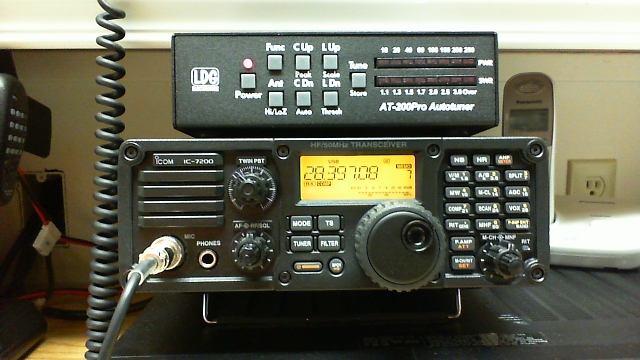
- Novice and Technician licensees may operate using single side band: between 28.300 and 28.500 MHz using up to 200 W.
- When the 10 m band is open as it is lately, high power is not necessary. Excellent contacts can be made even using very low power. Many stations will be using 100 W or less – in fact, I will amend that to say that MOST stations will be using 100 W or less. High power is simply not necessary, which puts Novice and Technician operators on a level playing field with other operators. Experience tells those of us who have been in amateur radio a long time that we are not going to bother turning on a linear amplifier to operate on the 10 m band.
- 10 m antennas are small and almost everyone can fit this kind of antenna into the space that they have available. Using our formula for a half wave dipole, 468 divided by 28.4 MHz (the middle of the Novice/Tech segment of the band), yields an antenna about 16 and one half feet long. That is a pretty manageable length! You would make each leg of a dipole 8 feet three inches long and feed it with 50 Ohm coax, such as RG-8X low loss if you must use a thinner cable or the standard size cable RG-213. Keep the coax run as short as possible in any case, because loss in the feedline increases as the operating frequency goes up. There is more loss per foot on 10 meters than on 75 meters. A quarter wave vertical antenna for 10 m is only a little over 8 feet high. If you want to construct a quad or Yagi antenna for 10 m, they are much smaller than 20 m directional antennas and thus have a smaller turning radius. A 10 m antenna is lighter and easier to handle, too.
- For our Technician Class Handiham members who have already purchased HF transceivers but who have never used them for anything but receiving, this is your chance to press that push to talk switch and enjoy operating SSB. Yes, I know that you have CW privileges on other HF bands, but this is PHONE, and conditions are so good that it is easy to make contacts. Of course Morse code contacts are easier and better during good band conditions, but the window for SSB is open right now.
- RF safety is a concern if you use indoor antennas on the 10 m band. Be sure to perform an RF safety evaluation and locate the antenna as far away from people as possible. Adjust the power level to achieve compliance. For more on how to do this, visit the ARRL website and check the TIS, or Technical Information Service. If you are a Technician Class operator who is studying for General, there is information both in your study materials and in the question pool.
 | It would be nice to extend these excellent Handiham resources to more members at a time when band conditions are so good. |
| Getting a taste of HF operation would surely make Techs excited about earning their General tickets. |
| The 10 m band is also a good place to learn more about HF operation because it is not as crowded and competitive a place to operate as bands like 20 m. |
| We are now hosting the software downloads for the W4MQ software. |
| The HF remote base stations do require some additional technical expertise to operate. Novice and Technician operators are usually the least experienced and need the most help getting things to work. Lyle, K0LR, and I don’t do much, if any, “tech support” on these stations because we simply do not have the time and most of the problems are located at the user’s own home computer anyway. My biggest fear is opening up a floodgate of emails and phone calls about how to install the software and get it to work. This is not an insignificant problem. An installation requires opening a free Skype account, getting audio settings correct, and then installing the W4MQ software and a required W4MQ update. After that, the software must be configured with the IP address of each station and the log in credentials. This is not a problem for a computer user with at least an intermediate skill level, but it is quite challenging for a user who does not know their way around a computer. |
| Technician users may get frustrated by operating practices on HF, which are much different than what they have experienced on FM repeaters. Of course you have to learn somewhere, but are we really ready to do a “sink or swim” exercise here? Maybe we need some training ahead of time, but we have none set up. |
[email protected]
Handiham Manager

The thrill of the hunt
I often think of amateur radio as if I’m on a hunting or fishing expedition. I know for younger and perhaps less patient individuals, this thrill may or may not be shared with the same excitement and enthusiasm. When I walk down the fourteen steps into my basement ham shack or drive up to the mountains for a few hours of portable, outdoors operating….I don’t always know what is waiting for me on the bands.
I’m reminded of an interview I did with Duncan McLaughlin, KU0DM back in episodes 28 and episode 29. I hope you’ll listen to those two older episodes. Duncan and I discussed the possible challenges of attracting todays youth into the hobby. The youth of today are growing up in the information age where everything is instant and immediate. Want to talk to someone on the other side of town? They probably have a cell phone. Want to talk to someone on the other side of the planet? They probably have Skype. Duncan believed the possible ice breaker was in the area of Radio Sport or contesting. Duncan described his philosophy as the difference between fishing and fish sticks. One can take a fishing pole to your favorite lake, pond or stream and may or may not catch a fish….but chances are the local grocery store will be well stocked in boxes of fish sticks. This simple, yet truly interesting way of looking at things is really what amateur radio is all about and in my opinion what makes it special.
While amateur radio requires a license in order to operate on the bands, what amateur radio gives us in return is a license to learn. What we learn might fall into the category of electronics, antennas, solar propagation etc. and these are all important. However, just as important, I enjoy learning more about the geography of those new DX stations I’ve been working.
Of course, when I see a station call sign such as a M0, ON or JA I do recognize them being geographically located in England, Belgium and Japan respectively. However, I’ve also really enjoyed learning more about the callsigns I’m not as familiar with such as UT, CT3 and my most recent DX entity of T32.
Yes our planet is large, but our wonderful hobby of amateur radio can make it much smaller if we let it. As most have probably heard, band conditions are getting better and better. Even for US technician class operators, the 10 meter band has been booming with lots of excellent DX opportunities. Go to your ham shacks and get those rigs fired up and enjoy the thrill of the hunt.
Until next time….
73 de KD0BIK (Jerry)
A Look Back at the Heathkit AT-1 [VIDEO]
With Heathkit‘s recent announcement of them getting back into the kit building business, and Amateur Radio is one of those category of kits coming back, I thought that this little video look at Heathkit’s first Amateur Radio kit would be a good way to celebrate that.I know they announced it some time ago, but better late then never right? Well, this video wasn’t uploaded till about a month ago and I just found it. But You’re the first ones I’m sharing it with. My only complaint about this video, is the presenter is very mono tone. He doesn’t sound enthused with anything. But all in all, it’s still a nice video. Hope you enjoy!
73.
Rich also writes a Tech blog and posts stories every Tuesday and Thursday on Q103, Albany’s #1 Rock Station website, as well as Amateur Radio stories every Monday thru Friday on AmiZed Studios and hosts a podcast called The Kim & Rich Show with his fiance’ Kim Dunne.













