Posts Tagged ‘amateur radio’

Amateur Radio High Altitude Balloon Sets Record

This is one of the coolest stories for the year I think. Ron Meadows, K6RPT and his son, Lee, launched a high altitude balloon along with the group they lead, the California NEAR Project, on December 11th. The balloon was caught in the jet stream at an altitude between 105,000 and 115,000 feet.

Picture of California Near Space Project's Twitter Feed

Picture of California Near Space Project's Twitter Feed

From there, the balloon was carried east at a speed of about 150 miles an hour and traveled across the United States, all along the way transmitting it’s APRS beacon of K6RPT-11. It then continued to travel across the Atlantic Ocean to Spain into the Mediterranean Sea. The balloon had traveled 6236 great circle miles in just 57 hours.

From the Southgate ARC website:

The balloon, which bore the call sign K6RPT-11 and could be tracked via APRS, traveled through California, Nevada, Utah, Colorado, Kansas, Missouri, Illinois, Indiana, Ohio, Pennsylvania, Maryland, Delaware and New Jersey. “When the balloon left the New Jersey shore behind, it was received by coastal stations as far away as Nova Scotia,” explained CNSP Team Member Don Ferguson, KD6IRE. “When it exceeded the range of these stations, we lost track of it and feared that we would not hear from the balloon again.”

The balloon finally came down December 14th, when it burst off the coast of Algeria.

This is a pretty exciting event and sure to peak the interests of people and perhaps inspire some to try High Altitude Ballooning themselves. This flight for the California Near Space Project was by far a huge success and I can’t wait to read more about their future flights.

For more details on this story, head over to the article on the Southgate ARC website and visit the California Near Space Project website.

Handiham World for 14 December 2011

Welcome to Handiham World!
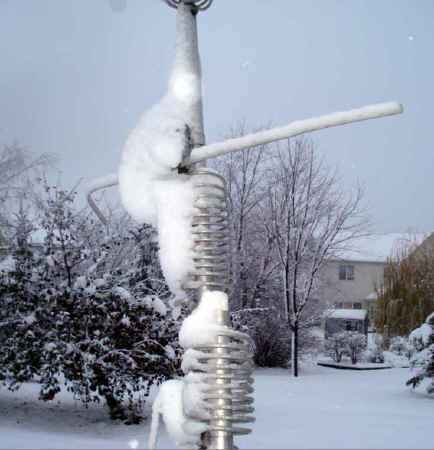
Butternut vertical antenna covered with a wintery coat of fluffy, white snow.
Wow, it’s hard to believe that we are only a week and a half until Christmas and two and a half weeks until 2012.  My January 2012 QST arrived in the mail the day before yesterday, and it is sure to provide some good reading over the holidays. The theme of the issue is “DIY”, or “Do It Yourself”, and big letters on the cover proclaim:  “Winter…  The perfect time of year to build something!”
In case you have not been following the DIY movement, you will certainly want to catch the article by Allen Pitts, W1AGP, on page 75.  “The DIY Magic of Amateur Radio” gives an overview of what is going on in the world of creative “makers” who enjoy the challenge of building projects from scratch.  As Allen points out, there is nothing new about doing it yourself in amateur radio.  Most of us will eventually build something for the ham shack, even if it is a simple project.  Even the most impressive home-built project had its roots in earlier simple projects that allowed for a learn-as-you-go evolution of building skill and confidence.  
There are different reasons that motivate builders.  If you don’t have much money in the ham radio budget, building your own antenna is a good way to get on the air and enjoy the process of figuring out what you are going to make, finding the parts, and learning to to make an antenna by actually making an antenna.  For that second project money might not be an object, and yet you might still decide to build your own project, because you can recall the fun and satisfaction of that first project.  Yes, building your own ham radio projects really does grow on you!  
Since there is a growing “DIY” movement out there that is not necessarily ham radio oriented, wouldn’t it make sense to help those folks learn about ham radio and its long history of building?  That’s what Allen’s article is about, and it showcases a new 8-minute video available on December 27 through the ARRL’s We  Do That Radio website.  I’ll provide the link to the ARRL website story at the break. 
Kudos to ARRL for pursuing this line of marketing amateur radio.  There are many misconceptions out there in the General Public, and it is important to tell our story to set the record straight.  Finding new and creative ways to get the word out is simply part of the new reality of sharing amateur radio.  If you’ll recall the post 9/11 days when emergency communication became a hot topic, amateur radio stepped in as a flexible volunteer-oriented way to augment existing public service communications.  Excitement grew around serving as emergency communicators, and there was a lot of growth in the new ham population.  The EMCOMM system evolved, too.  We now have a well-trained cadre of communicators whose focus is on that vital aspect of amateur radio.   Now it is time to move on to other interest groups, and makers are prime candidates for the exciting world of amateur radio building!
For Handiham World, I’m…
Patrick Tice
[email protected]
Handiham Manager

Christmas Gifts for The Ham Radio Operator

One year, the YL asked me what I wanted for Christmas. I told her, anything Ham Radio related would be a great gift for me. After about 30 seconds of awkward staring at each other, she asked where she could find those kinds of things, as she isn’t a Ham Radio op. I promptly pointed her to the ARRL website, but I also found another option for this year!

ham-radio-on-the-air-neon-sign

Photo Courtesy of TechNote Time

So I did a fast Google search and sure enough, the search algorithm,  came through again with the website TechNote Time. They do have some unique gifts for Ham Radio operators and the prices do seem reasonable. The one that stood out to me was the On Air sign in neon blue. When I do get my “man cave” and have my shack all setup, this sign will have a nice place in it.

The Christmas ornaments are a nice touch for the Ham Radio family tree. They are made of porcelain and come in a few different designs. There’s also decals, novelty signs warning you of electrical shock or RF radiation, and more. So some nice gifts to be had. The trick is, dropping the subtle hints to the shopper who is looking.

They also have gifts not related to Ham Radio, but some could still fit the bill. They even offer gift certificates, if you’re not sure what to get. So there are a bunch of options available.  If you’ve already completed your shopping, they well done! If not, you still have a little time to left to get something unique and nice for the Ham Radio op on your list.

73.


FoxNews.com Media Hit on 700K Amatuers in the US

While doing my usual trolling of the internet, I found a quick little media hit from a Fresno, CA, Fox news station, on the number of licensed Hams in the US. I figured I would share this one.

1200+ Mile Contact on 10 Meter Handheld

As Hams, we know the phrase “A little goes a long way” is very true in Ham Radio. Anyone working QRP can tell you that. There are people that have worked the other side of the planet with just a few watts. I worked Japan once with 5 watts with Grayline. But check out this video of 1200+ mile contact on a handheld.I didn’t even know they made 10 meter handhelds. But we can see one here in the video. As well as making that contact with just 5 watts of power. Not too shabby at all. I say keep this video handy for recruitment. This shows how radio can work.

73.

Handiham World for 07 December 2011

Welcome to Handiham World!

Heathkit HM-102 SWR/Wattmeter poses with Icom gear at WA0TDA.
Image: A venerable and still useful Heathkit HM-102 SWR/Wattmeter poses proudly amid my Icom gear. These days, it is an occasional test instrument rather than a device that is used every day. 
Kits – electronic kits – have always been a part of my ham radio world since I was licensed as a teenager in the late 1960’s.  Kits were around before that, and hearken back to the long tradition of amateur radio operators building their own equipment.  While not the same as designing and building one’s own gear from scratch, kits do allow those who want to feel more vested in their radio equipment to enjoy the “hands-on” experience of assembling the radio and learning more about the layout and circuitry than if they had simply unpacked a new rig and put it on the air.  I can’t think of a time when I haven’t owned at least several kits.  Some of them have been transceivers or transmitters, while others have been accessories or test gear. 
The motivation for owning kits has changed through the years.  Back in 1967, when I got my Novice ticket, and a year later, when I upgraded to General, it was more important to me to find affordable gear so that I could just get on the air. Kits like the Knight T-60 transmitter filled the bill. Paired with a Lafayette receiver that drifted like a rowboat in a hurricane until it warmed up, this little station was the source of more on the air fun than you could ever imagine. I was already familiar with Knight-Kits, having built a two tube regenerative receiver, the “Span Master”, while in high school. When I made the inevitable move to SSB, the Heathkit HW-100 was the kit of choice. It’s 20 tube circuit was challenging to assemble, but I laid everything out on our family’s ping-pong table in the basement and just followed the directions.  It worked the first time, and after alignment and installation of the case, provided my first really solid experience with phone operation, though I had plenty of fun working DX on CW. 
Over the years I built other kits, some of which were test gear that I still own and occasionally use today. Some kits, like a Heathkit SB-201 linear amplifier, were purchased assembled on the used market.  Later on I donated that amp to Handihams, having decided that high power wasn’t really all that fun or useful. There are plenty of good used radios and accessories on the market, originally built from kits but working well today. 
Today’s kit builder is motivated less by the need for economy and more by the desire to experience the fun of putting some of one’s own effort into the station equipment.  However, there is an important new niche in amateur radio kits – that of simply offering equipment that isn’t available any other way.  A third development is the evolution of superior kit radios that rival or best the already-assembled competition!  Cost does not necessarily enter into the decision making for any of these three kit builders.  
I was pleasantly surprised to hear from a group of kit builders here in the Midwest.  The Four State QRP Group has a kit building service and has built kits for hams who are blind or who just can’t see well enough to complete a kit themselves. They do not charge for their service and would like to offer their services to our members.  This is an option for those who cannot build a kit on their own but who would like to experience the fun of operating with a transmitter that would not otherwise be available to them. A link to their website follows after my identification. 
But what about kits that can be assembled by blind hams?  One inquiry that intrigued me recently came from K9EYE, who would like to find a kit for a QRP A.M. transmitter that is possible to assemble with minimal soldering.  Pierre and I both remember as kids having electronics kits or “labs” that were designed to allow for experimentation with a variety of circuits.  Since they were designed with clip and plug connectors, they lent themselves to assembly by just about anyone.  For some reason you couldn’t trust kids with hot soldering irons but wood burning sets seemed to be okay.  Anyway, we all survived to tell about it today!  But we would like to find some blind-friendly kits.  If anyone has sources or ideas, please let us know.  
For Handiham World, I’m…
Patrick Tice
[email protected]
Handiham Manager


A Ham’s Night Before Christmas

‘Tis the season to be jolly and give of yourself to your fellow man. Though I think that should be all year long, but still, around this time of year, it’s nice to spend time with friends and family and enjoy the time. This year I am feeling especially festive, simply because I am with my family. I know, I’m easy to please. But one of the other things I like this time of year is of course the entertainment. It’s a tradition for me to watch Miracle on 34th Street every year during the holidays. And this one may be a tradition I do every year. Post (or repost from this point on..) “A Ham’s Night Before Christmas”. The video is done by Gary Pearce, KN4AQ, with guitar melody by Don Mercz, WA3AYR. So sit back with your coffee or hot chocolate, grab a candy cane or a sugar cookie, and enjoy!



Subscribe FREE to AmateurRadio.com's
Amateur Radio Newsletter

 
We never share your e-mail address.


Do you like to write?
Interesting project to share?
Helpful tips and ideas for other hams?

Submit an article and we will review it for publication on AmateurRadio.com!

Have a ham radio product or service?
Consider advertising on our site.

Are you a reporter covering ham radio?
Find ham radio experts for your story.

How to Set Up a Ham Radio Blog
Get started in less than 15 minutes!


  • Matt W1MST, Managing Editor










