Posts Tagged ‘amateur radio’
 Handiham World for 18 January 2012
 January 18th, 2012 |
  Author:
Remember last week’s E-letter and podcast, when I mentioned that the number one priority here at Handihams would be to fix the website? That time has come, and here is the reason why:
Typically on Fridays I concentrate on producing new audio lectures for our licensing classes. Fridays are also a good time to catch up on loose ends that have collected during the week. Doing website updates is generally a little bit easier on Fridays because I know that I will be logging into FTP in order to put the audio I have produced onto the website anyway, so why not do other web updates while I am at it?
Well, last Friday proved to be a bit unnerving. As I had mentioned before, we had been having serious issues with the performance of the website Handiham.org that had caused pages to either be unavailable or load so slowly that many web browsers would simply timeout. Many of you could not reach our files or would only be able to download a partial file. Needless to say, this situation simply cannot go on. Not only is it bad service for our members, but it can eat up a lot of my time as I try to work my way through the many tech support complaints. Sometimes I have a way to work around it and help the person get the files they need and other times I don’t. In any case, Friday was not a good day for Handiham.org because it went down early in the morning and was off-line most of the day. I contacted the hosting service and they began to work on the problem which was on one particular machine in Utah.
Late on Friday the website did return to service. During the outage, it was difficult for me to work since I had to do everything that I could off-line and only later on plan to FTP the files to the website. Of course any members who needed files during the day were out of luck. Since we have had issues extending over months (though nothing quite this bad), we had already procured server space with Network Solutions, a respected company with which we already had a long-term relationship as our domain name registrar. I decided to start putting some serious effort into building a new beta website that would be the eventual replacement for the current one, but I had to step this effort up several notches over this past weekend.
When something like this happens, you really have two choices. You can either whine or complain about how awful things are and make excuses or you can look on circumstances as an opportunity to make something better. It is sort of like having your old fishing boat sink to the bottom of the lake. Yes, you miss your old fishing boat with all its dents and barnacles. On the other hand, you have an opportunity to get a new fishing boat and it can be exactly the kind of boat you have always wanted. A website is like that. We have had the old website for quite a few years now, and it has served us pretty well. However, over the years it has become cluttered with barnacles – too many links and just too much confusing stuff. It has become a little bit too dated and clunky to be useful, especially to newcomers who may be happening on it for the very first time.
Our opportunity is to build a new website that is easier to administer using Drupal 7, and to incorporate some much-needed changes. One new feature is the addition of a “Skip to Content” link near the top of the page so that blind users who are reading the page with screen reading software can skip listening to all of the menu links and go straight to the main page content. Another feature is a more pleasing view for sighted users without making the website inaccessible to blind users. And, of course, we are simplifying the menu structure to make the site less cluttered.
Our choice of Drupal for a content management system goes back quite a number of years when it was originally suggested by long-time Handiham volunteer Phil Temples, K9HI. We have been using Drupal 5.X and for the past few years 6.X. Drupal 7 has been under development for a couple of years and I have been testing it on my private website for quite a long time, watching as it matured. I feel that the time has come to make the change as long as we are redoing the website anyway. The new version of Drupal incorporates many features that had to be manually added to the old versions. Many administrative tasks are easier. We will eventually need to redirect Handiham.org to the new site, and, because of what we experienced last Friday, are going to try to do this as soon as possible.
As you might expect, there are going to be some problems. Any time you make a big website migration like this, coupled with a major redesign, there are going to be some things that might not work correctly or perhaps will be missing or not work at all. This will all take time to iron out. One thing that will have to be done is that we will have to re–register all of our users. I know this will be a major inconvenience for everyone, but it is really the only way to update the database on the new server with a clean installation. I think the strategy needs to be developed on exactly how we will do this, and I welcome user suggestions. I do have a data dump with e-mail addresses and usernames, so we could send out a blanket e-mail when the new site is ready. However, one concern I have about that strategy is that we may get an overwhelming number of hits on the new website as users try to create their new accounts. It may be better to use a targeted strategy of mailing perhaps 25 users at a time to even out the load. Anyone who has Drupal experience or who has administered a website is welcome to contact me directly with their comments.
The old website will still sit on the old server in Utah, but once the name Handiham.org is redirected, it will become unreachable. I will then take steps to reactivate our other Handiham domain name, Handiham.net. The old site would be available there for some period of time.
One problem that I anticipate is that the Handiham mailing lists with the Handiham.org domain name will cease to function. These two lists are the Handiham Radio Club list and the Handiham Volunteer Instructors list. The Wednesday E-letter list and the Friday New Audio Notification list will not be affected because they are hosted at Freelists. I may be able to reconfigure the club and volunteer lists with the.net address, but I would also welcome suggestions on how we should proceed with these lists.
Some of our users may be concerned about how this will affect the two Handiham Internet remote base stations. Neither station is connected in any way with the web hosting service and both are separately hosted on their own dedicated computers on Courage Center properties. Therefore, neither station will be affected in any way. We do update the remote base station status daily on the website, and this update will be continued on the new website as well.
Another change that will be implemented is the availability of more materials in DAISY format. This new format will replace some of the older MP3 audio for our blind members. This advancement will allow for easier navigation through the material for our blind Handiham members. This does not mean that we are moving away from human readers, so please don’t worry that you will never hear a human voice again on Handiham.org! Some materials, if they are available in computer text in the first place, are most easily converted to DAISY format that incorporates a voice produced by the computer software. Other materials are more properly and efficiently read by a human reader and can be imported into DAISY by special software. Our original production will still be done by Audacity so that we can more easily edit the audio and still produce four track cassette recordings for the Handiham members who need them during 2012. Of course Audacity remains our editor of choice for the Friday audio lectures and for the Wednesday podcast. As before, the free podcast will remain available to the general public in the iTunes store.
We are hoping that the transition will go smoothly, but you know as well as I do that a project like this is pretty complicated and there will always be some unforeseen problems. In fact, to me it sort of feels like planning for and setting up for Field Day. You always anticipate how much fun it is going to be and you have participated in the planning process for past years and like to think that you know you are not going to forget anything this year. Naturally, when you arrive at the Field Day site and start getting everything set up that is when you find out that no one packed Styrofoam cups for the coffee and the power supply cables are still sitting in one of the club member’s basement. That is how it will be for any new project and I am not going to be surprised when things don’t work on the website. What we can do is to work together to make the new website project successful by helpful suggestions that include specific recommendations on how to fix a problem whenever possible.
So, even though this is going to be a real roll-up-your-sleeves-and-get-to-work couple of weeks, I know that we are doing the right thing. I am encouraged by the American Council of the Blind website, which also uses Drupal 7 and the Bartik theme as its public portal. I also want to thank Handiham Radio Club members and Handiham volunteers who have visited the new beta website and given me suggestions and feedback. I really appreciate your help!
Handiham Manager

I’m Shocked and Disappointed…
Let me first start off and say that I believe something should be done to protect against piracy and to protect intellectual property (IP). However, like many of you, I feel the current legislation of SOPA (Stop Online Piracy Act) and PIPA (Protect IP Act) are the wrong way to go about it. Actually, these are both very dangerous pieces of proposed legislation. I encourage everyone to take action.
Websites like Google decided to place a black box over their Google Logo to show support against the SOPA and PIPA legislation. Other sites like Wikipedia have decided to black out their entire site again as protest. In both of these examples, Google and Wiki have posted links where visitors can read more and do more to stop this legislation.
I announced yesterday on Twitter, Facebook and Google+ (the three social media platforms I use) that while I agree something should be done to protect IP, I felt SOPA and PIPA in their current form was not the answer. I then stated my three amateur radio websites, http://myamateurradio.com, http://kd0bik.com/blog and http://kd0bik.com/sota would remain open to share the free flow of information to the amateur radio community.
I began hearing last night of several popular amateur radio websites would follow the trend Wikipedia has done and black out their websites for 24 hours. This is what has shocked and disappointed me. Please allow me to explain why.
Amateur radio is both a hobby and it is a service. Actually in times of need, the service amateur radio can provide is very important. But amateur radio is also more. It’s a community of like-minded individuals who come together to share the magic of radio in all its forms. While not all amateur operators practice this, for the most part we don’t let social, political, religious type issues prevent the free flow of information and enjoyment for the hobby. We prove this each and every day.
What disappoints me is when I’ve learned of certain amateur radio related websites have shut down in protest of the SOPA and PIPA legislation. I’m not talking about just displaying a banner…I’m talking about a full blackout with no access to the information. Again, I understand this is what “could” happen. However, the important thing to remember is…IT HASN’T HAPPENED!!!
Now…let me state I fully understand these websites have the freedom of speech to stay open or to shut down. In addition, I’m really not addressing the individual amateur radio operator who has a personal blog site and blogs about his activities in the hobby. If he or she chooses to shut their site down for 24 hours, this is of course his or her right. What I’m talking about are those sites which are built around supporting the community of amateur radio.
But don’t they too have the right to do as they please? Yes…of course. However, while these sites may be owned by a single individual…their existence is to support the amateur radio community. In many cases, these sites accept donations to help offset their operational costs (yes it does cost real money to host websites). These donations come from the community which uses the sites. Finally, much of the content created on some of these websites has been done so by….YEP, THE COMMUNITY. Therefore the way I look at it is the site just doesn’t belong to a single individual. It belongs to the community. More specifically it belongs to the amateur radio community.
Now I have thought long and hard about if I would actually mention by name some of the amateur radio sites I’ve discovered who chose to shut down in protest to SOPA and PIPA. I’ve decided I would. After all, in both of these examples the site owners/admins made public announcements so they certainly aren’t trying to hide.
The first site might actually surprise you. It did me. APRS.fi, this is the popular Automatic Packet Reporting System map site which many APRS enthusiasts use to track their mobile position. This site is also used by those participating in SOTA or Summits on the Air. In the example of APRS.fi, I find their decision to shut down the most troubling. Simple because many EMCOMM (Emergency Communications) groups utilize this website system and back to SOTA (as this is near and dear to me), many who participate in SOTA do so alone. They are on the trail alone and use APRS to beacon their trail position. While alternative sites exist, APRS.fi has somewhat become the most popular.
The second site fits the “belonging to community” example. HFPack has also blacked out their website in protest of SOPA and PIPA. The somewhat ironic thing I find disturbing about HFPack and their decision to black out the site is unlike every other example I’ve seen, they failed to provide links for visitors to contact their local representatives and links to help a visitor understand why they are protesting.
A friend of mine said it best, “The Interwebz community pokes itself in the eye to protest SOPA…”
In closing, I’ve worked very hard to eliminate certain topics of discussion from my podcast and blogs…especially political commentary. Yes I have opinions. I have ideas. Yes I VOTE. But I keep these things to myself as they don’t directly relate to what amateur radio is about. I will continue to use both APRS.fi and HFPack when the sites return. I’m not boycotting them and I’m not asking you to boycott them. I’m simply stating my opinion and my opinion is these sites should be open to share their services and content with all of us, the amateur radio community.
That is all…Thank you for your time.
73 de KDØBIK
Hellschreiber and microprocessors – Bridging more than 80 years
ZL1HIT (Bryan Rentoul) has bridged a gap of more than 80 years by combining the text transmission system developed by Rudolf Hell in the late 1920’s with current microprocessor technology.
 |
| A sample of received Hellschreiber test from Bryan’s beacon |
Hellschreiber sends a line of text as a series of vertical columns. Each column is broken down vertically into a series of pixels, normally using a 7 by 7 pixel grid to represent characters. The data for a line is then sent as a series of on-off signals to the receiver, using a variety of formats depending on the medium, but normally at a rate of 112.5 baud.
This process was historically accomplished with mechanical equipment but there are very few examples of this equipment still in operation and it is now sent and received by computer. Hellschreiber is very tolerant of noise and interference and requires only simple transmitters and receivers to work effectively.
 |
| German Hellschreiber unit in operation |
With a microprocessor generating the digital on-off signals a simple crystal oscillator transmitter can be used to form a beacon station, one that transmits a call sign and perhaps some other information over and over. Changing the transmitted message is as simple as reprogramming the microprocessor or having it respond to a connected input, for Eg. A thermometer, light sensor, switch, etc.
Receiving the signal and decoding requires a radio receiver capable of CW reception and a computer running any of several free software packages like FLdigi or Digital Master 780.
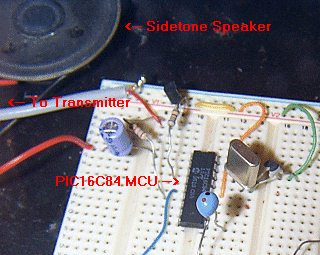 |
| The ZL1HIT beacon using a PIC microprocessor and a simple crystal oscillator transmitter. |
For more information and the PIC microprocessor source code please visit the web page of Bryan Rentoul here : ZL1HIT Hellschreiber / PIC Beacon
The SOTA Activities of KD0BIK–Blog Site
 I’ve setup an independent blog site to somewhat showcase my past and future SOTA or Summits On The Air activities. In addition to posting alerts to future SOTA activations and detailed trip reports after, I also plan to post some “How To” or instructional related topics all about SOTA.
These special instructional SOTA topics can all be found under the category of “How To”. In addition, I’ve setup links to all the various SOTA related websites and even documented some of the gear I carry along with me. The gear page explains what I use and also details into why and how.
You can access The SOTA Activities of KD0BIK by clicking the SOTA Activities link at the top of the page.
Thank you to all who continue to read my blog sites and listen to the podcast.
Until next time…
73 de KD0BIK
The first scratch…
You know how it is when you buy that new pickup truck and you’re so careful with placing anything into the back for fear of getting that first scratch.
A few months ago I learned about Keith, G6NHU and his QSO365 project. I thought to myself what a marvel idea and what a great way to ensure you get on the air more. Keith’s plan was certainly more than just the hope of making a contact a day. It was very well organized and he blogged about his progress throughout the year. Keith successfully completed his goal and did in fact make a QSO each and every day in 2011. Please visit his blog site to read all about his 2011 QSO 365 project.
I think we all struggle from time to time with staying active on the bands. I once interviewed Duncan McLaughlin, KU0DM on the practical amateur radio podcast. You can listen to this two part episode in episode 28 and episode 29. During the interview, I asked Duncan how he managed to stay active on the air with all the other activities a high school aged young man has competing for his spare time. His comment was simple. His goal is to make 5 contacts or QSO’s per week. This might be completed with a single QSO each day for five days or he might complete 5 QSO’s all in one day. The point was to at the very least have a goal and stick to it.
Sadly, I have experienced months where I’ve only made a handful of QSO’s and some months where I’ve made none. I’ve even experienced consecutive months of no QSO’s. I should note, these consecutive months of no on-air QSO’s had nothing to do with HF band conditions. It was available time and motivation to create available time.
As an example, the month of January 2011 I failed to make a single QSO. While I made 157 in February 2011, I experienced zero QSO months in March and April. I really came out of my shell in August with 69, then 302 in September (Colorado and Texas QSO Parties) and I finished the year strong with over 100 QSO’s each month in October, November and December. The month of January 2012 is still young and I’ve logged over 100 Q’s. While it’s not about the quantity or number of QSO’s I make in a given month or year, it really is the quality.
Back to that first scratch. Just after I kissed my wife and wished her a Happy New Year (just after midnight), my wife said to me, “Don’t you want to go down to your ham shack and make a first contact of 2012?” My wife is VERY supportive of my amateur radio hobby and everything that goes along with it (this blog, podcast, SOTA adventures etc.) Of course I said yes, be right back. I quickly fired up JT65 and the first QSO was in the log for 2012. Really without trying I found myself making QSO’s on Jan. 2, 3, 4, 5 etc. I guess you could say I’m trying for a QSO a day in 2012.
But why do I keep talking about a scratch? On the evening of 10 January, I didn’t make it down to the shack until after 9 PM local time. The bands were in horrible shape and I didn’t hear anything on 40 or 80m SSB. I checked the data modes and still nothing. I decided my best chance for a QSO was JT65 and I began calling CQ at 5 watts. Every couple of CQ cycles I increased the power by another 5 watts. Calling CQ at 10, 15, 20 and even 25 watts….NOTHING heard. I began to have the feeling you feel just after you get that first scratch in the pickup bed.
See…when you buy that brand new pickup truck, you do everything in your power to prevent that first scratch. I mean….just about everything. Then one day you look and there it is. As big as Dallas….that first scratch. From that point on you just simply don’t care. You haul anything and everything and don’t care if something slides and bangs around.
I wasn’t ready for the first scratch or the first day with no logged QSO’s. I turned the power up to 30 watts and sent my JT65 CQ out one more time. Thank fully, K5DHY in Texas heard me and replied. A few minutes later the QSO for the day was in the logbook. Whew….I avoided that first scratch.
So I guess you could say that I’m trying for a QSO a day in 2012. My rules are simple…have fun. The day it becomes a chore, I’ll stop. But right now it is fun and yes I realize I’m not even half way through my first month. 
Rules??? I don’t have any rules set really. All contacts will be HF. Most will be made in my shack. But others will most certainly be from portable operations such as SOTA and other portable/mobile operations. My calendar day is based on UTC. Which means in the evenings I’m working towards the next calendar day. This also sort of provides a safety net in the sense if I hadn’t made that QSO on the evening of the 10th, I could have made attempts the next day as long as I got it in the log before 00:00 UTC.
We’ll see how things progress and see if I can avoid that first scratch.
Until next time….
73 de KD0BIK
Handiham World for 11 January 2012

- Fix the website. This morning I tried to reach Handiham.org and it was so painfully slow to load that the web browser just gave up and displayed an error message. We have been encountering this problem more and more over the past year, and it is related to the shared web hosting server that we are using. More than once the hosting company took the site down, surprising us and causing me to have to drop everything else to deal with the problem. Furthermore, I have received complaints about audio files not playing through. This can happen through the loss of connectivity due to server overload. The Fix: Move the website to another hosting service. This project is a major one, and will result in a disruption of our website-based services, but it is going to have to happen sometime soon. We will keep you posted, but before we make the move I would like to hear from you if there is some website feature that you really would like to have that currently does not exist. In the meantime, if Handiham.org appears to be down, it may instead just be really slow due to overload. Wait a while and try again. If audio files do not stream all the way through, an alternative is to download them onto your hard drive then open them. If downloading is slow, try again later.
- Improve our audio recording quality. We depend a lot on audio delivered from the website, both for our weekly audio news and for audio lectures for those who are working on a license or upgrade. And we must not forget about the audio tutorials on how to use various rigs, either. It has come to my attention that some of the audio lectures are incomplete. One, for example, is Extra Class Lecture 59, which simply cuts off at the 42 minute mark. An alert Extra Class student let me know about this, and when I downloaded the lecture to check it, sure enough – the audio file was okay up to 42 minutes, after which it simply flat lined to the end. Checking my original MP3 file, I was disappointed to learn that it was also defective. Unfortunately the original Audacity file was long gone, so recovery was impossible. Since the Extra Class pool changes this summer, we have decided to just leave the defective file in place and concentrate on solving these kinds of quality issues with the new recordings that will begin as soon as the 2012 Extra Class pool is released. To improve our audio, we will be updating Audacity and tweaking the settings. We will also be using a new version of the Lame encoder for MP3 production. Because volunteers also produce audio for us at their own homes, we need to get more information out about how to record digitally. A series of how-to articles on this subject will be appearing in Worldradio Magazine soon.
- Upgrade the equipment at Radio Camp. Recently I proposed that we acquire a new radio for training purposes at Radio Camp. At the same time, we would buy a new rotor to replace a non-working old unit on the 50 foot tower at Camp Courage. The proposed radio is the Kenwood TS-590S with VGS1 Voice Guide module. Following the camp session, the radio could be pressed into service as a remote base station using the accessible Kenwood software interface. This suggestion is under discussion on the Handiham Radio Club mailing list.
- Assess the working space at HQ and make it more productive. A visit to our headquarters will make you a believer – that we need to do something to organize the working space better, that is. A hodgepodge of work stations, storage cabinets, and donated gear that needs assessment greets you as you walk in. We need to put some serious elbow grease into making our headquarters a better space for working and operating, as well as for checking radios and accessories out to see if they are working and to make minor repairs, assemble power cables and coax jumpers, and make sure that each radio has all of its accessories.
- Expand our Internet Remote Base capabilities. The addition of a TS-590S station would definitely be an improvement, but what if we could add a DX station with a tower and beam? That is what we will be discussing as we gather for Radio Camp 2012 in June. In the long run such a station benefits our members whether or not they attend a radio camp session. It is an essential service to offer remote base capability now, having begun as a quirky experimental project at Courage North several years ago. Included in our effort is a revamp of the existing W4MQ software, which could use some additional accessibility features. Since 2011 we have been hosting the W4MQ software project following the untimely death at age 58 of Bob Arnold, N2JEU, who had been hosting it for the past couple of years.
- Prepare a new Extra Class lecture series. As mentioned, the question pool changes on July 1. The Extra Class lecture series, designed to be blind-friendly and accessible to Handiham members with reading disabilities, takes an enormous amount of time to produce. Based on a variety of references, it will take the student through the concepts and not simply a reading of a textbook or the question pool. I hope to get through it more quickly this time and with better audio.
- Plan for the future. In the past we have periodically called on volunteers who serve as members of an advisory board. It is time once again to bring the Handiham Advisory Board back to life so that we can be sure we are hearing from our members as we plan our way forward into the next few years. Obviously technology is changing, and our services must change with it. I can’t see the future any better than the next person, but one thing I have learned from experience is that there is usually wisdom and insight to be gained by bringing knowledgeable people together to tackle projects like this. Any one person has limitations based on their likes and dislikes. In a group, we will have a chance to bring forward new ideas, hash them through, and decide where we need to place our efforts. This is timely, since I will turn 64 in April and will eventually retire. While that may not happen for a few years, we need to plan now for a smooth transition, and that can’t really take place easily without a “future plan” of where the Handiham program should be in the years ahead.
- Leverage social media. With other amateur radio organizations and services already in the game, we have some catching up to do. The Handiham program does not have a Facebook or Google Plus presence, and it is no longer possible to ignore these powerful marketing tools. Courage Center, our parent nonprofit company, and Courage Center Camps (of which we are part) both have Facebook pages. Figuring out a strategy is key, since we would need to limit our administrative time on such an account due to limited resources.
Handiham Manager

The Magic of DIY from the ARRL
I love my morning surfing. I’m always finding something good to share. One other morning, I found this one. It’s a video from the ARRL showing innovative, imaginative and fun ways hams use radio technology. It’s about 8 minutes long and it looks to be a recruitment video towards the DIY crowd.That I think is a good idea, as I have seen a couple videos from the Maker Fair on YouTube here and there, that incorporate Ham Radio in their projects. And the topper of this video in my opinion is the host, Diana Eng, KC2UHB, who is no stranger to the DIY, Fashion and Ham Radio communities. A Trifecta!
73.
[adrotate group=”2″]













