Posts Tagged ‘amateur radio’
 Vacuum tubes could revolutionize computer chips?
 May 26th, 2012 |
  Author:
 No, I’m fairly sure I haven’t lost my mind … that really is the right headline.
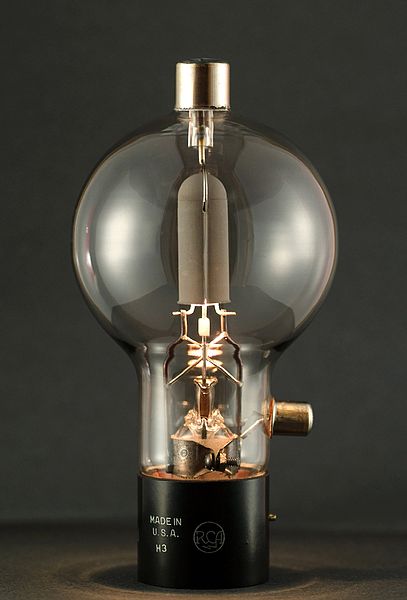 According to a resent paper published in the American Institute of Physics, nanoscale vacuum “tubes” manufactured using conventional chip making techniques have operated at frequencies as high as .46 THz.
Dr. Meyya Meyyappan, Director at the Center for Nanotechnology at the NASA Ames Research Center, has highlighted the advantages of nanoscale vacuum devices which include resistance to hard radiation and significantly improved operating frequencies.
.jpg) The increased operating frequency comes about because of the speed at which electrons travel through different materials. The speed of electron travel through silicon is comparatively slow, through graphine it is approximately 100 times faster and through a vacuum it approaches the speed of light.
The increased operating frequency comes about because of the speed at which electrons travel through different materials. The speed of electron travel through silicon is comparatively slow, through graphine it is approximately 100 times faster and through a vacuum it approaches the speed of light.
While the cavity is not technically a vacuum it contains so few atoms of any other material, such as oxygen, it is functionally the same. This also gives the vacuum nanoscale device an advantage in space where hard radiation can disrupt an electron’s travel through silicon leading to errors or sometimes permanent failure.
Dr Meyyappan estimates that vacuum nanoscale components will run ten times faster than the best conventional silicon chips and who knows what advances the future will hold. Faster chips will aid in signal processing and more capable software defined radios.
Do you want to monitor every CW & PSK31 transmission on the 40M band at once? With a vacuum “tube” rig you may be able to!
Handiham World for 23 May 2012
Welcome to Handiham World.

You can do it!
Today, just as we did last week, we are going to begin with Troubleshooting 101 as part of our initiative to help new ham radio operators (and even some of us older ones) learn how to do some basic troubleshooting for ourselves. Yes, it can be tempting to ask someone else to do things for us. This can become a bad habit when it keeps us from learning new things, especially things that we could – with a bit of practice – learn to do for ourselves. Knowing these basic things can serve us well in the future when no help is available.
Troubleshooting 101

Let’s get to today’s troubleshooting question:
Question: This question has to do with my workshop. Let me explain; over the years I have collected quite a few electronic parts and lots of hardware used in electronics and computers. While I have built some projects in the past and have done some repairs on various pieces of equipment, it seems like I seldom use many of these parts that I have saved up. My wife told me that the basement is getting to be kind of a mess and that I should clean out some of the “extra junk” from my shop. My question is, “How does one decide what to keep and what to throw away?”
Interestingly enough, I was just thinking about this very problem recently. It seems like whenever I have to work on something in my own shop, almost invariably I will have to go out and buy something to complete the repair or project. I am almost never able to pick something out of my junk box and make it work. Since I have been an amateur radio operator for decades, I have saved up a collection of really good stuff that I am possibly going to use some day – for something. The problem is that I have stuff that has been in the same place in the shop for 20 years and has never been touched. Now, you may be thinking that my workshop is such a mess that I just can’t find anything. That is not the case. I pretty much know where things are, but I just don’t seem to ever need them for a project or repair even though that is the reason I am keeping them.
Does any of this sound familiar?
I’ll bet it does; just about every other amateur radio operator does exactly the same thing. We might find an interesting treasure at a hamfest or swap meet, but we really don’t know what we would do with it other than use it for a project that never seems to materialize. So to answer the question, you need to come to terms with the reality of the situation. Let’s lay it out and be as honest as possible:
- Technology advancement: Technology has marched on, but your junk box collection has not. The fact of the matter is that most of the stuff you have collected might have been good for fixing electronic equipment that was in vogue 20 years ago or more. Today’s electronics use different kinds of parts and sometimes are not even user-repairable. Those vacuum tubes and wire wound resistors in that box underneath the workbench are probably not going to be much good to anyone but a person who restores old radios. If you are not such a person, then it is time to get rid of those kinds of parts. I could go on about other parts for radios and computers, but you get the general idea. If it is not likely to be used in current technology, get rid of it.
- Time is limited: Be honest about your time. You do not have unlimited time. You’re busy, perhaps busier than you have ever been, especially if you are still in your working years and are raising a family. Do you really have time to work on projects that will take many hours or even weeks or months to complete? It may be better to pare down your collection of project parts and keep only the most essential. Your reward for doing this is a tidier shop and less clutter. This will make it easier to do the projects that you do actually have time to complete.
- Your interests have changed: At one time you were interested in packet radio and by gosh, you still have that old terminal node controller on the shelf. Along with that, there is an old computer that used to run DOS and that would be “perfect” for your packet station. After seeing a club program about rhombic antennas, you decided to start collecting wire to make that rhombic antenna someday. Of course, you are also interested in getting several of those old computers you have saved back into service. Maybe you can put Linux on them. Well, guess what? If you haven’t done anything with these items for several years, your interests have probably changed and you are not likely to get around to any of these projects – ever. Give as much of this stuff away as possible and recycle the rest. Most counties and municipalities have some kind of recycling program for computers and electronics.
Just how honest can you be with yourself? After years of collecting all this junk, it can be difficult to admit that you are never going to get around to using any of it and that you are better off just getting the workshop cleaned out and tidied up so that you will have more space to work and less clutter.
Over the years I have seen some real junk collections. A few of them have been jaw-droppingly amazingly enormous collections worthy of being a swap meet in and of themselves. I could never imagine how anyone could have deluded themselves to the point that they actually believed all of this stuff would someday be useful! It would’ve been impossible for the person to use half of this stuff in two lifetimes, let alone one lifetime. One guy, an elderly gentleman, had a basement full of shelves arranged in rows, all stacked with equipment and parts at least 30 years old. Another had a basement and an additional storage building with row upon row of shelves holding old parts and radio gear. It is not as uncommon as you might think.
We have to face up to the fact that keeping things simple, actually expedites project-building and troubleshooting. When you have too much stuff, you waste time moving it around or digging through it to find some little part you think you might have. This is usually not worth the time and effort. You are better off buying a new part that will be exactly the right one when you need it. Furthermore, too much junk and clutter can make you prone to simply putting off a troubleshooting project because it is too much effort to work in your shop. If that is the case, you REALLY need to do some serious organizing.
At Radio Camp we will be talking about the essentials of a good, efficient home workbench. We won’t go into this lean and mean list of shop basics right now, but I will reveal that it is surprising how little one needs to have a really effective troubleshooting and project space.
Email me at [email protected] with your questions & comments.
Patrick Tice, WA0TDA
Handiham Manager
A dip in the pool

It’s time to test our knowledge by taking a dip in the pool – the question pool, that is!
Today we are taking a question from the Extra Class pool:
E4C09 asks: “Which of the following is most likely to be the limiting condition for sensitivity in a modern communications receiver operating at 14 MHz?”
Possible answers are:
A. The noise figure of the RF amplifier
B. Mixer noise
C. Conversion noise
D. Atmospheric noise
Long ago, when receivers used vacuum tubes and discrete components and when a VFO could drift like a rowboat in a hurricane, we reveled in the “good old days” of radio. Yes, these were the times when we sometimes listened with our hand on the tuning knob, either to follow a drifting signal or to try to find a sweet spot where we might hear a signal through all the noise. In retrospect, they were really “the bad old days”, because our equipment is so much better now. Receivers are so good that they have noise figures below noise that would occur naturally in the atmosphere and stability that rivals crystal control. Thanks to these advances atmospheric noise is now the biggest worry, so answer D is correct. In essence, engineers have done everything possible to the receiver itself to eliminate internally generated noise. It’s hard to do much about atmospheric noise, but now modes of operation have evolved to fight back against poor conditions. PSK-31, for example, is amazing – it works even on days when you would be hard pressed to hear a CW signal. As far as receivers go, if you are looking for the good old days, we are living in them right now!

Introducing the PARP Plus Weekly Edition

A new weekly audio edition of the Practical Amateur Radio Podcast, called PARP Plus is now available. PARP Plus will feature a rundown of all the amateur radio happenings taking place on the bands for the upcoming week and weekend. If you enjoy working special event stations, contests, dxpeditions…but just don’t have time to track down what is taking place and where, then I believe PARP Plus will help you.
If you have 15 minutes each week to listen to the podcast, I’ll run through all you need to know for all the on-air activities taking place in the week ahead.
Each weekly PARP – Plus Edition will release on Monday evening around 0000z and will cover the week/weekend ahead. Just listen and make note of the various special events, contests, dxpeditions, hamfests etc. that I discuss…then just work them.
You’ll still get your BIG PARP episode each month. PARP 56 will be available in June, just before Field Day.
I hope this new weekly format helps you. I also plan to mix in other content from time to time. So please download and listen. If you are already receiving PARP, you’ll get PARP – Plus the same way.
PARP Plus, episode 001 covering the week of May 22 through May 28 is available now at MyAmateurRadio.com.
73 de KDØBIK
Did Yaesu miss the boat?
Unfortunately I was unable to attend the Dayton Hamvention this year. It was on my list of things to try to accomplish for 2012, but since I’m heading out west to Pacificon in October, I needed to save my pennies for that adventure. The Dayton Hamvention will be moved to my “things to accomplish list” for 2013.
As you may know from my recent blogging, I do own the brand new Elecraft KX3. I described this little rig in a recent podcast as “ultra-lite, ultra-portable, ultra-awesome” and the KX3 certainly lives up to all of these fine attributes. While I’ve owned my Yaesu FT-817 for about 4 years, I really love the larger display of the KX3 and of course all the updated features certainly don’t hurt either.
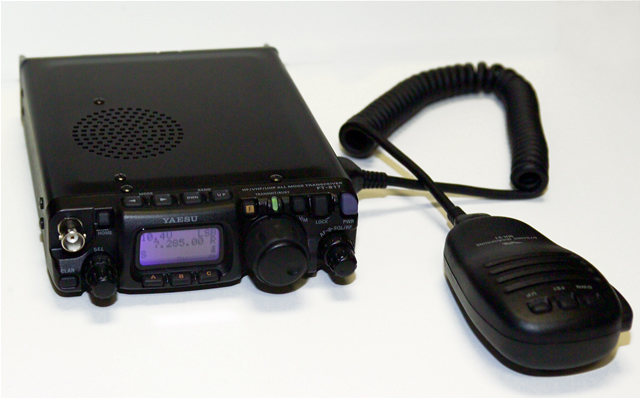
The Yaesu FT-817 was first released in 2001 and an updated FT-817ND model was made available in 2004. The 817 is based on the main circuit board design of its bigger and more powerful brothers, the FT-857 and FT-897.
As I stated, I purchased my 817 back in the 2008 timeframe and used it for portable operations and carried it along with me on hiking and backpacking trips. I became hooked on SOTA or Summits On The Air in the fall of 2011 and this became my main radio for that purpose.
While I’m perfectly happy with my KX3 and have already used it on one SOTA adventure, I was (like many) thinking, hoping, expecting, anticipating Yaesu to unveil it’s new QRP portable offering at the 2012 Dayton Hamvention. However, the Dayton Hamvention is over and there was no announcement or news of any kind from Yaesu regarding their future QRP/Portable offering. I’m wondering if the boat has sailed and left Yaesu high and dry?
With Elecraft announcing the KX3 at the 2011 Dayton Hamvention and opening the KX3 up for orders in late December 2011 and beginning to ship orders in the Spring of 2012, the 2012 Dayton Hamvention would be the perfect place to announce a new QRP offering from Yaesu. Well…that is if a new offering was planned.
Of course, Yaesu is big enough and perhaps powerful enough not to necessarily need to leverage an event like the Dayton Hamvention to announce a new QRP rig. Also, there is absolutely nothing wrong with the FT-817. While it may be over 10 years old, the old dinosaur is still kicking and screaming and loved in the QRP community. As I stated I do own one and I plan to keep it….for now!
So why do I even bring this up? Well I do have an interest in QRP operations and an updated offering from Yaesu would be great news for the hobby. However, I don’t view this as doom and gloom. I figure Yaesu will update their aging line of 817’s, 857’s and 897’s when they feel the time is right. However, I just wonder if that time is NOW!
Until next time…
73 de KDØBIK
Handiham World for 16 May 2012
Welcome to Handiham World.
You can do it!
Today, just as we did last week, we are going to begin with Troubleshooting 101 as part of our initiative to help new ham radio operators (and even some of us older ones) learn how to do some basic troubleshooting for ourselves. Yes, it can be tempting to ask someone else to do things for us. This can become a bad habit when it keeps us from learning new things, especially things that we could – with a bit of practice – learn to do for ourselves. Knowing these basic things can serve us well in the future when no help is available.
Troubleshooting 101
Let’s get to today’s troubleshooting question:
I sometimes use my handheld radio in the car. I can hear the repeater just fine, but I have had complaints that other stations can’t hear me. What’s going on here? Is there something wrong with my HT?
Yes, I’m afraid there is a problem with your radio. The problem is that it has a terrible antenna. Before you complain that the radio has always worked quite well when you used it around the house, let me explain.
Handheld radios are meant to be portable so that they are easy to carry around. Haven’t you noticed that people prefer smaller, lighter electronic devices? So what was once referred to as “a brick” – the venerable 2 meter HT – has evolved to a multiband miniaturized wonder that fits in the palm of your hand. The antenna on the old brink was just about the same length as the one on your new radio, though. These flexible “rubber duck” antennas are the ones that come as standard equipment with a new handheld radio. They have always been terrible antennas, but they are designed to be flexible so that they can bend without breaking and generally survive being dumped into a backpack, stuffed into a pocket, or crammed into a purse. A quarter-wave antenna for the 2 meter band should be around 19 inches long (48 cm), but the radio would hardly be portable with that big antenna, would it? The rubber duck antenna is inductively loaded so that it can be physically shorter but still act like an electrical quarter wave.
This seems like a great solution because now you have the equivalent of 19 inches of antenna in a tiny, convenient flexible stick. Ha, ha, that is a good one. Most of these rubber antennas are more like a “dummy load on a stick”. They are inefficient and lossy. A rubber antenna that came with the HT is probably okay if you are in a good location and not far from the repeater and are not moving around. The rubber antenna can receive okay but is not going to win any awards, but transmitting efficiently is just plain not a happening thing. When you move the antenna around, every slight cancellation of signal from multipath reception becomes a near-dropout. It is even worse inside a car, where the body of the car can block part of the signal and you are nearly always moving. No wonder your friends are complaining about your signal – because it is terrible!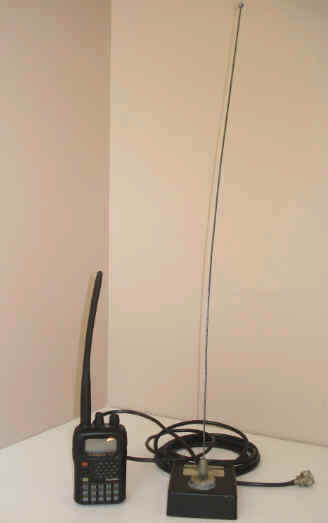
I placed my tiny Yaesu VX5R HT with the somewhat bent from years of carrying it in my pocket next to an old Larson 1/4 wavelength magnet mount antenna. The ACTUAL quarter wave mag mount towers over the HT with its wimpy rubber antenna. If only there were a way to use a quarter-wave magnet mount antenna, or even a 5/8 wavelength mag mount antenna, with my HT it would sure solve my transmitting problem and make the HT more useful as a temporary mobile radio.
Of course there is a way; you just need to get the right adapter to mate the mag mount antenna’s connector to your HT and you are in business, right?
Well, no – it’s not quite that easy. For one thing, you might not have a mag mount antenna. And you may not be familiar with these kinds of temporary antennas, especially if you are not a driver yourself and you ride with a spouse or a friend. Here are some things to consider:
- If you are going to move the antenna around a lot, such as using it on a friend’s car then removing it after you get where you are going, there are tiny, highly-portable miniature mag mount antennas with small diameter coax (RG-174U) with a connector to fit directly onto your HT. Actually, I prefer these antennas over other mag mounts because the light, flexible coax will not put extra stress on your radio’s SMA connector. MFJ makes the MFJ-1722 dual-band mag mount antenna and it is only around $15 – an accessory to your HT that is well worth the money.
- If you already have a more conventional larger mag mount with RG-58 coax, I recommend an adapter with a short piece of RG-174U coax so that the flexibility of the cable allows for comfortably moving the HT about as you use it. Stiff coax will put excessive pressure on the HT’s antenna connector and may eventually break it.
- If you are using an HT with an SMA connector, you may want to consider a special connector adaptor that seats against the body of the radio, taking pressure off the antenna connector.
- Pay attention to the routing of the feedline out the door. It may run through the gap between the door and the car’s frame, but choose a spot where the rubber gasket around the door frame will close gently against the wire.
- Avoid sharp bends when running coax.
- For longer term installations, test the water seal around the coax entry point with a garden hose.
- Place the antenna on the roof of the vehicle or on the deck of the trunk lid if the cable is to be run through the back seat and out into the trunk.
- Be sure the magnet has a serious grip on the metal car body!
- Avoid long, flapping runs of wire across the roof or trunk.
- If you have an antenna that screws onto a magnetic base, be sure it is screwed on tightly before traveling!
- Consider a small, easy to remove antenna that is placed just outside and above a back door. You can easily grab it off the roof and shove it on the back seat floor under a mat when you want to conceal the fact that you have a radio in the car or if you need the extra clearance to get into the garage. While you’re at it, unhook the HT and put it in the glove box or take it with you.
- If you are serious about using an HT in the car, you might also pop for the optional car charger. All the HT manufacturers offer them, and they can be in the glove box with an extra rubber duck antenna when not in use. You will likely need high power while operating mobile, and that can run your battery down quickly.
Once you start using a “real” antenna mounted outside the vehicle, you will wonder how you ever got by with an HT and the rubber antenna.
Email me at [email protected] with your questions & comments.
Patrick Tice, WA0TDA
Handiham Manager

Another Birthday for PARP
When I started the practical amateur radio podcast on May 8th 2008, I really had no idea how long it would last or how big it would grow. Four years later (and my 5th season podcasting) I still continue to receive emails thanking me for doing what I do. I’m also frequently reminded of why I podcast, when I receive emails letting me know a new ham has his or her license as a result of the podcast. I very much enjoy creating the audio podcast, the video supplements and blogging. I consider it an extension of the hobby.
This blog post is what I referred to in episode 55 (just released today), as part of the PARP Birthday Trifecta. In other words, I typically use my Podcast, my YouTube Channel and this Blog to Elmer and promote amateur radio to anyone who will listen, watch and read. These avenues are referred to as new media.
Pacificon 2012

Speaking of new media, I’ve been invited to attend the 2012 ARRL National Convention and Pacificon in October of this year. I will participate in a panel discussion titled, “Amateur Radio New Media Elmering”. I’m very excited to share the stage with other “Big Names” in the new media elmering space. I’m sure you’ve heard of all three…
Chris Matthieu, N7ICE is the founder/creator/developer of the amateur radio social networking site 73s.com.
Randy Hall, K7AGE. Randy is best known as that YouTube guy. Randy is approaching his 6th year of using his YouTube channel to Elmer. His total video views surpass the 2 million mark.
FInally, the three of us will be joined by Mr. Elmer himself…Gordon West, WB6NOA. Gordo has helped thousands earn their technician license (and upgrade to general and extra) through his exam prep guides and excellent audio material. I’m proud to say I’m a three time graduate of Gordo’s material.
I’m truly honored to have the opportunity to meet these three gentlemen and share the stage to discuss our share passions for helping others and promoting this wonderful hobby. I’ll make certain to continue to provide updates as we get closer to the October timeframe. I hope to see you at Pacificon.
A Gift to You
In an effort to help celebrate PARP’s 4th birthday, I asked three popular amateur radio vendors to help me celebrate. In return, each have provided coupon codes you may use for a limited time to save money when purchasing items from their website. Consider it a gift to you.
It just so happened I was able to tie each of these three vendors into the educational/discussion segment in episode 55 of the practical amateur radio podcast. The topic of episode 55 is about programming your radio.
I would like to thank Nifty Ham Accessories, RT Systems Inc. and RFinder – The Worldwide Repeater Directory for helping me celebrate the 4th birthday of the practical amateur radio podcast. Please listen to episode 55 to learn about the coupon codes from Nifty Ham Accessories, RT Systems Inc. and RFinder – The Worldwide Repeater Directory.
Until next time…
73 de KDØBIK
Mic Clickers: Easy 3-Point Guide.
1. DO NOT acknowledge any interference
2. DO NOT acknowledge any interference
3. DO NOT acknowledge any interference
Clear enough? Self-evident? One would blooming think so. However, I’ve regularly heard some less-than-fully-brain-QRV amateurs :
1. Acknowledge the interference, repeatedly
2. Provide the abuser with a useful and accurate signal report
3. Articulate ‘entertaining’ anger and frustration to encourage further abuse
Once you can grasp the simple, blinding reality that these abusers only do this to elicit a response – provide them with that response and they will continue, satisfied and emboldened. Deny them that response and they will, eventually, cease and desist. I promise you.
 |
| Owain Glyndŵr, detection genius. |














