Posts Tagged ‘6m’
 Great 6m Es Conditions Continue!
 July 8th, 2014 |
  Author:
  |
| 6m July 08 Courtesy: ON4KST.org |
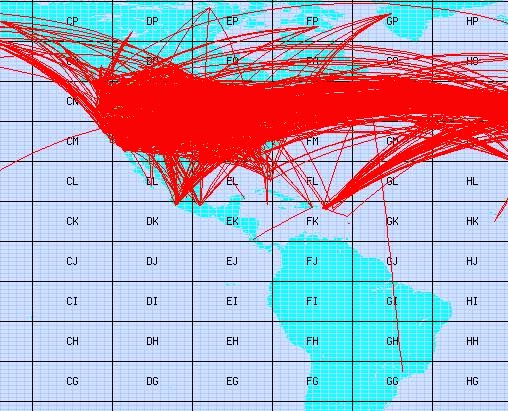
Six meter operators in the western part of the continent exchanged signals with Japan, Taiwan, China and South Korea beginning at around sunset on the west coast and continuing until 0230 the next morning! Many stations on both ends of the path filled their logs during the heyday event.
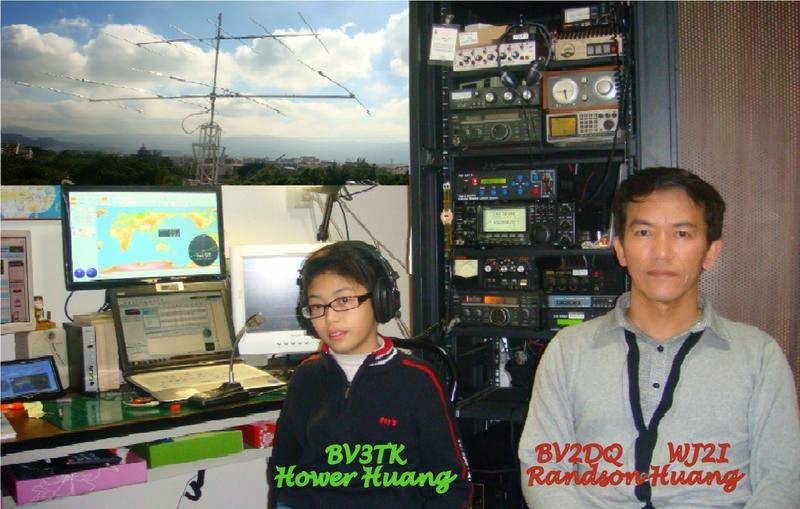
To add to the fun, BV2DQ (Ran) in Taiwan, was also active and gave several 6m ops a new country, working as far east as Colorado.
 |
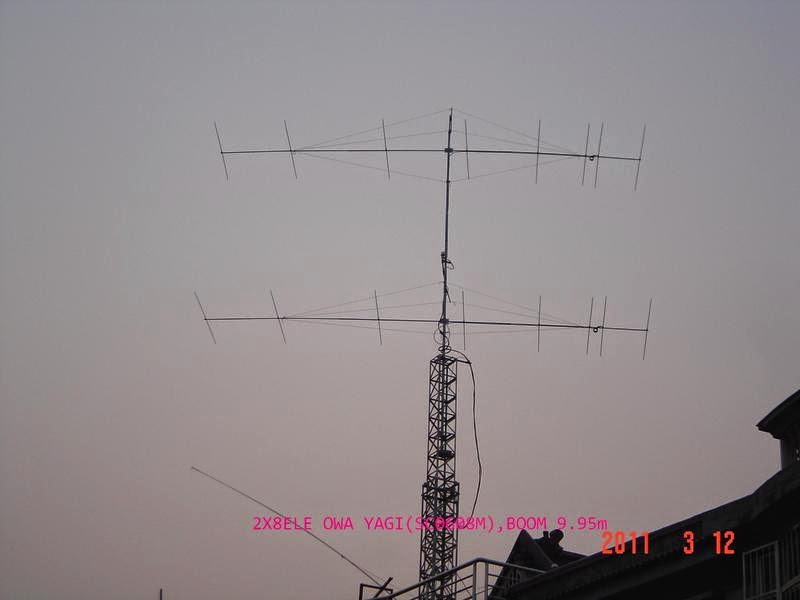 |
| BA4SI 6m stacked Yagis |
" W7FI Jim - That blows away my 113 JA last night, pile still calling when I qrt'd at 0800z. "
I was also present for the action, but worked only a few dozen of the strongest signals as I have been plagued with exceptionally high power line noise this summer, directly in line with Asia. Additionally, a new source of QRM has cropped-up in the form of an S9+ 49MHz wireless headset that has drifted up into the band. As the days get warmer, it has now drifted from below 50MHz up into the working part of the band and last night had settled itself smack on 50.090. Being a wide band FM signal, it effectively destroys any reception for about 50KHz of the band. As Murphy would have it, the crud is coming from the exact same direction as my beam heading to Asia. Yesterday I was able to roughly determine its location with a handheld Icom scanner and today I will use a quickly-built 6m dipole to zero-in on the offending source. Hopefully I can eliminate the problem soon.
6m – past the best?
I am beginning to think that 6m is now past its best both for Es opportunities and, of course, for F2 propagation. Almost zero Es on 6m in the last few days, mainly locals and a little GDX. I may give it a few more days before QSYing back down to 10m where both Es and F2 DX are more plentiful.
10m conditions should be good for N-S F2. Sunspot count is 256 (high) and 20-30MHz propagation is forecast to be “normal”.
If anything, solar activity has staged a bit of a comeback lately, but this may be just a blip.
UPDATE 1545z: As if to persuade me to stay on 6m, CN8LI (2113km) was spotted at 1450z.
UPDATE 1810z: No more Es here since CN8LI at 1450z. One blog reader tells me that I should try JT65 as there is more activity. JT9-1 worked well for me on MF with international 2-way QSOs with very low mW ERP. I think JT65 is more commonly used on 6m?

West Coast Day For 6m
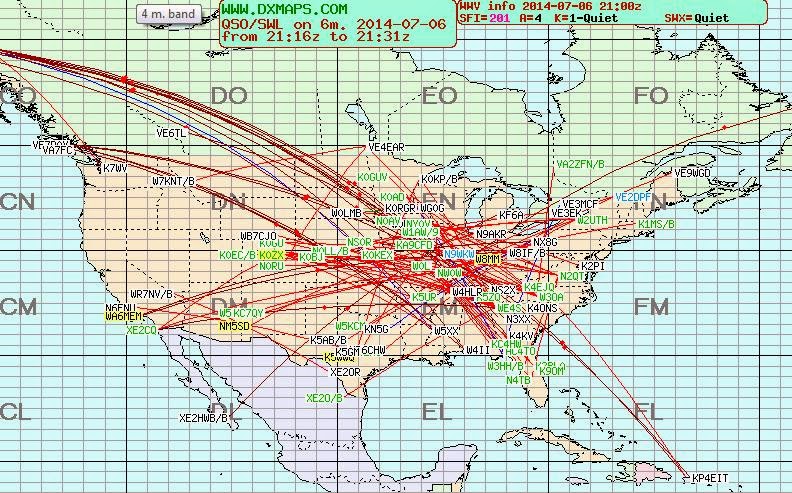 |
| Courtesy DXMAPS.COM |
At 0700 I began to hear bits and pieces of CN8KD in Morocco while he was working 4's and 5's ...every once in a while his CQ's would briefly rise out of the noise but never long enough or loud enough for me to reply. He eventually faded and the band shifted to a more northerly path and at around 0900 local time, EA8DBM (Canary Islands, AF) showed up on SSB, while working into the SE U.S.A. He was much louder further to the south but at 1632z I was able to work him on phone and a few minutes later on CW, down the band. In over 40 years of being on 6m, this was only my second African QSO, with my other one also being into EA8.
The best part of the opening today was the number of west coast stations that were able to put rare Africa into the log....and, for a number of them, it was the completion of WAC on 50MHz....very tough from the left coast. VE7DAY, K7SS and NA6XX will all be celebrating today!
As I post this at 2130z, the KL7's are cashing-in on the magic while working across the U.S. as far south as Florida! I've always thought the first week of July to be the best of the season for 6m...lets hope it keeps going.
Cycle 24 Still Crackling
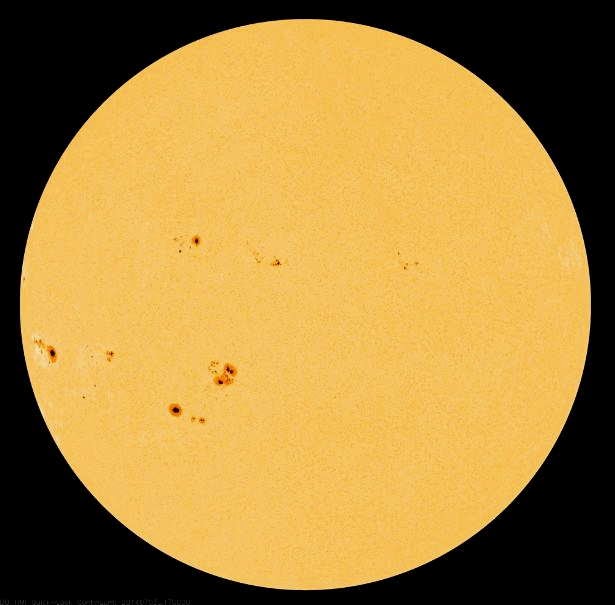 |
| The Sun Today / July 03 Courtesy: nasa.gov |
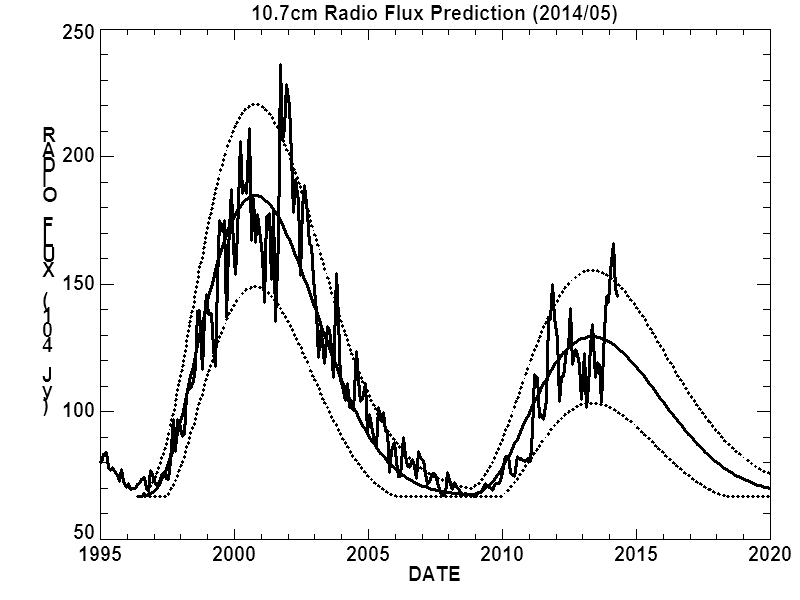 |
| Cycle 24 Prediction (courtesy: nasa.gov) |
The present rotation has brought a number of active sunspot groups into view along with several small solar flares. The elevated solar flux has had an immediate effect on propagation, producing excellent F2 conditions on the higher bands. Today's solar flux is pushing 170 and on the rise! It makes one wonder what other strange tricks Cycle 24 might have up her sleeve for us yet?
Active flaring during the summer 50MHz sporadic-e season can often produce some odd long-haul paths along with the possibility of some transcontinental auroral-e propagation....so hold on, as it looks like the ride is not yet over!
6m – WSPR spots from 4X1RF (3519km) yet again
My 6m 1W ERP WSPR signals are yet again being spotted in Israel.
I think this is now 5 days this season he has spotted me at this incredible distance. In all I must have had around 20 spots if not more from him? The considered wisdom is this is Es, but I do sometimes wonder what the propagation mechanism is. The lack of stations at intermediate distances may be because few are active on WSPR, but it “feels” like a single long hop, not unlike F2. My station and antenna are basic.
People who know better than me tell me it is not F2. Whatever, I am very pleased to have my QRP station being spotted so often in Israel.
Today, starting at 0704z, he has spotted me 6 times already by 0846z.
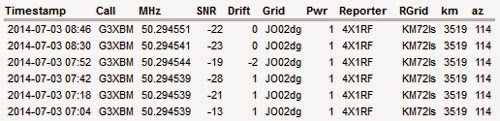 |
| 6m spots by 4X1RF (1W ERP here) to 0830z today |
Most Es spots seem to be from Scandinavia currently, just 1 from Italy.
UPDATE 0942z: Just Scandinavian Es for the last hour here.
UPDATE 1530z: Another spot from Israel of my QRP 6m signal at 1314z. That makes it 7 just today!

6m Action
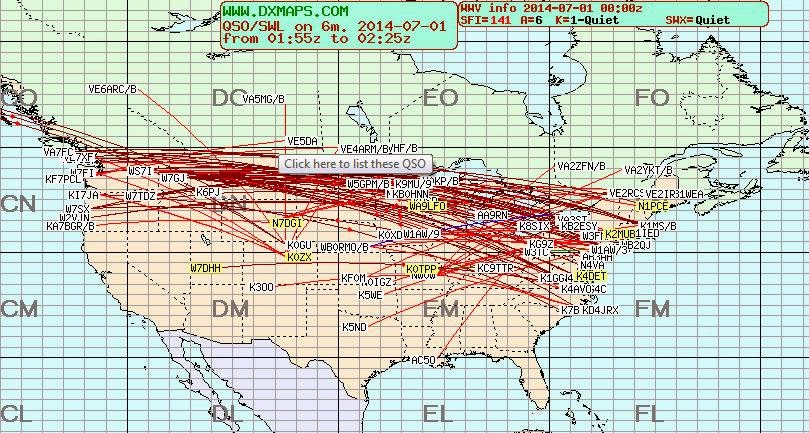 |
| Courtesy: DXMAPS.COM |
Where Are The Es ?
 |
| Courtesy: DXMAPS.COM |
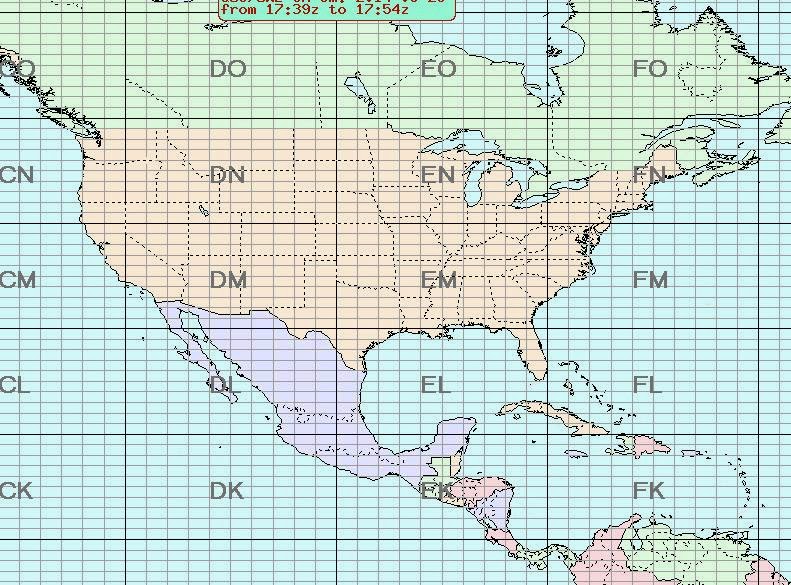
Having been on 6m now for over 40 years (yikes!), like most 6m operators I've come to expect a fairly good number of Es openings by the end of June. This summer's Es season has been beyond poor, with far too many days looking much like Saturday morning's 6m propagation map (above) from DX Sherlock.
So far, the only bright spot for me has been a very short twenty-minute opening to Argentina and a CW QSO with LU5FF on May 24 at around 1500 hours local time.

Most 6m ops feel that sunspot cycle peak years also produce poorer than normal Es activity so maybe this is all just normal...or perhaps our global climate shifts are having an effect on the triggering mechanisms for Sporadic-E, just 60 miles above our heads.
Real-time 6m propagation can be followed here; Region 2 for North America and Region 3 for Europe.
After so many summers on six, I personally believe that the best propagation usually happens during the first week of July, so there is still hope for a really terrific month ahead and still time for whoever controls the magic to yet redeem themselves.