 |
 Toroid winding can be fun…..well almost.
 10 August 2013 | by
 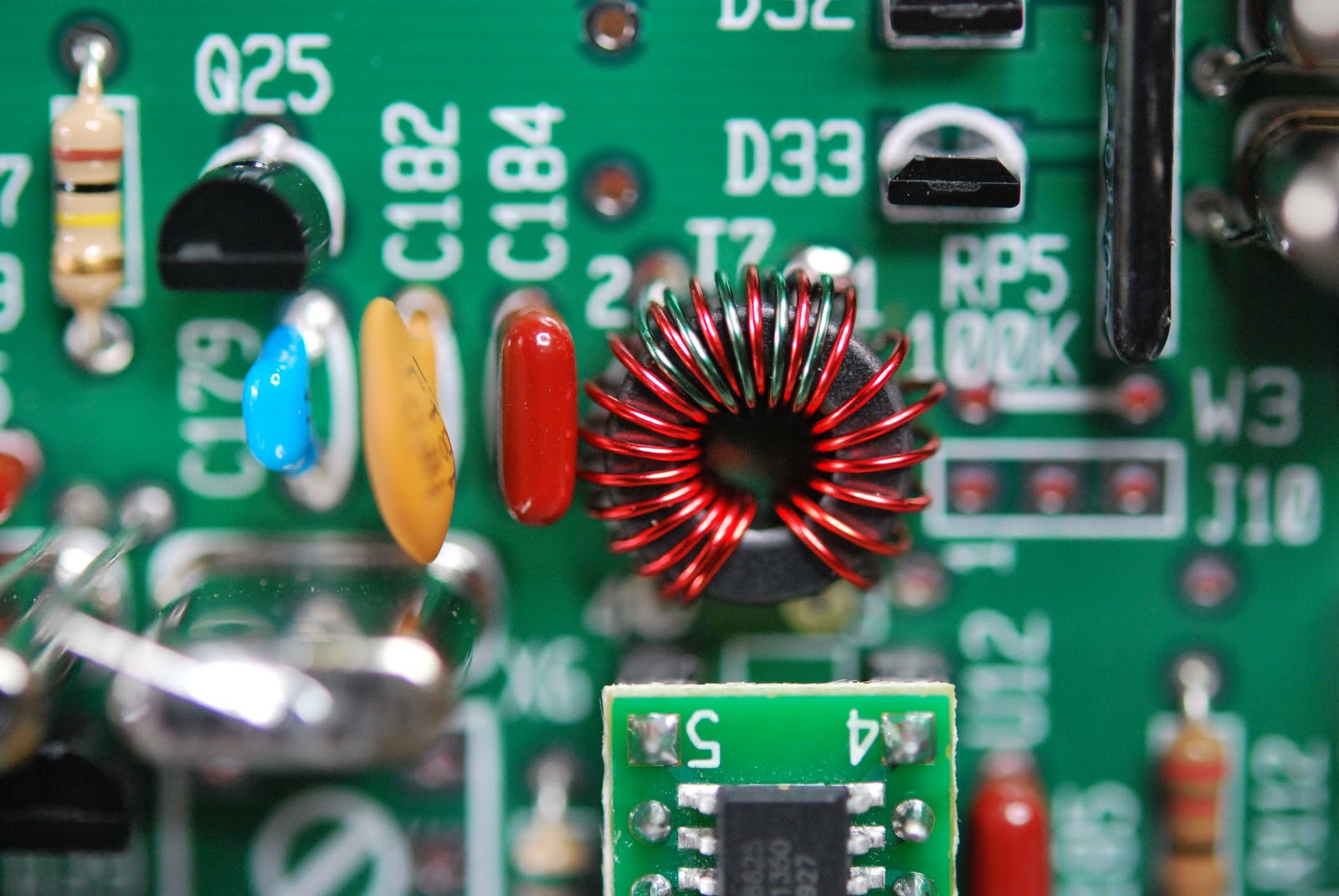 |
| The dreaded toroid... |
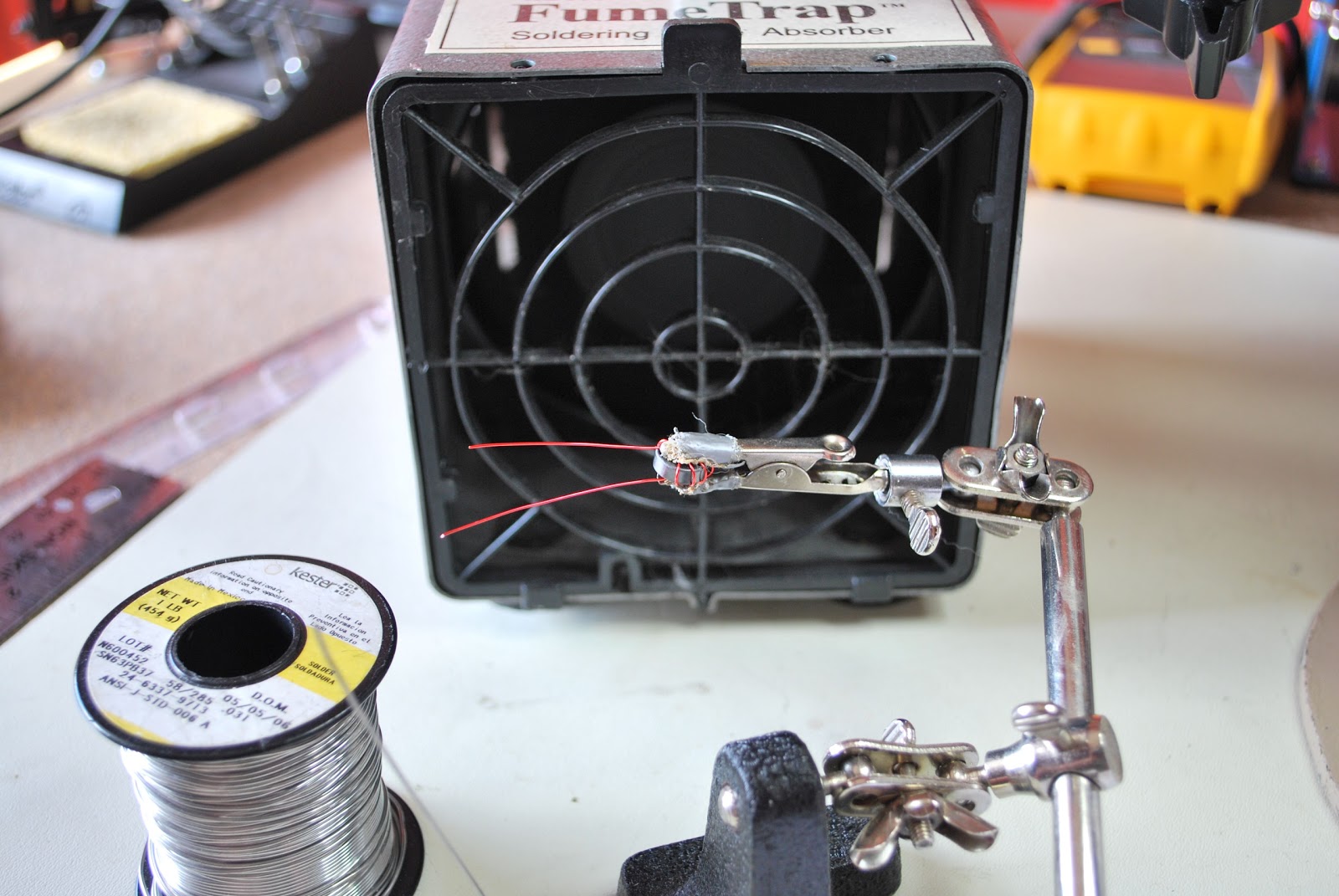 |
| Getting ready for solder blob |
B. Use sand paper.
C. The solder blob method.
D. Use a razor knife to scape the coating off.
E. I have heard some dipping the wire in var-sol....would not recommend it.
I use the solder blob method and I have tried the sandpaper (find it just to rough for the delicate work that is needed) I have tried the lighter method but found on the smaller toroids I am not able to control the heat and end up burning off to much insulation. The razor blade scraping I have not tried and really don't want a razor knife that close to my fingers. SO....it's the solder blob for me!! I find if I put the toroid in an alligator clip to hold it I can in a very controlled fashion remove the right amount of enamel from the toroid.
I change the tip on my Weller soldering iron to a larger tip and use a .030 diameter solder. Most of my board work is done with a .020 diameter solder.
DO NOT SKIP STEP 7.....
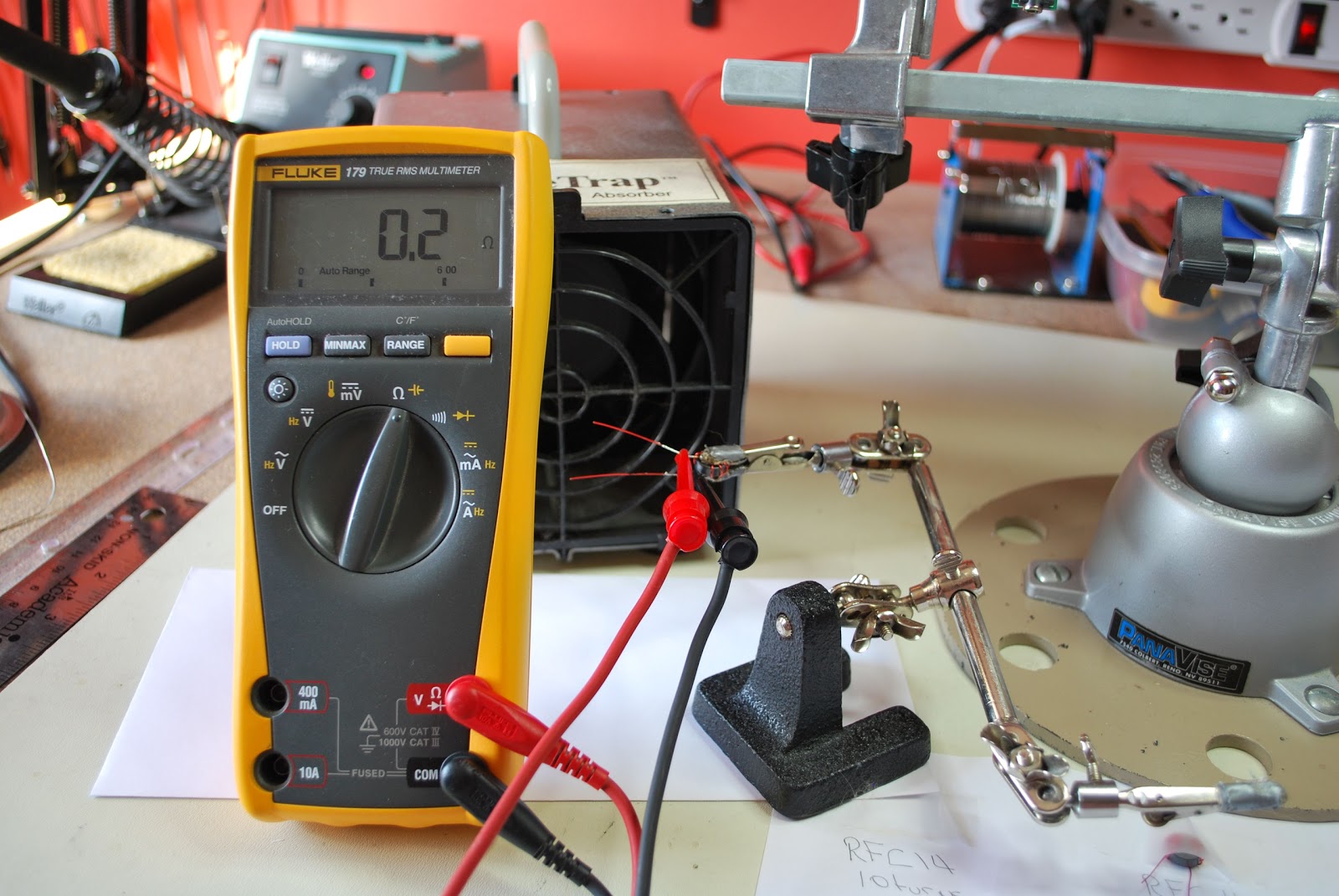
7. Once the toroid wire has been stripped I use my DMM to check to make sure the coating has been removed and there is good continuity. Oh and for toroids that have more that one winding I check to make sure there is not shorts between the windings as well.
8. It's now time to solder the toroid in place and I find once the toroid is soldered in place before the leads are trimmed you can heat each solder blob up again and give each lead a LIGHT pull with a pair of pliers. This will allow the toroid to sit firmly on the board.
Some tips
1. Practice practice practice......it's like CW it's an art and over time you will get the idea and look forward to it.
2. Some toroids have nice rounded edges but be aware of those with sharp 90 degrees edges. These toroids can if your not careful remove the insulating coating from your wire and potentiality cause a short.
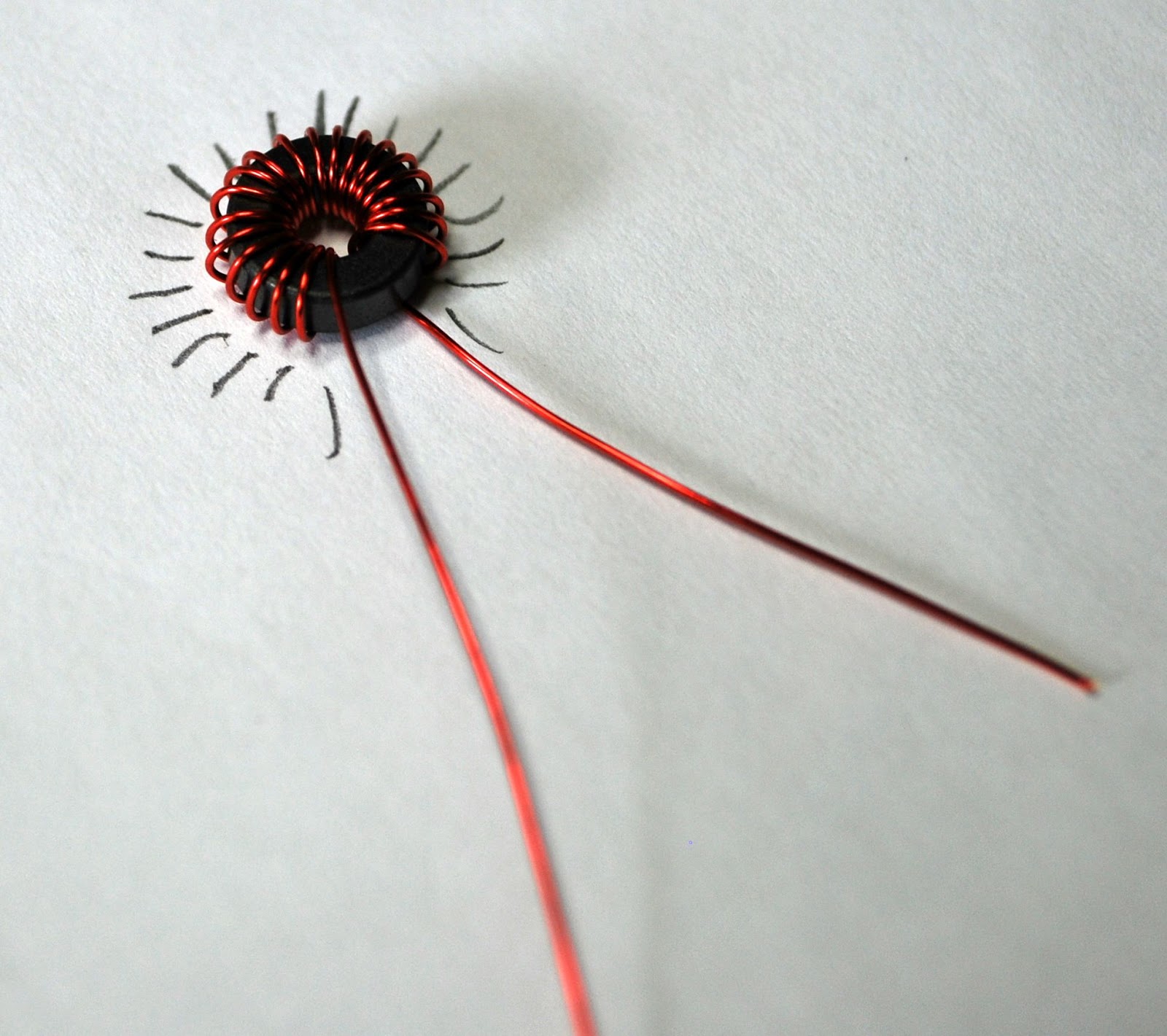 |
| Using a paper and pencil to count |
4. Use two sizes of soldering tip's one (I use the Weller ETC 1/8 tip) for the solder blob used to melt the insulation off the wire. Then a thinner tip (I use the Weller ETR 1/16 tip) for soldering the toroid to the board.
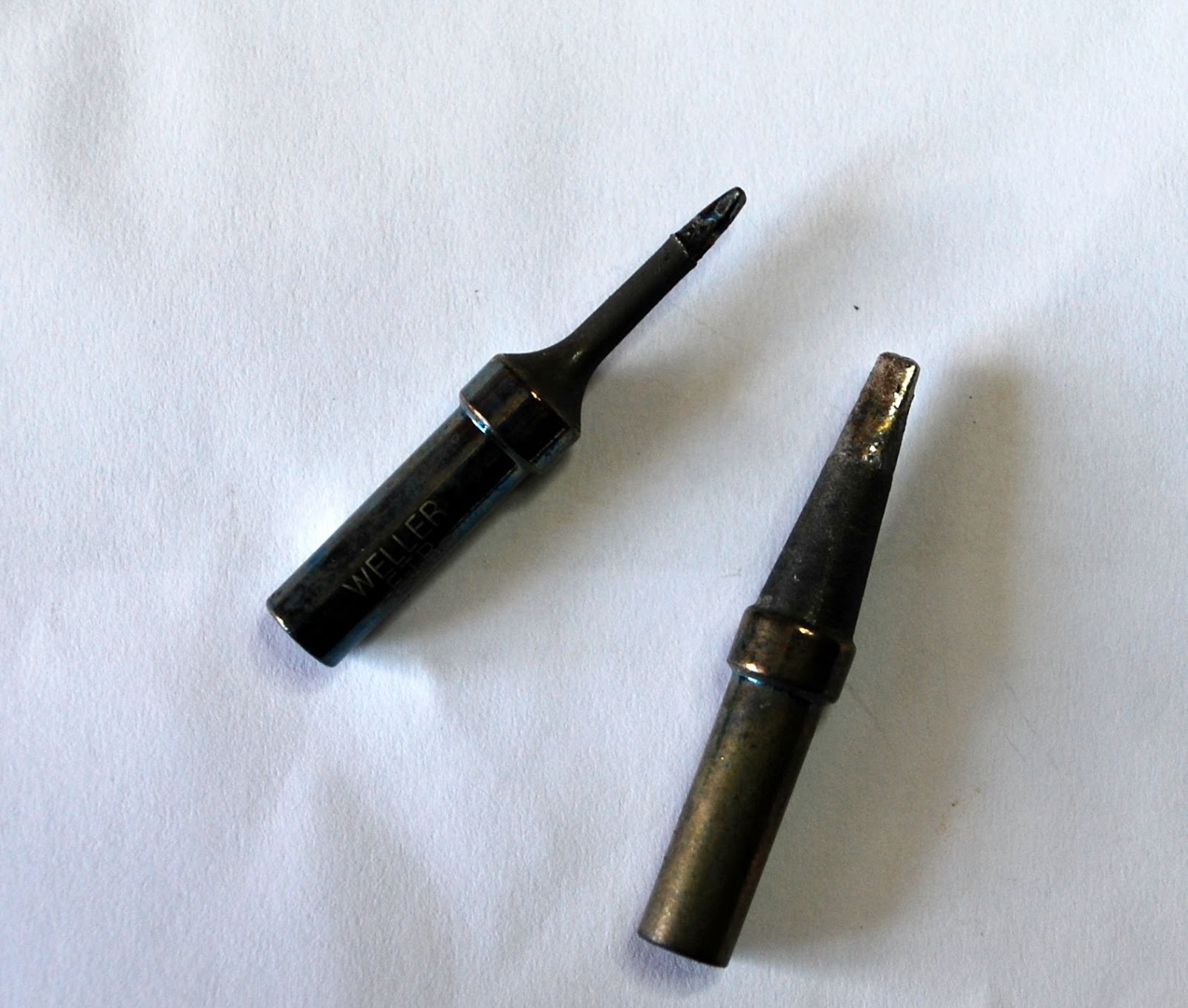 | |||
| ETR and ETC tips |
Coming soon how to wind the bi-filar toroid and transformer toroid.
Mike Weir, VE9KK, is a regular contributor to AmateurRadio.com and writes from New Brunswick, Canada. Contact him at [email protected].
30°+ in the shack
It’s been almost a year since I wrote something for Amateurradio.com. We all go through rough times and I certainly had my share of downs in the last 11 months (and not many ups to compensate those). I am even a bit ashamed to say that I didn’t surf over here for a while, so I did miss out on a lot of posts from Larry, Paul, Julian and the others.
This coming teaching season is going to be a little less stressful and so my good intention is to write at least one article each month. In the mean time you can visit my newly revised website with my radio blog, logbooks and weather. Yes, I did manage to put the 1-Wire weather station back in operation again. All the sensors are out on the balcony, with the pressure and a temperature sensors in the shack. Being high summer in sub-tropical Taiwan daytime temperatures usually hover around 34 degrees, with 26 degrees at night. The shack heats up so much in the daytime and stays hot at night that the temperature hasn’t dropped below 30 degrees for the past few weeks. Still, I am quite active at the moment, but more about that later….
Hans "Fong" van den Boogert, BX2ABT, is a regular contributor to AmateurRadio.com and writes from Taiwan. Contact him at [email protected].
Skeeter Hunt DX
According to the “official” Skeeter Hunt rules, working any DX station during the hunt is worth 3 QSO points. This year, like last year, the Worked All Europe coincides with the Skeeter Hunt. So working DX is definitely possible. In fact, just going from memory (not consulting my log as I write this) I know that last year I worked at least one European station, and it might have been two.
This year, we have an Amateur Radio op from South Africa who has requested and received a Skeeter number. Eddie ZS6BNE is Skeeter #114. Even though the Hunt occurs in his local evening time, he is going to go out, set up and try to make contact with as many of us as he can.
To recognize his special effort, anyone who makes contact with Eddie can count that QSO for 4 points, instead of the traditional 3 points for normal DX QSOs (The rules have been amended to reflect this) Please make sure to listen for him at or near the QRP Watering Holes on 20 and 15 Meters. If propagation is with us, those bands will probably provide your best shot.
I’d like to take this opportunity to thank Greg N4KGL, who talked up the Skeeter Hunt with the RApid Deployment Amateur Radio group (RADAR). It was via Greg’s post that Eddie found out about the Skeeter Hunt. Also, a tip ‘o the call sign cap to Pickett AD4S, who talked up the Skeeter Hunt on the NOGAQRP reflector.
A special “thank you” to anyone who has talked up the event and spread the word via e-mail, word-of-mouth, smoke signals or whatever means. Your help is appreciated more than you will ever know!
72 de Larry W2LJ
QRP – When you care to send the very least!
Larry Makoski, W2LJ, is a regular contributor to AmateurRadio.com and writes from New Jersey, USA. Contact him at [email protected].
40 meter revisited
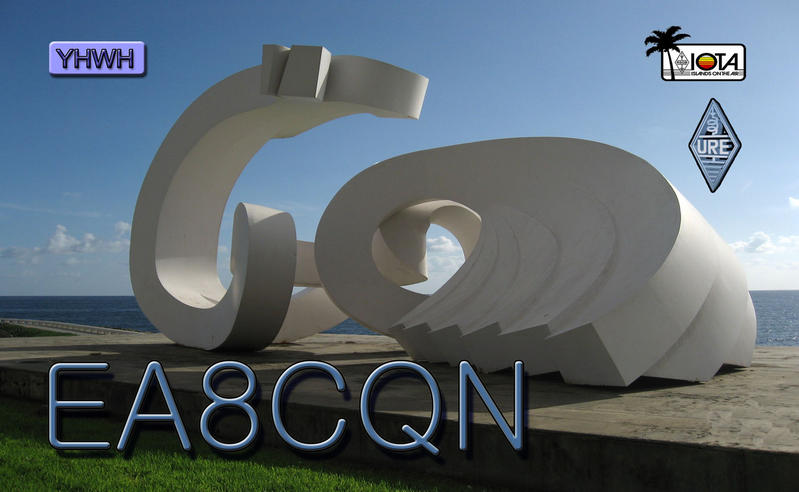
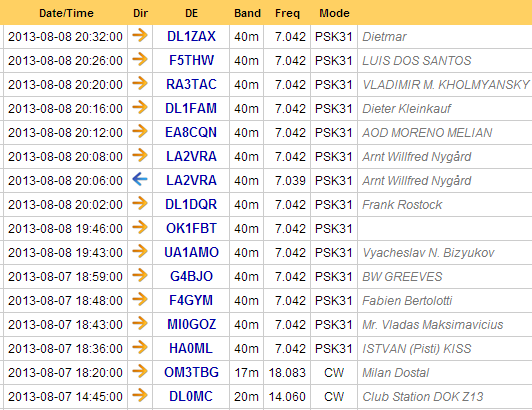
It was a long time ago I worked on 40 meter. With BPSK31 I had some luck. Best DX was EA8CQN Aod from Acuras - Las Palmas, Canary Islands (3195 km). I was running 20 watts into my end fed wire.
Paul Stam, PC4T, is a regular contributor to AmateurRadio.com and writes from the Netherlands. Contact him at [email protected].
Amateur Radio Newsline Report 1878 August 9 2013
Hamradioprojects.com
If you fancy trying your hand at Arduino or Picaxe projects and need to ask a clever person (Don’t look at me,I’ve already put a couple of thicko questions on) then the companion website to the ARRL book is up and running. The code for the projects is on the site too so if you’re not a fan of typing then cut and paste

Alex Hill, G7KSE, is a regular contributor to AmateurRadio.com and writes from Cumbria, UK. Contact him at [email protected].
Quick Outing to the Winnipesaukee River
Today my wife, Judy and I took a quick bike ride along the Winnipesaukee River. I stopped in a beautiful spot and operated for 15 minutes. I worked Macedonia, Croatia, the Czech Republic, and Italy.

What a glorious summer afternoon. The fields and farm land engulfed us as we rode along the trail in the warm sun. We stopped across from a small pond and walked into the woods and sat down on some rocks right at the river’s edge.

I heaved a 33 foot wire over some branches and set up the KX3 on the rocks. I operated on both 17 meters and 20 meters. There were plenty of strong stations on both bands. Here’s my log:
7 Aug-13 1950 14.010 Z320G CW 599 599 Macedonia
7 Aug-13 1955 14.009 9A2AJ CW 559 599 Croatia
7 Aug-13 2000 18.068 OK2AN CW 579 599 Czech Rep
7 Aug-13 2001 18.083 9A2YM CW 599 599 Croatia
7 Aug-13 2005 18.072 IK2SND CW 599 599 Italy

After making several QSOs, I packed up and got ready to head back. I’ve operated from this spot perhaps a half a dozen times. I’ve enjoyed it each time. I head up the hill to the bicycle and ride back.

Jim Cluett, W1PID, is a regular contributor to AmateurRadio.com and writes from New Hampshire, USA. Contact him at [email protected].
 Ham Radio Deluxe |
 W5SWL Electronics |
 Ham Radio Prep |
 KB3IFH QSL Cards  Hip Ham Shirts  HamRadioAuctions HamRadioAuctions Reliance Antennas Reliance Antennas Enigma Shop Enigma Shop |  morseDX  Ni4L Antennas  R&L Electronics R&L Electronics antennas.us antennas.us QRV QRV |
- Matt W1MST, Managing Editor
