 |
 Amateur Radio Newsline Report 1876 July 26 2013
 25 July 2013 | by
 - Ham radio will share a ride to space on a pair of joint mission satellites
- A pico balloon remains aloft for over 70 hours
- FCC streamlining appears to bedead this Congressional session
- Massachusetts looks to enact an anti pirate radio law and
- Lithium battery safety is once again a major concern
QRP Respect Day 2013
The time is 08:00 UTC – 12:00 UTC and the bands are 40, 20, 15, 10 meters. It is recommended to stick around QRP frequencies, according to Region 1 band plan: CW 7030 – 14060 – 21060 – 28060; SSB 7090 – 14285 – 21285 – 28,365.
You can find other informations on http://qrprespect.jimdo.com/ (Rules http://qrprespect.jimdo.com/qrp-party-it/) Click on the English tab.

Courtesy of DXCoffee www.dxcoffee.com
Mike Crownover, AD5A, is a regular contributor to AmateurRadio.com and writes from Texas, USA. Contact him at [email protected].
A 10GHz receiver using an LNBF and an RTLSDR – 10GHz RX for £20 or less?
Laurent F6FVY tweeted the other day a very interesting link, showing that people had used a LNBF designed for broadcast satellite reception and an RTLSDR dongle for 10GHz reception.
There are two good videos and I particularly liked the one from EA5KGD showing his reception of EB5EA’s 10GHz signals using the LNBF and the RTLSDR as an IF on around 618MHz.
So, I’ve ordered a suitable LNBF from the USA, which came in at just over £14 including shipping. If I can get a 10GHz receiver going for just under £20, I’ll be happy!
The only puzzle I have at the moment, which I am sure is easily solved, is that the LNBF requires its power to be fed up the coax. I am not sure what arrangement to use for this in conjunction with the RTLSDR. If anyone has seen anything suitable written up, I’d be very grateful! It looks like I need to find a way of feeding the 12V up the coax…
This looks like it would be fun to get going. There’s a 10GHz beacon on Cleeve Hill about 40 miles from here. I wonder if I could receive it and potentially look for rainscatter.
Tim Kirby, G4VXE, is a regular contributor to AmateurRadio.com and writes from Oxfordshire, England. Contact him at [email protected].
Summits On The Air (W0/SP-112) – Castle Rock
There is a very jagged peak just east of Buena Vista, CO called Castle Rock (not to be confused with the city by the same name). I knew this was a SOTA summit (W0/SP-112) and I had my eye on it for a while now. It is extremely rocky and jagged near its summit, so I was not sure if it could be ascended without a technical climb. A little research revealed that it was climbable but quite steep near the top. SummitPost.org has a good description of how to ascend this peak.
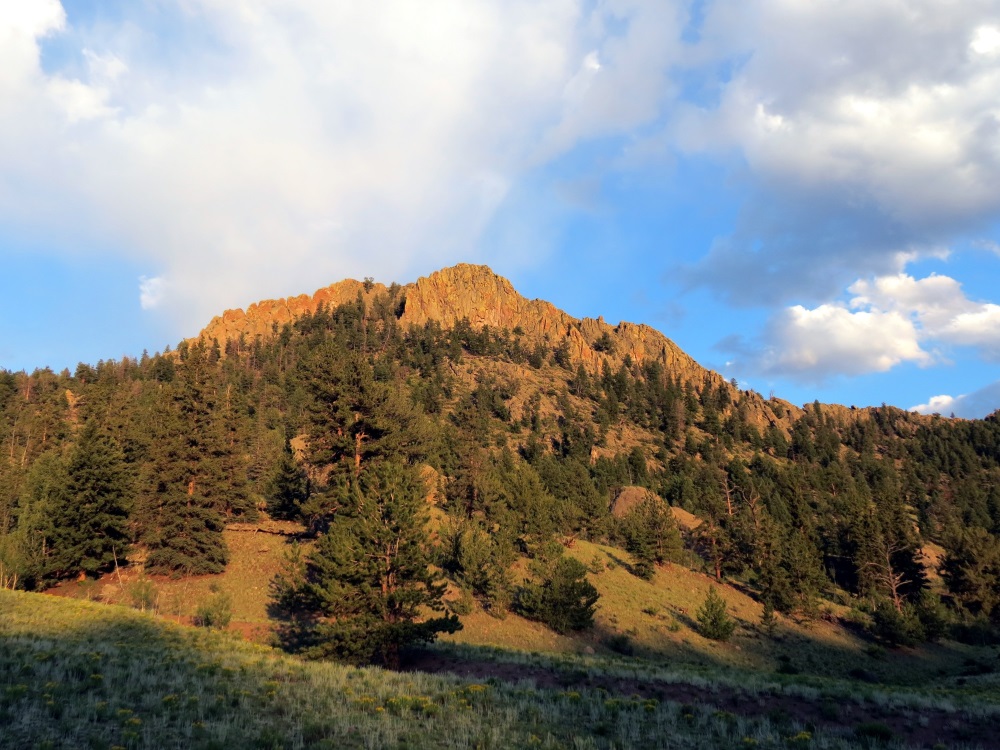
Castle Rock
My hiking partner and wife, Joyce K0JJW, joined me on the climb. We managed to get off the preferred route and got into some very steep rock scrambling. Good judgment prevailed and we regrouped and found a more reasonable path but probably cost us an extra hour of hiking. As advertised, it did get very steep at the top. (Study the SummitPost information more carefully than I did.)
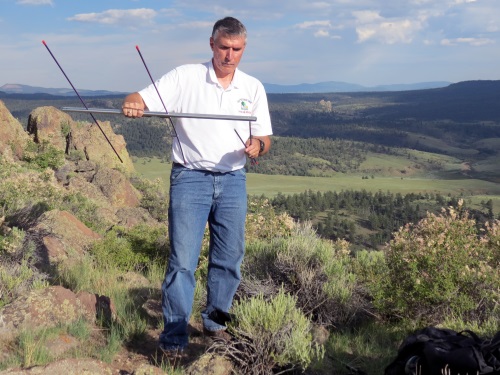
Assembling the Arrow 2-Meter antenna
Recently, I picked up an Arrow 3-element Yagi antenna for 2 Meters (Model 146-3). This antenna can be dismantled and carried inside a reasonable size daypack (or strapped on externally). The boom has two threaded holes for mounting the antenna on a camera tripod. I used a MountainSmith trekking pole that can double as a camera monopod and mounted the antenna on it.
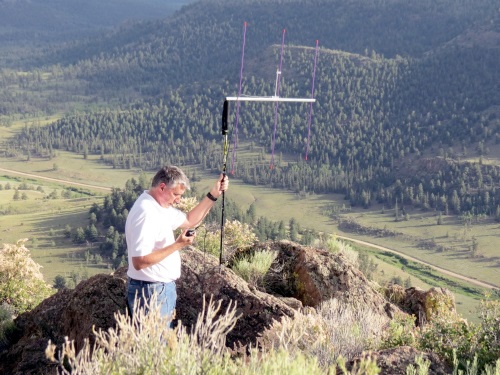
Operating with the Arrow antenna mounted on the trekking pole
For this SOTA activation, I kept it simple and just used my Yaesu FT-60 to work 2 Meter FM. Accordingly, I configured the Yagi antenna for vertical polarization. (There are two mounting holes on the boom, so you can choose vertical or horizontal orientation.)
The trekking pole is not self-supporting and does not provide much additional antenna height but it makes the antenna a lot easier to point for extended periods of time. I like to use a trekking pole for hiking, so this is a good way to get a little extra utility out of it. I am pleased with how this antenna system performed and will use it again.
73, Bob K0NR
Bob Witte, KØNR, is a regular contributor to AmateurRadio.com and writes from Colorado, USA. Contact him at [email protected].
Mountain to mountain QSO.
My lunchtime QRP session had that ominous look, like it was going to end up being a bust. The bands were nowhere near as hearty and robust as they were the past few days. 15 Meters had one strong signal, HA9RT booming in. I’ve worked Jozsef several times in the past, and even though he was coming in like gangbusters, I figured I’d let him get some new stations in his log.
20 Meters was a ghost town and 17 Meters seemed to be the liveliest of the three bands. Still, there wasn’t much activity and the signals I was hearing weren’t the strongest. I didn’t feel like going back into the building, so I decided to call CQ on 17 Meters.
Much to my surprise, I was answered by George KX0R who was the first place finisher in last year’s NJQRP Skeeter Hunt. George had a nice 579 signal into New Jersey. He was using an ATS3B at 5 Watts into an inverted “L” on a mountain in Colorado. Bald Mountain, SOTA peak W0/FR174, to be exact. 9,190 feet above sea level to be even more exact.
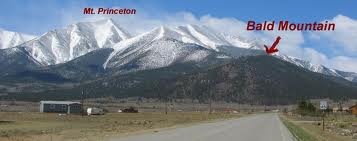
If you really, really, really, REALLY want to stretch the truth ….. you could say we had a mountain to mountain QSO. But that would be stretching the truth almost to the point of breaking it!
Warren, the town where I work, is located on the second ridge of the Watchung Mountains here in New Jersey. My height above sea level there is all of about 500 feet or so. Not much, by mountain standards, but since most of New Jersey is coastal plain and Piedmont, 500 feet is pretty high up there for a relatively flat state.
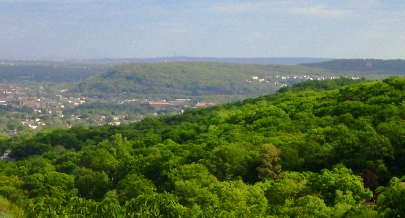
Now, according to geologists, if we went back in time, say about 200 million years or so, the Watchungs were about as tall as the present day Rockies or even the Alps. Just goes to show what time, rain, ice and wind can do to you, eh? So in essence, compared to the Rockies, and even the farther western Appalachians, the Watchungs are more or less just “hills”. But they’re our hills and the original settlers of New Jersey called them mountains, so who are we to argue?
72 de Larry W2LJ
QRP – When you care to send the very least!
Larry Makoski, W2LJ, is a regular contributor to AmateurRadio.com and writes from New Jersey, USA. Contact him at [email protected].
Handiham World for 24 July 2013
Pat Tice, WA0TDA, is the manager of HANDI-HAM and a regular contributor to AmateurRadio.com. Contact him at [email protected].
Visitors Book gone!
They say that to err is human, to really foul things up you need a computer. And I have been fouling a lot of things up recently. The latest thing that I fouled up is the G4ILO’s Shack visitors book.
On the site I also have a contact log. This runs from a backup of my KComm (MixW format) log file. KComm automatically backs up my log to the web server, in order to create an off-site backup of my log. As a bonus, I have a PHP script that reads this backup file and displays the contents in a human-readable format.
What I stupidly did, when re-configuring KComm after my computer troubles a couple of weeks ago, was put the guest book file name log.dat for the backup file name, instead of what it should have been: g4ilo.log. So when KComm uploaded my contact log backup it overwrote the guest book data file instead. I only discovered this after wondering why the contact log on the site wasn’t updating.
I looked back in the site backups maintained by the hosting service but they only go back a couple of weeks. I must have made the error before then. All I have managed to salvage is the most recent 3 entries. I’m rather upset about that, because the guest book contained comments made over many years from the early days of the site, which I had painstakingly preserved over various versions of guest book script.
At least I didn’t lose my contact log going back to 2001. That would have been a disaster!
Julian Moss, G4ILO, is a regular contributor to AmateurRadio.com and writes from Cumbria, England. Contact him at [email protected].
 Ham Radio Deluxe |
 W5SWL Electronics |
 Ham Radio Prep |
 KB3IFH QSL Cards  Hip Ham Shirts  HamRadioAuctions HamRadioAuctions Reliance Antennas Reliance Antennas Enigma Shop Enigma Shop |  morseDX  Ni4L Antennas  R&L Electronics R&L Electronics antennas.us antennas.us QRV QRV |
- Matt W1MST, Managing Editor
