 |
 Amateur Radio Newsline Report 1883 September 13 2013
 12 September 2013 | by
 - New Zealand and Japan sign a new reciprocal operating agreement
- Unlicensed operations on 2 meters in Europe becomes a growing problem
- Wildfire in Northern California destroys several repeaters
- A move to restructure the FCC passes the House of Representatives
- Two solar powered pico balloons set a new European flight endurance record
2 m sked with PE1BVQ with JT9
.png)
Tonight I planned a sked with PE1BVQ Hans with JT9 on 2 meters. And yes, I heard the JT9 signal of Hans, unfortunately, he didn't hear my signal. I only have a vertical for 2 meters, and there is 116 km between us. My antenna is without any gain. ;-) But is was nice trying. Thanks Hans!
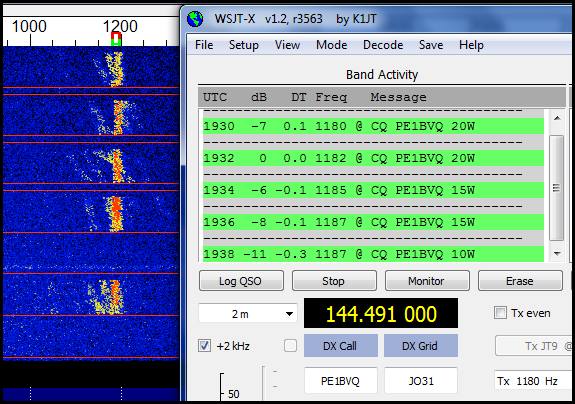
Test with different power levels. 10 Watts was still strong enough, 5 Watts: no trace at all. You should expect some power level of -20dB. Nice trying. Maybe also a sked with Bas PE4BAS in the future when his new shack is ready.
In the early morning I was calling CQ on 40 meter with JT9. No takers, but spotters.

Paul Stam, PC4T, is a regular contributor to AmateurRadio.com and writes from the Netherlands. Contact him at [email protected].
A Little Prevention and a Pound of Cure
Recently, a very active SOTA activator who had probably 80 or 90 summits to his credit suffered a heart attack while on a climb. These events are always a little sobering because we aren't so different in age. It isn't intuitive that an active individual would be a heart attack candidate. The fact is he had 100% blockage in one of his arteries. My son is an MD and explained that the body will build it's own bypass system over time, so 100% blockage means that the main artery was blocked, but there were several smaller bypass blood vessels that were at least transporting some blood, but obviously in the case, not enough.
There were two lessons to learn from this incident. The first in the preventive part. After say, age 50, we should have a full blown physical at least every other year, complete with an EKG that will check you heart capacity and function. If you have to borrow money to pay for the physical, you should do it. A physical is not an expense, but an investment that will yield a nice return in the form of additional years to enjoy all the things you have worked for in your life. We should do some exercise at least 4 times a week, even if it's just walking for 30 minutes. If you aren't currently exercising, get the physical first and if you are exercising don't assume that you don't have issues. The example above should be enough evidence to convince you of that. One health issue associated with ham radio is that we can do it sitting down which isn't necessarily good from a health perspective.
The second lesson from this is the pound of cure. If you are involved in outdoor activities, hiking, biking, etc.. carry a small first aid kit and include aspirin in the kit. This will help to temporarily mitagate heart attack symptoms until help can arrive. Get a book on outdoor first aid and understand what you can do when you are miles away from help and have a medical emergency. There are even several apps available for your smart phone that give solid first aid advice.
The outcome of the incident above was a good as you could hope. His hiking buddy was calm and solicited help from other hikers, one of which had some aspirin in his pack. They had cell service and could call 911 and the victim was flown to a hospital where a stent was put in. (If no phone service, have a 2m rig with the local repeaters in the memory) He is much better and should be able to get back to climbing soon. His recovery is due, in no small part, to the alert reactions of those around him.
So go make that appointment.
Mike Crownover, AD5A, is a regular contributor to AmateurRadio.com and writes from Texas, USA. Contact him at [email protected].
R0FA Sakhalin Island QSL Card
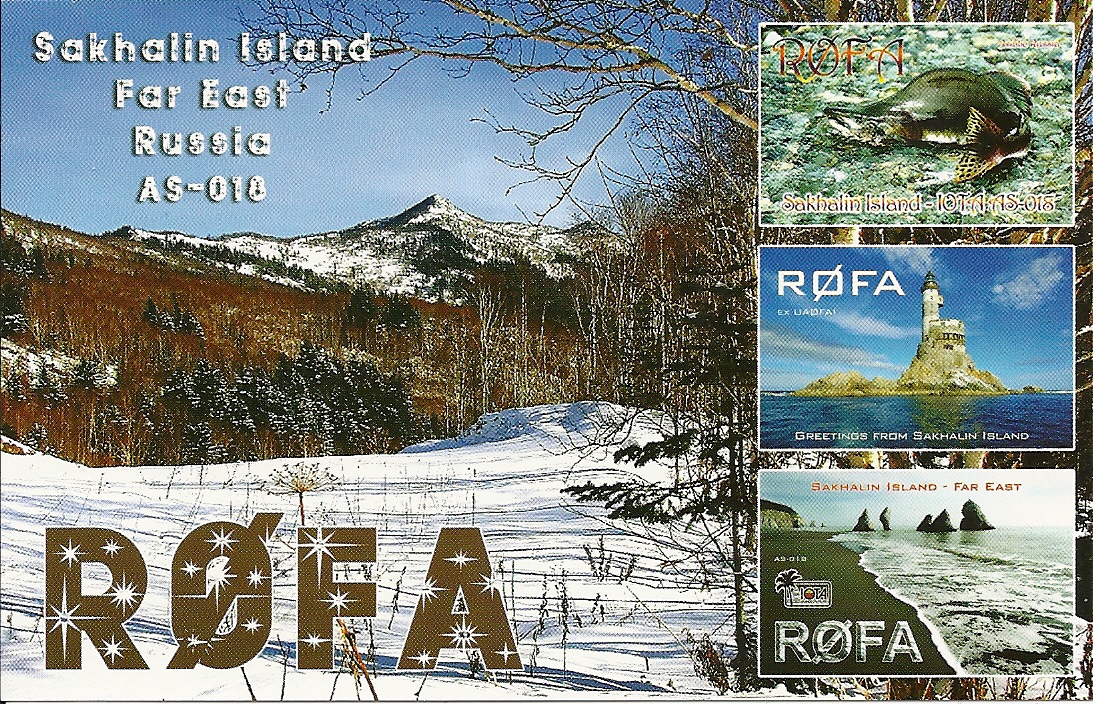
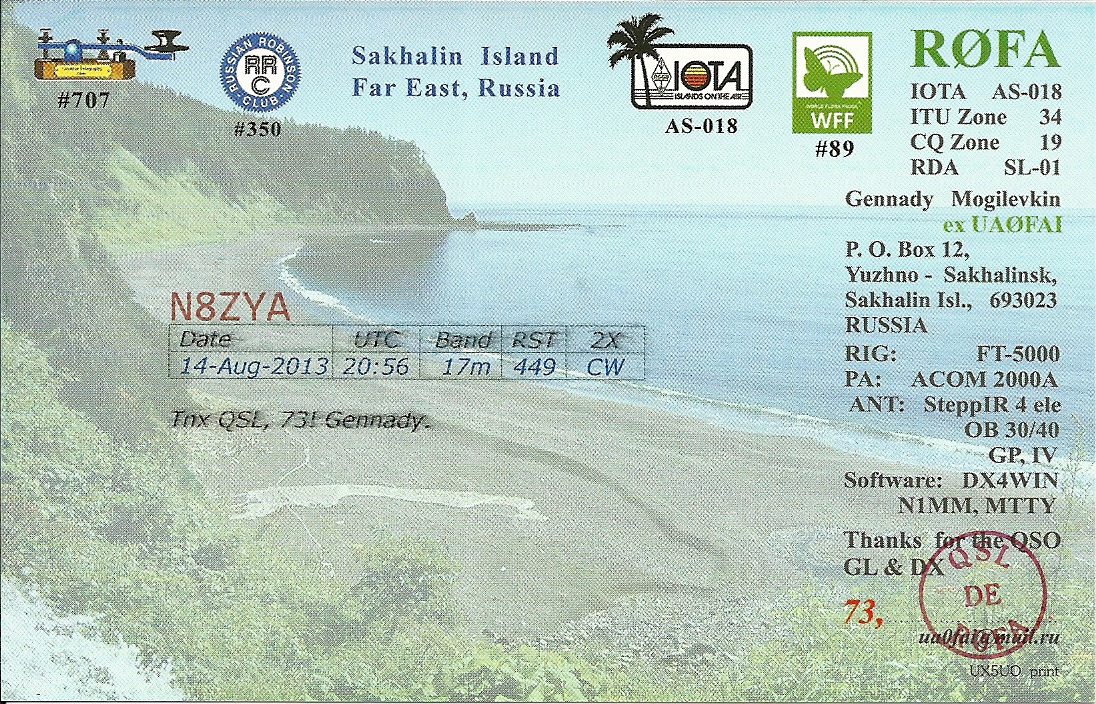
Got my verification QSL card from (R0FA) Sakhalin Island today! Should you take the time to read a few entries back; this island is shared by both Japan and Russia. I was able to work him with 3 watts and an indoor random wire antenna. This station was just above the mainland of Japan and a little East of China. When I spotted him on the cluster, he realized that I was “QRP” and stopped the “pile up” to say a special “hello”. You won’t find many willing to do this…..my reward for a great contact!
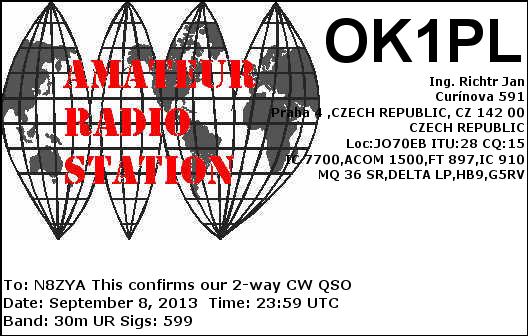
I’ve been out of town for a few days and turned the radio on immediately to see if anything was on the air. I worked OK1PL for the third time on 30 meters.
John Smithson, Jr., N8ZYA, is a regular contributor to AmateurRadio.com and writes from West Virginia, USA. Contact him at [email protected].
Tech Day 2013 – Saturday Sept 14
 Come join us on Saturday, September 14th, 2013 (9:00 AM to 2:00 PM) at the Prairie Winds Elementary School , 790 Kings Deer Point East, Monument, CO for Tech Day 2013. Tech Day is for beginner to intermediate hams who want to learn more and take that ‘next step’ in ham radio.
Everyone is welcome, no registration is required. Just show up with your bright smiley face, ready to learn something and have fun.
Presentations
9:30 am – Getting started in QRP operating from Steve WGØAT of Rooster & Peanut fame [http://www.youtube.com/user/goathiker]
10:30 am – Mobile radio installation tips with James KDØMFO
11:30 am – Practical antennas made out of copper pipe by Al WBØTGE
12:30 pm - Ham Shack 101 - the basics of setting up a home station by Stu WØSTU
1:30 pm – Some Practical Antenna Theory – Bob KØNR
* Each presentation is approximately 20 minutes with Q&A at the end.
Live Demonstations
All day long, we’ll have these displays set up so you can get a hands on look at radio operating:
QRP operating, Flex Software Defined Radio (SDR), HF antennas, mobile radio installation
The local Boy Scout troop will be selling hotdogs and drinks in hamfest style.
Tech Day 2013 is proudly sponsored by the WØTLM Amateur Radio Club
Bob Witte, KØNR, is a regular contributor to AmateurRadio.com and writes from Colorado, USA. Contact him at [email protected].
Many. many thanks!
Whew! The 2013 NJQRP Skeeter Hunt Soapbox page is 99% done and published! Hallelujah! I still have to post Andy WN0I’s photos. He sent me hard copies through the mail and my scanner is acting up; but I should have them up tomorrow Andy – please bear with me!
To see all the comments and photos published so far – please click here. And to see the scores and where you placed in the standings, click here.
Many thanks to all of you who participated this year, and thanks for all the photos and comments. If you sent me something and don’t see it – please resend! The big black hole that is the cyber world probably swallowed your e-mail on me!
Also, a very special thanks to Ward Silver N0AX, who included some nice words about the Skeeter Hunt in this week’s e-mail of “The ARRL Contest Update for September 11, 2013”. Muchas Gracias, Ward!
And once again, a very big special word of thanks to the NJQRP Club and it’s members for lending their name and for giving the Skeeter Hunt the credibility that it has.
72 de Larry W2LJ
QRP – When you care to send the very least!
Larry Makoski, W2LJ, is a regular contributor to AmateurRadio.com and writes from New Jersey, USA. Contact him at [email protected].
DX with Kite-Lifted Antenna at the Beach
Judy and I went to the beach today. I launched my antenna with a kite and worked Greenland, Greece and Italy in less than 10 minutes.

It was a remarkable day. In the mid-90s and not a cloud in the sky. We headed to the New Hampshire coast and arrived at Rye Harbor for a picnic lunch. After a walk on the beach, Judy went for a swim, and I went up to the point and launched a parafoil kite.

There was a good breeze and it went up in a jiffy. I had it up about 120 feet. At about mid-point I placed a loop in the line and tied my 33 foot wire to the loop. I had a nice vertical and set up the KX3 right below the wire.

I started on 15 meters and heard Peter OX3XR in Greenland with a strong signal. He returned my call and gave me a 599. He went on to the next station. I was thrilled.

I switched then to 17 meters and quickly worked a special event station SV130PAP in Greece. Again there was a quick exchange of 599 and we signed. Back to 15 meters and I heard IK3VUT in Italy calling CQ. Luca gave me a 559 and I gave him a solid 599.
With that I shut the station down. In barely 10 minutes I had worked three nice DX stations with the kite wire and I was pretty excited. Who could ask for more? Besides I had agreed to meet Judy in a few minutes.
Jim Cluett, W1PID, is a regular contributor to AmateurRadio.com and writes from New Hampshire, USA. Contact him at [email protected].
 Ham Radio Deluxe |
 W5SWL Electronics |
 Ham Radio Prep |
 KB3IFH QSL Cards  Hip Ham Shirts  QRV QRV Reliance Antennas Reliance Antennas |  morseDX  Ni4L Antennas  R&L Electronics R&L Electronics antennas.us antennas.us |
- Matt W1MST, Managing Editor
