 |
 QRP and Frustration
 21 August 2013 | by
 One of the biggest caveats that’s always mentioned to potential QRPers is what I like to call the “frustration factor”. All the QRP “how to” books bring this up. I’ve read them, you’ve read them …… I’m sure you’re familiar with all the bug-a-boos:
“Hams new to HF should never start out using QRP.”
“QRP is difficult, don’t expect much success.”
And my favorite – “Never call CQ using QRP.”
In my personal and most humble opinion, these statements, if they are taken as absolute truisms or rules of thumb, are pretty much hogwash.
But rather than refute these, or dwell on the negatives, I would like to accentuate the positives. If you’re new to the QRP game or are perhaps thinking of dipping your toe into low power waters, you SHOULD do several things to maximize your chances for success.
DO put up the best antenna that you can. A tower and beam are the best, if you have deep pockets and plenty of property and an understanding wife. If you’re like the rest of us mere mortals, that will probably mean dipoles, verticals or whatever. If you can, put them outside and put them up as high as circumstances permit. If you install a ground mounted vertical (not a bad choice) lay down as many radials as you can. If you’re stuck in HOA Hell, attic dipoles have yielded success. Magnetic loops, either home brewed or commercially built, such as the Alex Loop have saved the bacon of many covenant restricted Hams.
But whatever the case may be, just remember a quote that my friend Chris KQ2RP recently reminded us all about in his blog. To quote K2TK, “A poor antenna has infinite gain over no antenna”. In other words, while a better and higher antenna will maximize your QRP experience, ANY antenna is better than none. However, if you’re reduced to loading up your mattress boxspring, then you had better lay in a supply of Advil. Do whatever you can to put up the best aerial you can under your circumstances. This is not the place to skimp.
DO use the full “QRP Gallon”, which is the full 5 Watts for CW or 10 Watts for SSB, if you’re just starting out. While Rockmites and other flea powered radios do a great job, save QRPp for after you’ve gained some experience. QSOs made with less than a Watt ARE a heckuva lot of fun, but if you’re a QRP Newbie, save them for later.
DO make use of the various tools available to you. Reverse Beacon Network is one of these. Not only can you use RBN like a Cluster, to see who is on and who is calling CQ, but you can use it to gauge your own performance. Not getting any answers to your CQs? Check out your own call on RBN to see where and how you’re being heard. You can also use RBN to compare one antenna against another. I did this to check out my vertical vs. my wire on 80 Meters one Autumn evening last year. I picked a lonely, deserted frequency and called CQ with one antenna for about five minutes, and then switched. By going to RBN, I was able to see how (roughly) how one did against the other.
And while we’re talking about calling CQ, go right ahead and call CQ if you want to. Odds are you will be heard by someone, somewhere, depending on propagation. Many times, when a band has seemed dead, I have called CQ and have been answered, and have had great QSOs. I see no reason on God’s green Earth why calling CQ should be limited to those running power.
DO jump into the DX pileups! This will give you experience, which will be your greatest teacher. Getting on the air, making QSOs, and experimenting with antennas, participating in the QRP Fox hunts will teach you more than any Website, book, or Elmer. Getting your hands dirty and learning “when to hold ’em and when to fold ’em” will make you a veteran QRP op in no time. But remember, then it will be YOUR time to share what you have learned with those who come after you.
72 de Larry W2LJ
QRP – When you care to send the very least!
Larry Makoski, W2LJ, is a regular contributor to AmateurRadio.com and writes from New Jersey, USA. Contact him at [email protected].
A Navy Ship in the Southern Coal Fields of West Virginia
The advent of “radio” changed the nautical world. Today sailors still consider it a godsend much like “fresh water” and “smooth seas” as they traverse the worlds shipping lanes. Radio still offers security, comfort, and safety in the marine world today.
We don’t get many “seafaring” ships here in the “southern coal fields” of West Virginia; so it’s quite a surprise to hear that such a ship will be in our “home port” next week.
Although the capitol city of Charleston is in the southern coal fields, the Kanawha River is navigable due to a series of locks and dams. (there are three on this river) I worked as a deck hand on a river boat many years ago.
I hauled coal from the headwaters of this river to a large “coal fired power plant” on the Ohio River.
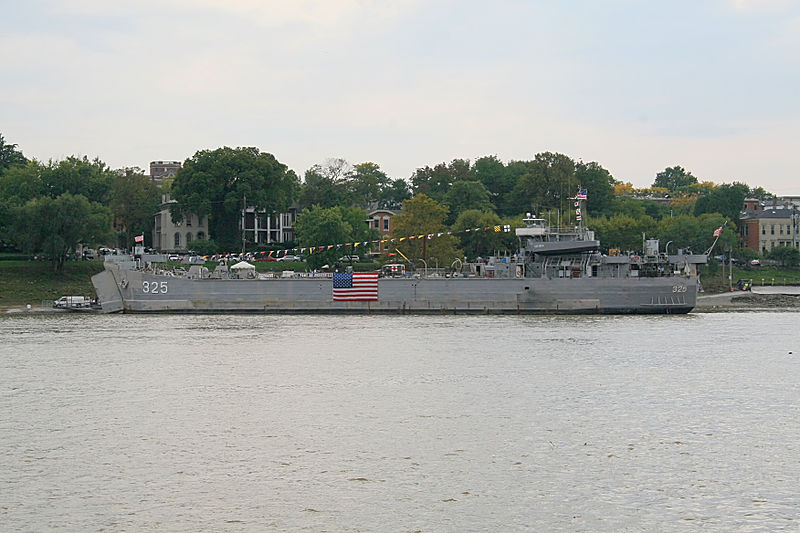
You can read about it HERE
I regret that I will not be in town the week LST 325 is docking in my hometown; but I hope the “radio guys” in my valley take the time to “roam” around this historic ship. These old “flat bottomed” boats were the “worst riding ships” on the seas. When I did the same a few years ago, and mentioned that I was a “ham” to one of the crew members, I was allow access to the “radio room” and made a CW contact with a “Marine Museum” in California.
I used 20 meters to make my 20 meter CW contact from the LST at that time.
Listen for the call sign WW2LST on the CW portions of the bands this year. Morse code played a significant role on these old ships because it’s one of the simplest and most effective modes of communication in the world.
I’ll be listening for it from Calgary this year.
John Smithson, Jr., N8ZYA, is a regular contributor to AmateurRadio.com and writes from West Virginia, USA. Contact him at [email protected].
80m JT65A
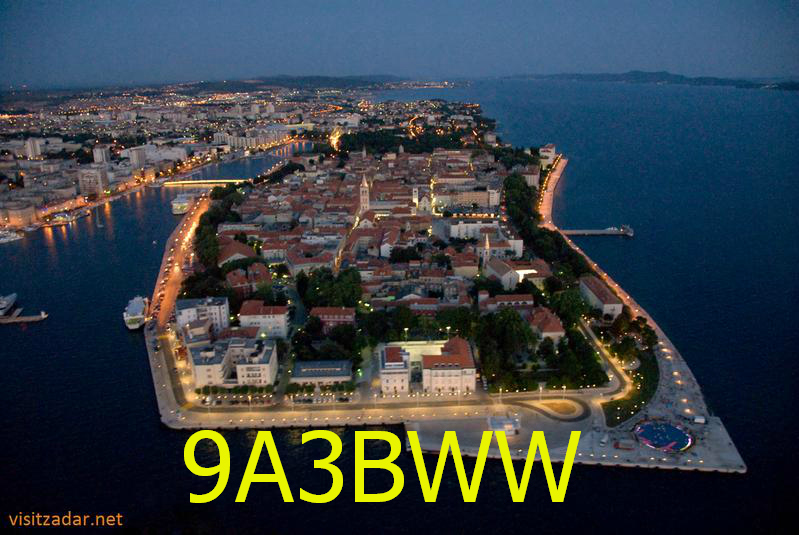
Though conditions are poor / fair on the lower bands, I tried JT65A on 80 meter tonight with my 3 band HyEndFed antenna which is made for 40-20-10m. I worked 9A3BWW -6dB # -14 dB. 1221 km. So I am very pleased with this qso. I also worked GW3TYI and DF2MR on 80 meter.
Paul Stam, PC4T, is a regular contributor to AmateurRadio.com and writes from the Netherlands. Contact him at [email protected].
IZ4RTE & UX1AA – Amazing Lunchtime Portable QRP
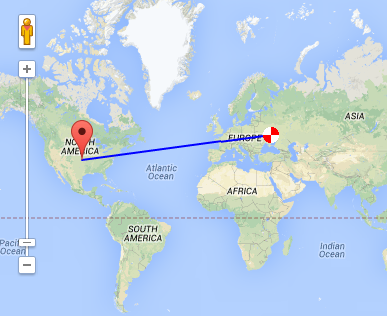 |
| Map from N0HYD to UX1AA |
Wow! It was a fun lunch today working portable from the park. I heard a little activity on 15 meters, but then tuned down to 17 meters and started having fun!
I had TWO great DX contacts on 17 meters today…
IZ4RTE – He was first up. He was calling CQ and after several repeats of my call he finally got it. He gave me a 519 and I gave him a 599. Eddie was near Bologna, ITALY! I don’t know call prefixes well enough to recognize where people are from – so I was super excited when he said this. From his QRZ profile apparently he was running a Elecraft K3 – so this was a nice 2xElecraft QSO.
UX1AA – I heard Serge finish a QSO and start calling CQ. It took several attempts for him to get my call, but he finally did. He gave me a 559 and he was 579 here in Kansas. When I looked him up on QRZ I realized he was in the western part of Ukraine! This is roughly 5,600 miles from my location!
It was about time to head back to work, but I spun to 20 meters and heard nothing, so I put out a CQ on 14.060. N7BBH – Steve in is Arizona. We have worked each other before in early August. Today he was on his TenTec Eagle at 40 watts – sounded great!
Well, another fun lunch time working QRP portable with my vertical EF QRP antenna. Its always fun, but today was exceptional with two nice DX QSO’s and working Steve again!
Burke Jones, NØHYD, is a regular contributor to AmateurRadio.com and writes from Kansas, USA. Contact him at [email protected].
A weekend at Sandy Hook lighthouse

For the last seven years the Ocean – Monmouth Amateur Radio Club has participated in the International Lighthouse / lightship Weekend. As in years passed we were hoping to operate from the Sandy Hook lighthouse, US0035 this year. Sandy Hook Lighthouse is located on the grounds of the former U.S. Army Fort Hancock facility, which is now part of the National Gateway Park System. After Super Storm Sandy in October of 2012 we were worried that we would not be able to use the facility as the storm had caused major damage to the Sandy Hook Gateway National Park area. Working with our contact in the park system we were informed in May of this year that the lighthouse had not suffered any major damage from the storm. We would be able to once again to operate form the light… so we started to plan “Operation Stronger Then The Storm.”
Plans were worked up to operate three stations: two high frequency and one VHF station. As in past years, we were going to hang wire antennas off the top of the light tower. The decision was made to use an Alpha – delta sloper off the North East quadrant and a G5RV hung as a sloper off the western quadrant. This would give use multi-band capability with paths to both Europe and the United States. With the antennas at ninety degrees to each other interference was keep to a minimum. Having the Atlantic Ocean and Raritan Bay on either side as ground plans would not hurt either. Our first HF station was an Yaesu FT-990, running about 125 watts (phone and CW). Station two was an Kenwood TS-50 running 100 watts on phone.
Arriving at the lighthouse at 06:00 Saturday morning work started. Our first order of business was to unload our vehicles and put up the shelters and then get the antennas ready to haul up the light tower. It was about this time that Mr. Murphy showed up. Our VHF station was to be operating on six and two meters. Unfortunately, the club member who would be bringing the VHF equipment had another engagement and he forgot about and could not make it. In true Ham Radio fashion we improvised something: A small homemade J-pole was hauled up the tower along with two hundred feet of coax and mounted to the light tower railing. The other two antennas followed and we were soon ready to get on the air.
Operations commenced around 0800. We worked mostly twenty and forty meters (which was as hot as a pistol!) in the HF bands. A mobile two meter radio powered by an AC power supply were hooked up to the J-pole and we were off and running. With about forty watts output on 146.520 simplex we were making contacts as far north as New Hampshire, west to Harrisburg, PA. and south to Cape May. Our clubs premiere CW operator also put up an end fed wire into a tree and operated a solar QRP CW station (3 watts). His most notable contact was to a Lighthouse in Cuba on forty meters. Both HF Stations were running and the only issue we had was the stateside contest that started around midday. So finding a quite spot to work was sometimes a challenge.
As night fell most of the contesters faded away and the bands were once again quiet. Operations worked into the night, until the overnight crew could not keep their eyes open. One member had set up a small six-man tent and a few of us sacked out there. The others caught some sleep in their vehicles. Waking before dawn we got back on the air. During the early Sunday morning hours other club members arrived bringing coffee, donuts and other snacks.
As with all our events food and drinks were available to the members who were at the event. Our club’s resident breakfast chief was not with us this year (his blueberry pancakes were missed). I provided the needed items and hardware to serve pork rolls and egg & cheese on hard rolls for Sunday breakfast. I have not heard of any issues with my cooking as of yet, and yes I had some too. We also would offer food and drink to any of the Park Rangers or other Park personal who came by to see us.
Operations continued till 1100 Sunday. With the threat of bad weather coming in we decided to pull the plug. After dropping the antennas, packing up the shelters and doing a ground clear walk we started off the hook. Our club cannot speak highly enough of the Sandy Hook National Park Staff. Any issues or questions were promptly answered or fixed. They came by often to be sure we were O.K. and to see if we needed anything. We have been informed that we will once again be welcomed back to operate in next year’s International Lighthouse / Lightship Weekend and we will all be looking forward to next year’s event.
Jeff Harshman, N2LXM, is a special contributor to AmateurRadio.com and writes from New Jersey, USA. Contact him at [email protected].
Five minute wonder
My Nevada WH3080 weather station has turned out to be a five minute wonder. Barely 3 months since we installed it, it has quit working. The base unit is no longer receiving information from the sensors.
Julian Moss, G4ILO, is a regular contributor to AmateurRadio.com and writes from Cumbria, England. Contact him at [email protected].
Bye Bye, My Raspberry Pi.

Yes, that is a Raspberry Pi on the bottom of my rubbish bin. I’m not saying the RasPi is rubbish, but I am not weeping about its loss, either.
As with many new things there is a hype and with the RasPi there was no exception: “What a bargain to get so much computer for such a low price.” Well, you pay for what you get, so when I got mine last year September I soon found out I also got a lot of problems to solve. More than I was willing to. The USB/network problem has been mentioned a lot on various sites. Stable power would solve that, so I build a very stable solid state PSU with 78S05 regulators and 6800uF capacitors. Even after that you just had to look at the USB ports and the network would come crashing down. Since I was running the RasPi headless this meant rebooting over and over again.
So my plan to build a solar powered weather and APRS digipeater were soon abandoned and with only a single USB 1-Wire dongle attached it just collected weather data. Uptimes were great, the longest one being over 100 days – until I accidentally switched the power off.
Then we had this, on July 14….
I shot the video just after fixing a drainage problem: the water was almost entering the shack. At 14 seconds you can see the first flash of thunder (the EMP hit the camera). It was a forebode of what was to come: a hit right behind where we live. The result: all the garage door openers and video doorbells were broken within a 50 meter range. Two of our routers were out and……the weather station. Network cables make great antennas, so the 1-Wire dongle didn’t respond to incoming signals after the hit any more. The RasPi was also dead, but later that night I put 5 Volts on the GPIO pins and it came back alive, albeit running very hot. I had a spare 1-Wire dongle, so the weather station was up and running again – for the moment.
But not a month later the expected happened: slowly the colourful LEDs on the RasPi main board dimmed until there was no life in them left. It must be a problem with the on-board voltage regulator, but they are glued to the board (yes, I tried removing one), so the rubbish bin it is.
Added bonus is that I now have a much cleaner spectrum, too! There have been projects to get the RasPi transmitting using the GPIO pins on the FM band, WSPR and what not. I found out that the RasPi was acting as a little spread spectrum transmitter, putting out carriers every 30 kHz on HF and 6 meters via the network cable. Unplug the network and it’s gone, plug it in and you broadcast 24 hours a day on multiple frequencies.
I already had a Atom board prepared and with some extra time spent the weather station was back up in a jiffy. My little PicoLCD screen also worked with the new set up, while with the RasPi it would just stall. Therefore, you can surf to pa2bx.nl, again, for the latest weather in Longtan, Taiwan.
So, the Pi is dead, long life the Atom!
Hans "Fong" van den Boogert, BX2ABT, is a regular contributor to AmateurRadio.com and writes from Taiwan. Contact him at [email protected].
 Ham Radio Deluxe |
 W5SWL Electronics |
 Ham Radio Prep |
 KB3IFH QSL Cards  Hip Ham Shirts  HamRadioAuctions HamRadioAuctions Reliance Antennas Reliance Antennas Enigma Shop Enigma Shop |  morseDX  Ni4L Antennas  R&L Electronics R&L Electronics antennas.us antennas.us QRV QRV |
- Matt W1MST, Managing Editor
