 |
 IC-7000 vs IC-7100 Special
 4 September 2013 | by
The IC-7000 vs IC-7100 Special is now available for download.
A no holds barred, cage match between the Icom IC-7000 vs the IC-7100. See how these two great mobile HF/VHF/UHF radios stack up beside each other in an unscripted competition. Who will win, Team Tommy or Team George?
31:26 radio competition
View in web browser: YouTube
George Thomas, W5JDX, is co-host of AmateurLogic.TV, an original amateur radio video program hosted by George Thomas (W5JDX), Tommy Martin (N5ZNO), Peter Berrett (VK3PB), and Emile Diodene (KE5QKR). Contact him at [email protected].
Magnetic Loop Construction – Part 1
So I got a little time over the weekend to make some progress on my magnetic loop antenna. I constructed this antenna from 1″ copper pipe in a square shape with 90 degree elbow. The loop is 30″ square.
At this time it will be rockbound on 20 meters, centered around 14.060 – so the bandwidth will be very limited. I want to do this so that I can do some testing before I go all out and convert it into a multi-band loop, which will hopefully work on 20-10 meters (with maybe 30 if I am lucky).
.JPG)
Making the Coax Stub Capacitor
So what I did was take a piece for RG-213 coax and cut it about 30″ long. Then on one end I removed about 2 1/2″ of the shield and pulled the braid away from the core. I taped it all up really well with multiple wraps of electrical tape, leaving about 1/2″ of braid and 1/2″ of conductor (sticking out of core).
After sanding the copper to a nice shine, I took some stainless steel hose clamps and clamped the braid to one side of the loop and the center conductor to the other side.
This piece of coax becomes the capacitor which will be used to tune the loop to the desired frequency. Right now it is longer than needed so it will resonate well below the 20 meter band.
.JPG)
The Feed Loop
I then took some RG-8 and made the feed loop. For my loop size the feed loop is about 1/5th the circumference of the main loop – so about 24″. I added a bit for the coax connector. I decided on a shielded Faraday loop after reading that they are quieter on the mag loop email list.
To construct this loop I formed the circle and soldered the center conductor to the braid at the bottom of the circle. Then at the top of the circle I removed about a 1/2″ of the braid only. I taped up all connections and exposed braid, etc.
.JPG)
Initial Tuning
I quickly taped the Faraday loop to the main loop with some painters tape because I wanted to see how it looked just sitting on the bench. Before I do the final tuning I will hang the loop on the wall of my garage – its final home. I was just excited to see where it was resonant!
So I hooked up the antenna analyzer and started a slow sweep from 20 meters down looking for the SWR dip. THERE IT WAS SWR 1.2 @ 11.131 MHZ – clear as day!
Next Steps
The next thing I am going to do is mount the loop to a piece of 1x wood and then mount that on the wall at its final location. Loops are sensitive to their surroundings, so you always want to tune them at the location they will be when completed.
Then with the analyzer connected I will start cutting 1″ chunks off the coax until I get close to 14 MHZ – the final tuning will be done by sliding the braid up and down the core to get the frequency exactly where I want it.
Once it is operational I will spend some time testing with the Reverse Beacon Network and making contacts. If it works well, ultimately I will construct a butterfly capacitor for tuning and build an Arduino stepper motor controller so that it can be remotely tuned from the shack.
I can’t wait to see how it works and if the noise floor is substantially lower than using my Portable QRP Vertical.
If you would like to construct something similar (although he shows a Gamma Match for the feeding) you should check out W2BRI‘s pages – great instructions with pictures to make everything easy.
Burke Jones, NØHYD, is a regular contributor to AmateurRadio.com and writes from Kansas, USA. Contact him at [email protected].
Japan

In the afternoon I was spotted in Japan on 17m with WSPR. Just like Ron PA2RF a few days ago. Also K0VM from Iowa.

Paul Stam, PC4T, is a regular contributor to AmateurRadio.com and writes from the Netherlands. Contact him at [email protected].
Slow it down
I worked a station at lunch time today, and it was a frustrating experience. He was sending way too fast …… not for me, but for him.
He was 599 Plus and should have been easy copy, and he would have been if he had been able to send his own call correctly more than once in a row. But it took a while to figure his call out, as he sent it differently each time, tripping over himself the whole way.
You know, when you turn up the code speed to that point, you’re not doing anyone any favors – yourself or the stations you’re trying to work. What’s the point of sending so fast that repeats become necessary or you turn off potential contacts? No one really wants to listen to gobbledygook.
It makes more sense to slow it down. You might not break any land speed records, and your ego may be a bit deflated, but you will also not send people away going, “Huh?!?”.
As they say in the FISTS club, “Accuracy transcends speed.”
72 de Larry W2LJ
QRP – When you care to send the very least!
Larry Makoski, W2LJ, is a regular contributor to AmateurRadio.com and writes from New Jersey, USA. Contact him at [email protected].
I’ve been had and taken for a ride!!
 |
| You think a deal is deal....NOT |
Well that was the end of that call and my PC was not fixed at this point, as a matter of fact he never even used this software to see if a fix could be done. So I ran the software and it finished, it removed my ham programs and would not allow me to download them again. I have contacted PayPal to dispute this product and get my money back so we will see what happens there. They are in the final steps so I should know soon.
My solution was to re-format my hard drives and get a good Mal-ware/spyware tool!!
Mike Weir, VE9KK, is a regular contributor to AmateurRadio.com and writes from New Brunswick, Canada. Contact him at [email protected].
30m WSPR tonight
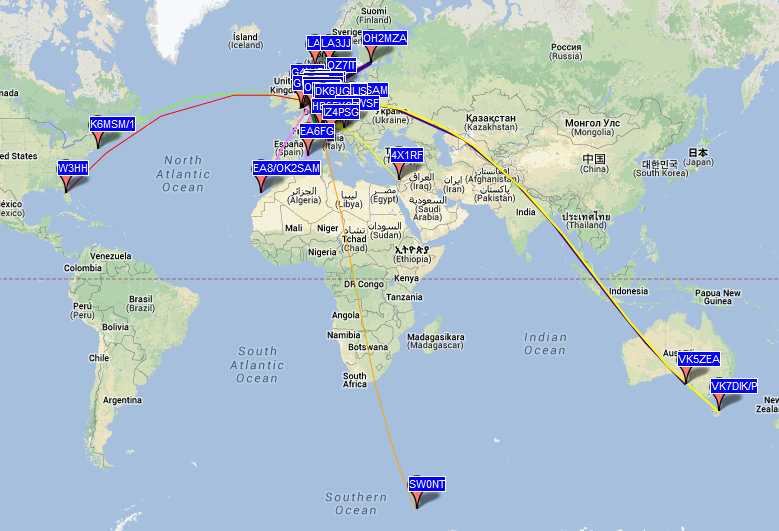
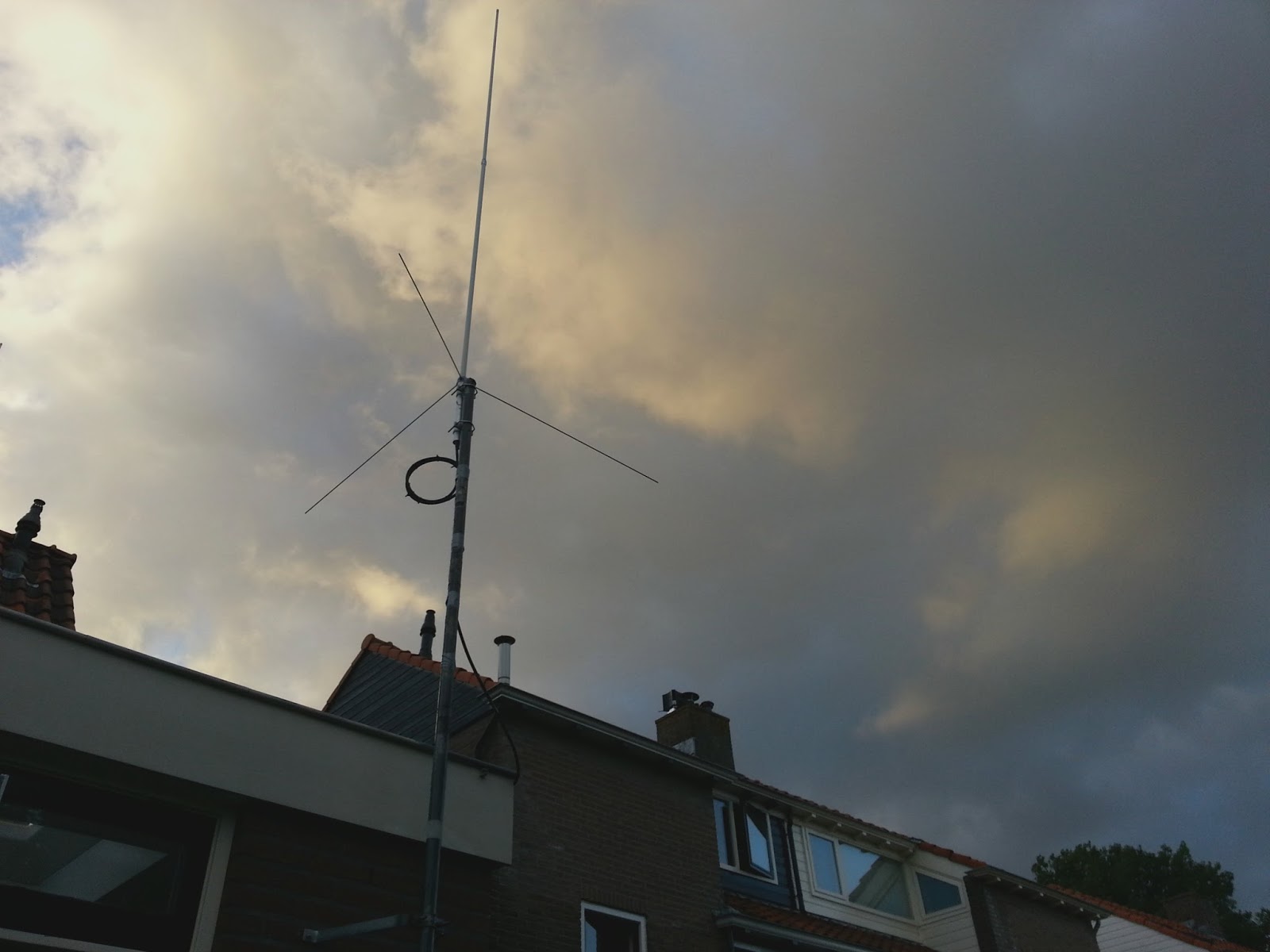
Good results on 30m tonight. This morning I made a few BPSK31 qrp qso's on 20m. Below my 6 meter antenna, unfortunately I hardly didn't make any qso this summer. Maybe 2 or so. I think it was the last time on 6 meter. I will replace the antenna for an another HF vertical.

Paul Stam, PC4T, is a regular contributor to AmateurRadio.com and writes from the Netherlands. Contact him at [email protected].
Cumbria Raynet and SBU35

One of our local runners approached me a few months ago, knowing I was a bit of a radio geek asking for advice on which walkie talkies to use for his upcoming trail race. For the unitiated a trail race is a bit like an old fashioned cross country but it generally goes over some serious terrain and can be quite long. Jon’s event was from Bassenthwaite to St Bees, totaling 35 miles. Not to be sniffed at. I’d suggested at the time that walkie talkes might not do it and as a member of the local Raynet group I offered our services.
Well the event was yesterday and after the runners set off at 8am I was manning checkpoint 1, some 20 miles into the race. Only the first couple of people through the check point looked ‘sprightly’ the rest took on more knackered looks as they went through. Eventually some RAF guys came through with packs on and the stragglers shuffled on. What’s this got to do with Ham Radio?
Well. the Cumbria Raynet group support a few of these types of events and I think our services were appreciated. The organiser thanked us and said he didn’t realise how complicated the whole thing was to maintain communications in a mountainous place. Perhaps it was the relief or local beer (Ennerdale Blonde) that helped his cheery outlook. Perhaps next year I’ll run it…with an APRS tracker! (It’ll need to be a very lightweight one though)
Alex Hill, G7KSE, is a regular contributor to AmateurRadio.com and writes from Cumbria, UK. Contact him at [email protected].
 Ham Radio Deluxe |
 W5SWL Electronics |
 Ham Radio Prep |
 KB3IFH QSL Cards  Hip Ham Shirts  HamRadioAuctions HamRadioAuctions Reliance Antennas Reliance Antennas Enigma Shop Enigma Shop |  morseDX  Ni4L Antennas  R&L Electronics R&L Electronics antennas.us antennas.us QRV QRV |
- Matt W1MST, Managing Editor
