 |
 A Mobile Station, QRPper and Two Frenchmen!
 30 September 2013 | by
 Wow! I can’t believe it has has been over a week since I have played radio. On this, the last day of September, I just had to get out. The weather here in Kansas was awesome – 75 deg, sunny and a light wind.
After getting setup, I heard a very faint CQ on 20 meters….
AK4JA (the QRPper) – Bob was calling CQ and was very faint, but readable. He was in Georgia. After reading his QRZ profile, he is a dedicated QRP addict, just like me. I had a bit of trouble copying him, but I believe he said he was running 200 MW! Thanks for the nice contact Bob!
Still on 20 meters….
N7IV/M (the mobile station) – Joe was calling CQ and was nice and strong here. He was calling from Minot, ND (which might be a new state for me) – he was running 200 watts from a TS 480 into a Hustler vertical antenna on rear fender. I believe he said he was on a long bike ride (but my CW skills were having a hard time keeping up 🙂 ). He thought my lunch time activities sounded amazing – and I agree! However, I think bicycle mobile sounds even better!
Now it was time to hit my favorite band for DX – 17 meters…
F8EMH (the first Frenchman) – Flo was calling CQ and after a couple of calls I was finally able to work him. He gave me a 229 – so he has good ears. He was 579 here and sounded great. Looking at the map, he looks to live in the northern part of France, really close to the border.
F8AAN (the second Frenchman) – David was also calling CQ at the bottom of 17 meters. It took a few calls for him to hear me, but we finally connected. He also had great ears giving me a 419 – he was 599 in here. He lives in the western part of France, almost on the coast it appears.
So after a week away, things were still just as fun! Today brought some interesting contacts, and some fun DX to boot.
Burke Jones, NØHYD, is a regular contributor to AmateurRadio.com and writes from Kansas, USA. Contact him at [email protected].
An interesting week at G4VXE (VHF Tropo, RTTY and Bad DVAP Data)
In my last post, the week had started well with some good tropo. That continued on Tuesday, when rather splendidly, I was able to work from home. Although I was busy, I was able to keep an ear on things. Around lunchtime, I just flicked up the volume on 432.200 which had been pretty quiet as I saw the meter flicker. I only caught the tail end and waited….
It was OE2CAL calling CQ at around S7! He worked a GW and I called and was very pleased to be able to make a QSO at around 1120km. Not bad at all. Signals dropped with me just after I worked him, although I suspect he turned his beam. I continued to hear him at good strength throughout the afternoon, sometimes stronger, sometimes weaker. On the vertical, I was hearing the DB0FT repeater on 145MHz from JO40 – not a bad distance.
Later in the week and over the weekend, tropo conditions were still good – although not over such great distances. I was able to work through an ON repeater on 145.6875 on Saturday and on Sunday morning, I had a nice simplex QSO with Ken, G3UDA in Shropshire.
With the CQWW RTTY contest over the weekend, any thought of JT65 or JT9 was off! No matter, I looked to see what RTTY signals were coming through on 28MHz.. Nothing amazing, but logged a few US, Asian and African stations. High power (100W) RTTY feels pretty unsubtle compared to JT65 and JT9 – but very different beasts, I suppose. It was nice to use PZTLog on RTTY for a change.
I also played a little on DSTAR, naturally whilst I was in the garden on Sunday morning, when it’s nice to listen to what’s coming through and have the odd QSO whilst working in the garden and the henhouse. The Raspberry Pi/DVAP combination works well, although I sometimes see an issue when I boot up, with the DVAPNode software reporting Bad DVAP Data and then resynchronising DVAP Stream. This seems to leave the CPU at 100% and so far, I’ve rebooted and it generally comes up ok next time. Not always and on Saturday it took a couple of goes. I’ll have to see if I can avoid rebooting and work out what process I have to kill and then restart. Nice QSO with Wis, YB0AZ from Jakarta, who told me there were two DSTAR users on his repeater in Jakarta. Him and his wife!
Finally, two of my favourite amateur radio bloggers are missing at the moment. Julian, G4ILO is taking a bit of a break on health grounds, as is Roger G3XBM who is also not well. Wishing you both the very best – hope to see you writing again very soon – I miss what you do.
Tim Kirby, G4VXE, is a regular contributor to AmateurRadio.com and writes from Oxfordshire, England. Contact him at [email protected].
CQ DX RTTY contest

If you can't beat them, join them. Normally I hate RTTY contests because they are all over the place and it's hard to make a qso with digi mode on HF. Now I made some contacts with RTTY just to give away points. I was active on 10 meter. Most stations from Asiatic Russia. This one from Egypt Cairo was special. Just because I do not work Egypt every day.

Kazakhstan always nice to work. Other stations on 10 meter RTTY: K3MJW, RG9A, RA9AU, RC9A, R9XC and RT9S. I also heard Australia and Brazil on 10, but could not work them.
Paul Stam, PC4T, is a regular contributor to AmateurRadio.com and writes from the Netherlands. Contact him at [email protected].
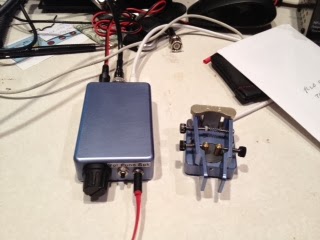
The Rock Mite and It Did
Mike Crownover, AD5A, is a regular contributor to AmateurRadio.com and writes from Texas, USA. Contact him at [email protected].
Big Magnetic Loop for QRP in the Park

I’ve been experimenting with magnetic loop antennas of various sizes and configurations for the past year or so. They are fun to build and even more fun to use.
QRP and Magnetic Loop antennas go hand in hand for many reasons. They work well, are very quick to set up, and are bidirectional! Its nice to be able to ‘aim’ an antenna at a prospective target, like say ‘Africa’!
Copper face plate with PL 259 and Gamma Match sticking out of the side

Soldering with a plumbing torch is necessary in some places, like attaching the main loop tubing to the PL 259.
It may not look very pretty here, but believe it or not, my torch soldering skill is actually improving. The PL 259 is attached with screws and is soldered with a regular soldering iron to reduce inter component resistance. I’ve pretty much settled on the Gamma Match for a number of reasons. It’s easy to match and its easy to build. It works well too.
This T’ fitting helps to make the loop more stable, therefore easier to transport for portable ops.

What would hams do without PVC pipe?
Half inch PVC tubing bisects the mast and passes through the center of it. This three point connection stabilizes the loop and makes it much more robust. My first few magnetic loops didn’t have this feature and were a bit ‘wobbly, and bent more easily as they bounced around in the back of my truck.
This is the ‘business end’ of the Gamma Match

Using a plumbing torch, I attached this copper strip to the Gamma match from the main loop tubing.
Here is another nifty improvement

You can see the support PVC pipe passing through the center of the mast here, The black piece is a plastic pipe clamp. It is held in place with tie wraps. I try to keep the use of anything made of metal to a minimum in the center of the loop. I’m not worried about radiation patterns as much as trying to keep the overall weight of the antenna low. The smaller PVC pipe on the left is a tuning stick. It is tied to the capacitor and is very light and makes reaching way up to tune the antenna unnecessary. Keep in mind that merely approaching this antenna closely affects the SWR. Touching it certainly changes the SWR as well.
How Well Does It Work?

I got great signal reports today, and that is saying something for a high Q antenna and only 5 watts of RF
This is my favorite pavilion at Hagen’s Cove Florida.

Hagen’s Cove is about 17 miles from my home, along the shore route. Its a county park that is right on the Gulf of Mexico. This particular pavilion is only 50 feet from the water’s edge. I bring a sandwich and bottle water lunch, but it took me an hour to eat it today. I had very curious visitors asking a million questions about radio, and my set up. I also keep my QSL cards handy to pass around. Visitors really like seeing them.
Hagen’s Cove

There is a kayak and canoe launching ramp here. Air boats have their own launch site close by. And darn it, I forgot my noise canceling headphones today, again! Air boats pass by in only inches of water and just 50 feet away, so I can’t hear anything on the radio when that happens. I have this place all to myself during the week, but its busier on weekend as you can imagine with such a nice venue.
For more information about Magnetic Loop Antennas go to http://groups.yahoo.com/group/MagneticLoopAntenna/
or http://groups.yahoo.com/group/MagLoop/
Hagen’s Cove is in Taylor County Florida http://taylorflorida.com/
73 de AA1IK
Ernest Gregoire
Ernest Gregoire, AA1IK, is a regular contributor to AmateurRadio.com and writes from Florida, USA. Contact him at [email protected].
Mobile Install
I have taken my HF mobile install through a number of different iterations (the constant being the rig: an Icom IC-706MKIIG). Today I hope that I have finally reached a lasting, workable setup. Here is a quick re-cap of my trials and tribulations:
First attempt (2007):
What this install lacked in experience, it made up in effort. The successes were routing the powerline and the feedline. The antenna system was a different story. My combination of Hustler and Hamstick antennas (along with the unfortunate choice of putting an Icom AT-180 autotuner in the mix) met with mixed success. I did make contacts and enjoyed the mobiling. The rig itself was placed under the passenger seat. Placed side by side with my TM-D710A left very little room and little clearance between the seat and the floor. I came to realize that my 2005 Toyota Tundra lacked any real great locations to stash a rig. The drivers seat (no way), behind the back seat (nope), under the back seat (not going to happen).
Tarheel Model 75A and the stake pocket mount (2008):
I have not regreted going with the Tarheel Model 75A. I finally figure out that using an autotuner was a non-starter and a screwdriver offered a great solution. The stake pocket mount was a mixed success. The way the pocket was always had the antenna sticking up at a funny angle. It also did not seem very secure. I still made lots of contacts and had lots of fun.
Switched to MT-1(S) mount (2009):
Switching to the MT-1(S) mount did a lot to improve my operations. By having the antenna mounted right to the side of the bed, my ground (… and other half of the antenna) was greatly improved.

Using the iPortable (2009-2012):
I don’t usaully have a passenger in the front seat – just two kids in the back. But having a heavy weight passenger in the front seat was a no-go for IC-706 in the all too cramped location under the seat. The iPortable setup allowed me to consolidate the IC-706MKII and the TurboTuner in one spot. No more messy nest of wires. But the iPortable offered somewhat of an obstacle to the kids in the back seat.
Current (…and final?) install (2013):
I have had the TM-D710A installed for a while. The AVMAP makes a good pairing and you can find my location via APRS here.

Now the iPortable is in the large tool box mounted to the bed of the pickup.

The big task was to reroute all the cables: an extension to the powerline, pulling out the feedline, and moving the control cable for the Tarheel antenna. The IC-706 includes the AD5X fan modification.

I had to drill a hole on either side of tool box to route the cables in and out. So far, so good – everything works and I am getting a full 100 watts out on every band.

I did forget to run a line for a CW paddle… that is on the To Do List.
There are also a few additional improvements I would like to make.
– 12v booster to 13.8v
– Extra 12v battery
– amplifier? 
Scott Hedberg, NØZB, is a regular contributor to AmateurRadio.com and writes from Kansas, USA. Contact him at [email protected].
Mobile Install
I have taken my HF mobile install through a number of different iterations (the constant being the rig: an Icom IC-706MKIIG). Today I hope that I have finally reached a lasting, workable setup. Here is a quick re-cap of my trials and tribulations:
First attempt (2007):
What this install lacked in experience, it made up in effort. The successes were routing the powerline and the feedline. The antenna system was a different story. My combination of Hustler and Hamstick antennas (along with the unfortunate choice of putting an Icom AT-180 autotuner in the mix) met with mixed success. I did make contacts and enjoyed the mobiling. The rig itself was placed under the passenger seat. Placed side by side with my TM-D710A left very little room and little clearance between the seat and the floor. I came to realize that my 2005 Toyota Tundra lacked any real great locations to stash a rig. The drivers seat (no way), behind the back seat (nope), under the back seat (not going to happen).
Tarheel Model 75A and the stake pocket mount (2008):
I have not regreted going with the Tarheel Model 75A. I finally figure out that using an autotuner was a non-starter and a screwdriver offered a great solution. The stake pocket mount was a mixed success. The way the pocket was always had the antenna sticking up at a funny angle. It also did not seem very secure. I still made lots of contacts and had lots of fun.
Switched to MT-1(S) mount (2009):
Switching to the MT-1(S) mount did a lot to improve my operations. By having the antenna mounted right to the side of the bed, my ground (… and other half of the antenna) was greatly improved.

February 2010
Using the iPortable (2009-2012):
I don’t usaully have a passenger in the front seat – just two kids in the back. But having a heavy weight passenger in the front seat was a no-go for IC-706 in the all too cramped location under the seat. The iPortable setup allowed me to consolidate the IC-706MKII and the TurboTuner in one spot. No more messy nest of wires. But the iPortable offered somewhat of an obstacle to the kids in the back seat.
Current (…and final?) install (2013):
I have had the TM-D710A installed for a while. The AVMAP makes a good pairing and you can find my location via APRS here.

Now the iPortable is in the large tool box mounted to the bed of the pickup.

The big task was to reroute all the cables: an extension to the powerline, pulling out the feedline, and moving the control cable for the Tarheel antenna. The IC-706 includes the AD5X fan modification.

I had to drill a hole on either side of tool box to route the cables in and out. So far, so good – everything works and I am getting a full 100 watts out on every band.

I did forget to run a line for a CW paddle… that is on the To Do List.
There are also a few additional improvements I would like to make.
– 12v booster to 13.8v
– Extra 12v battery
– amplifier? 
Scott Hedberg, NØZB, is a regular contributor to AmateurRadio.com and writes from Kansas, USA. Contact him at [email protected].
 Ham Radio Deluxe |
 W5SWL Electronics |
 Ham Radio Prep |
 KB3IFH QSL Cards  Hip Ham Shirts  HamRadioAuctions HamRadioAuctions Reliance Antennas Reliance Antennas Enigma Shop Enigma Shop |  morseDX  Ni4L Antennas  R&L Electronics R&L Electronics antennas.us antennas.us QRV QRV |
- Matt W1MST, Managing Editor
