 |
 VHF NFD Results
 3 October 2013 | by
 It seems a long time ago that we sat on top of Corney Fell with the sun shining and the winds blowing to set up the clubs NFD contest site. July seems like an age away. I only managed a very short time at the ‘operating table’ and with my current hiatus its taken me a while to catch up with all the results. Andrew, G4VFL popped a comment on the clubs website (http://mx0wrc.org) to say that we’d done a little better than expected. Overall 3rd in section but…
We came 1st in section for 70MHz
We came 2nd in section for 50MHz
& We came 2nd in section for 144MHz
I think we should be chuffed with those results and all credit to Andrew for doing all the donkey work in getting the bits and pieces together.
Alex Hill, G7KSE, is a regular contributor to AmateurRadio.com and writes from Cumbria, UK. Contact him at [email protected].
At 522,000,000 miles per watt, Voyager 1 might be the ultimate in QRP.
At 522,000,000 miles per watt, Voyager could be the ultimate in QRP … if you have the right antenna.
Owen Morgan, KF5CZO, is a regular contributor to AmateurRadio.com and writes from Texas, USA. Contact him at [email protected].
Geomagnetic storm

There is a geomagnetic storm going on. The noise floor is 12 dB less at the moment. I could work HB3ØOK and 9A282TN on 40m CW. I did hear ZL2AGY (!) but could not work him. Despite of a geomagnetic storm, I could hear the other end of the world.
Paul Stam, PC4T, is a regular contributor to AmateurRadio.com and writes from the Netherlands. Contact him at [email protected].
38,750 Miles per Watt Contact
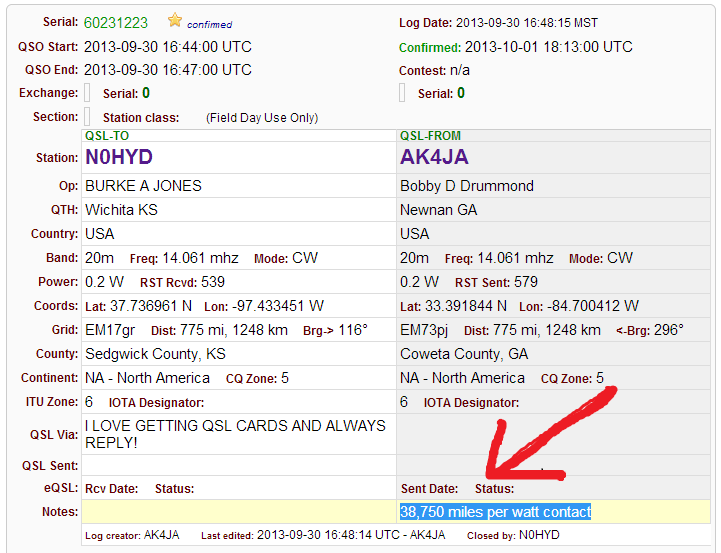
Yesterday I posted that I had worked AK4JA and that I thought he said he was running VERY low power, but my CW skills couldn’t be sure.
Well I just noticed he logged the contact on QRZ…
He was running 20 MILLIWATTS from a homebrew transmitter! He made note in the comments that this was a 38,750 mile per watt contact.
Wow! What fun to be on the other end of Bob who was running such low power. Keep having fun Bob!
Burke Jones, NØHYD, is a regular contributor to AmateurRadio.com and writes from Kansas, USA. Contact him at [email protected].
Good news
On two fronts really. The project at work that has taken up most of my energy is coming to its crescendo and that means in a months time it’ll back down to normal levels…..which means…more time for radio.
The other good news is that my planning application for a 12m mast and antenna has been approved! I haven’t had the official letter but the info is that it doesn’t come with any additional stipulations so that’s great news
Only the building of the other part of the planning application will get in the way of my new gear. Just an extension.
Alex Hill, G7KSE, is a regular contributor to AmateurRadio.com and writes from Cumbria, UK. Contact him at [email protected].
DX on 40 Meters with an Indoor Isotron Antenna
Due to a busy personal schedule, I’ve sparsely been on the air for a few days; but I still continue to work a few DX stations. Early this morning, I found this VERY satisfying QSO with a station near Munich Germany.

I’ve been hearing a few nightly DX stations, on the lower end of the General class portion of the 40 meter band, but never thought I could work one. I was very surprised when I called DJ6ZM on 7026 MHz with 5 watts from my indoor mounted Isotron antenna – and he answered with a “question mark“. (IMI)
After re-directing his beam, and me repeating my call sign a few times, he could hear me clearly, and responded with a 449 report! He lives about 15 KM from the headquarters of BMW motor company.

I’ve worked Germany 41 times now. Fifteen of them have been this year, but this is my first German contact on 40 meters. As most of my readers know, I live in a restricted antenna area near the state capitol in Charleston and use stealth antennas.
My 40 meter antenna has often been called “the bird house” because…let’s face it, I’ve seen bird houses about this size. Hihi
My 40 meter Isotron antenna is the one with the “small coil” on the left side of the painters pole.
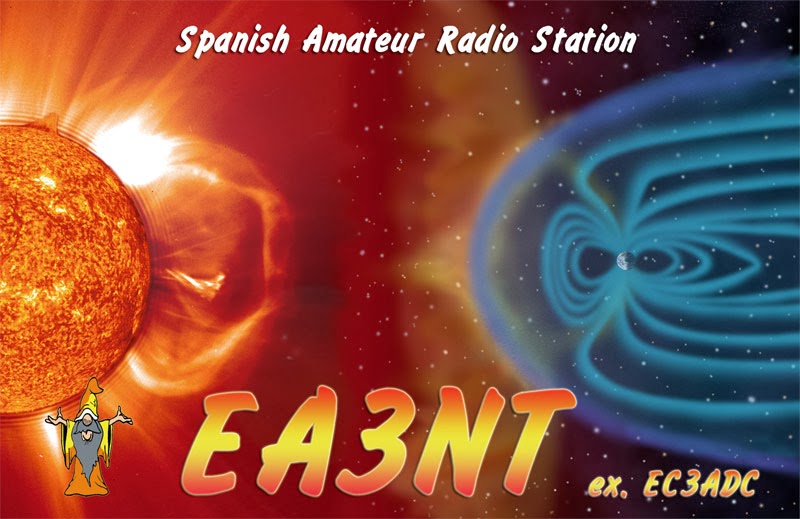
This morning, on 30 meters, I also worked EA3NT for the “third” time and he responded with “nice to hear you again”. This makes my 37th contact into Spain.
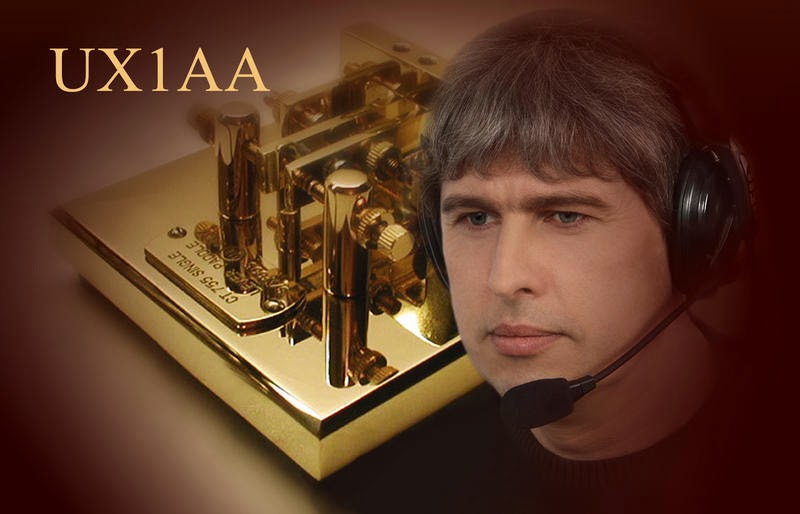
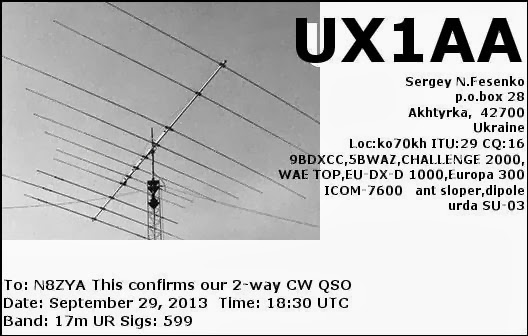
I’m also very proud of a nice contact, on the 29th of September, with UX1AA in the Ukraine ! This was a great signal on the 17 meter band. In addition to a nice card displayed on QRZ.com
John Smithson, Jr., N8ZYA, is a regular contributor to AmateurRadio.com and writes from West Virginia, USA. Contact him at [email protected].
Cool 12m SOTA contact
The past Saturday I had a rare weekend with not much on the schedule so I was chasing SOTA summits among other things. It was a fun day on the radio and I worked several Europeans on 12m. Currently the SOTA program has a 12m challenge in place which encourages activity on this band and when open, provides some fairly long haul DX for these QRP summit operations. I wasn't operating QRP, I was using my FT5000 and my Log Periodic Antenna up about 50 ft, however there are always several summit to summit QSO's among the activators that are QRP both ways across the pond. However this wasn't the most fun of the day.
Around 0130z on Saturday evening a SOTA spot came up for VK3ZPF, Peter, on a Mt. St. Phillack in Victoria, Australia on 12m SSB. I swung the beam around, not expecting to hear a peep. I wouldn't be writing the article if that is how it ended;-) I could hear the CQ faintly, but there was deep QSB. Finally on the peak I called and he came right back. We exchanged reports I had him in the log. A few minutes later, Glenn, VK3YY, who was with Peter was calling and I worked him as well. Glenn sent me an email saying that he was using a 40m EFHW antenna through an Elecraft T1 tuner and an FT817. Pretty cool and on SSB as well.
This radio stuff is fun.
Mike Crownover, AD5A, is a regular contributor to AmateurRadio.com and writes from Texas, USA. Contact him at [email protected].
 Ham Radio Deluxe |
 W5SWL Electronics |
 Ham Radio Prep |
 KB3IFH QSL Cards  Hip Ham Shirts  HamRadioAuctions HamRadioAuctions Reliance Antennas Reliance Antennas Enigma Shop Enigma Shop |  morseDX  Ni4L Antennas  R&L Electronics R&L Electronics antennas.us antennas.us QRV QRV |
- Matt W1MST, Managing Editor
