 |
 70cm UKAC with a simple set up
 9 October 2013 | by
 Last nights exploits on the UKAC on 70cms was a bit of a surprise for me. I trotted up to Sandwith water pumping station, noted for two things, a bit of height and a bit of noise (presumably from all the gubbins inside the station and from the mast nearby.
Needless to say I wasn’t expecting much and as the wind was getting all autumnal on me I took my trusty 5m decorators pole, 7 ele Sotabeam yagi and FT817 and these are the results. G4ODA took some doing but generally I was able to work pretty much all I could hear, a few got away but not too many and the GM stations were loud as anything and gave me equally good signal reports.

I don’t think I’ll ever win any prizes but I can’t fault the Sotabeam since swapping over from the 5 ele LFA on 2m, I see to get just as far, its light weight, robust and simple. As its also good for 70cm it makes the ideal companion to my simple set up.
I’ve also yet to find a simple rig to rival the FT817. It has a number of ‘diosyncrasies and a few faults but as an all rounder you can’t fault it.
Alex Hill, G7KSE, is a regular contributor to AmateurRadio.com and writes from Cumbria, UK. Contact him at [email protected].
Turkey

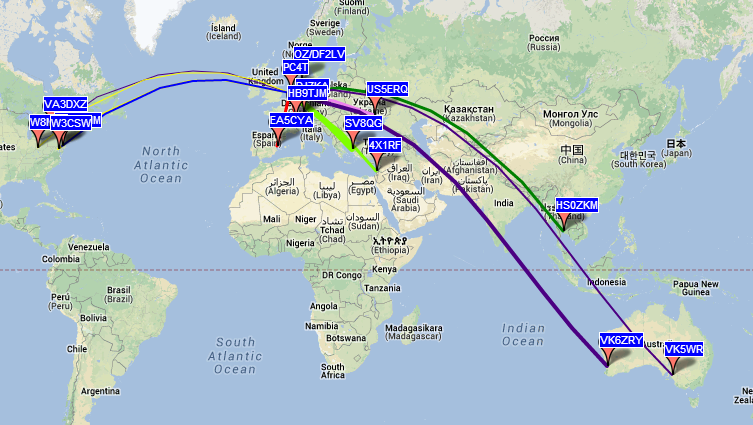
I had a qso with TA1GO on 20m (14076 KHz) with JT65A. Though poor propagation, I heard VK3FM and YV6BFE with JT65A.
Paul Stam, PC4T, is a regular contributor to AmateurRadio.com and writes from the Netherlands. Contact him at [email protected].
The Sun is flipping out!
Every approximately eleven years, the Sun produces a “cycle” of sunspot activity. At the very lowest point in this cycle, there are few, if any, sunspots observed. Such a lack of sunspots can last for weeks. During the peak of the sunspot cycle, there can be a multitude of sunspots, ranging in size. This cycle is known as the sunspot cycle. It is caused, in part, by the magnetic activity within the Sun. Every eleven years, the Sun’s magnetic polarity flips–the north becomes south, the south becomes north. This is normal. Every twenty two years, then, the Sun goes through one full magnetic flip cycle. The flipping seems to coincide with the timing of solar cycle maxima. When it flips, we know about where we are in the eleven-year cycle. The magnetic polarity of the Sun appears to be in the process of reversing, over the next few months. If so, then we’ve pretty much reached the sunspot cycle maxima for Cycle 24. Observers note that this cycle is quite a bit less active than the last few eleven-year cycles.
A video that talks about this reversal is here:
The flipping of the Sun’s magnetic poles: Sunspot Cycle 24
More information on the Sun and the cycle, radio propagation, and related topics:
On Twitter:
+ https://Twitter.com/hfradiospacewx
+ https://Twitter.com/NW7US
On Facebook:
Visit, subscribe: NW7US Radio Communications and Propagation YouTube Channel
First 28MHz DX of the season from the mobile
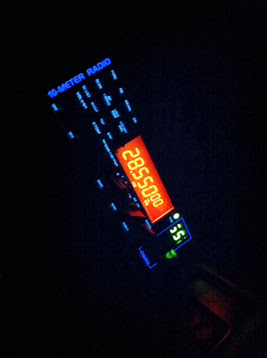
Driving home this evening, 28MHz was in good form with some strong US and South American signals audible.
I was particularly pleased to work Ziggy KZ9DX from near Chicago. Although my signal was not huge, I was happy that 12W to the mobile antenna was doing ok.
Hopefully signals will continue to improve and there will be AM contacts to be made soon!
Tim Kirby, G4VXE, is a regular contributor to AmateurRadio.com and writes from Oxfordshire, England. Contact him at [email protected].
Tidbits From the QRP History Book
It seems that Kruse felt that American operators had become too enamored with high power operation and that the QRM and inefficiencies of high power operation were precluding the "grassroots" operator from even hearing DX stations. Weiss writes,
"QST continually derided the abuse of power among American amateurs by coining a long list of derogatory epithets for the high power types. Such names as "watt-hog", "ether buster", "tribe of ampere hounds", "ampere chaser", "thunder factory', "watt burner" and "most miles per gallon" flowed across the pages of QST, leaving little doubt as to the attitude of the QST staff, and presumably the ARRL, to combat the developing dependence upon brute power by American amateurs in place of the ideals embodied in the QRP Operator...."
In, December 1923, the very first QRP contest, The Station Efficiency Contest, was announced with this subtitle, "Miles Per Watt: An Argument For The Small Set and For Intelligence In Place of Brute Force" Weiss comments, "In other words, the use of low power was inextricably linked with intelligence and diametrically opposite to high power"
Further Kruse argued, "...what if his brute power does let him cover 4,000 miles, isn't he still inferior to the other man who handled his power correctly and went twice as far per watt?"
So there you have it, QRP operation = Intelligence.
Need we say more;-)
The book goes into much more detail about the attack on high power operation and rising credibility of the QRP operator in those early days. Interesting reading and entertaining as well.
Mike Crownover, AD5A, is a regular contributor to AmateurRadio.com and writes from Texas, USA. Contact him at [email protected].
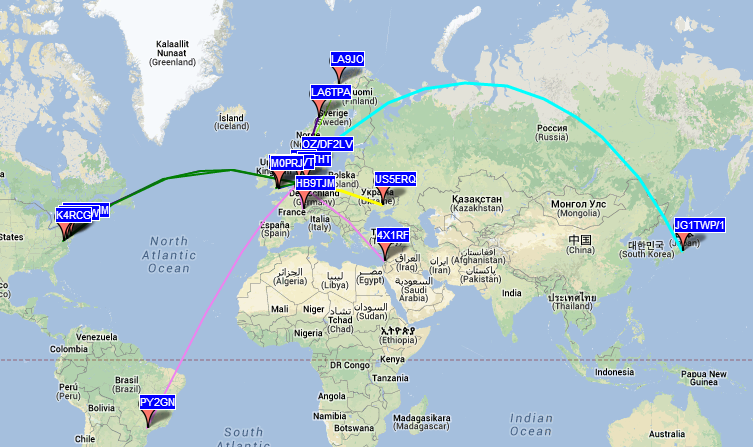
20m WSPR
Paul Stam, PC4T, is a regular contributor to AmateurRadio.com and writes from the Netherlands. Contact him at [email protected].
Digital Voice (DV) – the new FM?
 |
| My home DSTAR hotspot. Comprising 2m PMR radio (underneath), GMSK modem (top) and Raspberry Pi computer (bottom). |
Rob Law, MW0DNK, is a regular contributor to AmateurRadio.com and writes from Anglesey, Wales. Contact him at [email protected].
 Ham Radio Deluxe |
 W5SWL Electronics |
 Ham Radio Prep |
 KB3IFH QSL Cards  Hip Ham Shirts  HamRadioAuctions HamRadioAuctions Reliance Antennas Reliance Antennas Enigma Shop Enigma Shop |  morseDX  Ni4L Antennas  R&L Electronics R&L Electronics antennas.us antennas.us QRV QRV |
- Matt W1MST, Managing Editor
