 |
 28Mhz activity: Can we learn from the CBers?
 3 October 2013 | by
 I can hear a sharp intake of breath from some of you, but bear with me…!
You have to admire the way the CBers make the most of the spectrum. For the last month or so, as I’ve been getting back to the car in the evening, I’ve been turning the 10m rig on. By and large the amateur band has been quiet, with the occasional Brazilian station coming through.
Tune down a MHz or so and listen to the CB band and there’s distinctly more activity. The 27.555MHz calling frequency (not legal in the UK, of course) generally has something going on, even if conditions are poor.
I suppose amateurs, if they find 28MHz closed, they head off to another band – whereas the CBers, in theory, only have the one band that they can use, so make the best of it. It must be the VHF operator in me, but I find a half-open band far more interesting than a wide-open band – it’s far more fun to try pulling the weak signals through than having them boom in! So, I admire the guys that are trying out propagation day in and day out and making, from what I hear, some interesting contacts.
When the band is poor or half open – the concept of a centre of activity or calling channel makes some sense. A weak signal somewhere between 28.400 and 28.600 is unlikely to be heard – but perhaps if there was a centre of activity – someone somewhere might hear something.
I wondered whether the 10-10 International group might ‘nominate’ a centre of activity, but could not see that they did – nets at specific times, certainly – but nothing more generalised.
I seem to remember somewhere reading that 28.400 was nominated as an unofficial calling frequency. Perhaps over the winter, when the band is not in great shape, we should make a few calls there anyway and see what happens! I’ll bet some interesting contacts would result.
Maybe some possibilities for 29MHz AM too – some more activity around 29.000 and 29.010MHz AM would be very welcome.
On many bands, it’s all about activity. 28Mhz deserves more of our attention, even when it’s not wide open! See you on 28.400 SSB or 29.000 AM, maybe?
Tim Kirby, G4VXE, is a regular contributor to AmateurRadio.com and writes from Oxfordshire, England. Contact him at [email protected].
VHF NFD Results
It seems a long time ago that we sat on top of Corney Fell with the sun shining and the winds blowing to set up the clubs NFD contest site. July seems like an age away. I only managed a very short time at the ‘operating table’ and with my current hiatus its taken me a while to catch up with all the results. Andrew, G4VFL popped a comment on the clubs website (http://mx0wrc.org) to say that we’d done a little better than expected. Overall 3rd in section but…
We came 1st in section for 70MHz
We came 2nd in section for 50MHz
& We came 2nd in section for 144MHz
I think we should be chuffed with those results and all credit to Andrew for doing all the donkey work in getting the bits and pieces together.
Alex Hill, G7KSE, is a regular contributor to AmateurRadio.com and writes from Cumbria, UK. Contact him at [email protected].
At 522,000,000 miles per watt, Voyager 1 might be the ultimate in QRP.
At 522,000,000 miles per watt, Voyager could be the ultimate in QRP … if you have the right antenna.
Owen Morgan, KF5CZO, is a regular contributor to AmateurRadio.com and writes from Texas, USA. Contact him at [email protected].
Geomagnetic storm

There is a geomagnetic storm going on. The noise floor is 12 dB less at the moment. I could work HB3ØOK and 9A282TN on 40m CW. I did hear ZL2AGY (!) but could not work him. Despite of a geomagnetic storm, I could hear the other end of the world.
Paul Stam, PC4T, is a regular contributor to AmateurRadio.com and writes from the Netherlands. Contact him at [email protected].
38,750 Miles per Watt Contact
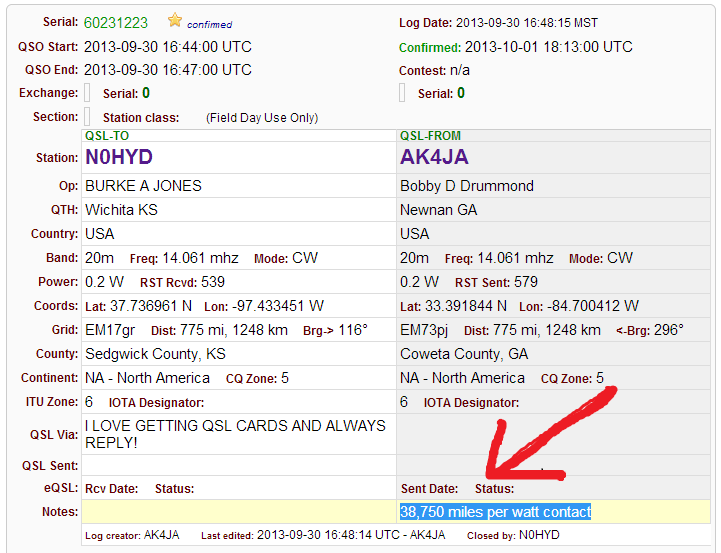
Yesterday I posted that I had worked AK4JA and that I thought he said he was running VERY low power, but my CW skills couldn’t be sure.
Well I just noticed he logged the contact on QRZ…
He was running 20 MILLIWATTS from a homebrew transmitter! He made note in the comments that this was a 38,750 mile per watt contact.
Wow! What fun to be on the other end of Bob who was running such low power. Keep having fun Bob!
Burke Jones, NØHYD, is a regular contributor to AmateurRadio.com and writes from Kansas, USA. Contact him at [email protected].
Good news
On two fronts really. The project at work that has taken up most of my energy is coming to its crescendo and that means in a months time it’ll back down to normal levels…..which means…more time for radio.
The other good news is that my planning application for a 12m mast and antenna has been approved! I haven’t had the official letter but the info is that it doesn’t come with any additional stipulations so that’s great news
Only the building of the other part of the planning application will get in the way of my new gear. Just an extension.
Alex Hill, G7KSE, is a regular contributor to AmateurRadio.com and writes from Cumbria, UK. Contact him at [email protected].
DX on 40 Meters with an Indoor Isotron Antenna
Due to a busy personal schedule, I’ve sparsely been on the air for a few days; but I still continue to work a few DX stations. Early this morning, I found this VERY satisfying QSO with a station near Munich Germany.

I’ve been hearing a few nightly DX stations, on the lower end of the General class portion of the 40 meter band, but never thought I could work one. I was very surprised when I called DJ6ZM on 7026 MHz with 5 watts from my indoor mounted Isotron antenna – and he answered with a “question mark“. (IMI)
After re-directing his beam, and me repeating my call sign a few times, he could hear me clearly, and responded with a 449 report! He lives about 15 KM from the headquarters of BMW motor company.

I’ve worked Germany 41 times now. Fifteen of them have been this year, but this is my first German contact on 40 meters. As most of my readers know, I live in a restricted antenna area near the state capitol in Charleston and use stealth antennas.
My 40 meter antenna has often been called “the bird house” because…let’s face it, I’ve seen bird houses about this size. Hihi
My 40 meter Isotron antenna is the one with the “small coil” on the left side of the painters pole.
This morning, on 30 meters, I also worked EA3NT for the “third” time and he responded with “nice to hear you again”. This makes my 37th contact into Spain.
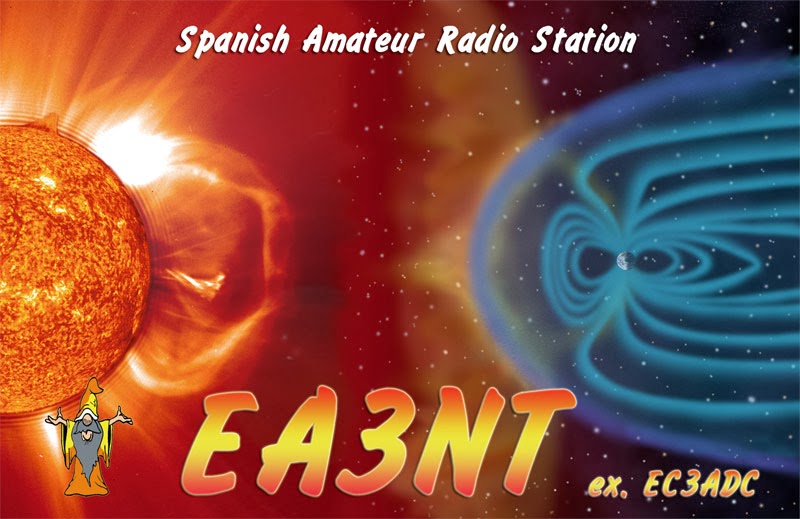
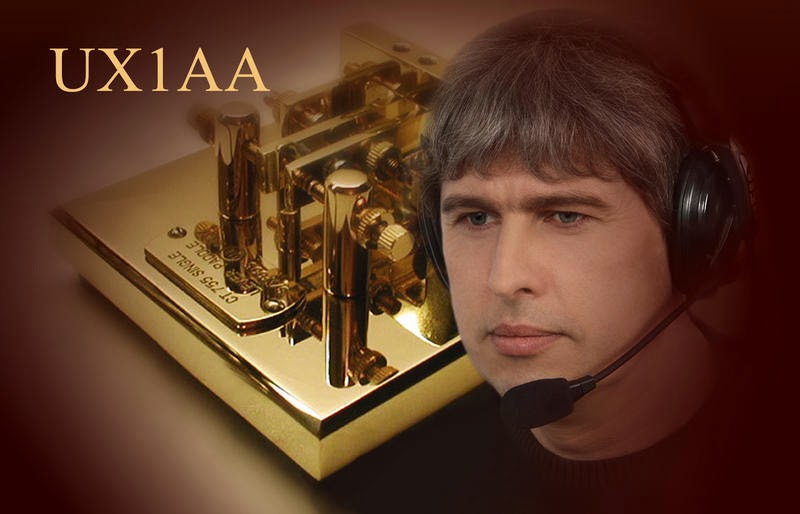
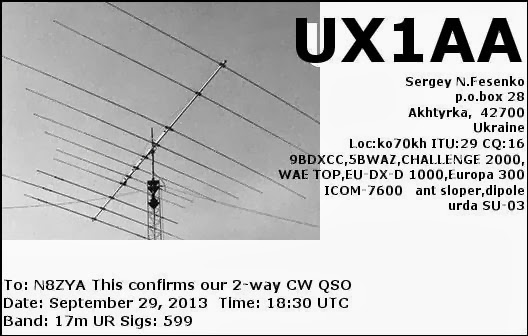
I’m also very proud of a nice contact, on the 29th of September, with UX1AA in the Ukraine ! This was a great signal on the 17 meter band. In addition to a nice card displayed on QRZ.com
John Smithson, Jr., N8ZYA, is a regular contributor to AmateurRadio.com and writes from West Virginia, USA. Contact him at [email protected].
 Ham Radio Deluxe |
 W5SWL Electronics |
 Ham Radio Prep |
 KB3IFH QSL Cards  Hip Ham Shirts  HamRadioAuctions HamRadioAuctions Reliance Antennas Reliance Antennas Enigma Shop Enigma Shop |  morseDX  Ni4L Antennas  R&L Electronics R&L Electronics antennas.us antennas.us QRV QRV |
- Matt W1MST, Managing Editor
