 |
 More loggings on 472khz WSPR
 23 October 2013 | by
 Over the last week or two, I have been running my 472khz WSPR receiver to see what I could ‘catch’. As you may remember, this is all very simple – the unmodified FT-847 connected up to an untuned Butternut vertical! However it seems to work at least a little!
Some new stations received over the last week or so have been
DK7FC
OR7T
G3XIZ
F4DTL
F5WK
EI0CF
DG3LV
Propagation varies quite heavily from day to day. Some days I hear only a couple of G stations and other days, I hear the more distant DL stations.
If you’ve not tried, I really recommend that you have a listen!
Tim Kirby, G4VXE, is a regular contributor to AmateurRadio.com and writes from Oxfordshire, England. Contact him at [email protected].
Show Notes #112
Episode #112 Audio (Listen now!):
Topics
- A segment on PAE kernels and POSIX commands that were cut from the last episode, aired now for your listening convenience!
- Review of CrunchBang Linux
- Voice of Russia to cease shortwave radio service
- Higher FCC Vanity Call Sign Fee is Effective August 23
- Important Shortcuts For Linux Beginners
- No More free Ham Radio Deluxe
- Linux Lite 1.0.6
- email from RAC:
- RAC Bulletin 2013-026E – 2013 Simulated Emergency Test (SET)
- http://www.rac.ca
- Announcement: New HF Youth Net:
- Social Media Roundup
- Facebook Likes
- Matthew M.
- Tom R.
- Facebook Likes
- Subscribers and Donations
- none
- Feedback
- Comments from Chris W
- E-mail from Richard G. KD0RG (formerly KD0BJT) host of the LowSWR Podcast
- Outro
- Thank you to our monthly and yearly subscribers.
- Thank you to all of our listeners, live and quasi-live.
- You can reach us at [email protected]. You can leave us voice mail at 1-909-LHS-SHOW (547-7469).
- Please subscribe to the mailing list.
- Go to CafePress and Printfection and buy some of our show merchandise. Each purchase helps out the show.
- Listen live every every other Tuesday at 8:00pm Central.
Episode Music
- “Catawumpus” by Spark Thugs from the album Spark Thugs, courtesy of Jamendo.
- “Space Echo” by I’m Bad Like Jesse James from the album With Slippers, courtesy of Jamendo.
Russ Woodman, K5TUX, co-hosts the Linux in the Ham Shack podcast which is available for download in both MP3 and OGG audio format. Contact him at [email protected].
Radio silence
This evening was supposed to be a UKAC night for me but with strong winds and flooding earlier in the day I decided not to head up to Sandwidth with a 50MHz antenna, just in case it got nasty. Even though it looks quite down here in the valley (I’m not just talking about 50Mhz activity either- Only GI4SNA can be heard) the top of the hill will be muddy and potentially windy.
So what to do with the radio time. We’ll I’ve been carrying around a plastic case for some time wondering when I’ll get around to using it as a sturdy case for packing up my FT817 and taking on trips with. The case  used to hold a complex vice but the parts are happier in my tool box. So i stripped out the old foam and measured up the insides. It measures just about the wrong size for the easy to use pick and pluck foam so I ordered a 5 mm base layer and 40mm deep top layer from eFoam. The job is fairly simple and needs only a very sharp long bladed knife and a bit of patience.
I laid out the rig, tuner, wall wart, battery, mic and a few odds and ends into the case and carefully marked out the positions using a steel rule and marker pen (making sure the marker pen was on the inside of the are to be cut as I didn’t want any left over pen. I suppose you could just as easily cut it and turn it all over but that may require extra thinking.
So with holes cut out and the bottom layer done, like so (as they say on Blue Peter) there wasn’t much to do apart from fill it up with the goodies. So with a free(ish) plastic case and a few quid’s worth of foam I’ve got a budget Pelicase. Probably just as sturdy for my needs and significantly cheaper.
Just one reminder, the blade needs to be very sharp and a light sawing action seemed to cut the foam nice and smoothly. Just one last thing to do is to raid the spare elastic department (If we have one) and form a kind of retaining strap for the bits in the lid.
Who said UK activity night should be limited to on air activity?
Alex Hill, G7KSE, is a regular contributor to AmateurRadio.com and writes from Cumbria, UK. Contact him at [email protected].
So where do youse guys hang out, anyways?
Sorry for using the “Tony Soprano” vernacular, but that’s a question often asked by budding QRPers, or those looking to dip a toe into the pond, wondering what QRP signals sound like.
To answer the question truthfully – just about everywhere! Anywhere we have frequency privileges given to us by the FCC, you will find QRPers. But I know that’s not the spirit in which the question was asked. Because, yes Virginia, there are “special” frequencies where QRPers tend to congregate. Not that there’s anything magical about them, they’re just frequencies that QRPers have come to know as “the watering holes”. Just like animals from the African savanna meet and greet each other at the local pond, lake or stream, so QRPers tend to congregate at certain frequencies where the odds are good we will meet others of our species.
For CW, they are as follows:
160 Meters ~ 1.810 MHz
80 Meters ~ 3.560 MHz
40 Meters ~ 7.040 and 7.030 MHz
30 Meters ~ 10.106 MHz
20 Meters ~ 14.060 MHz
17 Meters ~ 18.080 MHz
15 Meters ~ 21.060 MHz
12 Meters ~ 24.906 MHz
10 Meters ~ 28.060 MHz
And for SSB:
160 Meters ~ 1.910 MHz
80 Meters ~ 3.985 MHz
40 Meters ~ 7.285 MHz
20 Meters ~ 14.285 MHz
17 Meters ~ 18.130 MHz
15 Meters ~ 21.385 MHz
12 Meters ~ 24.956 MHz
10 Meters ~ 28.885 MHz
In fact, the Long Island QRP Club has a very nice .pdf that you can print out and laminate and keep close by for easy reference. You can find it here. You will notice their list also lists other frequencies as well, because there’s no hard and fast rule, written in stone. And more than likely, you will hear QRPers clustering around these neighborhoods and not on these frequencies EXACTLY (although it often feels that way during a QRP contest!).
Now, when you get to those frequencies, you will undoubtedly hear some weak signals. But if you get blasted by a 599++++ signal, don’t automatically assume that it’s a QRO station intruding. It just may be that due to propagation and band conditions, that powerhouse signal you are hearing just might be generated by a transmitter putting out 5 Watts or less. Don’t assume that QRP always equals “weak”. Just ain’t so! If there’s one thing the QRP Fox hunts will teach you, is that QRP equals Low Power, not necessarily Weak Signal. Yes, you will work your share of 339 and 559 stations, but if you get involved with QRP and hang with it long enough, you’ll hear your share of eardrum blasters, too.
Now to a different matter. I got an e-mail this morning from my good friend Bob W3BBO telling me about how good propagation was on 10 Meters Sunday afternoon. I didn’t get the chance to get on yesterday, but you can sure as all heck guess where I went to during my lunchtime QRP session today! Yep, 10 Meters and it was hopping today, too. I worked Denmark, Italy and Croatia with no problem at all – no repeats, practically armchair copy both ways – although QSB did rear its ugly head now and then. Oh man, I wish 10 Meters was like this everyday! I am hoping this lasts for a couple of weeks (or months) – fingers crossed!
72 de Larry W2LJ
QRP – When you care to send the very least!
Larry Makoski, W2LJ, is a regular contributor to AmateurRadio.com and writes from New Jersey, USA. Contact him at [email protected].
Bike Ride in East Andover with DX
Judy and I rode our bicycles in East Andover this afternoon. It was gorgeous. I worked Cuba, St. Kitts, Portugal, Ukraine and Belgium.

We rode on the old Northern Rail right of way. The tracks are gone now, and it’s a bicycle and walking path. We sailed along through tunnels of gold and orange. Really beautiful. We stopped at a beach along Highland Lake. I operated at a picnic table there for about 20 minutes.

I tossed a line over a branch and pulled up a 30 foot wire. I used the earchi.org 9:1 unun and my KX3. I made one QSO on each band… 10M, 15M, 17M, and 20 meters. First I had a quick exchange with Eduardo in Cuba… CO8LY and I traded 599s. On 15 meters I worked V44KAI, Joel in St. Kitts. We gave each other 559s and I answered CT7AEQ in Portugal on 17 meters. Ted was a 599 and gave me the same report. Finally I worked Boris in the Ukraine. RU3ZC gave me a 569 and he was 589. Before leaving the spot, Judy took a quick photo by the lake.

Then we jumped on our bikes and rode about 3 miles to the east toward Franklin. We stopped at a beaver pond along the Sucker Brook.

Just below the bridge the beavers had built a small dam. But it was big enough to turn a large swamp into a small pond. I threw a wire over a tall pine tree along the pond and set up the KX3 on 20 meters. Someone had placed a small picnic table at the spot.

I heard Jean, ON4AEF from Belgium signing with another station and I called him. He gave me a 559. He was a very strong 599. “UR QRP FB,” he sent. “Great signal. Rig HR K2 10W X QRP like you!” It was a wonderful QSO and a perfect finale to our bike ride.
We turned around and headed back to the car. Cold weather is coming Wednesday.
Jim Cluett, W1PID, is a regular contributor to AmateurRadio.com and writes from New Hampshire, USA. Contact him at [email protected].
Lost Island DX Society Mysteriously Reappears
 As reported here in this blog, the Lost Island DX Society has been missing in action for over a year. Various rumors propagated around the internet and amateur radio community concerning what happened to these LIDS. Recently, the Fi-Ni Report came to life and reported that the LIDS are actively planning (or at least discussing) working the CQ Worldwide DX Contest. Of course, this is the SSB version of the contest.
No explanation has been given for the year long absence of the LIDS and the Fi-Ni Report.
73, Bob K0NR
Bob Witte, KØNR, is a regular contributor to AmateurRadio.com and writes from Colorado, USA. Contact him at [email protected].
Studies on Morse code recognition
 |
| Nice drawing of Morse key by Dutch radio amateur Dick Kraayveld, PA3ALM (http://www.morsecode.nl/pa3alm.html) |
In the early 90’s there were some interesting studies performed on Morse code recognition and the effects of pitch frequency, signal to noise ratio and code speed. They were part of the PhD work of Peter Montnémery who is a medical doctor and also radio amateur SM7CMY. I reread these papers now since there was a discussion on the pitch frequency (CW pitch resolution) just recently on the Elecraft mailing list. This discussion comes up from time to time, as it did for instance in 2006 also (Sidetone questions — copy speed vs sidetone pitch).
The two first papers are probably the most interesting ones for radio amateurs, so therefore I have posted their abstracts and a key figure from each of them also.
 |
| Press figure for larger size |
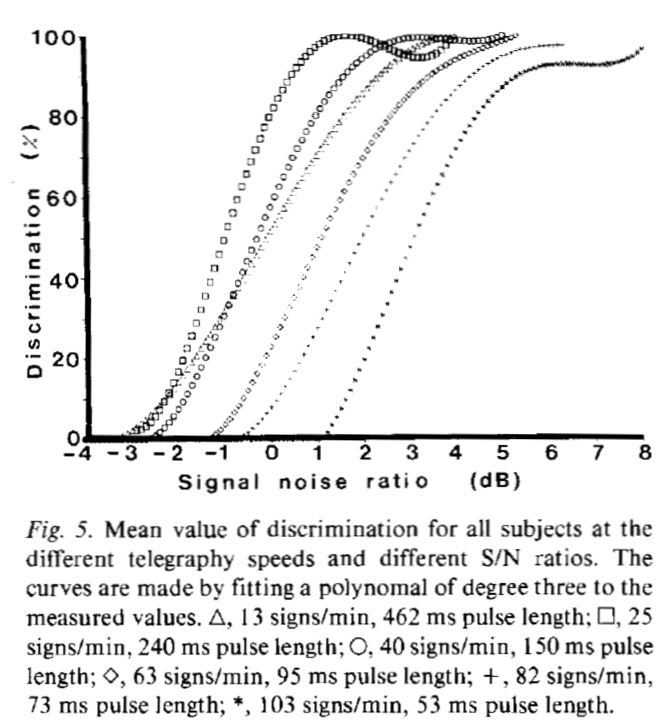
Paper 1: Montnemery, P., Almqvist, B., & Harris, S. (1991). Recognition of Telegraphy Disturbed by Noise at Different S/N-Ratios and Different Telegraphy Speeds A Comparison to Short-Tone Audiometry. Scandinavian Audiology, 20(1), 33-39.
Abstract: “The ability to recognize telegraphy at different S/N ratios and telegraphy speeds was compared for 10 normal-hearing men trained in detecting telegraphy. The ability to recognize telegraphy disturbed by noise decreased with increasing telegraphy speed and reduced S/N ratio. The recognition of telegraphy disturbed by noise seems to follow the relations known from experiments with short-tone audiometry.”
The figure above (Fig. 5) shows recognition in % vs signal to noise ratio (SNR) for speeds 13, 25, 40, 63, 82, and 103 characters per minute (CPM) which when divided by five correspond to 2.6, 5, 8, 12.6, 16.4, and 20.6 words per minute (WPM). Note how recognition at the 90 % rate is easiest (works under lowest SNR) at 5 WPM, then 8, then the exception for the slow speed 2.6 WPM, and then gets even harder at speeds 12.6, 16.4, and 20.6 WPM.
 |
| Press figure for larger size |
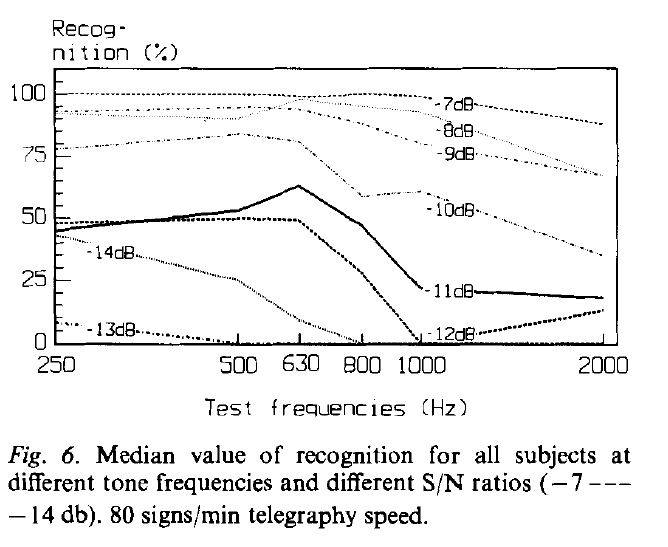
Paper 2: Montnemery, P., Almqvist, B., & Harris, S. (1992). Recognition of telegraphy signs at different listening levels and frequencies. Scandinavian Audiology, 21(4), 255-260.
Abstract: “The recognition of telegraphy masked by noise at 40 and 80 signs/min telegraphy speed was studied in 10 normal-hearing subjects at different sound pressure levels (25–85 dB SPL in steps of 5 dB) as well as at different test frequencies (2000, 1000, 800, 630, 500 and 250 Hz). The ability to recognize the signs varied with varying SPL. Recognition for most of the subjects was best at an SPL close to 70 dB. All subjects improved their recognition as the frequency was lowered to 500 Hz, some even at 250 Hz. These facts should be taken into consideration when training telegraphy operators as well as in the construction of radio receivers to permit listening at low frequencies. Furthermore, the critical ratio was calculated at the different test frequencies.”
The figure above (Fig. 6) shows recognition rate at different pitch frequencies at a speed of 80 CPM = 16 WPM. There is an improvement as the pitch is lowered and it more or less seems to level off at 500 Hz, except for the lowest SNRs (-13 and -14 dB) which improve at a pitch of 250 Hz. As a side note, the SNR scale must be different from that in the former figure since the values are considerably lower here.
The other papers in the thesis “Signal Detection in Noise, with special reference to telegraphy” are:
- Paper 3: This study is on the effect of stimulating each ear simultaneously with different sounds: Montnemery, P., & Harris, S. (1995). Effect of dichotic presentation on the recognition of telegraphy signs. Scandinavian Audiology, 24(1), 39-45.
- Paper 4: Montnemery, P., Almqvist, B., & Harris, S. (1995). Performance of electronic Morse decoders in decoding telegraphy masked by noise. Scandinavian Audiology, 24(1), 57-62.
- Paper 5: Montnemery, P., & Harris, S. (1995). Recognition of telegraphy in hearing-impaired telegraph operators. Scandinavian Audiology, 24(2), 107-115.
The first paper shows how lowering the speed enhances recognition when conditions are poor. Unfortunately only 250 and 500 Hz were tested in the second paper, but it should be clear that a low tone is preferable. If one were to do a follow up study, it would be interesting to zoom in on the frequencies between 250 and 500 Hz for further testing. Since 40 and 80 CPM is only 8 and 16 WPM, it would also be interesting to test at higher speeds.
Sverre Holm, LA3ZA, is a regular contributor to AmateurRadio.com and writes from Norway. Contact him at [email protected].
 Ham Radio Deluxe |
 W5SWL Electronics |
 Ham Radio Prep |
 KB3IFH QSL Cards  Hip Ham Shirts  HamRadioAuctions HamRadioAuctions Reliance Antennas Reliance Antennas Enigma Shop Enigma Shop |  morseDX  Ni4L Antennas  R&L Electronics R&L Electronics antennas.us antennas.us QRV QRV |
- Matt W1MST, Managing Editor
