 |
 Win a Free SDR Receiver Package!
 4 December 2013 | by
 AmateurRadio.com & NooElec have teamed up to give away
SDR (Software Defined Radio) receiver packages to TEN hams!
If you haven’t had the chance to play with an SDR receiver, here’s your chance! Using freely available software (SDRSharp, HDSDR), a modest antenna, and an inexpensive USB SDR dongle (the NESDR Mini or NESDR Nano), you can tune from 25 MHz – 1750 MHz right from your PC.
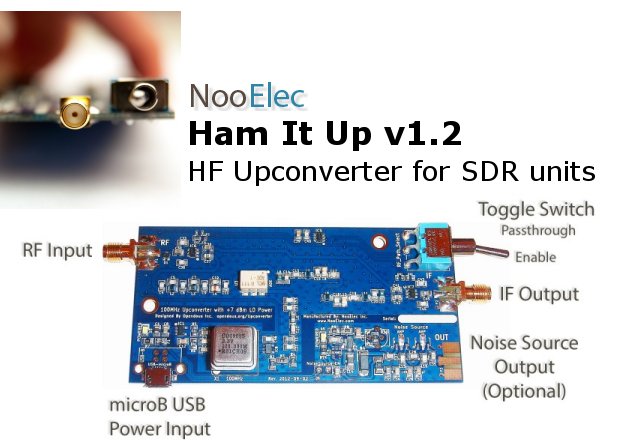
If you want to listen to MF/HF, just add the inline Ham It Up upconverter to tune down as low as 500 kHz. There’s even an Android app (SDR Touch) that allows you to plug these USB SDRs into your tablet (Android 4.0+, must support USB OTG)!
These little USB SDR receivers are amazing and extremely affordable (under $20). They are a lot of fun to play with!
Prize Packages
We’re giving away TEN prizes including:
Two (2)
Complete HF sets including:
NESDR Mini receiver
Ham It Up upconverter
SMA to MCX cable
SMA to BNC adapter
SMA to PL259 adapter
SMA to F adapter
Two (2)
Complete Touch SDR sets including:
NESDR Nano receiver
SDR Touch license (for Android tablets)
USB OTG micro & mini cables
Three (3)
NESDR Mini receivers
Three (3)
NESDR Nano receivers


Eligibility
All licensed Amateur Radio Operators worldwide
(Worldwide shipping is included!)
How to Enter
It’s simple!
Leave a comment to this post.
(e-mail address will not be shared)
Entry Duration
Only 1 week!
You may enter only once from
4 December 2013 18:00 UTC
to
11 December 2013 20:00 UTC
(multiple entries from the same entrant will be discarded)
Winner Announcement
11 December 2013
We will announce the winner on AmateurRadio.com.
You can get the winner announcement by
subscribing to our free Amateur Radio Newsletter via e-mail,
following our posts via RSS feed, or via Twitter (@amatradio).
Sign up so you won’t miss our next prize drawing!
Please tell your friends about this giveaway!
Thank you to NooElec for offering these fantastic prizes!
Learn more about their cool USB SDR receivers!
Visit their website at NooElec.com / eBay store / Amazon store
For more information about SDR, check out the SDR sub-Reddit (/r/RTLSDR), Ham Radio Science and RTL-SDR.com.
The winner will be chosen at random (using random.org) from all valid comment entries to this post received by the contest deadline. Entries will be deemed valid at the sole discretion of AmateurRadio.com and may be rejected for any reason, including inappropriate comments. Entries received after the deadline will not be considered. The prize may not be transferred. The prize may not be exchanged for cash. Winner agrees to allow AmateurRadio.com to use their name and callsign to announce them as a winner on our site, and to share their contact information with the sponsor for the purposes of awarding the prize. No purchase necessary to win. Odds of winning dependent on total number of entries received. Winner is responsible for any applicable taxes or fees imposed by their jurisdiction. Void where prohibited by law. E-mail addresses of all other entrants will not be shared with any third party, including the sponsor.Matt Thomas, W1MST, is the managing editor of AmateurRadio.com. Contact him at [email protected].
Show Notes #118
Episode #118 Audio (Listen now!):
- Tuxmachines Tentatively Sold to Techrights
- Raspberry Pi Exceeds Sales Expecations
- Russ, K5TUX, No Longer 10M Virgin
- HAMRADIONOW.tv – Gary Pearce KN4AQ
- Episode 104: Be Prepared (Be Very Prepared)
- Watch the episode on the http://www.HamRadioNow.tv web page
- HamRadioNow has episodes on many topics of interest to Hams & non-Hams alike: From Amsat to Field Day to community service, etc…
- Scientists predict sun’s magnetic field is about to flip
- E-mail exchange with Mike N2HTT
- Donations and Subscriptions
- Thomas H. (Very generious donation)
- Richard G. (Yearly)
- Gary U. (Monthly)
- Jim N. (Monthly)
- Bill H. (Monthly)
- Bill A. (Monthly)
- Scott P. (Monthly)
- Social Media Roundup
- Google+
- Randall P.
- Michael R.
- Facebook
- Ben S.
- Twitter
- 73s @73s
- Ken KKØHF @RadioGeek
- Rugby LUG
- Latest Digitals @LatestDigitals
- HamRadioForever @HamRadioForever
- David L. KK4WW @Apple1computer
- Glenn @KD5HCL
- Jason B. KY9J @jasonbegley
- RUSSELL – M3LCZ @m3lcz
- Jeffrey B. NT1K @itsBail
- Norman P. CVWOC @CVWOC
- Andy H. K5PO @K5PO
- Todd S. @wm8c
- Phil H. @k4ne
- Kevin T. @N5PRE
- Trent f. @N4DTF
- Greg W. @k4hsm
- Jeff P. @ke4ole1
- Jeff D. @ke9v
- Marco b. @iw2iga
- Mike M. @n5jky
- David L. M0IBC
- Tim P. @KG8OC
- Eltje aka Drs. C @PA3CEE
- Chuck M. N9KY @deN9KY
- Steve C. @K4DXV
- Danny P. @NG9R
- Rob W. @RobM_TMA
- Pete D. @RadioN3FNE
- Stephen H. @g8ebm
- Mitch @KF5OEF
- William S. @NE4RD
- Thomas D. @TomDavis_KF5GBL
- Craig V.@KB3SBI
- N8VSI – Scott P. @N8VSI
- Jon @N5JLD
- Mike R. @badtoyz
- Mailing List
- Mike R.
Outro
- Please check out our website: http://lhspodcast.info.
- Become an ambassador! Visit the Web site for upcoming events and information how you can represent Linux in the Ham Shack at a nearby Linux con or hamfest.
- You can e-mail us at [email protected] or leave a voice mail at 1-909-LHS-SHOW (547-7469).
- All hate mail is routed to Harrison at [email protected].
- Please subscribe to the mailing list. A link is on the Web site.
- Go to CafePress and Printfection and buy some of our show merchandise. Each purchase helps out the show. You can also help the show by clicking on the sponsored ads in the right-hand column of the homepage.
- http://www.cafepress.com/lhspodcast
- http://www.printfection.com/lhspodcast
- Listen live every every other Tuesday at 8:00pm Central time, or Wednesday at 0200z. Our recording schedule and countdown timer to the next episode is on the Web site.
- Thank you to all of our listeners, live and quasi-live.
- “Fluoride” by Brad Sucks from the album Guess Who’s a Mess, courtesy of Jamendo.
- Released January, 2013.
- Track length 3:42
- http://www.jamendo.com/en/track/1001527/fluoride
- “Locked In” by Fresh Body Shop from the album Make This End, courtesy of Jamendo.
- Song released July, 2007
- Track length 3:42
- http://www.jamendo.com/en/track/73155/locked-in
Russ Woodman, K5TUX, co-hosts the Linux in the Ham Shack podcast which is available for download in both MP3 and OGG audio format. Contact him at [email protected].
A mystery at the new QTH
 |
| Things are coming along |
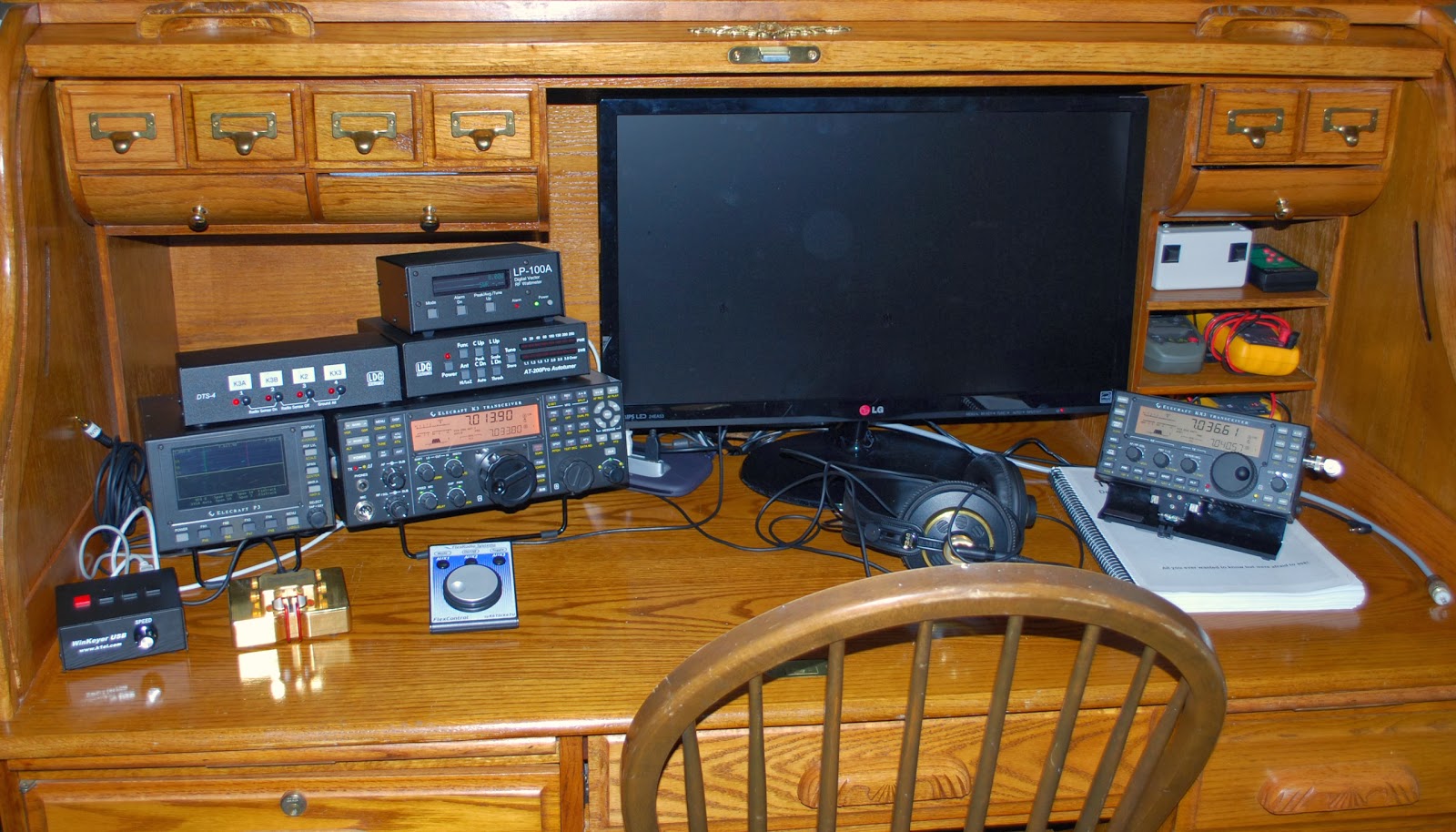
My setup is a stealth operation and really can't put the Alexloop on the balcony but I am 6 stories up and back in the townhouse I did have the Alexloop inside and it did very well so at this point I am stumped.
Mike Weir, VE9KK, is a regular contributor to AmateurRadio.com and writes from New Brunswick, Canada. Contact him at [email protected].
Soggy Contest
I should really get extra points for being out in the West Cumbrian winter but hey ho at least it wasn’t Corney Fell, that really is nasty in the driving rain.
Another reasonable attempt with the 5w and 3 ele beam. A bit frustrating tonight as I could here many stations much further away but just couldn’t work them but then again I’m not in it for the glory, just a bit of fun.
Here’s the map all the same. The east coast does get missed quite a bit but there is a lot of rock in the way.

Alex Hill, G7KSE, is a regular contributor to AmateurRadio.com and writes from Cumbria, UK. Contact him at [email protected].
Foxx 3 TRX build
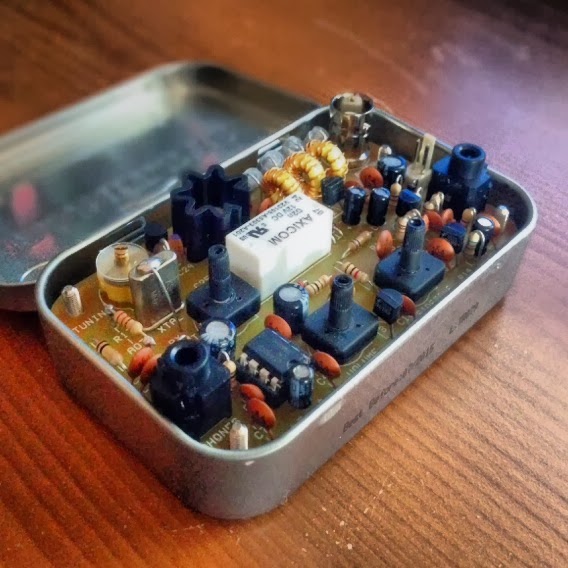 So it was my birthday recently and to celebrate the turning of another year and that I had indeed taken a day off – I decided to build a FOXX 3 QRP CW transceiver. These little kits are available from Kanga-products.co.uk and are designed to fit in a Altoids tin.
The kit comes pre bagged up in separate bags, and its just a case of soldering the correct component to the correct area on the circuit board. The kit itself is a 1 Watt QRP transceiver that can be bought on various bands. Mine was for the 20m band.
The board has a clear and easy to read Silkscreen and the pads are suitably wide enough to allow anyone with different levels of skill to create the kit. Each step allows you to test each part of the board, so you learn how each part of the kit relates to the transceiver as a whole.
I had a great time building it, it’s a simple, easy and great fun little kit. I hope to take it out and about – so hopefully you can hear my tiny signal on 20m soon.
Dan Trudgian, MØTGN, is a regular contributor to AmateurRadio.com and writes from Wiltshire, England. He's a radio nut, IT guru, general good guy and an all round good egg. Contact him him here.
FT-817 Radio Pack
There is a company called AMP-3 that has developed a very nice pack/bag to efficiently transport the FT-817, power supply, cables, connectors, log, etc.. I used this bag in a recent activation in New Mexico and was impressed with it's practicality. I have no financial interest in AMP-3, other than I've sent them a lot of money for their products.
Below is a link to a video of how the pack works.
http://www.youtube.com/watch?v=c_pUIzlqzKU
Also he web site address is:
http://stores.amp-3.net/-strse-73/Custom-Made-Yaesu-817/Detail.bok
Mike Crownover, AD5A, is a regular contributor to AmateurRadio.com and writes from Texas, USA. Contact him at [email protected].
Where to find the $20 Software Defined Radio?
A while back I wrote a blog post about the availability of $20 software defined VHF/UHF radios in the form of re-purposed USB digital television dongles.
Now-days, with the improvements in software and documentation, the hardest part is finding the right dongle. What you order from EBay, and what you receive, can be two different things and only some of the dongles are suitable for use as VHF/UHF software defined radios.
So, I was pleased to see that at least one hobbyist electronics supplier has sought out and supplies a suitable device for SDR at a fair price :

Adafruit has available the USB dongle and “antenna” suitable for experimentation for $22.50, not far from the EBay (direct from China) price.
Click here to go directly to the product page: Software Defined Radio Receiver USB Stick – RTL2832 w/R820T
No, I didn’t receive a free evaluation unit and I don’t work for Adafruit … I’m just glad to see these useful devices available from a local company with an increased chance of you “Getting what you paid for.”
Adafruit also helpfully stock the adapter cables to convert the less common MCX antenna connector into the much more common BNC connector: MCX Jack to BNC RF Cable Adapter
Owen Morgan, KF5CZO, is a regular contributor to AmateurRadio.com and writes from Texas, USA. Contact him at [email protected].
 Ham Radio Deluxe |
 W5SWL Electronics |
 Ham Radio Prep |
 KB3IFH QSL Cards  Hip Ham Shirts  HamRadioAuctions HamRadioAuctions Reliance Antennas Reliance Antennas Enigma Shop Enigma Shop |  morseDX  Ni4L Antennas  R&L Electronics R&L Electronics antennas.us antennas.us QRV QRV |
- Matt W1MST, Managing Editor
