 |
 10m still lively
 9 December 2013 | by
 Still seeing plenty of transatlantic stations on 10m WSPR. I wonder how long it will last?
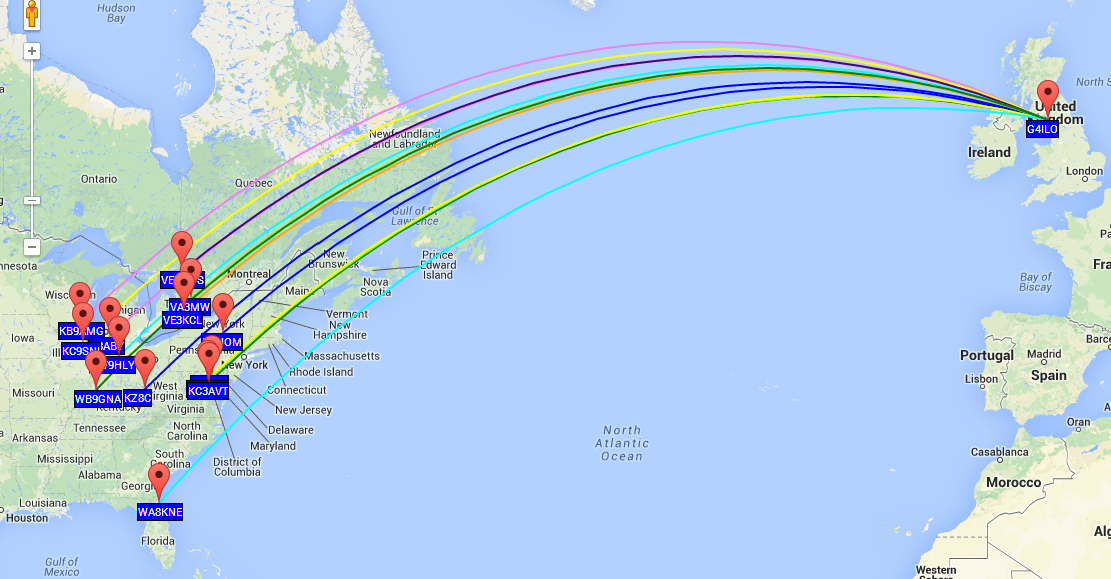 |
| WSPR spots on 10m band at G4ILO |
Julian Moss, G4ILO, is a regular contributor to AmateurRadio.com and writes from Cumbria, England. Contact him at [email protected].
The Spectrum Monitor fills void left by Monitoring Times

I was excited to see that Ken Reitz, KS4ZR, managing editor of MT, will continue to publish an e-magazine called The Spectrum Monitor. As most of you know, Monitoring Times has ceased publication with the December, 2013 edition.
The lineup looks fantastic:
Keith Baker KB1SF/VA3KSF, “Amateur Radio Satellites”
Kevin O’Hern Carey WB2QMY, “The Longwave Zone”
Mike Chace-Ortiz AB1TZ/G6DHU “Digital HF: Intercept and Analyze”
Marc Ellis N9EWJ, “Adventures in Radio Restoration”
Dan Farber ACØLW, “Antenna Connections”
Tomas Hood NW7US, “Understanding Propagation”
Kirk Kleinschmidt NTØZ, “Amateur Radio Insight”
Cory Koral K2WV, “Aeronautical Monitoring”
Stan Nelson KB5VL, “Amateur Radio Astronomy”
Chris Parris, “Federal Wavelengths”
Doug Smith W9WI, “The Broadcast Tower”
Hugh Stegman NV6H, “Utility Planet”
Dan Veeneman, “Scanning America”
Ron Walsh VE3GO, “Maritime Monitoring”
Fred Waterer, “The Shortwave Listener”
Thomas Witherspoon K4SWL, “World of Shortwave Listening”
A charter subscription is available for the very affordable price of $20 and includes 12 issues available in a variety of digital formats.
Matt Thomas, W1MST, is the managing editor of AmateurRadio.com. Contact him at [email protected].
Say Hello to Acorn and Barley
After losing Rooster, the alleged brains of the WG0AT SOTA team, we have great news from Steve, WGØAT.
Two new goats have joined the herd, getting trained up for more Summits On The Air (SOTA) action.
Meet Acorn and Barley, or is it Barley and Acorn? Watch out, Peanut, you’ve got company.
Bob Witte, KØNR, is a regular contributor to AmateurRadio.com and writes from Colorado, USA. Contact him at [email protected].
Things I’ve learnt this week
1. A clicking noise from a hard disk doesn’t mean anything good.
2. This stack of part finished or finished bu not boxed up projects needs to be dealt with over the Christmas break if not beforehand or the XYL will go bananas.
3. Must not buy any more bits and pieces off Hans Summers, G0UPL (http://www.hanssummers.com/index.php) until I’ve completed all of number 2. Oh apart from the gps and replacement pa’s for my QRSS transmitter.
4. The UKAC contest series is short, enjoyable and keeping me close to a mic but isn’t helping with getting on HF.
5. No matter how much I think they’ve started, there are no builders in the back garden working on the extension. This is all very well as its not costing me anything but it means there is no tower up.
Alex Hill, G7KSE, is a regular contributor to AmateurRadio.com and writes from Cumbria, UK. Contact him at [email protected].
Messages from space
 |
| Messages decoded from the FUNcube-1 satellite |
Julian Moss, G4ILO, is a regular contributor to AmateurRadio.com and writes from Cumbria, England. Contact him at [email protected].
Social Media Noise
 A few weeks back, I had a Too Much Information meltdown, because I was being overrun with information spewing forth from various sources. To be specific, I regularly get communications from these feeds: email, SMS text, RSS feeds, Twitter, Facebook, LinkedIn and Google Plus. The amount of “stuff” that was coming in was getting out of hand so I sprang into action.
First, I asked myself, how did I get into this mess? The general trend I see is that when I first start using a particular communications tool, my goal is to connect up with as many interesting feeds as possible. For old school email, this usually means subscribing to email lists, mostly via Yahoo Groups. For Twitter, this means Following other people that have interesting tweets. As more people engage in these media, the available stuff grows rapidly. Then Google Plus comes along, which tries to improve on Twitter but is somewhat redundant with the other social media. That is, I get Google Plus postings that are the same as ones from Twitter and Facebook.
The big trap I fell into is the fear of missing something. There’s so much interesting stuff out there, I wanted to grab it all. In reality, I was still missing stuff because I was being overrun with superfluous information. Ah! This is really the classic communication problem of signal-to-noise ratio. Some of these feeds have too much noise in them so I was losing the signal!
What constitutes noise? Lots of things: Foursquare check ins, Fitbit updates, off topic posts in email lists, etc., etc. Of course, noise is in the eye of the beholder, so what is noise to me may be valuable information to you. Also, a few “noise bursts” are OK but lots of noise degrades the signal-to-noise ratio.
With signal-to-noise ratio as the primary measure, I ruthlessly slashed my collection of information sources. I dropped out of many of the Yahoo Groups (actually, I moved them to web only), I reduced the number of SMS text alerts, I pulled back on the number of Facebook friends, deleted less interesting RSS feeds. On Twitter, I started to pay attention to noisy tweets…if someone has a tendency to send noise and not so much signal, they are gone.
If I dropped you from Twitter or the other social media, please don’t take it personally. It’s just me unclogging my digital life.
Those are my thoughts…what are you doing to manage your digital life?
73, Bob K0NR
Bob Witte, KØNR, is a regular contributor to AmateurRadio.com and writes from Colorado, USA. Contact him at [email protected].
The lunatics have taken over the asylum
This is a repost of a posting made in 2009. It is still as true today as it was then.
I received an email a couple of hours ago to tell me that the Windows setup file for VOAProp is reported as containing a trojan at VirusTotal, so I checked for myself. It’s true. Thei nstaller is reported as containing a trojan by 8 out of 41 scanners none of which I have heard of or have any reason to take seriously.
I checked the original copy of the KComm setup file that I have here just in case my web site had been hacked and a trojan planted. But the result was the same. I also checked the downloads of a couple of other programs of mine including MorseGen and VOAProp. They produced virtually the same scan results as for KComm.
 For years I have advised people that if they have downloaded a file from a source they would trust and their security software flags it as suspicious, they should scan it at VirusTotal to get a consensus of opinion as to whether the file really is a virus, a trojan or spyware, or just a false alarm. Unfortunately, VirusTotal has kept on adding new virus scanners to its armoury regardless of whether they are any good or not. The lunatics are taking over the asylum and as a result, VirusTotal has become useless as a tool for ordinary PC users to check whether a file is suspicious. I recommend jotti.org instead.
Some of my programs that are accused of containing a trojan were last updated several years ago. They have since been downloaded by hundreds or thousands of people. It is inconceivable that they could have contained a trojan that remained undetected all that time. The thing that all the programs have in common is that the installers were all created using the same setup generator. The likelihood is that somebody used the same setup generator to create an installer package for a trojan and the third rate scanners are picking up on something in the installer package that is not unique to the trojan.
I have no desire to waste my time contacting the developers of obscure anti-virus products to inform them about this false reporting of my programs. Nor do I have any plans to repackage all the programs using a different setup generator. I’m sorry, but third rate virus scanners are not my fault and I don’t have the time or the inclination to deal with the problems they cause. If you choose to trust your virus scanner instead of me I won’t argue with you.
Some of the scanners are flagging the fact that the files have been compressed using UPX. This is a harmless tool used to make executable files smaller. It is not a malware. But I don’t know how users of these scanners are supposed to know that.
Julian Moss, G4ILO, is a regular contributor to AmateurRadio.com and writes from Cumbria, England. Contact him at [email protected].
 Ham Radio Deluxe |
 W5SWL Electronics |
 Ham Radio Prep |
 KB3IFH QSL Cards  Hip Ham Shirts  HamRadioAuctions HamRadioAuctions Reliance Antennas Reliance Antennas Enigma Shop Enigma Shop |  morseDX  Ni4L Antennas  R&L Electronics R&L Electronics antennas.us antennas.us QRV QRV |
- Matt W1MST, Managing Editor
