 |
 Show Notes #119
 18 December 2013 | by
 Episode #119 Audio (Listen now!):
- Article: How to install and configure Conky on Linux
- Amazon delivery drones comming soon to a town near you
- Linux Mint 16: Improves Cinnamon Desktop
- A Memory Comparison of Light Linux Desktops
- WEFAX and APT
- APT: Automatic Picture Transmission
- WEFAX: Weather Facsimile, aka HF RadioFax
- WXtoImg: http://www.wxtoimg.com/
- Slow Scan Television
Announcements & Feedback
- Shout-out to Jerry Taylor, KD0BIK
- New Contest: Win a Raspberry Pi
- The contest began December 1st, 2013 and runs through January 31st, 2014. The winner will be announced on the live recording of LHS Episode #123 on February 4th, 2014. Entries must be received by 12:00am Central on February 1st, 2014 in order to participate. There are three ways to win.
- Active Linux in the Ham Shack paid members will be automatically entered to win. Therefore, if you are already a member or if you sign up for a membership (either monthly or yearly) by January 31st, 2014 you will be entered into the contest. Your membership must still be active on February 4th, 2014 at the time of the drawing to win.
- You may also enter by calling the LHS Voice Line at +1-909-547-7469 and completing the following thought: “My new Raspberry Pi will be used to…” Be as serious or ludicrous as you want. This method of entry requires no money, just a little of your time. Make sure to leave your phone number or e-mail address so we can contact you if you win. Your personal information will not be disclosed, but your response will be played on the air!
- You can render artistically in some way your concept of a Raspberry Pi. This can mean the computer, a raspberry pie, or some other interpretation we haven’t thought of yet. You can use any artistic medium, from a sketch to beat poetry. Be creative! You will receive TWO entries into the contest if you choose this option. We will post your creativity on the Web site for others to enjoy, and mention what you’ve done on the show. Have fun with it!
- The winner will receive a brand new Raspberry Pi, HDMI-to-DVI converter and power supply with USB cable that can be used to power your new Pi from a wall outlet or any powered USB port. Thank you for being a loyal follower of the show. We look forward to your entries and best of luck!
- Feedback
- Voice mail from Doug, N6LMX
- Donations & Subscriptions
- Ben S. (Yearly)
- Steve C. (Monthly)
- Social Media Roundup
- Facebook
- Tom R.
- Robert B.
- Google+
- Ben S.
- Twitter
- Dick (W4RNO) – @6L6GT
- Jacob (KD0SJV) – @1094Jacob
- Jim (KE4INM) – @KE4INM
- @rf_transmitters
- Vitaliy (UR6LAD) – @UR6LAD
- Mailing List
- Chuck (VE3VSA)
- Gary (K6PDL)
- Robert (AC8GE)
- Sid (W8SFC)
- Todd (K7HPY)
- Please check out our website: http://lhspodcast.info.
- Become an ambassador! Visit the Web site for upcoming events and information how you can represent Linux in the Ham Shack at a nearby Linux con or hamfest.
- You can e-mail us at [email protected] or leave a voice mail at 1-909-LHS-SHOW (547-7469).
- All hate mail is routed to Harrison at [email protected].
- Please subscribe to the mailing list. A link is on the Web site.
- Go to CafePress and Printfection and buy some of our show merchandise. Each purchase helps out the show. You can also help the show by clicking on the sponsored ads in the right-hand column of the homepage.
- http://www.cafepress.com/lhspodcast
- http://www.printfection.com/lhspodcast
- Listen live every every other Tuesday at 8:00pm Central time, or Wednesday at 0200z. Our recording schedule and countdown timer to the next episode is on the Web site.
- Thank you to all of our listeners, live and quasi-live.
Music
- “The Feel” by Backnbloom from the album Music for the Modern Monkey, courtesy of Jamendo and Rathole Radio.
- “Love This Place” by Derek Clegg from the album Here Comes Your Fate, Quick Duck, courtesy of Rathole Radio and the Internet Archive.
Russ Woodman, K5TUX, co-hosts the Linux in the Ham Shack podcast which is available for download in both MP3 and OGG audio format. Contact him at [email protected].
It’s now between two antennas……….and some last minute exciting news!!!!
I am tending to lean towards the fan box loop as it looks nothing like an antenna as the last thing I want are the condo cops coming after me. This unit is not really made for rain and is "portable" meaning I will have to take it in and out when using it. As for the 1788 it sure is more money but it covers more bands and is built better and I am a firm believer in you get what you pay for! So my delema is which antenna to go for.......
The 1780 fan box
1. It is cheaper but that may not be a good thing
2. It looks nothing like an antenna.
3. Very portable so small footprint.
BUT
1. Only covers from 14-30 meters
2. Not good in bad weather due to housing construction.
3. Has to be taken in and out.
The 1788
1. Covers from 15-40 meters
2. Solid construction
3. Able to be left outdoors year around.
BUT
1. The cost is more.
2. It looks like an antenna
3. May be hard to hide and hiding it may affect it's preformance.
Some exciting news regarding my signal getting out in this concrete jungle!
I was able to get the loop out and in the horizontal position and it worked great! The receive was very good and I was able to finally get spotted on the RBN. This are only U.S spots but with 5 watts and up to this point batting ZERO in the spot dept I am thrilled to see that my signal is getting out. Now I just have to fine tune things. At this point I have not tried WSPR but now that the horizontal position seems to work that is my next step to see how I do using WSPR.
rows to show: showing spots for DX call: VE3WDM search spot by callsign | ||||||
|---|---|---|---|---|---|---|
| de | dx | freq | cq/dx | snr | speed | time |
| W8WWV |  VE3WDM VE3WDM | 7016.9 | CW CQ [LoTW] | 7 dB | 23 wpm | 2305z 13 Dec |
| NY3A | VE3WDM | 7016.9 | CW CQ [LoTW] | 9 dB | 23 wpm | 2305z 13 Dec |
| WZ7I | VE3WDM | 7016.9 | CW CQ [LoTW] | 10 dB | 23 wpm | 2304z 13 Dec |
| W2MKM | VE3WDM | 7016.9 | CW CQ [LoTW] | 11 dB | 23 wpm | 2304z 13 Dec |
| K1TTT | VE3WDM | 7016.9 | CW CQ [LoTW] | 10 dB | 23 wpm | 2304z 13 Dec |
| W3LPL | VE3WDM | 7031.9 | CW CQ [LoTW] | 1 dB | 23 wpm | 2255z 13 Dec |
| K1TTT | VE3WDM | 7032.0 | CW CQ [LoTW] | 8 dB | 23 wpm | 2255z 13 Dec |
| WZ7I | VE3WDM | 7031.9 | CW CQ [LoTW] | 8 dB | 23 wpm | 2255z 13 Dec |
| WE9V | VE3WDM | 7031.9 | CW CQ [LoTW] | 6 dB | 23 wpm | 2255z 13 Dec |
| W8WWV | VE3WDM | 7032.0 | CW CQ [LoTW] | 8 dB | 23 wpm | 2255z 13 Dec |
| W4KKN | VE3WDM | 7031.9 | CW CQ [LoTW] | 4 dB | 23 wpm | 2254z 13 Dec |
| NY3A | VE3WDM | 7031.9 | CW CQ [LoTW] | 9 dB | 23 wpm | 2254z 13 Dec |
Mike Weir, VE9KK, is a regular contributor to AmateurRadio.com and writes from New Brunswick, Canada. Contact him at [email protected].
Just a normal day

Paul Stam, PC4T, is a regular contributor to AmateurRadio.com and writes from the Netherlands. Contact him at [email protected].
Christmas is coming….
No, I’m not expecting any new radio related ironmongery or a new rig. Especially as this week seems to have cost me a small fortune ( I had to buy a new car but that’s another story). Bust Christmas can give you a little bit extra, time that is.
I’ve only planned on doing 2 things, one is to activate the clubs callsign MX0WRC on Sunday, something that hasn’t been head on the air for a while. After refurbishing the shack the temporary antenna came down in the strong winds we regularly get so a Delta Loop will be helping us out. The plan is to show a few of the more novice operator how to use the clubs kit in the warmth. So if you hear a feint CQ from far off Cumbria then please call back. You may make a novice’s day.
The other little job will be to give away a few points in the RSGB VHF Christmas Cumulative contest. I’ve long lamented about the poor VHF signals that make it into St Bees but with a fair breeze I should work a few stations further afield than GD land (about 40 miles across the Irish sea). I’ll probably do it from the house so the QSO’s will be less than 10 but hey its only a bit of fun.
So If I don’t hear you or work you on Sunday then I hope to try again between 26th December and the 29th December for some armchair operating. Tea and biscuits at the ready!
Alex Hill, G7KSE, is a regular contributor to AmateurRadio.com and writes from Cumbria, UK. Contact him at [email protected].
Scratchy Tivoli Audio Model One
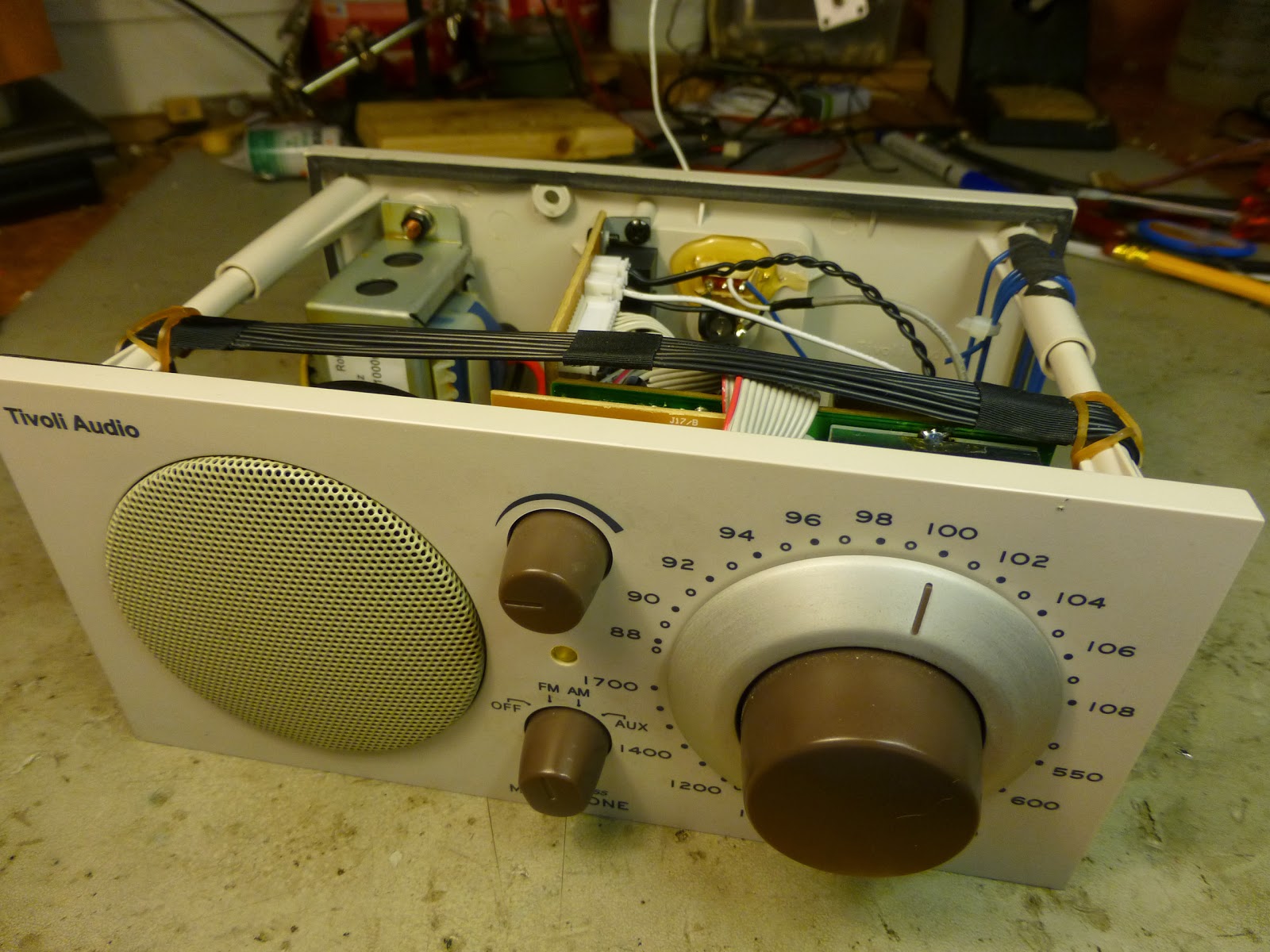
The Model One has been a huge success. But in many ways it is a daring retro design judging from all the features that are missing in this radio. I am thinking of features such as a customizable equalizer, a digital display, and memory presets. It just has a plain old analog tuning dial for FM and AM.
The radio could as far as I can tell just as well have been made in the 70’s except for some of the IC’s which are used. Actually it is easy to see the similarity with the even older KLH Model 18 from the 60’s, and yes – Henry Kloss played a role in both radio designs. But that makes for easy repairs, such as a seemingly common fault in the FM tuning capacitor, which over time may develop contact problems.
The radio is in many respects exceptionally well made. The tuning dial has a quality vernier drive. The audio section is well built with a powerful amplifier, a strong magnet for the loudspeaker, and a bass port design for the wooden cabinet. All are factors which contribute to its reputation for good audio. If one can trust measurements on the web, it has been equalized for enhanced bass and treble with the mid’s some 6 dB down. These are well-known tricks for getting a warm and crisp sound with universal appeal. Internally the tuner section, which is built around the TEA5711T chip, is well shielded for frequency stability as seen in image 2.
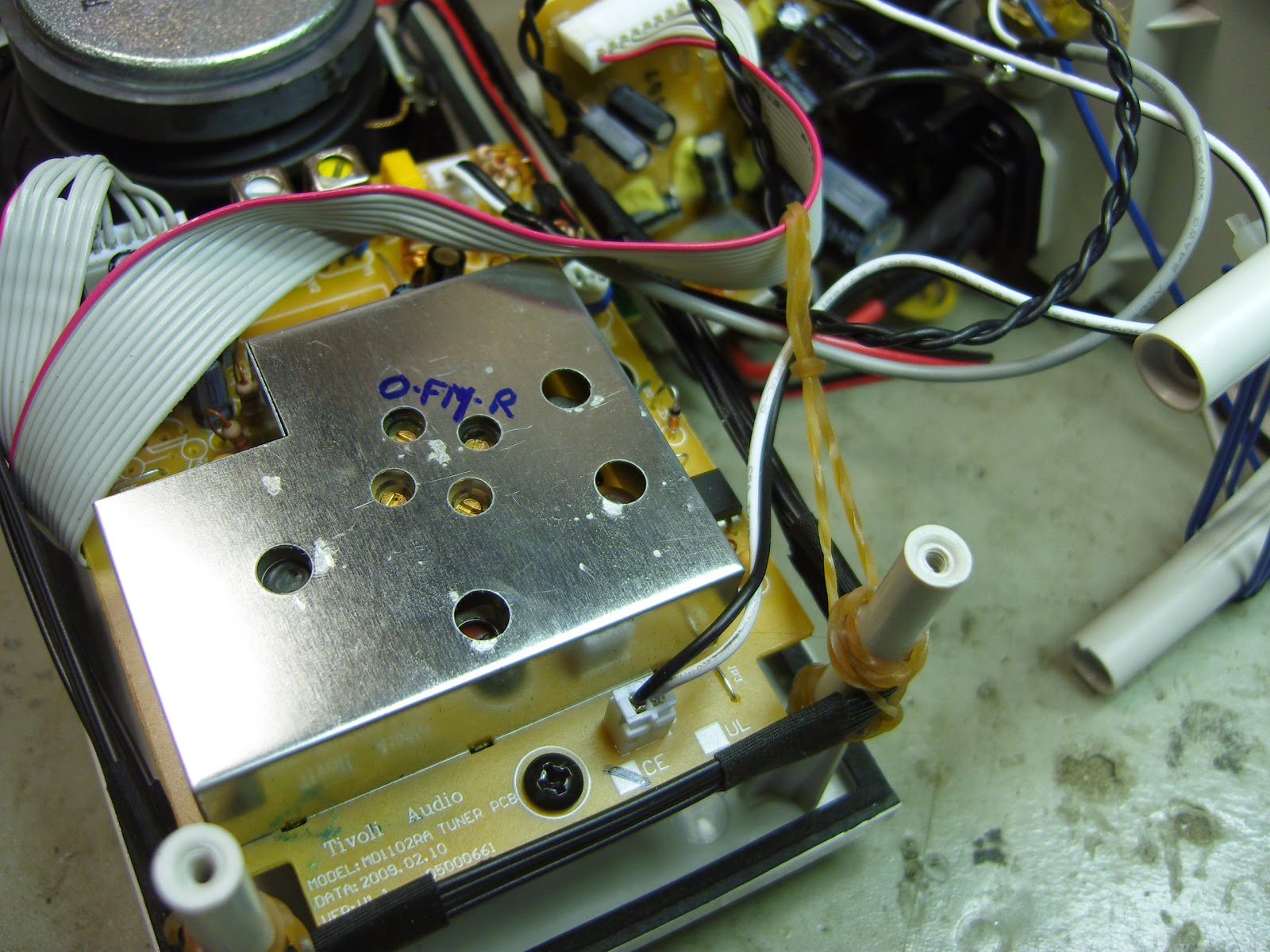 One weakness which manifested itself after only 3-4 years in this particular radio is that it became hard to tune, scratchy, and unstable on FM due to intermittent contacts in the tuning capacitor. According to the TEA5711T datasheet it is a varicon which for AM has 140/82 pF, for FM 2 x 20 pF, and for trimmers 4 x 8 pF. This particular unit had a Mitsumi varicon. Some say, when this fault occurs, that the varicon must be replaced and others say it can be cleaned. Who do you think I sided with?
Disassembling the radio is quite straightforward if you are used to this kind of work. The tuner is enclosed in shielding on both sides of the PCB. The shields can carefully be desoldered as shown in image 3. That exposes the varicon, and its plastic casing can be lifted as shown in the last image.
 I sprayed it with contact spray and the radio came back to life. The only problem was that the tuning on FM had shifted so that a station on 100 MHz now appeared on 107 MHz. A little detective work around the circuit showed which trimmer that was for the FM oscillator and which one that was for the FM RF circuit (marked O and R in image 2). Since the oscillator trimmer was set for its maximum capacitance with the plates covering each other, it was easy to reduce the value and get the FM dial back to normal again, and then to peak the RF trimmer.
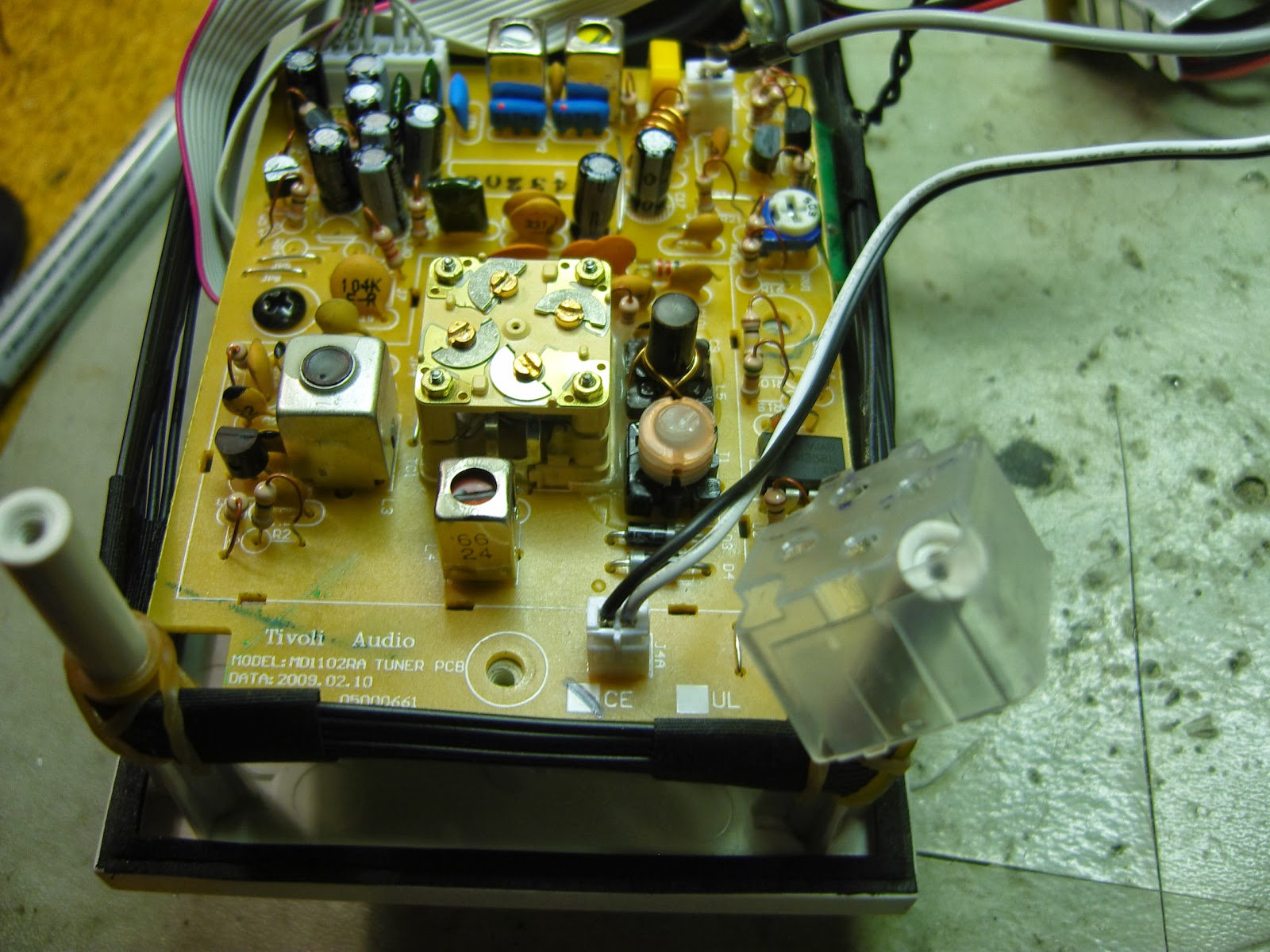 It got me wondering though to see that it had been necessary in the first place to have the oscillator trimmer set at its maximum value. It was just as if the tuning capacitor never had had its full value, even in the factory, and that it finally got it after my cleaning.
Sverre Holm, LA3ZA, is a regular contributor to AmateurRadio.com and writes from Norway. Contact him at [email protected].
QRP and 10 meters
Since the flux has been in the 160 -170 range lately, last week's 10 meter contest was full of activity. It was a great opportunity for me to increase my QRP DXCC count which was at 160 entities worked going into the weekend. The bottom line, with the exception of V55V on SSB, I was able to work everyone I chased. It was harder work that I thought it would be, which is a testament to how busy the band was.
So with the band hopping, I fired up the KX3 and went hunting. I was able to work TK5EP, 4O3A, OX3XR on CW and ZS1TMJ on SSB. It was Saturday morning when I made these QSO's, so it was still early in the contest, I'm sure on Sunday, these stations would have been a little easier to work. I picked up four new counters on 10m and threw in FG5FR on 15m to get my QRP DXCC to 165. It was a fun weekend and it's good to hear some much activity on 10m.
So, go have a look at 10 meters, better yet, call CQ. You mght be surprised who comes back.
Mike Crownover, AD5A, is a regular contributor to AmateurRadio.com and writes from Texas, USA. Contact him at [email protected].
AmateurLogic.TV 61: Echolink Pi and TVduino

AmateurLogic.TV Episode 61 is now available for download.
It’s the AmateurLogic Christmas Spectacular. Join the crew and special guest for a festive holiday event.
Peter hacks his Degen SW Receiver. Tommy puts the Arduino on TV. George trudges on in his effort to use the Raspberry Pi as an Echolink node. And a hilarious look at the 2013 ALTV Holiday Gift Guide.
A 1:13:08 AmateurLogic celebration of the season and other good stuff.
View in web browser: YouTube
George Thomas, W5JDX, is co-host of AmateurLogic.TV, an original amateur radio video program hosted by George Thomas (W5JDX), Tommy Martin (N5ZNO), Peter Berrett (VK3PB), and Emile Diodene (KE5QKR). Contact him at [email protected].
 Ham Radio Deluxe |
 W5SWL Electronics |
 Ham Radio Prep |
 KB3IFH QSL Cards  Hip Ham Shirts  HamRadioAuctions HamRadioAuctions Reliance Antennas Reliance Antennas Enigma Shop Enigma Shop |  morseDX  Ni4L Antennas  R&L Electronics R&L Electronics antennas.us antennas.us QRV QRV |
- Matt W1MST, Managing Editor
