 |
 Oh my Heavens – mea culpa!
 11 January 2014 | by
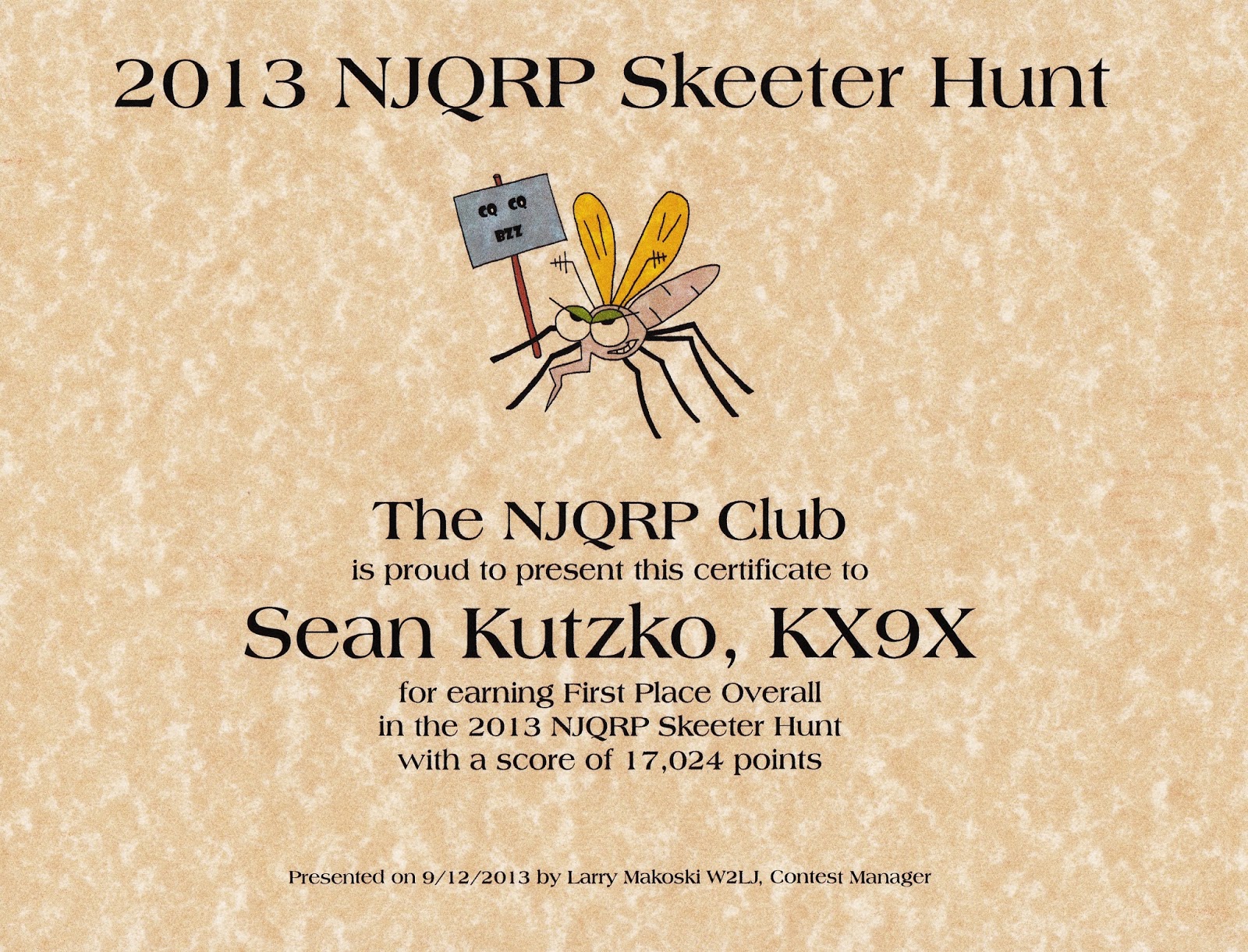
 I received a gentle nudge from one of the 2013 Skeeter Hunt participants this week via an e-mail, “Did you ever get the certificates out?”.
Larry Makoski, W2LJ, is a regular contributor to AmateurRadio.com and writes from New Jersey, USA. Contact him at [email protected].
Making the Best of a Bad Situation

The Chemical Spill yesterday still continues to plaque us here in Kanawha Valley. Some fresh water has arrived but there’s still not enough for everyone. A few of our neighbors have simply “left” their homes and will stay with friends or relatives until city water is again deemed safe for human use. We were not able to find water today although we went to three different places which were broadcast on the local radio station.
The remaining quantity of the 30,000 gallon leaking tank has been moved to a safe location and the soil around the tank is being trucked to another location. Best estimates of the quantity of the leakage have been placed at around 5,000 gallons.
“Up to 300,000 West Virginia residents were told not to drink tap water on Friday after a chemical spill called its safety into question, and health officials said water in the affected area should only be used for flushing toilets and fighting fires.”
The N8ZYA households biggest concern is water for our pets and our personal hygiene. The concentrations of the chemical in the water supply is still much to high to risk drinking, bathing, or even washing dishes. This chemical has been erroneously picked up and pumped into nine different counties. All schools and day care centers are closed and all restaurants are closed. The economic consequences of this disaster will be enormous.
I’ve not heard any calls for communications from the Ham radio community but I have everything prepared should the call go out.
My neighbor invited us, and about a dozen friends, to dinner this evening. We had soup, which was made before the chemical leak, along with a salad, and lots of wine. We gave an elderly lady on our street a couple bottles of our water.
John Smithson, Jr., N8ZYA, is a regular contributor to AmateurRadio.com and writes from West Virginia, USA. Contact him at [email protected].
Finally some WSPRing with the Alexloop.
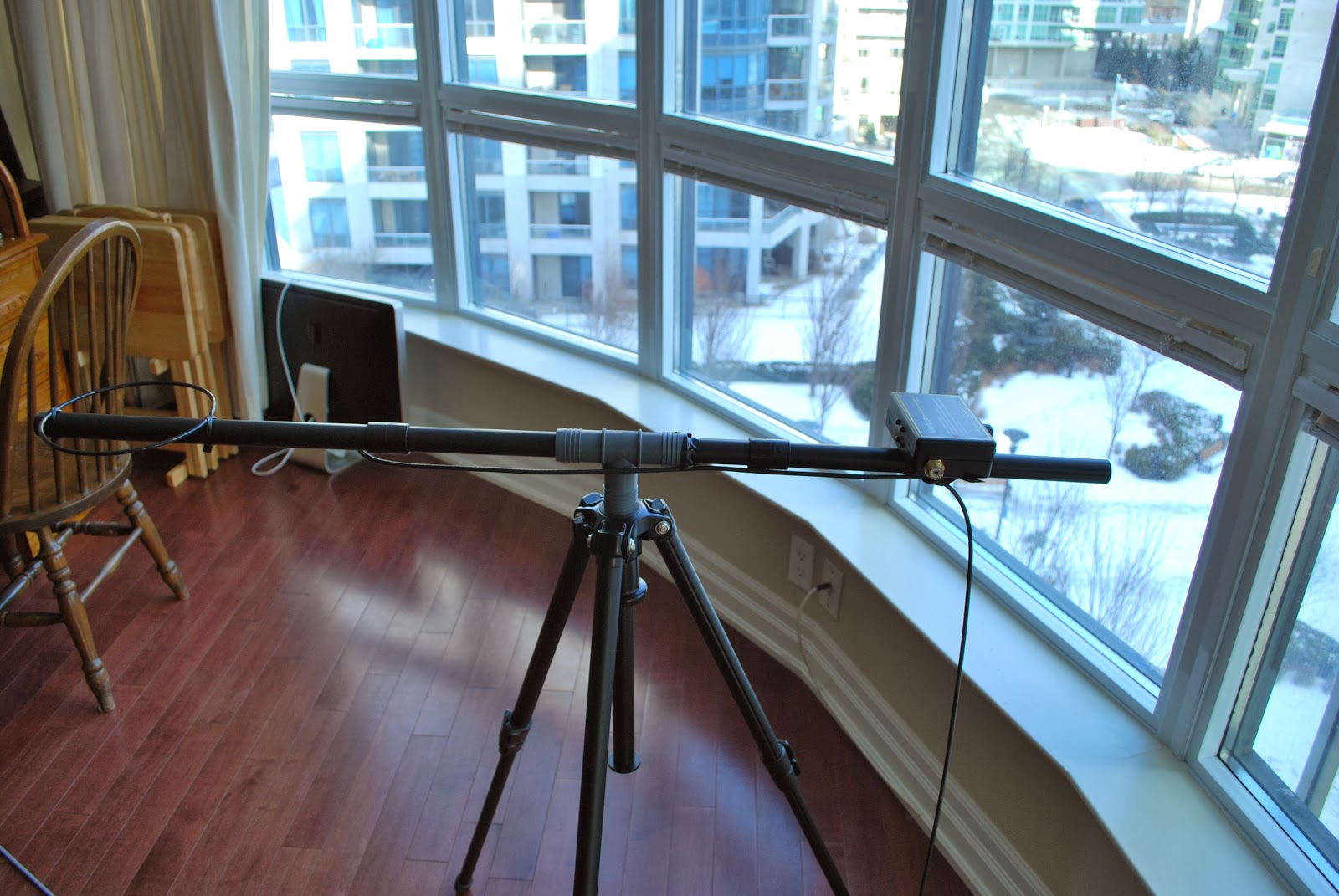 |
| A shot of the loop with the "T" fitting |
I finally set things up to get WSPR up and going, so yesterday during the day and then into the evening I was WSPRing to see how my signal was getting out from the condo. Up to this point I have only used the Reverse Beacon Network or RBN which involved CW at 5 watts. I was not thrilled with the results and was really wanting to give WSPR a go. During the day I tried 10m and 20m I started out with 1 watt and in terms of WSPR that is some pretty high power. The antenna once again was the Alexloop in the horizontal position, at first attempt on both bands the Alexloop was indoors. It was not surprise that there were no spots at all it was time to move the loop out onto the balcony. Once setup I went back to 10m and it was about 2pm local time with no results again. I then jumped over to 20m and it was just U.S stations and very few I might add that received my signal. It was time to pack it in for the afternoon and some chores had to be done and I would get back on in the evening hours.
At 7 pm local time I was up and WSPRing on 40m and with great hopes as the band sounded good and I was decoding some WSPR DX such as EA3NEI. I once again was only heard in the U.S and this time I used up to 5 watts!! Maybe it was that conditions were poor out this way as they have been over the past week. Over the weekend if I get time I am going to give WSPR a go once again and see how it works out.
Mike Weir, VE9KK, is a regular contributor to AmateurRadio.com and writes from New Brunswick, Canada. Contact him at [email protected].
Wrestlemania
Back when I had an easier job I decided that I’d attempt to make a really simple, lightweight rotator that used off the shelf servos or stepper motor’s driven by an Arduino. Either interfaced with a PC or as a stand alone device.
Well, things move when you’re not looking and it seems like my bright idea was also several others, and whilst I’ve been busy not doing anything radio, others have.
I’d managed to buy a couple of servos off eBay and managed to drive them with the standard examples. Although the movement wasn’t as smooth as I’d have liked. Perhaps a couple of large capacitors would have helped but as I didn’t have anything suitable to hand I thought I would have a go anyway.
Well it didn’t work out like that. After spending over an hour installing the Windows 8 drivers (how to turn you off an operating system!) I hooked up the Arduino and wrestled with the servos. Either they are knackered or there’s something missing…..
Time to take a step back and reflect, or buy a few caps
Alex Hill, G7KSE, is a regular contributor to AmateurRadio.com and writes from Cumbria, UK. Contact him at [email protected].
Something different for a change.

How about making your last 200 contacts in your logbook look a bit special, or even your most memorable contacts look like a piece of artwork?
Well I did just that. After seeing a Facebook post by John (KK4EQF) he showed how he logged over 400 call signs on a map of the US (Click here to view) I decided to take my last 200 QSO’s and overlay them on a map of the UK.
After a little fiddling I settled on this configuration. I’m really quite pleased with it and I might even print a copy & frame it. It’s a lovely way to show off your QSO’s – Even the wife agreed its quite pretty !
Dan Trudgian, MØTGN, is a regular contributor to AmateurRadio.com and writes from Wiltshire, England. He's a radio nut, IT guru, general good guy and an all round good egg. Contact him him here.
The Most Essential Things in Life

The N8ZYA family, and approximately 100,000 others in the immediate Charleston West Virginia area, can’t drink the water, wash dishes, bathe, do laundry, or use the city water supply for ANY reason due to a large chemical tank which is leaking dangerous chemicals into our water supply tonight. The governor has declared a “state of emergency” until the concentration and amount of a liquid used in the coal mining cleaning process can be determined and evaluated for public safety.
In essence, our drinking water can only be used to flush the toilet, or for putting out a fire. It should not be touched with human hands.
“Through a news release, the Kanawha County Commission Emergency Management says a product leak of 4-Methylcyclohexane Methanol at Freedom Industries on Barlow Dr. is responsible for the contamination of the local water supply. Local health department officials are urging restaurants and bars to close immediately”
Which brings me to the caption of the post above. In this case, and above all other resources, water is at the top of the list, every time. It’s not a luxury, it’s essential for life.
I’ve always assumed clean drinking water is possible by filtering or boiling; but chemical contamination is an entirely different problem. There’s not much can be done except hope it moves downstream and eventually becomes harmless.
I hope clean water arrives by truck in the morning.
John Smithson, Jr., N8ZYA, is a regular contributor to AmateurRadio.com and writes from West Virginia, USA. Contact him at [email protected].
Good article in the January 2014 edition of WorldRadio Online
If you’re a subscriber to WorldRadio Online, be sure to check out the article on Page 16 in the January 2014 edition. There’s an article by Cory GB Sickles, WA3UUV, which is entitled “”Elmering” in the Age of the Internet”, and it deserves your attention.
Prominently featured are several folks who should be easily recognized by just about any serious QRPer, and they are Rem Donnelly K6BBQ (whose videos are often posted here), Steve Galchutt WG0AT (ditto), and Chuck Carpenter W5USJ. Also mentioned is Randy Hall K7AGE. Rem, Steve and Randy are noted for their informative, fun and educational videos that appear on YouTube (and here). Chuck is noted for his great website and all the informative and helpful topics that he covers there. And the help and advice he offers in the Rockmite and other e-mail reflectors is worth its weight in gold.
These guys deserve the title “Elmer” which is so sorely needed this day and age. When I attended an Amateur Radio licensing course back in the late 1970’s, I had a course teacher, but no true “Elmer”. After I got my ticket, most of what I learned was by trial and error, often proverbially hitting my thumb with that hammer. Things would have gone infinitely smoother (but not necessarily better!) had there be someone I could go to, to ask for advice and encouragement.
These days, however, it seems that when people seek new knowledge, the first place they head to is Google, Bing or some other search engine. The service that the above mentioned Hams provide is so invaluable – and by no means are they the only ones. There are so many great resources of Amateur Radio information out there, like we’ve never had before. The Internet is ripe for the picking of this treasure trove of information.
That being said, what are you doing to help this effort along? Don’t think you don’t have anything valuable to add, because you do. Your help is constantly needed not only to encourage those who are thinking of getting licensed, but also those who are recently licensed and are unsure of themselves. There are so many things you can do, I’ll list just a few here:
1) Become a Volunteer Examiner. Not only will you meet people who are just entering the hobby, but you can befriend them and explain to them about the whole new world that is opening up to them. Tell them about local clubs and Ham Radio activities, invite them to come out to a local Hamfest or club meeting, or even the occasional Saturday breakfast “with the guys” – remember, for the bit of time that they are taking “The Exam”, they are a captive audience. Strike while the iron is hot.
2) Make a YouTube video and share it with the world. Got a new idea, process or invention? Have a unique or new way of doing something in Amateur radio that’s never been done before? Make a video and post it! They say a picture is worth a thousand words. If that’s true, then a good video is worth about ten million! To this day, I owe as great deal of thanks to TJ W0EA, for posting a video about the LowePro Traveler 150 camera bag and how he uses it to carry his QRP gear. It convinced me to go out and buy mine, and as of now, I wouldn’t think of using anything else for that purpose. I had been struggling to find a good solution for quite some time when I happened upon his video, it was just what I needed to see, at just the right time.
3) Start a Website or a blog. A fine example is Chuck’s website, and for a fine example of Amateur Radio blogs – just look down the right edge of this site. You think I list a lot? Maybe, but even more are needed. Do you have a new or unique idea that no one’s covered before, that’s just waiting to be shared? You say that you don’t want to start a blog, but have something you’d like to cover and are not sure how to do it? Contact me. I’ll gladly lend you space here. (or see #5 below). I’ll even help you put your idea into words if you like, and YOU’LL receive all the credit that you’ll so richly deserve! And your story needn’t be technically minded. Just sharing a story of how you accomplished hanging your antenna or putting together your station or how you configured your computer and radio for WSPR or PSK31 may be all the encouragement that is needed by someone who is attempting to do the same thing – but has no one to ask, or may be too shy to ask, or maybe has been reading articles, but just doesn’t “get it”.
4) Get on your local repeater, ESPECIALLY when you hear a “new” call. Nothing is more special that being welcomed and acknowledged on the air. Don’t be afraid to talk to new and any younger voices that you hear on the air. The welcome that you extend today will exist long into the future, and will be an inspiration as to how new Hams years down the road will be treated.
5) Write an article, as mentioned above in bullet point #3. Have a unique idea or maybe a new perspective on something that’s tried and true? Write something about it! While it would be nice to see your name in QST or CQ, there are other “niche” publications out there – literally begging for contributions. For the CW and QRP crowd, right off the top of my head, I can think of The Keynote (FISTS), SPRAT (GQRP), QRP Quarterly (QRP ARCI), and the K9YA Telegraph e-zine (CW enthusiasts). For other facets of the hobby, I am sure there are just as many outlets available.
6) Always keep the kids in mind. If you get the opportunity to demonstrate this hobby to kids, especially younger ones – don’t let the chance slip through your fingers. You may think that kids look upon this hobby as “dull”, “uninteresting”, or “ancient”. Maybe some do, but even more don’t. Some of the best times I’ve had have been explaining Amateur Radio to school kids, Boy Scouts, etc. The looks on the their faces, and their enthusiasm will warm your heart and will in turn, encourage you and keep you young.
7) Teach a license class. This is maybe one of the best ways to pass along your love of this hobby to the next generation of Hams. Don’t know where to begin? Get in touch with the ARRL, they have a whole department that is willing to help you get started. And it doesn’t have to be just kids that you aim your teaching sights on. Most high schools give opportunities for free or low cost continuing education courses for adults. often held on weekday evenings. Offer to teach a radio license course for them. They’ll do a lot of the groundwork and advertising for you – you just need to supply the teaching part. You’d be very surprised how many retired folks there are out there, looking for a new hobby.
The main idea here is to share, to help not only those thinking about becoming Hams, but also to put out the helping hand to those who are recently licensed. And you’ll also find that you’ll be helping yourself by keeping your enthusiasm for this wonderful hobby vibrant in your own life.
72 de Larry W2LJ
QRP – When you care to send the very least!
Larry Makoski, W2LJ, is a regular contributor to AmateurRadio.com and writes from New Jersey, USA. Contact him at [email protected].
 Ham Radio Deluxe |
 W5SWL Electronics |
 Ham Radio Prep |
 KB3IFH QSL Cards  Hip Ham Shirts  HamRadioAuctions HamRadioAuctions Reliance Antennas Reliance Antennas Enigma Shop Enigma Shop |  morseDX  Ni4L Antennas  R&L Electronics R&L Electronics antennas.us antennas.us QRV QRV |
- Matt W1MST, Managing Editor
