 |
 ARRL DX with the K2
 17 February 2014 | by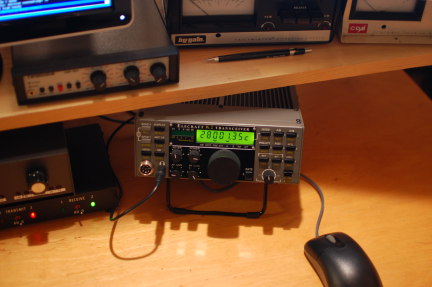
One of the goals I had for the K2 that I failed to mention in the previous post was to fill-in for the K3 in DXpedition service. This is a tall order. It also necessitated upgrading the basic K2/10 to a 100-watt K2/100—being loud (enough) is an important part of pileup control. I had the good fortune to come across an already-assembled final amplifier unit at an attractive price a few days after I purchased the radio. I took that as a sign!
Another rite of passage for the K2/100 would be…how does it perform in a pileup? One of the really great things about ARRL DX CW since the advent of the CW Skimmer and Reverse Beacon Network is that literally any U.S. station (especially on the East Coast, my Western and Midwestern friends will remind) with a modest signal can elicit a blistering run of Europeans. I’ve been relatively unhappy with the K3′s response to pileups, with callsigns often being mushed together more than with other radios (e.g., the TS-930S). I understand that tailoring the K3′s AGC should help this—the KE7X book now graces my shelf but I haven’t had a chance to explore all of his suggestions yet. Having heard anecdotally that the K2 does better in this regard, I was excited to break it in with ARRL DX.
Sarah worked this weekend and I was frankly wiped out from a full week at work plus shoveling 18 inches of snow and cutting up trees from the previous week’s ice storm! Nothing approximating a “full” operation was in the cards. In about two hours of operating, mostly on Sunday, I made about 140 QSOs on 10 and 15 meters. I’m happy to report that the K2 did quite well with regard to the pileup response and I didn’t manage to break it CQing hard at full power. The K2 also passed the “W3LPL test”…Frank lives just a few miles away and is frequently quite loud here. But, I could still hear nearby stations with no problem at all. The one thing that disappointed me about the K2 is that it seemed a little deaf as the 15-m band was closing to Europe. A number of stations were right at the noise floor and were tricky to copy. This might have been “one-way” propagation, too, a topic I should write about at some point.
The upshot is that I’m extremely pleased with the K2 and I look forward many more QSOs with it!
Ethan Miller, K8GU, is a regular contributor to AmateurRadio.com and writes from Maryland, USA. Contact him at [email protected].
Day 3 of ARRL CW contest time to drop the power!
 |
| Pumping out 1/2 a watt |
 |
| Hard at work |
1 contact made at 3 watts
4 contacts were made at 2 watts
7 contacts were made at 1 watt
6 contacts were made at .5 of a watt
1 contact made at .1 of a watt
1 contact made at 5 watts ( this being the only contact not netting me 1000 miles per watt)
Some of the miles per watt numbers
II9P at .5 of a watts netted me 18,470 miles per watt
K5RT at .1 of a watt netted me 11,808 miles per watt
CN2AA at .5 of a watt netted me 7682 miles per watt
F8CIL at .5 of a watt netted me 7662 miles per watt
F5NBX at .5 of a watt netted me 7608 miles per watt
CS2C at .5 of a watt and netted me 7216 miles per watt
This contest I was just a point giver and not in the contest to submit a score. I wanted to test out the MFJ 1788 antenna to see how my location and antenna performed. Some things that still have to be done, I have to get the contesting software and radio control software up and running. Have the SWR problem on 10m and 20m figured out with the MFJ 1788 loop, for some reason the best SWR I can get is around 9! On a positive side this contest proved to me that the antenna will get out even with QRP or QRPp power!!
Mike Weir, VE9KK, is a regular contributor to AmateurRadio.com and writes from New Brunswick, Canada. Contact him at [email protected].
A spring day stolen from winter – a chance for some satellite QSOs
After the appalling weather of the last few weeks – the storm on Friday/Saturday was probably the worst windstorm I can remember here – today dawned sunny and still. And mild!
I decided to take advantage and see if I could make some garden portable satellite QSOs. The first useful pass was from FO-29. I decided to try it half duplex rather than dragging everything out for the full duplex kit. Perhaps I should have done! I called CQ but no QSOs. I did hear EA6VQ and a DL5 on CW (whose call I’ve forgotten!) quite nicely. Had I had the full duplex kit going, I could have hopefully tuned around and make the contacts. Never mind!
Next pass was SO-50. I’m not usually so optimistic about SO-50 passes at weekends as they can be quite busy and chaotic, but I thought I would listen anyway. CT2GOY was the first station heard, working a Frenchman. The QSO finished and I dropped my call in and worked him for the first time. Next station heard was EA6VQ – obviously having a satellite morning too! He had a couple of QSOs before I was able to work him, which I was delighted about – my first Balearic Islands QSO on satellite.
I missed the the next FO-29 pass somehow – doing a little work in the garden – and what a pleasure it was to be outside again! My last SO-50 pass of the morning and my window for activity was quite a low one up to the North – maxing at around 15 degrees. Those can sometimes be a bit of a challenge with my 5W and handheld gear but anyway, I heard a couple of SP stations that I missed and then worked OH2FQV – always a nice QSO.
We have to pop out this afternoon, so no more opportunity to be outside with the gear – but feels nice to have been out there!
Tim Kirby, G4VXE, is a regular contributor to AmateurRadio.com and writes from Oxfordshire, England. Contact him at [email protected].
MFJ 1788 and ARRL CW contest
 |
| The K3 doing it's work |
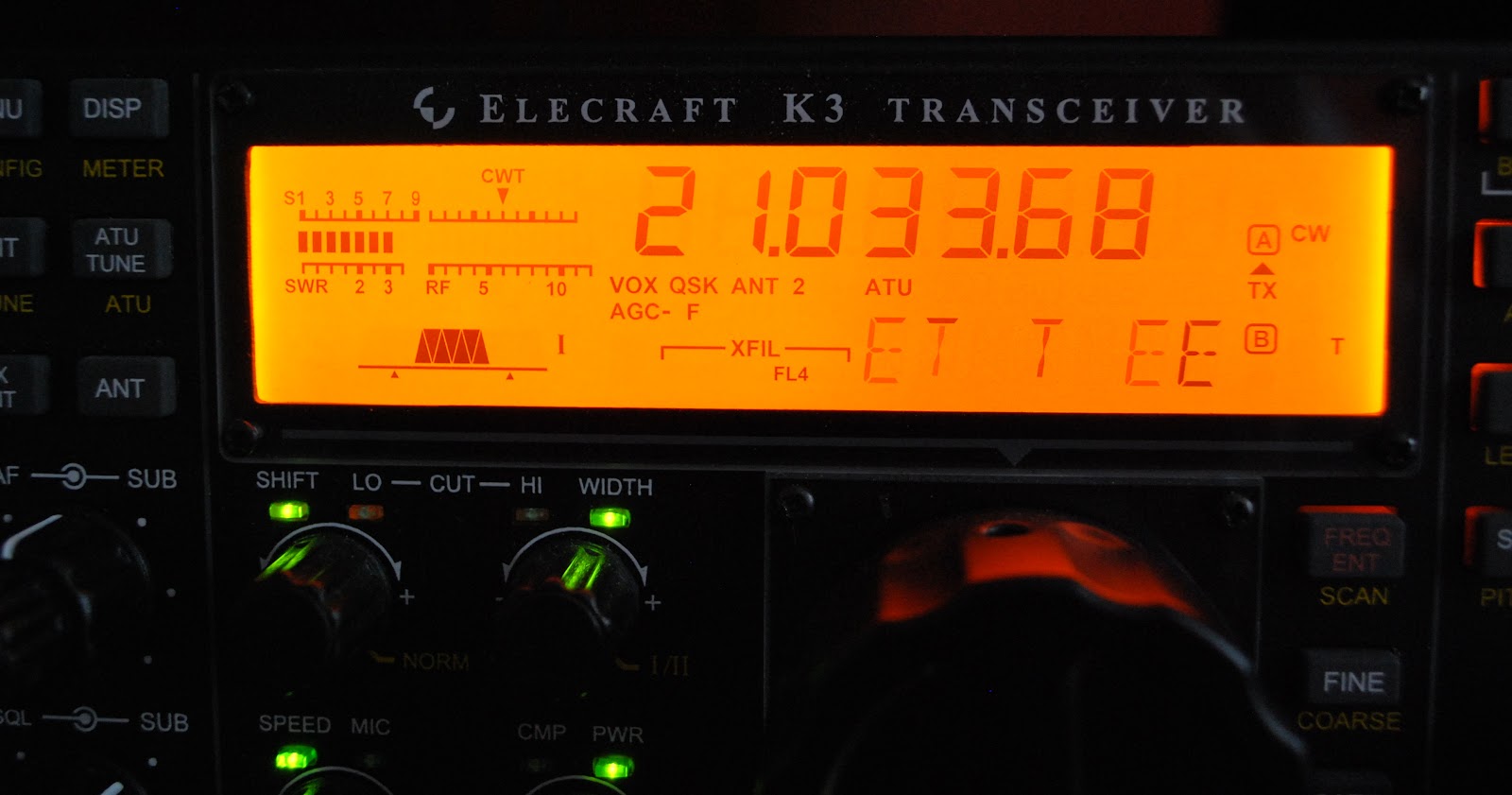
My SWR was in around 1.4 to 1 and it was very simple to adjust the SWR as I went up and down the band. You just have to get the hang of tuning the loop and it is a simple push of the fine adjustment button and your all set to go. This evening I tried 40m and there was lots of EU stations but for some reason I was not able to make any contacts so after a short time I shut things down for the evening.
Tomorrow I am going to try to make some contacts with less than 5 watts and hopefully get some 1,000 miles per watt contacts.
Some of the highlights were:
Tunisia
Balearic Island
Finland
Alaska
Nicaragua
Mike Weir, VE9KK, is a regular contributor to AmateurRadio.com and writes from New Brunswick, Canada. Contact him at [email protected].
Up and running
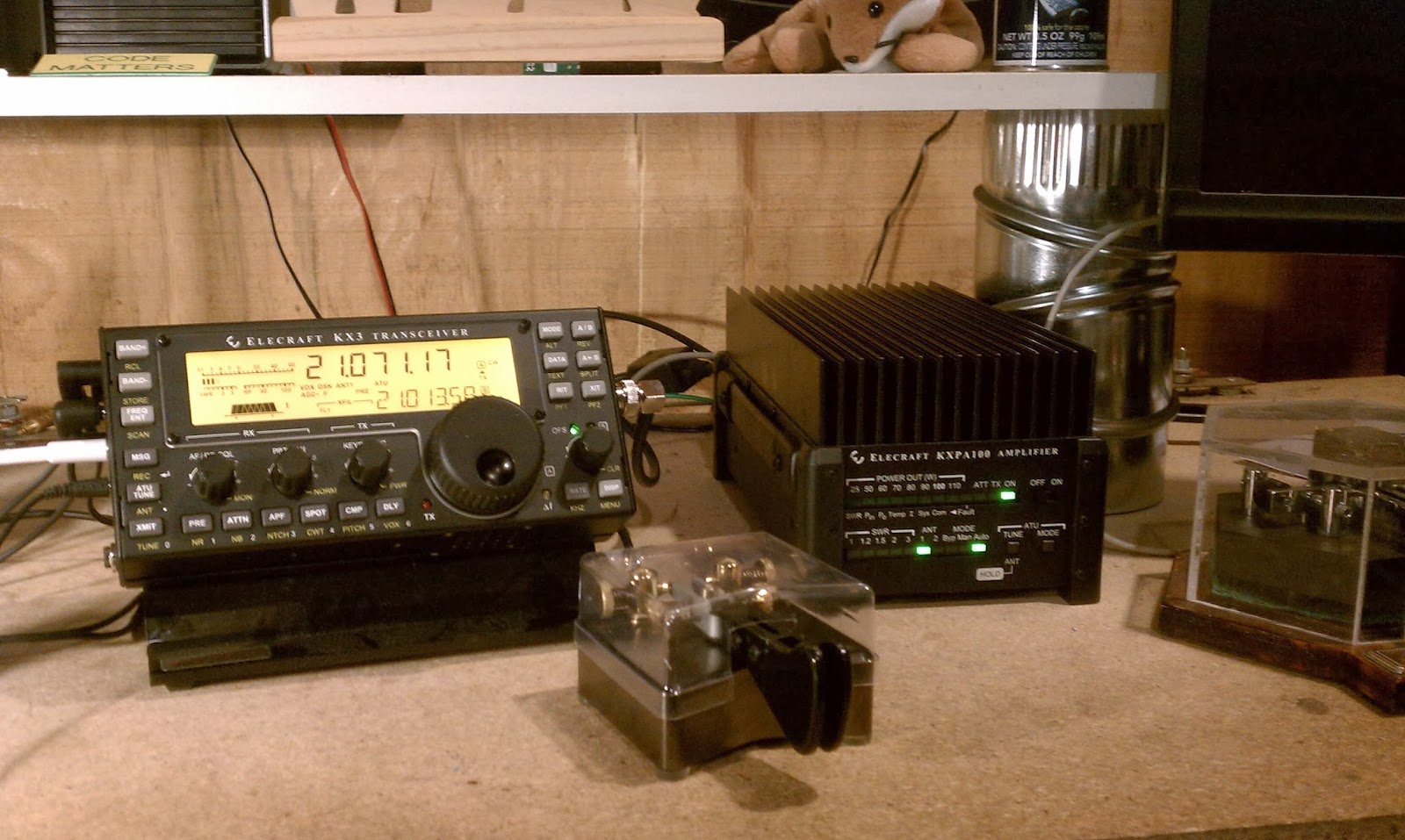
Today, after completing a few chores, I finally got a chance to assemble my KXPA100. For the record, I did not pre-download the assembly or instruction manuals. Maybe I should have, but I didn’t. I decided to just wing it and go with the flow after opening the box.
A few guys on the KX3 e-mail reflector claimed an assembly time of two hours. I completed mine in just a little over one hour. Basically, all you’re doing is securing the autotuner board to the amplifier, and then putting the housing on. Not much work, easy as pie to do, and you end up saving a couple hundred dollars.
I learned a few things the hard way:
1) Don’t assume you have the latest firmware in your KX3 just because you normally upgrade often. I thought I had the latest version, only to discover I didn’t. When I couldn’t get my KX3 to go above the 12 Watt level, I knew something was wrong. A firmware update took care of that.
2) Keep the KXPA tuned “off”. Sounds strange, doesn’t it? There is an “On/Off” switch on the KXPA100, but it is meant for when you are using the amp with a radio other than a KX3. If you use a KX3, it totally controls the amp. Turning on the KX3 turns on the KXPA100. Turning off the KX3 turns off the KXPA100. If you have the “On/Off” switch turned on while using the KXPA100 with a KX3, the LED indicators don’t work properly. You may set the KX3 for, say 75 Watts – but the LED indicators won’t light up properly. Turnng the switch off remedies that.
Item 1 was prominently mentioned in the manual. I had assumed something, and you know what happens when you assume. I didn’t see anything about the “On/Off” switch in the manual, but admittedly, I glossed through it and did not read it as carefully as I should have – again, my fault.
It is working properly, and I did give it a trial run my making some ARRL DX Contest QSOs at higher power just because I could – not because I needed to. I think in most cases, QRP would have worked. Tomorrow, however, I want to take the amp on a “shake down cruise” and really give it a go – just to see how these boots feel and break them in a bit.
Not that I am abandoning QRP – by no means. For 95 to 99% of the time, my KX3 will continue to purr along at the 5 Watt or less level. But having this amp sure would have been handy a week ago for adding FT5ZM to my log. I’m enough of a DXer to regret having missed that opportunity.
73 de Larry W2LJ
QRP – When you care to send the very least!
Larry Makoski, W2LJ, is a regular contributor to AmateurRadio.com and writes from New Jersey, USA. Contact him at [email protected].
Learn how to work the FM ham satellites

Clint Bradford, K6LCS
Many hams don’t have the financial resources to buy some of the more exotic equipment you see in the full-page QST ads. Don’t worry, you don’t have to feel left out! What almost every ham DOES have is a dual-band HT. Clint Bradford, K6LCS, has created an excellent THE go-to resource to show you how you can easily work the FM birds with minimal equipment — most of which you probably already have! His site is truly a wealth of information.
He shared this with me:
It has been my mission in life the past 8+ years to show those who have never worked an amateur satellite that they CAN do it – with equipment they probably already own. I mean, when I first saw an AMSAT table at a hamfest several years ago, I just walked on by, wrongly believing that I needed 100W of TX power, multiple Yagis on the roof (which has led to divorces in my state), and that expensive Yaesu rotator.
Clint lays it out step-by-step:
- Radio options
Clint uses a Yaesu FT-60R with a speaker mic, but you can use most dual-band HTs that feature the ability to program “split frequencies.” Ideally, you could use a second radio (or scanner) and work in full-duplex mode. According to Clint, there are discontinued HTs which support full-duplex including the Kenwood TH-D7/TH-D79, Icom IC-W32a, and the Yaesu FT-470/FT-51/FT-530.
- Antenna options
Clint recommends the Arrow Antenna Model 146/437-10WBP or Elk Log Periodic Model 2M/440L5, but these very nice (but expensive) antennas aren’t your only option. He suggests that you could build a simple and inexpensive tape measure beam with very acceptable results. Just want to listen? Well, Clint shares that although it takes more patience and finesse to work satellites with “lesser” antennas, one of the first 2-meter reception reports from the ARISSat-1 was from someone using the stock antenna on his Yaesu VX-9 HT!
- Find an “easy” satellite
Clint recommends starting off with SO-50 or even the ISS (International Space Station). He has a great satellite schedule page on his site which lists the current status/availability of each bird and the necessary frequencies and CTCSS. Of note, some birds may require the transmission of a certain tone to activate a timer. After that, a different subaudible tone is used for the duration of the QSO. He does note that SO-50 can be a little “finicky” — for best results, work it full-duplex.
- Track the satellite
You have to know both when the satellite will be “visible” to you, and where you’ll need to point your antenna. Clint has a tracking page on his site which lists some of the programs and apps he recommends. While there are a variety of commercial options, he offers some good free options including AMSAT’s Online Satellite Tracking and Heavens-Above.
- That’s it! Have fun!
If you haven’t already done so, download and print his 4-page PDF guide called Work FM Satellites with your HT! to use as a reference. Thanks for the hard work, Clint. We appreciate it!
Matt Thomas, W1MST, is the managing editor of AmateurRadio.com. Contact him at [email protected].
SSN data file goes AWOL
I’ve not updated the VOAProp file ssn.txt for a while as some irritating health issues kept on getting in the way. I thought I would have a try today butit seems the NOAA data file Iused to update it from has moved to a new address. Does anyone know where it has gone to?
Julian Moss, G4ILO, is a regular contributor to AmateurRadio.com and writes from Cumbria, England. Contact him at [email protected].
 Ham Radio Deluxe |
 W5SWL Electronics |
 Ham Radio Prep |
 KB3IFH QSL Cards  Hip Ham Shirts  HamRadioAuctions HamRadioAuctions Reliance Antennas Reliance Antennas Enigma Shop Enigma Shop |  morseDX  Ni4L Antennas  R&L Electronics R&L Electronics antennas.us antennas.us QRV QRV |
- Matt W1MST, Managing Editor
