 |
 Non-English display for the K3NG Arduino Morse keyer
 9 March 2014 | by
 German, Swedish, Danish, Norwegian, Finnish, and some Spanish characters in the display are now supported by the K3NG Arduino Open Source Morse keyer. I have worked with OZ1JHM, Hjalmar and K3NG, Anthony, in order to implement this using the 8 custom-designed characters of the LCD display (based on the Hitachi HD44780). This should satisfy the call I had for such support here on this blog last year: Which non-English Morse characters are the most important ones?
Here are examples using the phonetic alphabets of these languages.
- For Norwegians and Danes – Æ, Ø, Å:
- For Swedes and Finns. But if you are not, then perhaps you still need to send your shopping list of IKEA products in Morse? – Å, Ä, Ö
- For Germans – Ä, Ö, Ü:
|
|


|
|


 |
| German: Ärger Ökonom Übermut |
 |
| España |
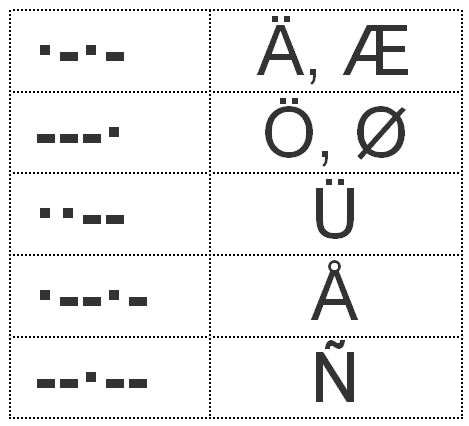
The most likely combinations of characters are:
- Æ, Ø, Å, Ü, Ñ for Danish/Norwegian.
- Ä, Ö, Å, Ü, Ñ for German/Swedish/Finnish.
It should be noted that Ö=Ø and Ä=Æ when it comes to Morse code (and meaning).
It is also possible to support the CH which has its own Morse code (—-), but so far I haven’t been able to find a symbol that represents this letter. Neither should it be much of a problem to support other letters also, such as French accents and the C cedilla (À, È, É, Ç). All it takes is to generate a bit pattern using an editor such as the one provided here and replace some of the above characters.
I am very happy for the collaboration that took place to make this possible and not the least to Anthony, K3NG for making his work available and his willingness to accept ideas for changes and improvements. For the time being, this feature is in the beta version, but hopefully it will eventually find its way into the official version. It can be enabled by uncommenting:
- #define OPTION_NON_ENGLISH_EXTENSIONS
- #define OPTION_DISPLAY_NON_ENGLISH_EXTENSIONS
Sverre Holm, LA3ZA, is a regular contributor to AmateurRadio.com and writes from Norway. Contact him at [email protected].
Aircraft scatter propagation and the Air Scout software by DL2ALF
This morning as I was putting the Practical Wireless column together and in particular, some microwave reports, I remembered that sometime ago I had heard about the Air Scout software by DL2ALF. This software uses data from FlightRadar24.com and plots it on a map. Not only that, but you can enter in your locator, the target station’s locator and the software will give you an idea of when there are aircraft in the right place to reflect the signals and enable a brief contact.
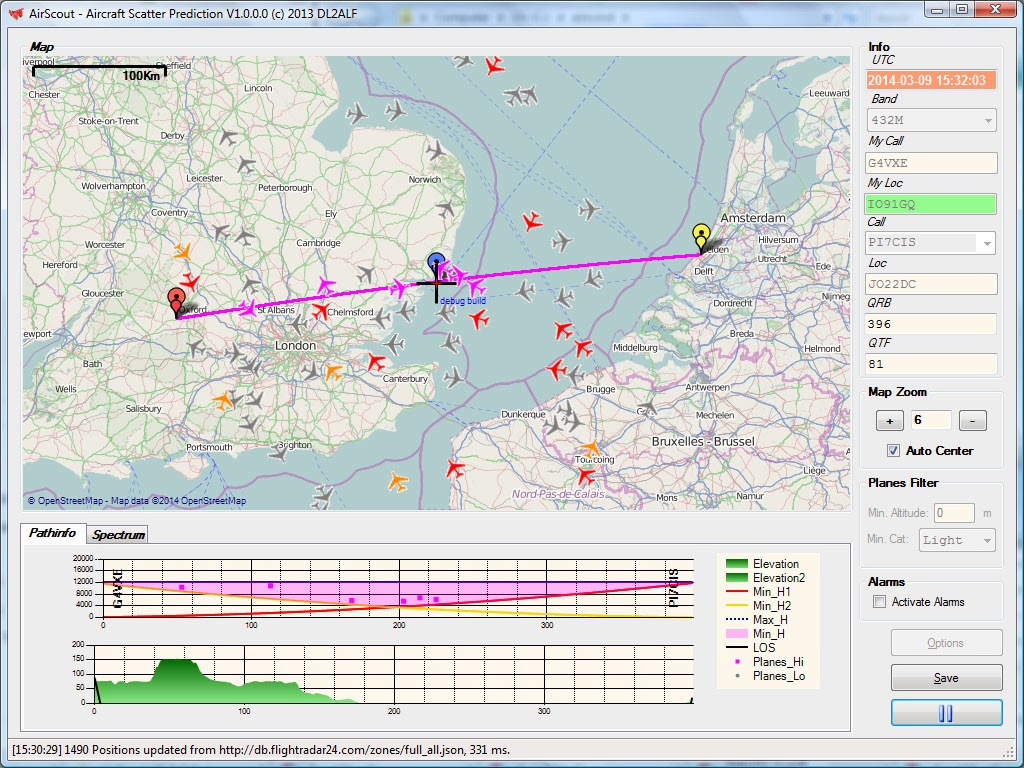
The first path I tried was quite a simple one, from here to the GB3VHF beacon on 144MHz. Although I can hear it all the time, even on the collinear, it is very quickly apparent when there are aircraft on the path, by the Doppler shift. It didn’t take long for me to see that the software was working and aircraft reflections were being heard at ‘the right time’.
A more challenging path was the 432MHz one from here to PI7CIS in JO22. At the moment, with the 10el yagi, I am not hearing the beacon all the time, so I left the FT847 running with the beam pointing towards Holland and after a few minutes, I heard a weak signal from the beacon. Sure enough, referring back to the AirScout software, there was an aircraft along the path.
Very interesting! I must look at this software a little more and see if I can learn a little more about how I might use it to make some aircraft scatter contacts.
You can download a copy of AirScout here
Tim Kirby, G4VXE, is a regular contributor to AmateurRadio.com and writes from Oxfordshire, England. Contact him at [email protected].
Series Seven Episode Five – DX Heat & Programming Software (9 March 2014)
Series Seven Episode Five of the ICQ Amateur / Ham Radio Podcast has been released. The latest news, Martin (M1MRB) and Colin (M6BOY) discuss the relevance of Amateur Radio, Martin (M1MRB) discusses DX Heat with Tobias (DH1TW) and Martin Rothwell (M0SGL) reviews programming software.
News stories inculdes:-
- Ham radio antenna rules debated in Poway
- Radio Ham's Sprite satellites launch in March
- Listening to D-STAR with DSD 1.7
- Oregon hams locate missing dementia patient
- St. Patrick Day special event station GB1SPD
- Ukrainian special event stations
- Distributed Ground Station Network For CubeSat Communications
- Radio hams seek exemption from mobile handheld ban
- Amateur Radio - Your Gateway to Wireless Communication
- RadioShack to close up to 1,100 stores
Colin Butler, M6BOY, is the host of the ICQ Podcast, a weekly radio show about Amateur Radio. Contact him at [email protected].
On air (ish)

It’s a bit quiet here at the moment, but I have managed to get back on the just lately. A couple of QSOs here and there and I’m quite happy. I did focus most of my attention on 10m where of late the propagation has been stunning.
I haven’t managed the very exotic or rare DX stations simply due to the amount of time I have been on air.
Below is a quick QSO I had with one of the Sochi special event stations. It’s a very quick QSO but you get the idea.
Dan Trudgian, MØTGN, is a regular contributor to AmateurRadio.com and writes from Wiltshire, England. He's a radio nut, IT guru, general good guy and an all round good egg. Contact him him here.
DX from the Frozen Pemi
What a relief to hike again. It warmed up to 45F today and I hit the trail. Down to the Pemigewasset River where I worked Spain, Poland, Norway, Germany and Greece.
I walked about a mile on the access road to the river along the snowmobile trail. Weeks Brook is still frozen. Soon it will be rushing with the spring melt.

Right in front of Shaw Cove is a sharp curve in the road. There’s a row of tall pine trees directly exposed to the southern sun. Even though two feet of snow covers the ground in most places, there is a bare patch at the base of these trees. I set up the KX3 at 5 watts with a 33 foot wire up to one of the pine branches. I spread a plastic bag on the ground to sit on.

I started out on 17 meters and heard Christian, LI8OM in Norway. He gave me a 449 and he was 599. This is not an ideal spot for propagation because there is a steep hill directly to the east… toward Europe. So I never expect strong reports here… but it was 55F in the sun and one of the few spots available to operate at this time of year.
Next, I exchanged reports with Serge DL1DGS in Germany. He gave me a 559 and I was pleased to work him again after a long time.

Shaw Cove is directly across from where I sat… and farther… the main flow of the Pemi. Both are frozen and probably won’t break up for a few weeks.
Now I switched to 12 meters and made three quick contacts with SZ7SER, a radio club in Greece followed by DL5LYM in Germany and SP7ASZ, Andy in Poland.
For a final contact I went to 10 meters and worked Oscar, EA1DR in Spain. I’d only operated for 15 minutes, but made six nice contacts. I packed up for the return hike up the hill.

This has been one of the coldest, snowiest and longest winters for several decades. One warm day is all it takes to raise my hopes for spring and summer adventures to come.
Jim Cluett, W1PID, is a regular contributor to AmateurRadio.com and writes from New Hampshire, USA. Contact him at [email protected].
Brazil with QRP
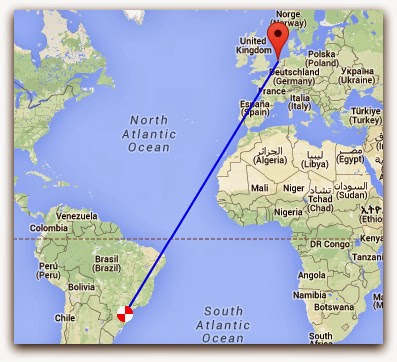
Saturday is always a busy day for me. Hardly any time for radio. But I tried JT9 on 10 meter; the first station I heard was PY5EJ. I called him with 5 watts and he replied to me. I was hard because I had a lot of QRM of strong European stations. I moved up a little higher, so we could finish the QSO.
Paul Stam, PC4T, is a regular contributor to AmateurRadio.com and writes from the Netherlands. Contact him at [email protected].
Like ….. only the best Birthday present evhur!
My question ……. how did he know?
QRPTTF Saturday May 3, 2014
A “heads up” announcement.
Due to concerns about the “Polar Vortex” still being around in April in some areas, both privately and on QRP-L, I have decided to move QRPTTF this year up two weeks to:
SATURDAY, MAY 3, 2014 1200-2359 UTC.
Hopefully, this will bring warmer weather to most of you. Following weekends are Mother’s Day and some RTTY, etc. contests. Turns out, a good weekend for some great opportunities for some special QRP DX contacts. That weekend is the 10-10 contest, which normally attracts many DX stations on the “wet noodle” band. Also, it is the SOTA International Day, which puts plenty of EU DX stations on the air, many running QRP. SOTA in Europe has already been alerted to participate in QRPTTF as well, as they have in the past.
I will ensure our exchange is compatible with these two DX events to avoid any lengthy discussions. This information has already been submitted to Hornucopia (WA7BNM) Contest site and the ARRL for their Contest Calendar.
Frankly, I haven’t even come up with a theme or the rules yet. But will soon. With the uncertain weather and predictions of late snows in some areas, nothing exotic to cause any hardships. If you have an idea or two, please let me know.
Mostly, since May 3 is moving it “up” more than most would expect, I wanted to get the word out ASAP.
I don’t know how much this will help us out here in the west (MDT and PDT), but it should really allow those in the CDT and EDT time zones to work some good EU DX, and hopefully give you a few new countries.
Rules will be posted in the usual place: http://www.zianet.com/qrp/
I hope everyone will find this change agreeable, and at least a bit warmer.
72, Paul NA5N
Thankls Paul, but you really didn’t have to do this on my account! (grin!)
72 de Larry W2LJ
QRP – When you care to send the very least!
Larry Makoski, W2LJ, is a regular contributor to AmateurRadio.com and writes from New Jersey, USA. Contact him at [email protected].
 Ham Radio Deluxe |
 W5SWL Electronics |
 Ham Radio Prep |
 KB3IFH QSL Cards  Hip Ham Shirts  HamRadioAuctions HamRadioAuctions Reliance Antennas Reliance Antennas Enigma Shop Enigma Shop |  morseDX  Ni4L Antennas  R&L Electronics R&L Electronics antennas.us antennas.us QRV QRV |
- Matt W1MST, Managing Editor
