 |
 Back in the saddle again!
 20 March 2014 | by
 You have probably noticed my lack of activity on the blog for the past little while. It’s been a hectic, topsy-turvy couple of months. Let me explain.
On New Year’s Eve, my co-worker left work early, telling me that he “might be back” in a few hours. Turns out that he was having some medical difficulties and checked himself into a hospital. Fortunately, he healed and got better. Unfortunately, he decided not to return to work, at least not where we work anyway.. So, since the beginning of the year, I have been alone at work, and have been busier than the proverbial “one armed wallpaper hanger”. One man doing the work of two made the possibility of leaving my desk for the car during lunch just a wistful desire. Add to that, numerous snows, a colder than normal January and February, and I’m not so sure I would have headed out there, even if I could have!
A replacement co-worker was hired and started yesterday. So today, even though it’s overcast, it is warm (comparatively). It was 40F (4C) at lunchtime and I took advantage of not being alone anymore and headed out to the car for some lunchtime QRP for the first time since last December. I wasn’t sure what to expect, but boy howdy, did it turn out to be great!
It seemed liked all the higher bands were just jumping with activity – 10, 12 and 15 Meters were alive with signals and I worked someone on each band. I worked CO6RD and R2014E on 15 meters. I worked HA9RT and OH4MDY on 12 Meters, and OK1DMZ on 10 Meters. I wish I had more time as it seemed like there were people from just about everywhere on the bands!
Whoopi-ty-aye-oh
Rockin’ to and fro
Back in the saddle again
Whoopi-ty-aye-yay
I go my way
Back in the saddle again
And it feels so good!
72 de Larry W2LJ
QRP – When you care to send the very least!
Larry Makoski, W2LJ, is a regular contributor to AmateurRadio.com and writes from New Jersey, USA. Contact him at [email protected].
Handle for K2
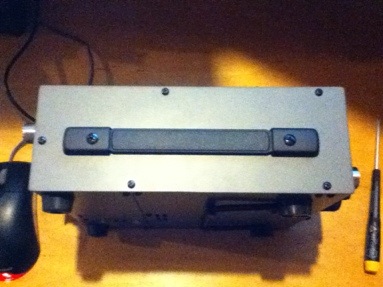
Yaesu MHG-1 hand strap for FT-450 works great on the K2.
Ethan Miller, K8GU, is a regular contributor to AmateurRadio.com and writes from Maryland, USA. Contact him at [email protected].
Proposal for a fourth ultimatic mode: First paddle priority
The ultimatic mode is an alternative to the iambic mode for sending Morse code from a dual lever paddle. When pressing both paddles the last one to be pressed takes control, rather than the alternating dit-dah or dah-dit of the iambic mode.
In the K1EL Winkeyers there are actually three ultimatic priority modes. This is shown in the table below that comes from page 9 in the specification for the command for setting the PINCFG Register. (K1EL CW Keyer IC for Windows Winkeyer2 v23 10/5/2010). This is a de facto standard for interfacing to and controlling a keyer, as an example it is used in the K3NG Arduino Open Source Morse keyer.
 |
K1EL has defined bits 6 and 7 for setting this up by remote command. I propose that the last possibility, ’11’, presently undefined and unused, be used for a new mode. This mode is “First paddle priority” meaning that the last paddle which is pressed is ignored. It can also be interpreted as an emulation of a single-lever paddle. I and others have found that helpful in eliminating errors when keying. See for instance “Single Paddle operation with Iambic paddles” by Larry Winslow, W0NFU, in QST, October 2009 and the Iambic to Single Paddle kit from WB9KZY or my earlier blog post “Single-lever and ultimatic adapter“.
My proposal is that the bits for the ultimatic mode be used like this:
- 00 – Last paddle priority, i.e normal ultimatic
- 01 – Dah priority
- 10 – Dit priority
- 11 – First paddle priority or Single Paddle Emulation (New)
Sverre Holm, LA3ZA, is a regular contributor to AmateurRadio.com and writes from Norway. Contact him at [email protected].
Arduino Frequency Display For Kenwood TS-520S HF Ham Radio PART 2
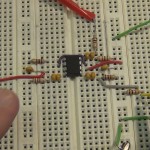
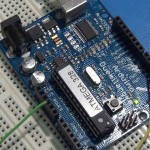
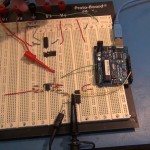
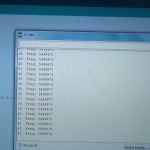
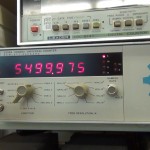
This is (PART 2A & 2B) of the project “Arduino Frequency Display For a Kenwood TS-520S HF Ham Radio”. This part covers small signal amplification of a 0.2 volt peak-to-peak 5.5 MHz signal into Schmitt triggered NAND gate for cleanup before being cleanly counted by the Arduino. All parts: (PART 4), (PART 3), (PART 2), (PART 1)
(PART 2A)
(PART 2B)
Here are the datasheets for the two chips I used in (PART 2)
74HCT132 Quad 2-input NAND Schmitt trigger (PDF)
NE592 video Amplifier (PDF)
Thanks for joining!
Photo Gallery
CLICK PHOTO for gallery view and click a SECOND time for hi-resolution image. Click thumbnails on lower right and lower left of gallery to navigate gallery photos.
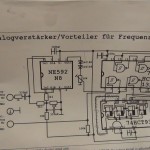
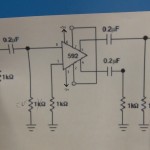
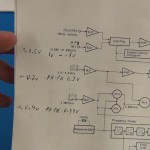
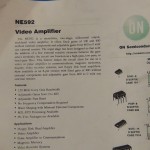
Thanks for joining!
Todd Harrison, KF7NBI, is a regular contributor to AmateurRadio.com and writes from Arizona, USA.
Are American Amateurs Different?
I’ve noticed two things in recent years, and I’m not sure if it’s just me or I’m really on to something different with American radio amateurs. The first observation is that there seems to be more “homebrewing” or construction of equipment outside of the US. This isn’t to say there isn’t homebrewing within the US, far from it. Obviously there is an active and vibrant QRP community in the US. But as a general trend, there seems to me to be more equipment construction and “rolling your own” in other countries. I’ve noticed with the number of inquires and feedback emails I receive for my open source amateur radio hardware projects, foreign amateurs outnumber US amateurs by a ratio of 10 to 1. Most are in Europe, however I’ve heard from amateurs in India, Japan, Australia, and other countries outside of Europe. I think US amateurs spend a lot of money on the hobby, but there seems to be more of a buy it and operate mentality where DX amateurs tend to be more frugal and more apt to construct things.
My second observation is that US amateurs seem more down about the future of amateur radio, in general, than foreign counterparts. US amateurs tend to complain about the state of the hobby, ARRL, the FCC, code tests, incentive licensing, young people, etc. US amateurs tend to be more negative online. They’re much more apt to bring up partisan politics in QSOs and online, and they often make mental leaps connecting the perceived decline of amateur radio and the social and political climate in the US.
These are just observations, and I have no scientific data to back this up. I’m especially curious about what radio amateurs outside of the US observe with those in their countries. Is the US unique in some regard with attitudes about amateur radio? Do you feel there’s more low-level technical experimentation outside the US? Is this all just my perception and not reality?

Anthony, K3NG, is a regular contributor to AmateurRadio.com.
Spring Hike to Profile Falls
It was gorgeous today. Tim W3ATB and I headed to Profile Falls and set up right alongside the Pemigewasset River. We worked Russia, the Canary Islands, PA, OH, NC, and Belgium.
We had lunch in Bristol and then drove out the back road toward Hill Village. We turned left toward the Smith River and parked the car not far from Profile Falls.

We walked through the woods about a half mile toward the Pemi. The Corps of Engineers has a picnic area along the river. We set up right under an 85 foot pine tree.
Tim brought his HB-1B and tossed a line over the pine branch and pulled up his portable Par antenna. He was running about 4 watts with internal batteries on 20 meters and snagged W1AW/8 in Ohio within a few minutes of sitting down. He was ecstatic.

I set up on a nearby table. I tossed a line over a second pine branch and pulled up a 33 foot wire. I was using the earchi.org 9:1 unun with the internal tuner on the KX3. I set up on 12 meters with 5 watts.
I worked Alex RA6MQ in Russia almost immediately. He was a 599 and gave me a 559. Within two minutes, I worked another station… EA8/OH2OT in the Canary Islands. We exchanged quick 599’s.

I switched to 10 meters, and worked ON6MG in Belgium followed by Alex RA6MQ again. He had also switched to ten meters. It was fun to work him on two bands. By now my fingers were getting a bit chilly so I built a small fire in the grill by the table and listened while Tim racked up the QSOs.

Tim had a long chat with Don, KD3CA in PA and told him we were operating outdoors alongside the river. When they finished Tim made a quick contact with K4DJ in North Carolina and exchanged SKCC numbers.
We packed up and walked along the river to enjoy the remarkable scenery… sparkling water, deep blue sky and brilliant snow. We stopped for a minute to soak up some warm sun before heading back down the trail towards the car.
From here, it only gets better… warmer days, melting snow and finally spring!
Jim Cluett, W1PID, is a regular contributor to AmateurRadio.com and writes from New Hampshire, USA. Contact him at [email protected].
Sri Lanka

It was early (06:21) in the morning, but I tried 10 meter checking for activity. I only heard 1 CW station; not very strong but finally I could decode the signal 4S7LXG Sri Lanka. A new DXCC, so I tried my luck. Yes, after a few calls he replied to me. That’s DXCC number 132.
Paul Stam, PC4T, is a regular contributor to AmateurRadio.com and writes from the Netherlands. Contact him at [email protected].
 Ham Radio Deluxe |
 W5SWL Electronics |
 Ham Radio Prep |
 KB3IFH QSL Cards  Hip Ham Shirts  HamRadioAuctions HamRadioAuctions Reliance Antennas Reliance Antennas Enigma Shop Enigma Shop |  morseDX  Ni4L Antennas  R&L Electronics R&L Electronics antennas.us antennas.us QRV QRV |
- Matt W1MST, Managing Editor
