 |
 Series Seven Episode Six – Return to Antarctica Mike Gloistein GM0HCQ / VP8CMH/MM (23 March 2014)
 23 March 2014 | by
 Series Seven Episode Six of the ICQ Amateur / Ham Radio Podcast has been released. The latest news, Martin (M1MRB) and Colin (M6BOY) discuss making representation of Amateur radio and Martin (M1MRB) and Chris Howard (M0TCH) interview Gloistein GM0HCQ / VP8CMH/MM about his work in Antarctica.
- OSCAR-11 / UOSAT-2 celebrates 30 years in orbit
- Maplin put up for sale
- Transatlantic 29 kHz VLF transmission
- Amateur Radio Beacon and Repeater renewal 2014-2017
- Pi Slow Scan TV wins 'Make' contest
- Canadian Exam update
- Delaware State Police and ARES Group join forces
- Ham radio operators provide serious public service
- Ham radio satellite operation from Isle of Lewis
- New energy-efficient lights can wipe out radio
- New frequencies for French radio hams
Colin Butler, M6BOY, is the host of the ICQ Podcast, a weekly radio show about Amateur Radio. Contact him at [email protected].
Experiments with the SSB satellites (AO-73, FO-29 and VO-52) with the V2000 vertical
Browsing around the AMSAT-UK site yesterday, I came across this article by the ever inspirational Ray, W2RS about how he had made QSOs on the SSB satellites using nothing more than a dual band mobile whip, a diplexer and SSB transceivers for 144 and 432MHz.
Well! I wondered if I could do something similar, given that I had the V2000 vertical up on the mast. In some respects, it is a ‘long whip’ as Ray discusses, putting quite a lot of radiation towards the horizon, which is what’s normally wanted for tropo, but not for satellites, but there are certainly some vertical lobes.
So, I fed the V2000 into the Diamond diplexer and then connected the appropriate coax from the diplexer to the FT847’s 144MHz port and (separate) 432MHz port.
An initial test to see if there was much desense or crackle was positive.
The first satellite around was AO-73, which was testing its’ transponder in daylight. After a bit of fiddling around, I was able to hear my CW, just as the satellite flew over the horizon! Then VO-52 came over and I was receiving good signals on 145MHz and again was able to hear my CW, sufficiently to call CQ. No-one came back, but it’s a start! I also managed to hear myself on a pass of FO-29 with reasonable elevation.
This is all quite promising and I’m pretty sure that I will be able to make some QSOs in due course, most likely on CW.
However, all of this enthused me sufficiently that I’m aiming to be able to take the FT847 out into the garden (or out portable) with the diplexer and the Elk to try and make some contacts with the yagi.
Good fun – thank you for the inspiration, Ray!
Tim Kirby, G4VXE, is a regular contributor to AmateurRadio.com and writes from Oxfordshire, England. Contact him at [email protected].
HamRadioNow: MotoTRBOStar
Last night I uploaded HamRadioNow Episode 138. I’m calling it MotoTRBOStar because it’s about a newly announced handheld radio that will claim some firsts: it’s the first “dual-digital” mode radio (D-STAR; and MOTOTRBO, or generically DMR – Digital Mobile Radio); and it’s the first non-ICOM off-the-shelf radio to do D-STAR.* The episode is an interview with the CEO of Connect Systems, Inc., Jerry Wanger (rhymes with Ranger). CSI (isn’t that a TV show?) has been selling analog, trunked and DMR digital handheld radios in the commercial service. Recently, Jerry learned that a lot of hams have latched onto his radios for use on the ham-band MOTOTRBO repeaters. The radios are quite inexpensive, and apparently pretty high quality.
Jerry had a novice license long ago, but never mastered the code to upgrade. Side note: back in the 60’s, a Novice license ran one year and couldn’t be renewed. And Novices had voice privileges on only one band: two meters. So Novices who spent too much time on two-meter AM (there was almost no FM then) and didn’t get their code speed up to 13 wpm for a General could get a Tech, but then they were confined to VHF/UHF. Again, repeaters were just barely getting started and were mostly unknown, so Techs were in a kind of Purgatory. But it was a way to keep licensed. Evidently Jerry didn’t choose that route. But he’s about to get re-licensed now.
So Jerry appreciates ham radio, and decided to make a model radio (CS700) that was more “ham-friendly,” with features like DTMF and the ability to program frequencies and parameters directly from the keypad. Then he decided to add D-STAR. That model, the CS7000, is planned for Fall release. He’ll be at Dayton to show it off.
Jerry does the software and designs the hardware specs himself, and has the radios manufactured in China. As he says, he can buy the finished radios cheaper than he can buy the parts.
So that’s all in the interview. Now I’ll wax a bit philosophical on the topic.
I’ve been a ham since 1965, WN9NSO, in the Chicago suburbs. And while I did play on two meter AM with a Heathkit Twoer (to the displeasure of my mentors, who warned sternly about neglecting the code), I also spent enough time in the 40 and 15 meter Novice cw bands to wick the speed up and pass my General after just a few months. And while I have almost always had a presence on HF, I’ve felt more at home on VHF/UHF. I was introduced to FM almost immediately. I had a Motorola 30D base station in my shack, and 80D mobile in my Dad’s car by 1967 (these were ancient, all-tube radios. The 80D even had a Dynamotor to power the transmitter). There were only two or three repeaters on the air in Chicago at the time. I was too young (and never an engineer) to be much of a leader at the time, but I watched the FM boom from a front row seat.
Fast forward to the early 2000’s. I’m editor of the SERA Repeater Journal, the magazine published by the SouthEastern Repeater Association, the group that does frequency coordination for 8 states. I come across a reference to D-STAR, and while I didn’t think much about it at the time, I did ponder a digital future in my column. But D-STAR wasn’t one of those flights of fancy that came and went. With ICOM behind it, D-STAR grew beyond it’s original 1200 MHz system as ICOM added radios for 144 and 440 MHz. Meanwhile, I had moved from editing the magazine to producing ham radio video on DVD as ARVN:Amateur Radio//Video News. I bought ICOM’s first D-STAR dual-band mobile, the ID-800, and handheld, the IC-91, and soon after produced a documentary titled Digital Voice for Amateur Radio. The DVD also featured a segment on HF digital voice, and a little on APCO-25, another VHF/UHF digital mode being adapted from Public Safety radio to Amateur Radio. I’ve written a few articles and reviews in QST on D-STAR and ICOM radios. I’m not the foremost authority on it by any means – I consider myself a journalist (with a side of pundit these days), not an expert – but I’ve learned a lot. And ham radio doesn’t have many pure journalists. Everybody’s involved.
D-STAR was met by hams with sharply divided reaction (and more than a few yawns). A few embraced it immediately (best thing ever). A few more were rigidly opposed (End Of Amateur Radio As We Know It). Most, if they were even aware of it in the early years, were more wait-and-see. Not gonna sink a lot of money into a radio that might not go anywhere. All the D-STAR radios were good Analog radios, too, but they were a few hundred bucks more expensive, so while the radio wouldn’t be useless, it would have been a costly experiment.
Turns out D-STAR has hung around and grown fairly quickly. It’s in most major and medium metro areas, and even some rural areas, of the US and many countries around the world. But there’s still plenty of territory that has had analog FM for decades but no D-STAR at all yet. Any long road trip will quickly bear that out. You’ll drive a long way between “islands” of D-STAR coverage. It’s very much like FM was in 1970 – available mostly in the larger cities. I remember being excited when driving toward Denver way back then. A mountainside repeater on 146.94 broke my squelch about 100 miles out after hours and hours of radio silence.
D-STAR proponents, and even us “objective journalists” (OK, I’m not objective on this) point out how much technology is going digital (TV, cell phones, a fair amount of two-way business and Public Safety radio) while hams have barely moved the needle, except for the all-text modes. Yeah, we led the way with Packet Radio in the 80’s (a few did, anyway… not most of us). But for a group that likes to talk more than anything else, our voices have remained mostly analog, right up to today. Digital has some advantages (signal to noise, voice+data, and spectrum efficiency), but they haven’t been compelling enough yet to get wholesale adoption. Except for D-STAR, they mostly haven’t been built-in to radios. And on HF especially, we don’t know how we’d use them for some of the core activities like contests and DX.
As we gaze outside of our pasture to that real world that’s growing increasingly digital, there’s another issue to note. Digital doesn’t stand still very long. Upgrades happen fast, and sometimes older stuff becomes obsolete – even unusable – pretty quickly. Analog TV made it about 60 years. Vinyl records a little longer. CDs aren’t dead, but sales went to nearly zilch, after about 20 years. On the Internet, where software and apps can be easily upgraded or replaced, we’re talking a few years or even months. Remember “RealTV”? And you know that 70″ 1080p High-Def TV you just got. Obsloete. Here comes 4k. Then 8k. Broadcast TV stations are going nuts trying to figure out to squeeze that into their “Advanced” television system. **
I’m about to edit my next HamRadioNow that I recorded yesterday with Bruce Perens K6BP. Bruce is a serious open-source guy, so he never had a great love for D-STAR. Bear that in mind when he declares it obsolete. Objectively, things in ham radio move slower. Whenever there’s fixed hardware involved, upgrades can’t happen that fast – it costs too much. But D-STAR is 15 years old, and better technology is available. Yaesu claims their new C4FM “System Fusion” is “better.” Bruce disputes that, and I don’t have the background to determine it for myself. But I can say that if Yaesu is correct now, what can they say in 5 years (0r 5 months) when the next something better comes along?
Bruce is involved in a couple of projects. For HF, there’s FreeDV, and for VHF/UHF, it’s the “HT of the Future.” Both are based on the open-source CODEC2, which is still very much under development, and always will be, at least for the foreseeable future. Today, FreeDV is a sound-card mode that you can run much like PSK-31. Tomorrow, you might punch it up on the mode switch (Flex will probably be the first radio to have that option). FreeDV – and probably a lot of new modes – will be upgradable by downloading software. I won’t say it will never be obsolete, but it’s the kind of thing that will move us from being slow-moving dinosaurs tied to our fixed-technology hardware, into a more nimble future where we are not walled off from each other by incompatible modes. All this stuff is coming up in HamRadioNow Episode 139, as soon as I can stop typing here and get back to editing it (maybe tomorrow or Monday).
Ya know… I’ve never operated FreeDV or it’s predecessors (FDMDV, WinDRM) that I featured in Digital Voice for Amateur Radio. I don’t have a computer sitting next to my HF rig… at least not yet. All my computers are busy doing something else. But I’ll find one soon, and give it a try.
73, Gary KN4AQ
* Devices like the DVDongle are cool, but they’re not standalone radios. There are a few modules that you can use to turn an analog radio into a D-STAR radio using its 9600 packet port, but that’s not off-the-shelf. The NW Digital radio might lay claim to being the first non-ICOM commercial D-STAR capable radio if it reaches production before the CS-7000 does, and right now it’s a race. But while it will do D-STAR’s DV voice mode, it’s really designed as a multi-mode platform for medium-speed data, using D-STAR’s DD mode and many others. It will have exciting uses, but it’s not your grab-and-go handheld or mobile radio.
** My career has been in the audio/video production business, mostly making commercials. I quickly learned a lesson: never stick a label on anything that calls it “new.” And never call anything “final.” OK, sort of two lessons.
The “new” lesson came from a reel of alignment videotape that we used at a TV station I worked for. You had to run that through the old 2″ “Quad” videotape machines to align the heads before making a recording, so the reel got used several times a day. It started life as a 5-minute piece of tape, but every time you used it, you’d then rewind it and thread a piece of blank tape for recording onto the machine. That rewind was high-speed, and if you didn’t catch it fast enough, the end of the tape would flap like crazy, and get frayed. You had to cut the frayed piece off lest it get caught in the high-speed spinning video heads next time, clogging the hell out of them and maybe ruining a head assembly that cost tens of thousands of dollars to replace. The boss would be very angry.
When I started working at the station, that alignment reel had about 45 seconds of tape left on it, having had a half-inch of frayed end cut off many, many times. And the flange was grimey from all the hands that had loaded it on the machines over the years. But there beneath the grime, just barely readable in faded Sharpie, were the words that some engineer wrote just after he took that reel out of the box for the first time: Alignment Tape. 5 min. NEW.
Gary Pearce, KN4AQ, is the host of HamRadioNow.tv. If you enjoy this and other HamRadioNow programs, help keep them 'on the air' with a contribution. Contact him at [email protected].
80 Meter fun and disappointment
Last night was my last stint as a Fox in the QRP Fox hunts for the 2013/2014 season. I served as the 80 Meter Fox last night, and I was chomping at the bit, all ready to have a fantastic night handing out pelts. I’ve been having very good success nabbing the 80 Meter Foxes this season as a Hound, so I was expecting reciprocity last night as Fox. When I turned the radio on at about 0045 UTC and heard a very low noise floor, I was happy. I was also a bit surprised as we’re now officially in Spring and I was expecting it to be way noisier. I should have know something would be “off”.
I started right on the mark and was off to a running start, but then about 0120 UTC, it seemed like the bottom of the band fell out. I went from a decent pileup to calling CQ over and over. Switching between the vertical and the wire seemed to not make much of a difference. I was surprised that the QSB was so deep and sharp. My buddy, Bob W3BBO joined the fray last night, and using him as an example – when he called me, the W3 was a good and honest 579 – the BBO was ESP!
And so it went for the last hour – calling CQ over and over with takers here and there. A very short mini pileup at about 0150 UTC for a few minutes and back to calling CQ. In all, I handed out 41 pelts. While I had a ton of fun, it was also a huge disappointment to me as I had set a personal goal of handing out 60. After the hunt, I took a look at my spots on RBN. I was heard by skimmers up and down the East coast and out as far as Illinois. My best DX for the night was working Dale WC7S in Wyoming and Tim KR0U in Colorado.
Afterwards, I was reading e-mails on the Q-FOX reflector, where most of the Hounds were reporting very high noise levels on 80 Meters last night. I guess that added to the misery for the night. My fellow Fox, Jim KG0PP handed out only two more pelts than I did, so it’s obvious that he had to face the same obstacles in Colorado that I faced in New Jersey.
It’s funny how perspective can change. Last month, when I was serving as 40 Meter Fox and band conditions were excellent, it seemed that 90 minutes for the hunt was nowhere long enough. Last night, with lousy band conditions, that same 90 minutes was interminable.
Ending the season as a Fox on a low note was not what I had in mind, but as the Brooklyn Dodger fans used to say – “Wait ’til next year!”
72 de Larry W2LJ
QRP – When you care to send the very least!
Larry Makoski, W2LJ, is a regular contributor to AmateurRadio.com and writes from New Jersey, USA. Contact him at [email protected].
Norway, Bulgaria and Philly – QRP!
Had a brief time to head to the park at lunch today – and once again had a blast!
Here is the low down….
LA5UF – Joe was calling CQ on 21.040. It took him a bit to dig me out and get my call right. He gave me a 449 and he was a solid 559 here in Kansas. Joe hails from Norway.
LZ2HR – I heard him calling CQ on 28.0299 with no takers. I threw my call out and he came right back to me. He gave me a 589 and he was a solid 599 here. Fun!
I called CQ for some time on 10 meters, and even though I was spotted all over on the RBN – no dice.
Then I heard….
K3DY calling CQ on 21.0469. We had a nice QSO with more than just a contest exchange. The band was a bit up and down, but solid copy both ways. Tony said he was reading my page as we talked. Thanks for the nice QSO Tony! Tony is outside Philadelphia, PA.
Any lunch time with a little CW is always fun!
I hope to get a version of my Portable QRP Antenna installed in the attic this weekend. We will see how that goes. I would really like to get a station setup at home, and eventually try some of the digital modes.
Burke Jones, NØHYD, is a regular contributor to AmateurRadio.com and writes from Kansas, USA. Contact him at [email protected].
0,5 W on 20 meter WSPR
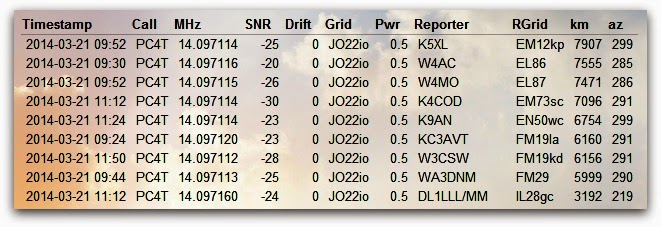
It seems to be that propagation is fair. So I tried 0,5 Watts on 20 meter today with WSPR. I show only reports above 2000 km.
Paul Stam, PC4T, is a regular contributor to AmateurRadio.com and writes from the Netherlands. Contact him at [email protected].
Amateur Radio Newsline Report 1910 March 21 2014
- Hams asked to assist in the hunt for Malaysian Airlines Flight MH 370
- Ukraine and Russia bring intruding signals to some HF ham radio bands
- Hams in France get new band allocations and more bands may come
- FCC invites public comment on proposal to restructure the 10 GHz band
- Ohio radio club to celebrate Earth Day on the air
- Surrey Space Center in UK developing virtual ride to space
 Ham Radio Deluxe |
 W5SWL Electronics |
 Ham Radio Prep |
 KB3IFH QSL Cards  Hip Ham Shirts  HamRadioAuctions HamRadioAuctions Reliance Antennas Reliance Antennas Enigma Shop Enigma Shop |  morseDX  Ni4L Antennas  R&L Electronics R&L Electronics antennas.us antennas.us QRV QRV |
- Matt W1MST, Managing Editor
