 |
 DXCC QRP
 26 March 2014 | by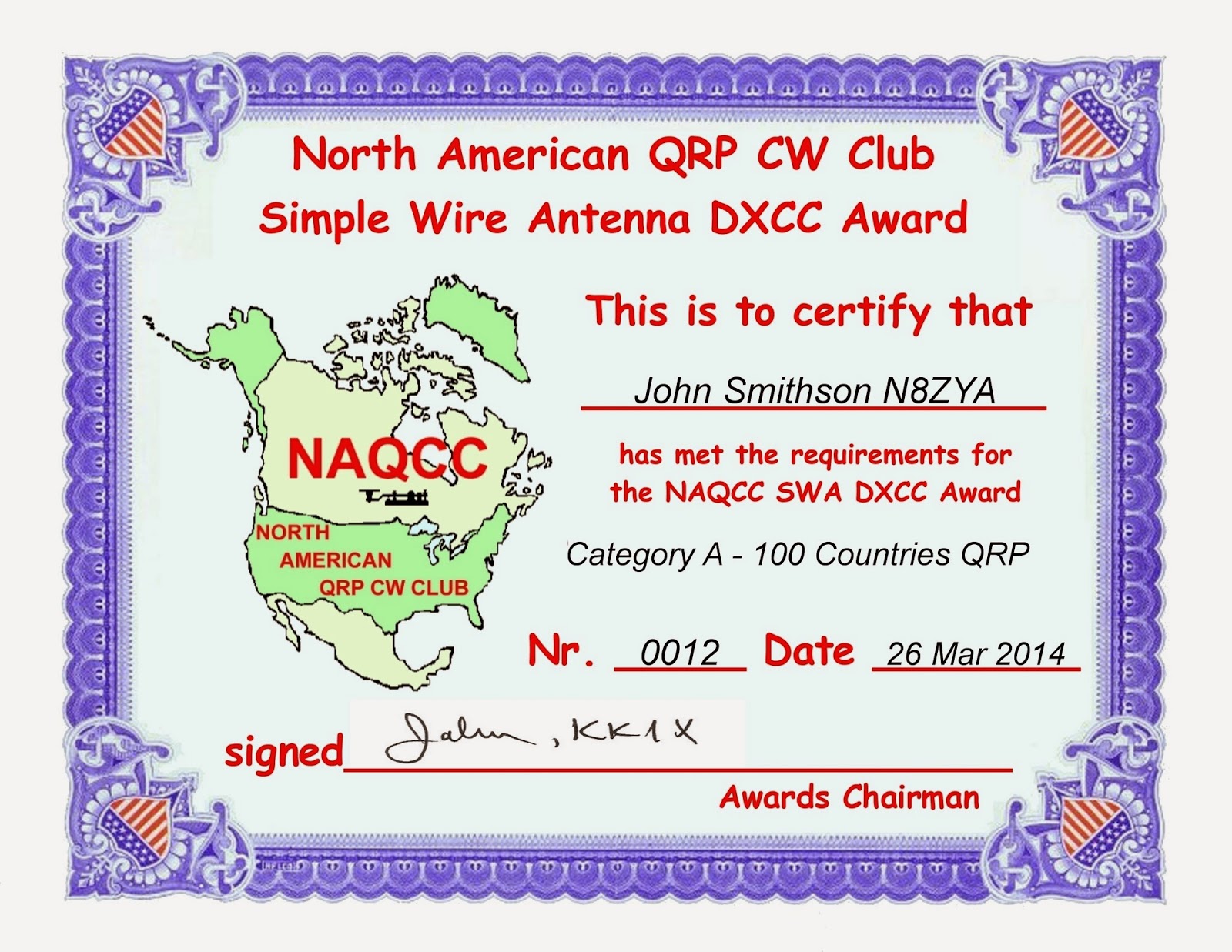
It’s taken a while, but when I finished tallying up my countries, there were 102 countries in the DXCC logbook a few nights ago. I had just sent in my WAS (worked all 50 states) data in February, and received my certificate for that award, just a few weeks ago.
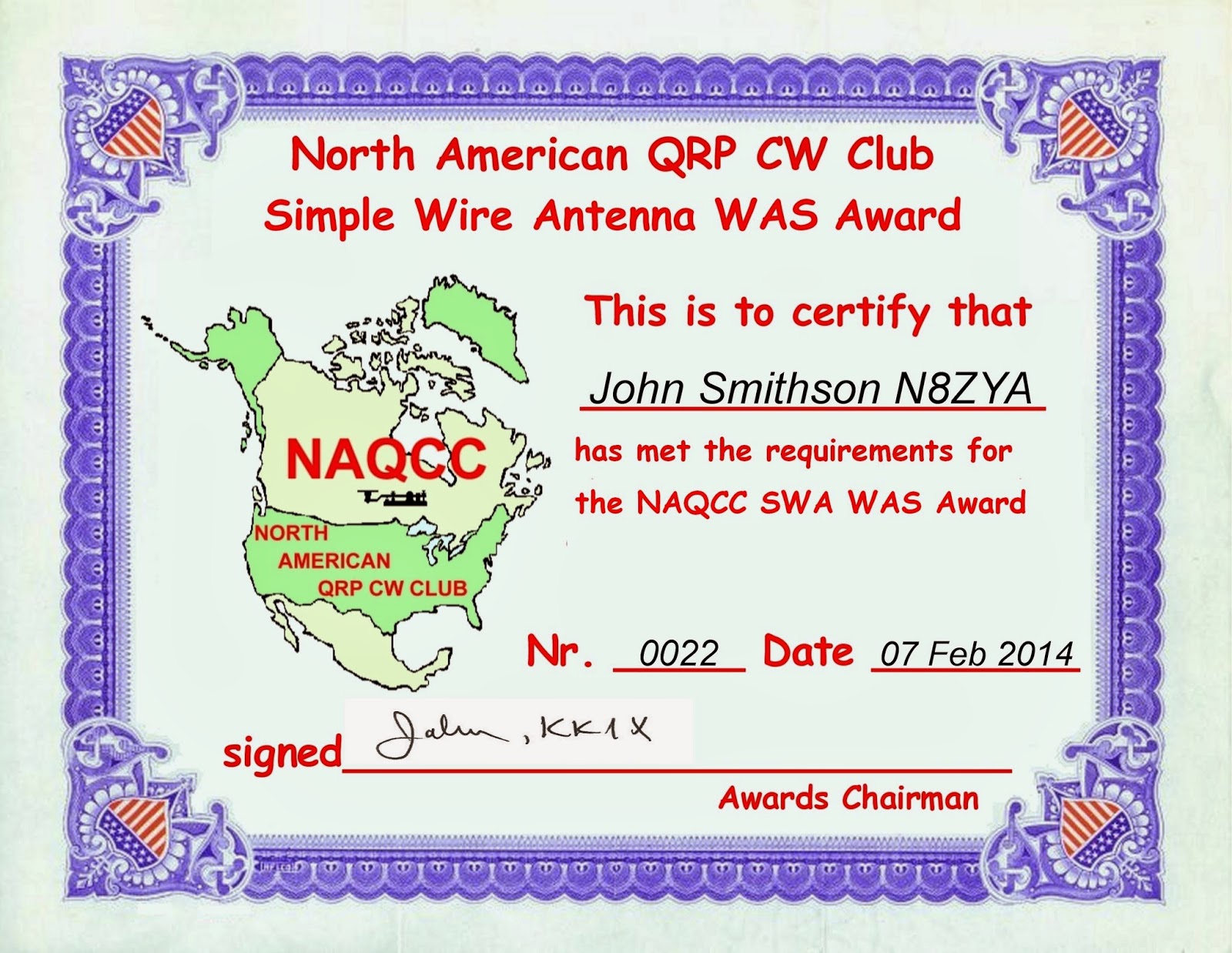
It’s taken me about three years to achieve both these awards, with never more than 5 watts of power, and indoor “stealth” antennas. My immediate neighbors still don’t know I’m a ham radio operator, and since I live in a historic area, where outside antennas are prohibited, I consider that a good thing. lol
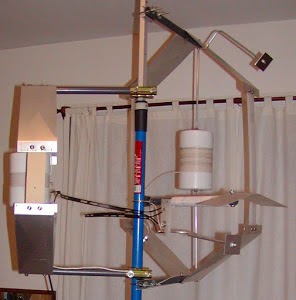
I worked nearly all of my WAS contacts (48) with my Isotron antennas on either 40 meters or 20 meters. Alaska and Hawaii were my two most difficult states; I worked those with a 50 ft length of “Radio Shack” speaker wire which I strung around the perimeter of a spare room in the house. The wire runs from my tuner, across the windows, which have wooden curtain rods, across the hallway, over the top of an “open” wooden door, and is tied off the the “downstairs” wooden stair railing. It’s a tough way to do it, and it’s a true “random wire“, but I’ve enjoyed every minute of the challenge it took to work those 102 countries.
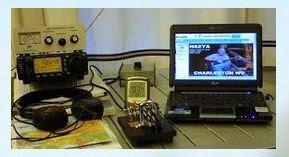
The process accelerated a little before September of 2012 when I started using “dedicated band dipoles” for my DX contacts. My indoor “upstairs” space is very limited but I’m able to stretch out a dipole for 10 meters and 15 meters. Those two dipoles barely hang between the wooden curtain rod, on one side of the house, and the bathroom window sill, on the opposite side of the house. This picture below shows my “end fed” 10 meter antenna. The 15 meter dipole antenna requires an “open door” and an extended length to the bathroom window frame.
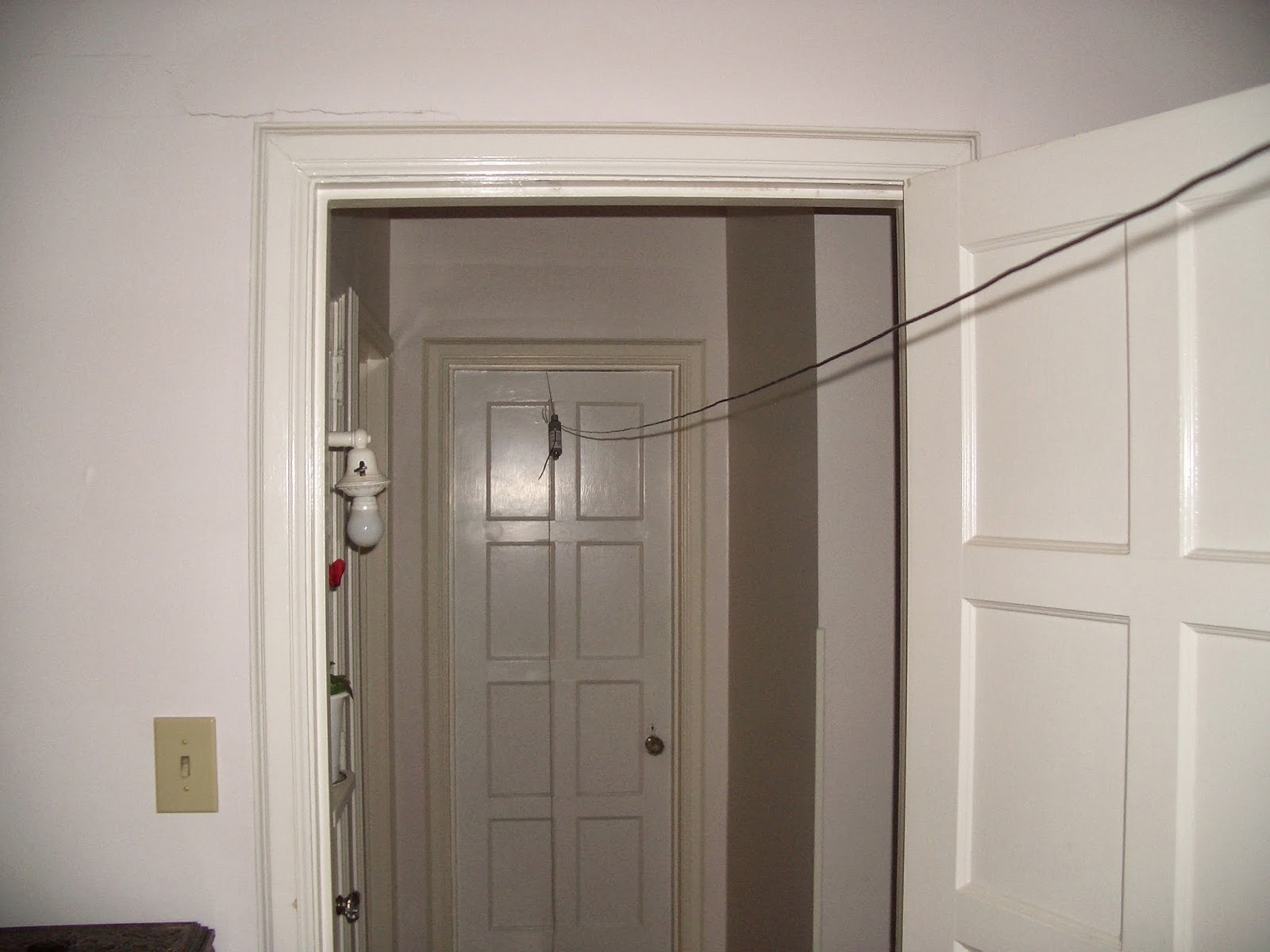
Those two antennas work well on those bands (even indoors) but the 50 foot random wire, which allows me easy access to the 17, 12, and especially the 30 meter band, were the true deciding factors in my DXCC award.
What are my immediate goals now?
There’s DXCC on a “single” band, working the “capitol cities” of every country and state, or perhaps working DXCC with “outside antennas” while operating in the field. I’m not sure what it will be now that I have the QRP DXCC award but I’m sure something will soon grab my attention.

The North American QRP CW Club has always been my favorite organization. I hope my addition of the NAQCC DXCC QRP Award will be an inspiration to those of our members who think working over a 100 different countries with five watts, or less, of power and “simple wire antennas” is impossible.
Those 17, 12, and 30 meter contacts were actually done with about 3 watts of power. Never say the word “never” when I comes to QRP. I’ve been an optimist when it comes to my QRP operations. I’m looking forward to the next challenge, whatever it might be.
John Smithson, Jr., N8ZYA, is a regular contributor to AmateurRadio.com and writes from West Virginia, USA. Contact him at [email protected].
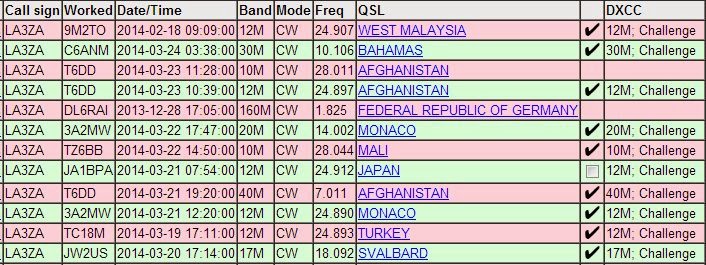
Fantastic Conditions on 10 and 12 m
Sverre Holm, LA3ZA, is a regular contributor to AmateurRadio.com and writes from Norway. Contact him at [email protected].
And again
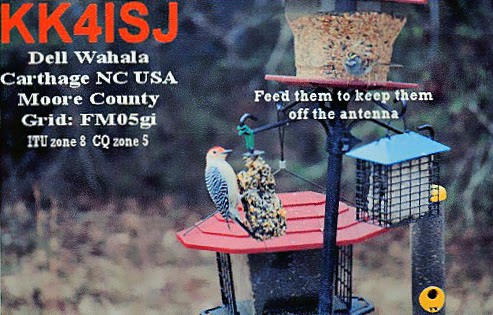
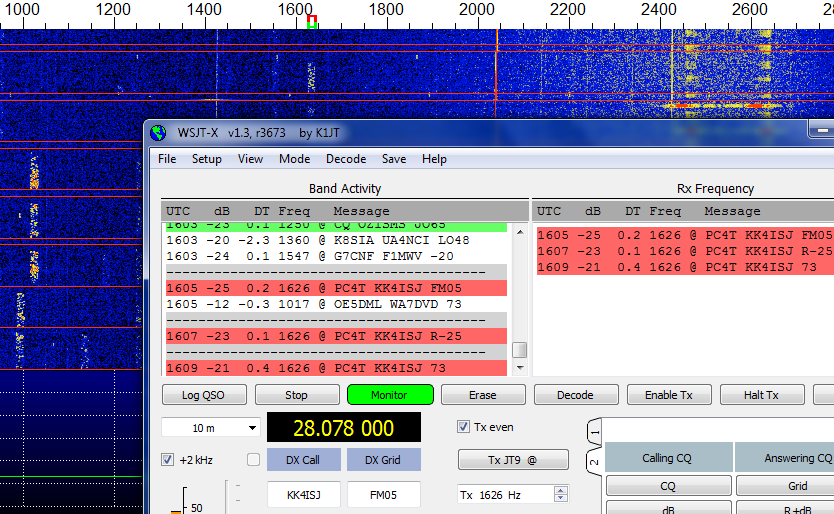
Yesterday 10 m was in a very good shape again. I made 2 qso's with 500mW JT9. First RW3TP 2537km report -13dB, second KK4ISJ 6596km report -25dB. If I told such a story 20 years ago that I made 500mW qso's over more than 6000km they will laugh at me. Yes, Joe Taylor did a great job. Today propagation is poor, but you'll never know...
Paul Stam, PC4T, is a regular contributor to AmateurRadio.com and writes from the Netherlands. Contact him at [email protected].
Two Down, Ten to Go
Yes..I know this blog update is late by several weeks. But the good news is I’m still on track to complete my 2014 QSO a Day challenge. As I write this, I’ve nearing the 90 day mark and all has been smooth sailing. Hopefully my March update will hit your blog catchers in a more timely manner.
While my total QSO count is low for February, I did manage one new DX and added the Philippians to my logbook.

The QSO breakdown for February is as follows:
Mode
Number QSO’s
JT65
34
SSB
3
PSK31
0
2m FM
0
Additional notes of interest:
DX Stations Worked in February – 1
New DX Entities in February – 1
Total QSO’s for February – 37
Total QSO’s for 2014 – 110
Total consecutive QSO days – 59
Days left in 2014 – 334
Until next time…
73 de KD0BIK (Jerry)
Jerry Taylor, KD0BIK, is a regular contributor to AmateurRadio.com and writes from Colorado, USA. He is the host of the Practical Amateur Radio Podcast. Contact him at [email protected].
The allure of DX
is a very good thing, but can be bad at times. My buddy W3BBO describes it as an “obsession” or an “addiction”. I’d have to agree with him there. Once you get your first taste and get hooked, there’s no turning back. Add QRP power to the mix and, if you’re addicted to challenges – stick a fork in you, you’re done.
The bands were alive with signals again during lunchtime today. But yet, I only worked two stations. My addiction got in the way. I worked Laci HA0NAR in Hungary, who I have worked many times before. I also worked LY10NATO, who asked me to spot him, as he was calling CQ without many takers. Being in the car, away from the Internet, I didn’t have that luxury.
My downfall came when I heard TX6G on 12 Meters. He was LOUD. 599+ loud at times. I immediately thought, “Wow! THAT loud, here’s my chance to work them QRP.”. Not today, Grasshopper, not today.
Undoubtedly, if I wasn’t so hard headed, I could have worked at least three or four more stations in my limited time allotment. However, my stubborn Polish side got the better of me, and I did a Don Quixote, and chased a windmill.
The windmill won.
72 de Larry W2LJ
QRP – When you care to send the very least!
Larry Makoski, W2LJ, is a regular contributor to AmateurRadio.com and writes from New Jersey, USA. Contact him at [email protected].
More QRP again
My daily routine, I start my day with CW on 14060 KHz. I listen for for activity. The last few days I worked OH9XX/P on 20m, I was using 5 watts. Yesterday UA2FAI, I was using 1 watt. Also worked RG3R with 1 watt but with JT9 on 10m. Of course all with the Yaesu FT817 and my end fed wire. Today we have nice spring weather. Sunny but a little cold about 1,5 C now at the moment. Yesterday also good results with WSPR into the USA with 500mW on 10m.
Paul Stam, PC4T, is a regular contributor to AmateurRadio.com and writes from the Netherlands. Contact him at [email protected].
Arduino Frequency Display for Kenwood TS-520S HF ham radio PART 3
This is PART 3 of the project “Arduino Frequency Display For a Kenwood TS-520S HF Ham Radio”. This part covers 0.9 volt 38 MHz signal amplified into Schmitt triggered NAND gate for cleanup before going to a divide by 8 ripple counter chip then finally being cleanly counted by the Arduino using multiply by 8 math function to restore counts to 38 MHz. All parts: (PART 4), (PART 3), (PART 2), (PART 1)
Thanks for joining!
Todd Harrison, KF7NBI, is a regular contributor to AmateurRadio.com and writes from Arizona, USA.
 Ham Radio Deluxe |
 W5SWL Electronics |
 Ham Radio Prep |
 KB3IFH QSL Cards  Hip Ham Shirts  HamRadioAuctions HamRadioAuctions Reliance Antennas Reliance Antennas Enigma Shop Enigma Shop |  morseDX  Ni4L Antennas  R&L Electronics R&L Electronics antennas.us antennas.us QRV QRV |
- Matt W1MST, Managing Editor
