 |
 And here I thought it was me!
 12 April 2014 | by
 To say it is a beautiful day in New Jersey today is in understatement. The sun is shining, and the temperatures are in the upper 60s (20C). The breeze (if there is any) is so gentle that you don’t even notice it. So I decided that after grocery shopping, but before other chores, that I would sneak off to the park and try out the EARCHI antenna. I built the 9:1 UNUN late last Autumn and didn’t get a chance to try it out.

So it ends up that today was not the day to base a critical performance review on, I will have to wait for another weekend with decent weather and better band conditions for another test. In the meantime, I will also browse the Internet to see if I can garner more information on optimal radiator lengths for use with a 9:1 UNUN.
72 de Larry W2LJ
QRP – When you care to send the very least!
Larry Makoski, W2LJ, is a regular contributor to AmateurRadio.com and writes from New Jersey, USA. Contact him at [email protected].
AmateurLogic Live Stream
AmateurLogic.TV will be streaming live tonight at 7:00 PM CDT. Special guest Randy Hall, K7AGE. Plus Tommy and George’s revenge for the Vegemite incident and more.

The live stream has completed now. Thanks to all who joined us. Look for it to be posted in the next day or so.
George Thomas, W5JDX, is co-host of AmateurLogic.TV, an original amateur radio video program hosted by George Thomas (W5JDX), Tommy Martin (N5ZNO), Peter Berrett (VK3PB), and Emile Diodene (KE5QKR). Contact him at [email protected].
More on FO-29 and VO-52 operation with the V2000 vertical
A little later FO-29 was due over and I wondered if I might be able to hear anything. The pass was quite quiet, but I did hear my Twitter friend, Berend, PA3ARK on CW. I was able to find my signal and place it reasonably close to Berend’s and we had a bit of a sketchy, but valid QSO.
Really pleasing to find that some simple CW satellite operation is viable with just a vertical antenna.
Berend sent a nice photo of the entry of the QSO in his logbook!
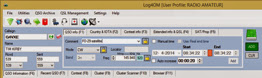
Evening update: I caught a late afternoon pass of VO-52 and was hearing myself well enough to have a tune around and was able to answer UT3UX who was calling CQ on CW and work him. I’ve not found too much CW activity so far. I’m sure I can work some SSB, but with the slightly lower signal levels, CW gives a bit more latitude!
Tim Kirby, G4VXE, is a regular contributor to AmateurRadio.com and writes from Oxfordshire, England. Contact him at [email protected].
Wouxun KG-UV8D: Hands-on review

I had the opportunity this afternoon to be one of the very first people to go hands-on with the new dual-band Wouxun KG-UV8D HT courtesy of Danny at BuyTwoWayRadios.com. What’s the verdict? I’m impressed!
VHF/VHF dual receive — for the win! This is a great feature and, at least for me, one of the most compelling reasons to upgrade to this radio. It mixes the audio from the two frequencies so you won’t miss anything. Great feature for EmComm, especially. I personally don’t have a great need for cross-band repeat, but that’s just icing on the cake.
-

- Speaker/mic jacks are well protected
-

- PTT and various function buttons are easy to tell apart by feel
-

- Standard Wouxun keyboard layout
The text on the color screen is so much easier to read than on previous Wouxuns. There’s about twice the screen real estate and it makes the radio much more usable. Although I didn’t get a chance to play with every feature of the KG-UV8D, I can honestly say that this radio seems to be much easier to program from the keypad. I think that larger screen helps a lot. For the first time, I feel that I could field program one of these without the manual. Trust me, that’s saying something!

The radio seems slightly narrower and thinner than previous versions. This is a definite step up and it improves the ergonomics of the radio. The PTT button is large and segmented in a way that makes it hard to mistake it for a function button as with the KG-UV3D. The programmable buttons under the PTT are also cool. You can program it to activate the FM radio or to start scanning, for example. Very easy to customize.
-

- I like the recessed battery eject button
-

- Slim profile battery
-

- Chassis backplate
The battery is different which is a little disappointing for those of us who have a collection of older Wouxun batteries, but I like the changes they’ve made to the way it slides on and off the chassis.
The rubber ducky antenna they include is OK, but for me a Smiley 270A would replace it in short order. And speaking of antennas, why can’t Wouxun figure out if they want to use SMA-male or SMA-female on these radios? I think we can all agree that they should just standardize on one or the other. This radio has a SMA-female connector while my KG-UV3D is SMA-male.
I’ve fallen in love with this little radio and I’ve only had it a few hours. When they begin shipping in a couple weeks, I will definitely be ordering one. While there aren’t really any must-have new features (except dual-receive), the radio just feels much more refined than other radios I’ve used that are anywhere near this price point.
Whether you’re a brand new ham looking for your first rig or you’ve been at this game for decades, you can’t go wrong with this $139 radio.
Update 4/28/2014:
If you click through to BuyTwoWayRadios.com, you will notice that the final price of this radio is now $159. If you order this radio, don’t forget to use the coupon code 139UV8D to get the original $139 price! Not sure how long this coupon code will remain active. Your mileage may vary.
Matt Thomas, W1MST, is the managing editor of AmateurRadio.com. Contact him at [email protected].
W1AW/Ø is coming to Colorado
Mark your calendars, the ARRL Centennial QSO Party will make a stop in the Centennial State of Colorado in May. The dates are 21-27 May and yours truly has signed up to represent Colorado in this incredible event.
I’m sure by now you’ve already heard about the ARRL Centennial QSO Party and hopefully you’ve already been busy making contacts. I’m slightly behind schedule, but thankfully each of the 50 states will be on the air twice during the calendar year. My goal is to work them all.
When I first learned of the opportunity to represent Colorado in this event I knew I wanted to sign up for a operating slot or two. While my station is a small pistol in the world of high power contest stations, I’m still excited to put the Centennial State of Colorado on the air from my home QTH during the ARRL Centennial QSO Party.
Currently my on-air timeslots are 22 May (00:00 – 03:00 z) 20m Phone and 25 May (15:00 – 18:00 z) 20m Phone. You can learn more about this year long event by visiting the ARRL Centennial QSO Party website.
I may sign up for additional timeslots if the need requires. As we get closer to the event date, I’ll be sure to post a reminder. You can also follow me on Twitter and Facebook where I’ll post real time information on where you can find me on the bands.
Until next time…
73 de KDØBIK
Jerry Taylor, KD0BIK, is a regular contributor to AmateurRadio.com and writes from Colorado, USA. He is the host of the Practical Amateur Radio Podcast. Contact him at [email protected].
QRSS v3 kit
Before the decking project was formally sanctioned and actioned through the domestic funding board / xyl I had thought about ordering a little kit to build over the summer. I had built the v2 QRSS kit from Hans Summers, G0UPL and have used it on the 30m band and frankly enjoyed both the built and the fun tinkering with it.
The v3 kit changes the design slightly in as much as it used a more common 16×2 LCD and the PCB size as increased slightly. But from what I can tell there is a deal of difference between the two designs. Both encourage the builder to tinker with the PA’s, increase functionality with GPS and use the add on LPF relay to build a multi band TX. The one big and obvious change is the used of the dedicated DDS.
Plans for this kit are to still do the build and then buy up 10 kits and build them at the BEC fab lab one Saturday. I will no doubt get a suitable date for the build day at next weeks club meeting. Until then its finish the decking or be in trouble with the domestic CEO.
Alex Hill, G7KSE, is a regular contributor to AmateurRadio.com and writes from Cumbria, UK. Contact him at [email protected].
Ham Radio and Fitness
There are notable exceptions, within the hobby, that will get you out. Expeditioning, fox hunting (outside), Summits on the Air and I'm sure there are a few others. In fact, and I may be a little biased, I think that the SOTA Goat award is one of the toughest awards in amateur radio. The SOTA Goat is an activator award, you must earn 1,000 activator points with the highest value summit worth 10 points. There are some bonus points available during extreme weather conditions, but suffice it to say you will have to summit at least 100 peaks and operate to earn the award. Normally it takes several years to earn this award and you have to do it on your feet.
However, if you aren't into Summits or other outdoor forms of radio there is device that you can wear on your wrist to motivate you to get up and around. These devices count your steps in a day and depending on the device will nudge you to get up when you have been sitting too long. All of these devices have accompanying apps that will sync with the device to give you statistics on your day including steps and the quality of your sleep. I currently use a device made by Jawbone and although I have a somewhat regular exercise regimen, it reminds and motivates me to keep it up. An extra walk around the block or around the office, if done regularly can make a difference in your overall fitness.
I blogged here several months back about the backpacker mentality of saving ounces in our packs while we were carrying extra pounds on our bodies. Since that blog I have lost ten pounds and signficantly improved my stamina. The higher fitness level we can achieve improves our odds to live long enough to achieve some of our sedentary goals.
Mike Crownover, AD5A, is a regular contributor to AmateurRadio.com and writes from Texas, USA. Contact him at [email protected].
 Ham Radio Deluxe |
 W5SWL Electronics |
 Ham Radio Prep |
 KB3IFH QSL Cards  Hip Ham Shirts  HamRadioAuctions HamRadioAuctions Reliance Antennas Reliance Antennas Enigma Shop Enigma Shop |  morseDX  Ni4L Antennas  R&L Electronics R&L Electronics antennas.us antennas.us QRV QRV |
- Matt W1MST, Managing Editor
