 |
 QRPttF 2014
 4 May 2014 | by
 Today was QRP to the Field for 2014, and it was also my birthday. What a present! Although I didn’t get to spend anywhere near as much time on the air as I would have liked, I got a little air time in and that’s always a good thing.
The theme for today was Tres de Mayo in honor of Cinco de Mayo. Well, here in New Jersey there really aren’t an abundance of locales with a Mexican flair. So I got a little creative.
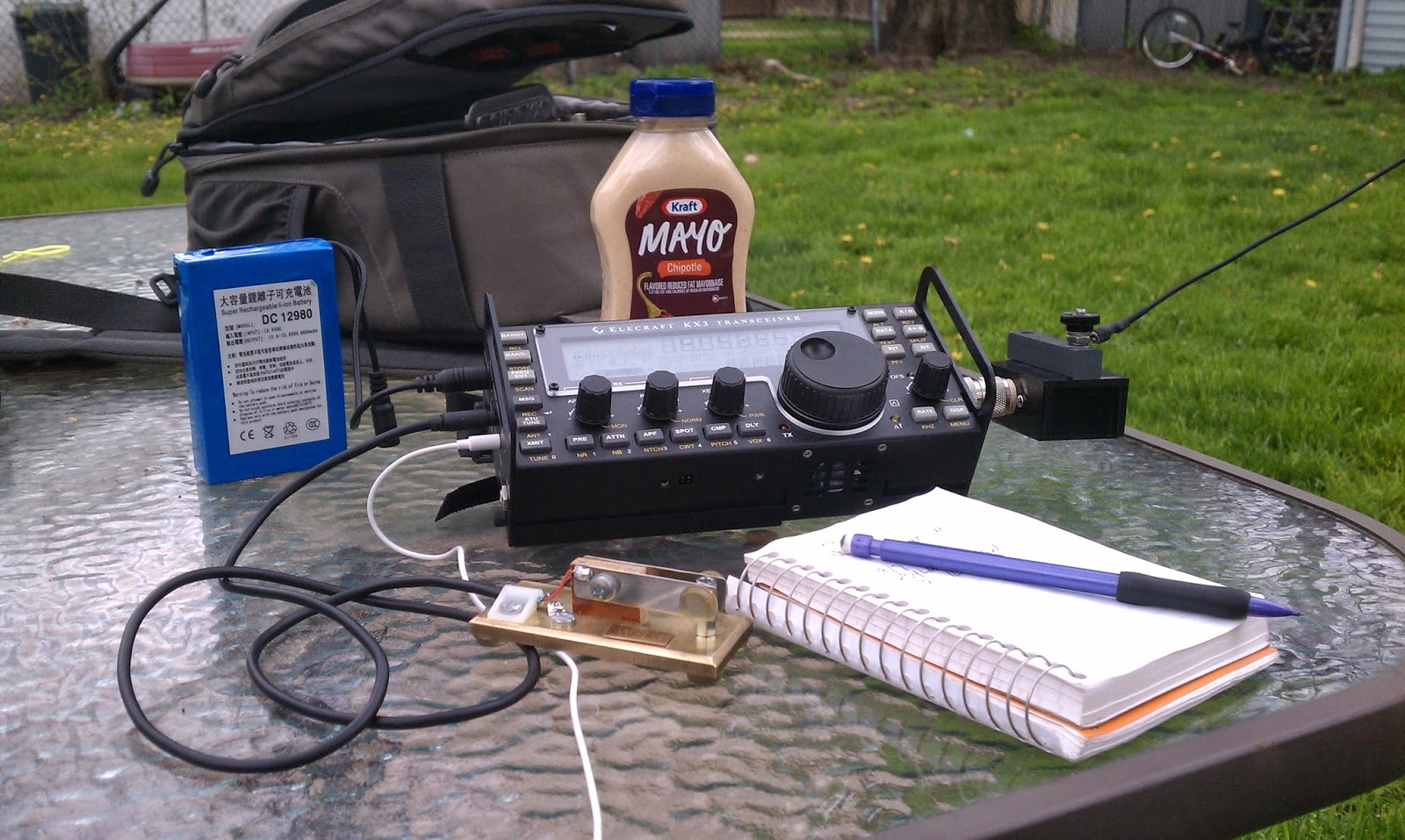
Yes, I placed some Chipotle Mayo next to me while I operated.
I got to experiment a bit too. I used both my Par EndFedz and the EARCHI 9:1 Unun with a 36 foot radiator. The Par EndFedz performed as expected. The EARCHI performed much better than last time. The extra three feet of wire made a big difference. The KX3 handled the wire well on all bands, 40 through 10 Meters with minimal clicking and clacking from the auto tuner.
In the hour or so of operating time that I got in, I worked about a dozen or so stations. Included were some very familiar calls like Mert W0UFO, Jerry N9AW, Rick NK9G, Dave AB9CA, Gene N5GW and Kelly K4UPG among others.
So even though I didn’t get a lot of operating time in, I did learn more about the EARCHI end fed. I think it will serve well as an all around multi band antenna for portable ops.
72 de Larry W2LJ
QRP – When you care to send the very least!
Larry Makoski, W2LJ, is a regular contributor to AmateurRadio.com and writes from New Jersey, USA. Contact him at [email protected].
Series Seven Episode Nine – Questions Anwsered & Repair Tips (4 May 2014)
Series Seven Episode Nine of the ICQ Amateur / Ham Radio Podcast has been released. The latest news, Martin (M1MRB) and Colin (M6BOY) discuss Anonymous use of Ham Radio, Ed Durrant (DD5LP formerly VK2JI) joins us with his first report since moving to Germany and Martin (M1MRB) answers questions and gives repairs tips.
- Ofcom active in Somerset
- Coalhouse Fort Easter Activation
- 4m addition to Mt. Leinster repeater
- 16 New England communities to host International RadioSport competition
- ICASA awards long-term 5MHz license to SARL
- SARL 5MHz Activity Weekend
- AM Broadcasters and Radio Hams have common interest
Colin Butler, M6BOY, is the host of the ICQ Podcast, a weekly radio show about Amateur Radio. Contact him at [email protected].
Texas SOTA Trip – The Law of Averages
As I have written here recently, the SOTA program recently added 40+ one point summits in South Texas. These summits are within a reasonable drive for me, so I was enthusiastic to activate them and after all, they are all one pointers, they should be easy enough. Just as a reminder for those who haven't caught the SOTA virus yet, point values range from 1 - 10. Oddly enough, 1 is the only odd number used in the valuation scale. Summits can be worth 1,2,4,6,8 or 10 points. Don't ask, I have no idea.
I've already activated Peak 2002, which was the first South Texas group summit activation. I ended up walking 8 miles for that point. Not to worry though, they can't all be that long. So in the spirit of adventure (and not point accumulation), I planned to activate two of these summits during the International SOTA day and the QRP to the field (QRPTTF) events. My two targets were Bullhead Mountain, W5T/ST-007, and Pikes Peak, W5T/ST-029. Yes there is a Pikes Peak in Texas. The one in Colorado is worth 10 points, the Texas version is worth, the aforementioned, one point.
I'd done my research and determined that there was a better than even chance these summits would be accessible. While on private land, these peaks are in sparsely populated areas that likely aren't posted. However you never know until you get there.
Bullhead Mountain, W5T/ST-007, is a limestone peak north of Vance (formerly Bullhead) and the intersection of Farm roads 335 and 2631 in far western Real County (at 29°49' N, 100°00' W). The summit, at an elevation of 2,042 feet above sea level, rises on the southern edge of the Edwards Plateau. Local vegetation includes open stands of live oak, Ashe juniper, and mesquite on the uplands and ridges and live oak and Ashe juniper woods on the hills and escarpments.
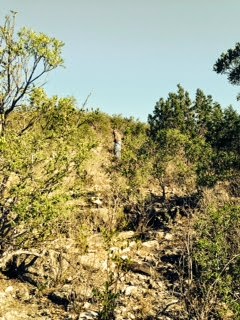 |
| The Trail up Bullhead, One of more open areas |
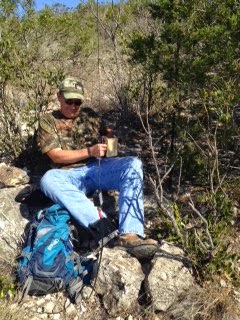 |
| Operating from Bullhead Mountain |
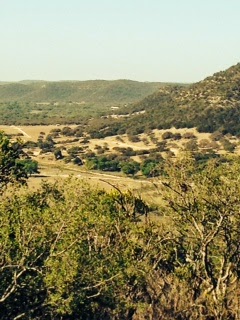 |
| View from Bullhead Mountain |
The bands were a little finicky. Only made QSO's on 20 meters. Nothing on 12m despite the RBN hearing me at PJ2T.
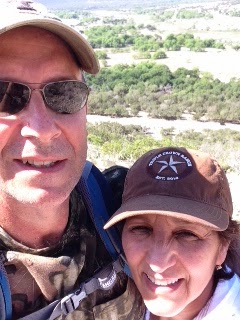 |
| Cris and I. Our Jeep is the black speck on the road |
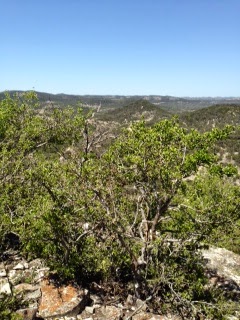 |
| View from Pikes Peak |
This summit was every bit as tough a Bullhead. There is a road that goes over the shoulder of the mountain which means you only have to climb 300 feet in about 1/3 of a mile. Again, that's steep and again no trails. I operated from the very top of the summit. A nice breeze cooled us down for the now 85F temperatures.
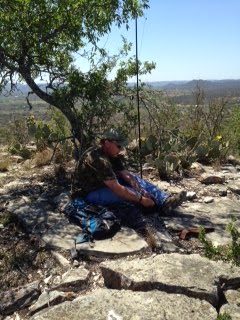 |
| Operating from the Summit of Pikes Peak, Texas |
We had contemplated doing Wildcat Peak also. Another one pointer, not too far from Pikes Peak, however, we were tired. These ascents and descents were taxing because of the steepness and the full time bushwhacking through brush and the temperatures were warming up. My thermometer in my jeep read 90F when we got down. We had a nice Texas lunch in Camp Wood. A lunch buffet with Mexican food and Chicken Fried Steak. It doesn't get much better than that.:-)
 |
| Cactus Flowers |
 |
| Texas Mountain Fauna |
So, what about this Law of Averages? Well, in the SOTA world there are some easy summits. Some you can even drive up to the summit or park near the top and take a nice trail a few yards to the summit. I have felt a little guilty about that in the past, getting so many points for so little effort, but no more. The Law of Averages does apply to SOTA. These one pointers were intense, difficult mountains to do. However, I suppose it all averages out. After doing these mountains, my guilt in doing an easy one has disappeared:-)
Photo credits to my XYL Cris, KC5HZQ
Excerpts above were taken from the Texas State Historical Association.
Mike Crownover, AD5A, is a regular contributor to AmateurRadio.com and writes from Texas, USA. Contact him at [email protected].
Practical Wireless with the LM386 unleashed

“Improving the LM386 Audio Amplifier” is the title of always inspiring Rev. George Dobbs G3RJV’s column in this month’s Practical Wireless. George talks about the basic amplifier with a voltage gain of 20 (26 dB) and how it is straight forward to increase gain to any value up to 200 (46 dB). The article then shows how it can be built dead-bug style.
Then he goes on to talk about various ways to improve the circuit such as for hiss reduction and even higher gain. In that connection he also mentions my article “Unleashing the LM386” from SPRAT in the Autumn of 2003. That circuit was an enhanced version of the high-gain circuit of Kazuhiro Sunamura JF1OZL. Basically it increases the gain to up to more than 70 dB, enough for it to drive a loudspeaker. My circuit also adds bandpass filtering. All this is achieved by adding only 5 passive components to the basic amplifier. The circuit was recently revisited in SPRAT by Johnny Appel SM7UCZ. He added a 40 dB Darlington pair preamplifier for even further gain.
The bandpass filtering (not low pass as the article says) is due to the series resonance of 100 uF and 1 mH which happens at about 500 Hz making it a nice CW filter.
It was good to see my article revisited as I think the idea deserves to be better known and to be considered in more LM386 amplifier circuits. The same goes for the improved muting circuit of the LM386 using pin 7. I developed both in the period when I was interested in minimal transceivers like the Pixie 2 and in true QRP spirit was interested in how to achieve much with as few as possible components.
One thing which is not mentioned in Practical Wireless is that the circuit may be used in such a way that it really squeezes out every grain of amplification of the poor little LM386, so the warning I wrote when I wrote an introduction to “Unleashing the LM386” for the blog (see link below) is worth repeating:
One word of warning is prudent here. As the 200 ohm pot approaches zero ohms, the amplification becomes so large that the series resistance of the 1 mH inductor and the ESR (equivalent series resistance) of the 100 uF capacitor in combination with the open loop gain of the LM386 will determine gain. Some of these values are unspecified for standard components and may vary a lot. Therefore such a setting is not recommended for use in mass-produced circuits. However for a hobbyist’s one-of-kind circuit it should be fine.
A poor copy of the last of the three pages of the Practical Wireless article, where the high gain options are discussed, is shown.
See also:
- Unleashing the LM386, introduction to article in SPRAT, No 116 (Autumn 2003)
- Using pin 7 of the LM386 to reduce BCI and add side tone to Pixie 2, based on article in SPRAT, No 113 (Winter 2002)
Sverre Holm, LA3ZA, is a regular contributor to AmateurRadio.com and writes from Norway. Contact him at [email protected].
FabLab first
After some cautious first steps my first laser cut parts have been made. The case for the clubs upcoming WSPR kit build prototype has been, well, lasered.

There’s a couple of minor points to address but for a first effort I’m pretty pleased.
The idea was to cut for a single sheet a ‘desktop’ case for the U3 WSPR transmitter that could display a callsign or something similar on the front as a customisation as well as being simple and space efficient. Yep, you can buy a case but its quite nice to be able to make one in Cumbria rather than China. I should be able to get 4 and a half of them out of a single 300mmx600mm sheet.
All I have to do now is fix the faults and make it right next time.
Alex Hill, G7KSE, is a regular contributor to AmateurRadio.com and writes from Cumbria, UK. Contact him at [email protected].
KX3 Heat Sink
If you operate your Elecraft KX3 in a portable environment (and perhaps even if you don’t) there are a few must-have add-ons which really help protect your KX3. You are probably already aware of the popular KX3 KX Endplates and KX Cover available from Scott, AK6Q and his Gems Products website. I received both as a Christmas present from my darling wife and love what they do for my KX3.
In addition to operating SSB phone via my KX3 on SOTA activations, I also enjoy grabbing my Buddipole a battery and heading outdoors for some picnic table portable operations in a park or really just about anywhere. In this setting I typically bring along my laptop and operate PSK-31 or JT-65. However, one thing I’ve noticed (and have been concerned about) is how the KX3 has the potential to heat up when running these digital modes (even at 5w or less). This is especially evident in the warmer months of the year.
A few weeks ago I was browsing the KX3 Facebook page and learned about an add-on heat sink designed, built and sold by a fellow ham in Canada. This OM’s name is Fred Meier, VE7fmn. I contacted Fred via email and he quickly provided a detailed response on how he designed his KX3 heat sink and provided cost and availability information. While I did find one other heat sink being marketed for the KX3, I believe Fred’s version is more effective at dissipating the heat from the KX3 and it looks great while doing it.
Here’s what Fred’s KX3 heat sink looks like installed on my KX3.


Fred’s KX3 heat sink is well built and designed to be durable. The fins on the heat sink are not going to bend or break off and only adds an additional 8 ounces of weight to the KX3.
I’ve conducted a few tests while in the shack and had the KX3 running PSK-31 and JT-65 at 10w and never received the overheat warning. I couldn’t run above 5 watts inside or outside the shack without the heat sink installed. I’ve yet to test the KX3 with heat sink installed outside in a portable setting, but I’m confident I will not have any issues. If you would care to read another review of VE7fmn’s heat sink, please go here.
As I’ve stated, I love operating portable with my KX3 and I’m Happy, Happy, Happy to have this wonderful add-on to help keep my KX3 Cool, Cool, Cool.
Until next time…
73,
Jerry
Jerry Taylor, KD0BIK, is a regular contributor to AmateurRadio.com and writes from Colorado, USA. He is the host of the Practical Amateur Radio Podcast. Contact him at [email protected].
Amateur Radio Newsline Report 1916 May 2 2014
- Coconino County Arizona bans mobile ham radio
- UK regulator Ofcom proposes new CB rules and more
- Hams in India help with recent elections
- Florida man hit with a $48,000 NAL for alleged cellphone jamming
- Ham Nation to go live from the Dayton Hamvention
- Time to select USA's team for the World ARDF Championships
 Ham Radio Deluxe |
 W5SWL Electronics |
 Ham Radio Prep |
 KB3IFH QSL Cards  Hip Ham Shirts  HamRadioAuctions HamRadioAuctions Reliance Antennas Reliance Antennas Enigma Shop Enigma Shop |  morseDX  Ni4L Antennas  R&L Electronics R&L Electronics antennas.us antennas.us QRV QRV |
- Matt W1MST, Managing Editor
