 |
 Music and Mountains
 29 May 2014 | by
 Memorial Day Weekend is therefore a Holiday weekend that finds many of us enjoying a three day weekend. The weekend was busy and memorable one for me. The weekend began with a 300 mile drive to play a show with my band, The No Refund Band, at a venue in Crystal Beach, TX. Crystal Beach is on the Bolivar Peninsula, east of Galveston Island on the Texas Coast. We had a great show there. (You can check out my band at norefundband.com )
The next morning (Sunday), my XYL Cris and I got in the Jeep and headed to the Ouachita Mountains in Oklahoma. This would be a 430 mile drive with the purpose of getting as many SOTA points as possible. The drive from Houston was very nice. North of Houston you take Hwy. 19 which goes through the piney woods of east Texas. Of course Texas is a big state and on this highway alone I went through Palestine, Athens, Canton and Paris. The road is nice and the speed limit is 70 - 75 mph and the traffic was light. As long drives go, this one wasn't bad.
The Ouachita Mountains cover southeastern Oklahoma and west central Arkansas. Along with the Ozark Mountains, the Ouachita Mountains form the U.S Interior Highlands, one of the major mountainous regions between the Rocky Mountains and the Appalachian Mountains. It is a beautiful area that is very green and lush with mountains and valleys that induce tranquility.
From a SOTA perspective I had done my research to find the most efficient route to accumulate the most points in relatively short amount of time. I had to be backon Tuesday for work, so I would have 24 hours get as many points as possible.
Sycamore Lookout W5O/OU-005 (8 pts)*
We arrived 20:15 UTC. The summit has easy access from the highway and I was QRV by 20:35. I set up next to the commercial antenna's with no RF issues. The bands were not in good shape and the WPX contest was in full swing. I made 10 QSO's in 25 minutes on 17 and 40 meters and decided to move on to the next one.
Peak 2210 W5O/OU-006 (8pts)*
This summit is just up the road a few miles and the highway is in the activation zone. I did ascend about 50 feet vertically to the summit. I set up just below the summit ridge. Unfortunately, the cell service was spotty and I wasn't able to spot myself. For some reason I wasn't picked up by the RBN network either. Consequently I called CQ for 10 minutes on 17m with no responses. I finally had cell service long enough to get a call off to Fred, KT5X, to ask him to spot me. It still took me 10 minutes after the spot to get my 4 QSO's. Conditions were not good.
Winding Stair Mountain W5O/OU-002 (10 pts)*
Winding Stair Mountain is a nice hike. The trail head is across the road from the Campground and the hike is about 3 miles roundtrip. We encountered a troop of Boy Scouts training for their upcoming 68 mile trek at the Philmont Scout Ranch in New Mexico. Conditions were only marginally better, I made 11 QSO's in 25 minutes.
After this summit we made out way to the Green Country Inn in Heavener, Oklahoma where we had a room. The hotel is a great place to stay if you find yourself in the area. The next morning began early to make sure we got to the summits we planned.
Lynn Mountain W5O/OU-001 (10 pts)*
Getting to this summit is best done with a 4WD vehicle. While a 2WD would make it most days, a 4WD is preferred. The road does enter the activation zone, but I took an ATV trail for the short walk to the summit. This summit is very green and overgrown so I operated from the trail. The weather was overcast and as I left the Jeep it started to rain. We were prepared with rain gear and umbrellas to provide a mini-shack on the summit. There was a light rain during the entire activation. Conditions were a little better and, since the WPX contest was over, 20m was available again. I was on the air at 1335 UTC, so I think I was a little early for propagation and some late rising operators. I made 12 QSO's on 20m and 40m.
Pigeon Benchmark W5O/OU-013 (10 pts)*
This summit is off the same road as Lynn Mountain. The hike to the activation zone is a 2 mile round trip. The trail to the summit is an overgrown ATV trail. The walking is easy with about a 220 foot elevation gain over the mile to the top. The grass on the trail is knee high and it was wet from the rain, so it was a very wet hike. Conditions were much better as I was QRV at 1510 and made 20 QSO's on 20 and 40 meters.
Rough Mountain W5O/OU-014 (8 pts) *
The road to this trail head requires a 4WD. The road crosses the Ouachita trail a about a mile in from Hwy. 259. This is nice 2.5 mile round trip hike with about 500 ft. elevation gain over the 1.25 miles to the summit. The trail is nice. I made 22 QSO's from here.
*Additional details on how to get to these summits can be found on the SotaWatch page for each summit
So there you have it, 54 SOTA points in 24 hours. We had a 500 mile drive home that we made in about 8 hours. So in total we traveled 1,200 plus miles to enjoy music and mountains to make memorable Memorial Day weekend.
A short highlight video can be found here:
https://www.youtube.com/watch?v=NZhGh-XATJ0
Mike Crownover, AD5A, is a regular contributor to AmateurRadio.com and writes from Texas, USA. Contact him at [email protected].
Homebrew Buddipole
In a couple earlier posts, I wrote about making a homebrew Buddistick using Budd Drummand’s (W3FF) plans. His plans can be found on his page located here: https://sites.google.com/site/w3ffhomepage/.
I knew when I started building my station that I wanted a couple of portable antennas. I like making things, and decided to give his antennas a shot after deciding that I might be able to actually make an antenna that worked following Budd’s directions. I made the Buddistick first, then later made the Buddipole. Both are easy to make and work well. I use them both (not at the same time) for my main antenna right now, until I can get a full size dipole hung up, and coax run to the house etc. I am fairly new to the HF world and I don’t have my home station complete yet, so these antenna were a quick and easy way for me to get started on HF.

Pictured first are the components of the Buddipole. Starting at the top-left are the two 20 meter coils. To the right, the shorter coil set is for 15 and 17 meters. To their right is the “T” component for mounting the antenna on a painters pole. The black adapter changes the threads from PVC to the painters pole. In the middle are the two antenna whips, mounted in some CPVC with speaker wire coming out of the ends allowing for connections to be made to the whips. The bottom two pieces are CPVC arms with speaker wire running through them, and connectors.
The following picture shows the Buddipole set up with the painters pole extended. The length of the extended painters pole in this picture is about 10 ft.

The plans that Budd published has the coax line ending with the spade connectors. I bought a piece of 50ft coax with PL-259’s installed already on both ends and I did not want to cut one of them off, so I made the following adapter. It is simply a small project box from Radio Shack, with a SO-239 mounted in it and speaker wires connected to the SO-239 center and ground. The orange line is old fly fishing line for hanging the box from the antenna. I use a velcro strip for this.

Here is a table that I made showing how I setup the antenna and the resulting SWR measurements. I think the higher SWR on 20 and 6 meters is due to the proximity of the metal eve troughs that the antenna is near with extended. If I orient the antenna parallel to the gutter, the SWR goes up. My house sits approx SW-NE so pointing the red end of the antenna North puts it at about 45 degrees to the gutter and the SWR goes down. This is the most convenient place to set up the antenna within reach of the radio inside allowing for the 50ft run of coax. The whip column is how many additional sections of the whip I need to extend not counting the 1 section length it is with all the sections pushed in. I think if I got this away from the house a few more feet, the SWR would come down on 20 & 6m.
| Band | Coil | Red Whip | Black Whip | Res Freq | Min SWR | Height | Red Orientation |
| 20M | 20M | 3 + 10 in | 5 | 14.175 | 1.5 | 12 | N |
| 17M | 15/17 | 3 + 1.25 in | 5 | 18.127 | 1.06 | 12 | N |
| 15M | 15/17 | 2 + 2 in | 3 | 21.250 | 1.24 | 12 | N |
| 10M | none | 4 + 5 in | 4 | 28.850 | 1.19 | 12 | N |
| 6M | none | 0 + 4.375 in | 0 | 51.850 | 1.2 | 12 | N |
I have made SSB and PSK31 contacts on 20, 17, & 15 meters. I have not made contacts yet on 10 or 6. Someday I’ll do that.
Below are the graphs from my antenna analyzer showing the antenna setup for each band in the table above.
20 Meter

17 Meter

15 Meter

6 Meter

Overall I am happy with the antenna. I don’t expect it to work like a full size dipole, but for the ease of setup and take down, it’s working for me. I have talked to South America, Europe and all over the US with both the home-brew Buddistick and Buddipoles.
My email address is on my QRZ.com profile. If anyone has questions, I’ll be glad to respond to any email.


Wayne Patton, K5UNX, is a regular contributor to AmateurRadio.com and writes from Arkansas, USA. Contact him at [email protected].
ALTV Episode 67 stream
Who’s up for some AmateurLogic.TV streaming Thursday evening. Tommy and George will be putting the Dayton Episode together. Begins around 6PM CDT, 2300 UTC.
The show won’t be released until next month, but you can get an advanced viewing as we put it together.
The stream is live now. Watch it here live:
Chat room is at www.amateurlogic.tv/chat
George Thomas, W5JDX, is co-host of AmateurLogic.TV, an original amateur radio video program hosted by George Thomas (W5JDX), Tommy Martin (N5ZNO), Peter Berrett (VK3PB), and Emile Diodene (KE5QKR). Contact him at [email protected].
Time to play with GPS and Arduino
I’ve always enjoyed playing about with time. Accurate time is not really a fascination but I do like a clock to tell the time. The MSF 60khz time signal is one source and I have played about with that system with an Arduino and it works well, when there is a good signal for a whole minute. GPS time has always been a bit of a thing for me because you can set it to UTC and it’ll always show UTC and frankly there are a lot more libraries available to play with. GPS Tiny & GPS Tiny+ are two of those and this evening I ‘forked’ a sketch to use a cheapo off the shelf gps module to tell the time and date on a 16×2 LCD. Nothing spectacular but hey if I can do it then so can anyone. Here’s a short sweet video of it in action (near the window!)
sketch goes a little like this
#include <TinyGPS++.h>
#include <SoftwareSerial.h>
#include <LiquidCrystal.h>
/*
This sample sketch demonstrates the normal use of a TinyGPS++ (TinyGPSPlus) object.
It requires the use of SoftwareSerial, and assumes that you have a
4800-baud serial GPS device hooked up on pins 8(rx) and 9(tx).
*/
static const int RXPin = 8, TXPin = 9;
static const uint32_t GPSBaud = 9600;
// The TinyGPS++ object
TinyGPSPlus gps;
// The serial connection to the GPS device
SoftwareSerial ss(RXPin, TXPin);
// initialize the library with the numbers of the interface pins
LiquidCrystal lcd(12, 11, 5, 4, 3, 2);
void setup()
{
ss.begin(GPSBaud);
lcd.begin(16,2);
lcd.setCursor(1,0);
lcd.print("Tiny GPS+ Time");
delay(3000);
lcd.setCursor(1,2);
lcd.print("by Alex, g7kse");
delay(5000);
lcd.clear();
}
void loop()
{
// This sketch displays information every time a new sentence is correctly encoded.
while (ss.available() > 0)
if (gps.encode(ss.read()))
displayInfo();
if (millis() > 5000 && gps.charsProcessed() < 10)
{
lcd.print("No GPS detected");
for (int positionCounter = 0; positionCounter < 20; positionCounter++) {
while(true);
}
}
}
void displayInfo()
{
lcd.setCursor(4,0);
{
if (gps.time.hour() < 10) lcd.print(F("0"));
lcd.print(gps.time.hour());
lcd.print(F(":"));
if (gps.time.minute() < 10) lcd.print(F("0"));
lcd.print(gps.time.minute());
lcd.print(F(":"));
if (gps.time.second() < 10) lcd.print(F("0"));
lcd.print(gps.time.second());
}
lcd.setCursor(3,2);
{
if (gps.date.day() < 10) lcd.print(F("0"));
lcd.print(gps.date.day());
lcd.print(F("/"));
if (gps.date.month() < 10) lcd.print(F("0"));
lcd.print(gps.date.month());
lcd.print(F("/"));
lcd.print(gps.date.year());
}
}
Alex Hill, G7KSE, is a regular contributor to AmateurRadio.com and writes from Cumbria, UK. Contact him at [email protected].
80 meter WSPR
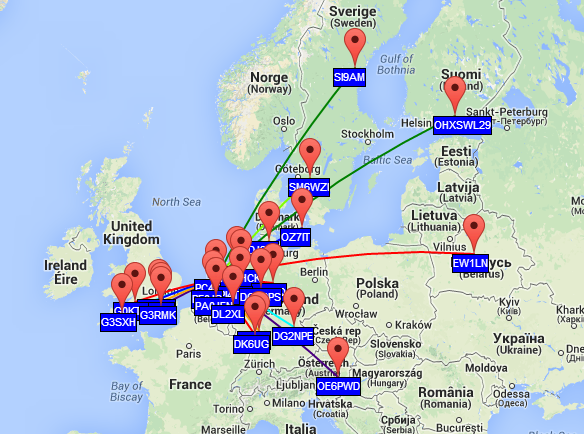
Paul Stam, PC4T, is a regular contributor to AmateurRadio.com and writes from the Netherlands. Contact him at [email protected].
KDØBIK operating as W1AW/Ø
Colorado’s first week to host the W1AW/Ø portable station in celebration of the ARRL Centennial events has come and gone. This particular week was a busy week for me both at work and in the hobby of amateur radio. In addition to working two shifts operating W1AW/Ø, I also presented the Summits on the Air program presentation to two area amateur radio clubs. Yes…I also managed to keep my streak of at least one QSO a day alive.
As Colorado began hosting the W1AW/Ø portable operations, we also fell right into the middle of a weather pattern which almost like clockwork the heavy storms would roll into the Denver area from the west. These storms produced all your typical spring storm weather scenarios including rain (lots of rain in some areas), hail (enough to bring out the snow plows), thunder bolts and lightning (all very, very frightening) and yes…tornados. Tornados are somewhat rare in the metro Denver area, but this particular week we had sightings just about every day.
My first shift to operate W1AW/Ø was scheduled to begin at 0000z on Friday, (Thursday evening local). The storms rolled through Denver right on cue with tornado sirens and flashing of lightning around the area. Below radar image captured about two hours before my shift would start.

Thankfully the clouds parted just before the start of my shift.

On time, I began calling CQ on 20m. There had been a short gap between operators and our fellow hams were ready to attempt to work Colorado. Quickly I built a small pileup and began operating the strongest stations I could hear. I’m really glad I spent many evenings operating just as my own callsign and sharpening my skills in working small pileups.
If you’ve been listening to the HF bands in the past week or two, you certainly know conditions have been poor with noise levels very high on the bands. Of course the storms which had moved through Colorado certainly were not helping with overall conditions.
My friend Martin, W3MLK was my first contact and he was kind enough to run a few minutes of video/audio and posted on YouTube. Martin’s QTH is in Delaware. Thank you Martin for recording my audio.
Statistically speaking, my Thursday shift was far easier and a lot more enjoyable as band conditions were stronger. I managed 348 QSO’s during my three hour shift compared to only 156 on Sunday morning (1500 – 1800z). While I’m not sure how this compares with other operators, I enjoyed my time operating W1AW/Ø and representing the Centennial State of Colorado in the ARRL Centennial Event. It was a lot of fun!
OK….it’s now time to get back to work. My lunch break is over and this is another busy week in the office.
Until next time…
73 de KDØBIK
Jerry Taylor, KD0BIK, is a regular contributor to AmateurRadio.com and writes from Colorado, USA. He is the host of the Practical Amateur Radio Podcast. Contact him at [email protected].
LHS Episode #129: Don’t Penetrate Me
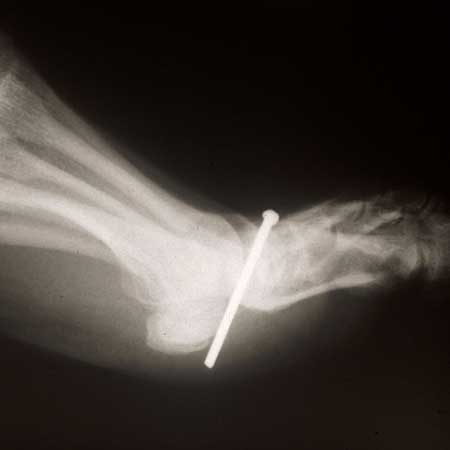 In this episode of Linux in the Ham Shack, your mild mannered hosts discuss ham radio self-education, elmering and Hamvention. On the Linux side of things, we look at installing drivers for a Yaesu radio, and take a live look at a Debian-based distribution known as SolydX. There’s also lots of feedback, and a surprise visit by our ol’ pal Richard. Chaos ensues!
73 de The LHS Guys
Russ Woodman, K5TUX, co-hosts the Linux in the Ham Shack podcast which is available for download in both MP3 and OGG audio format. Contact him at [email protected].
 Ham Radio Deluxe |
 W5SWL Electronics |
 Ham Radio Prep |
 KB3IFH QSL Cards  Hip Ham Shirts  HamRadioAuctions HamRadioAuctions Reliance Antennas Reliance Antennas Enigma Shop Enigma Shop |  morseDX  Ni4L Antennas  R&L Electronics R&L Electronics antennas.us antennas.us QRV QRV |
- Matt W1MST, Managing Editor
