 |
 Town Council Meeting
 10 June 2014 | by
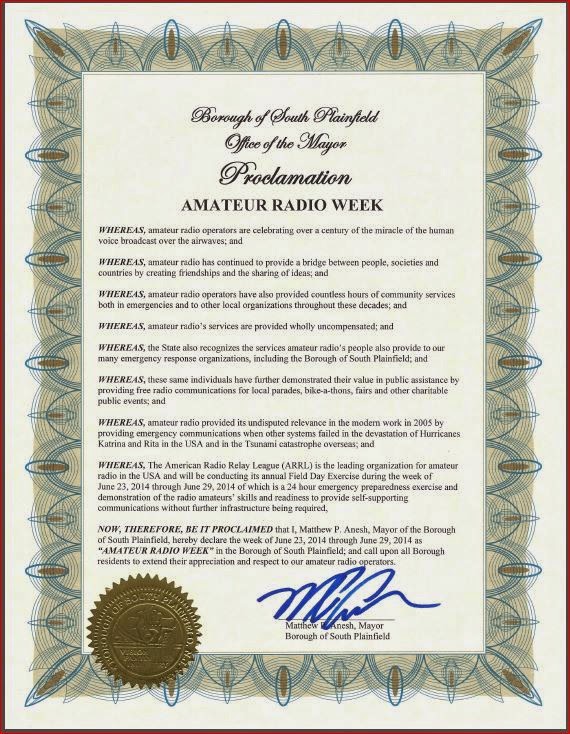
 I attended the Town Council meeting in South Plainfield, NJ. Our mayor issued a proclamation declaring June 23rd through June 29th as Amateur Radio Week in South Plainfield. Most of the members of the South Plainfield Amateur Radio Club were on hand, and we had our picture taken with the mayor.
One of our members, Wayne N2LRE has the actual printed proclamation, and he is going to scan it, and when I get an image, I will post it here. (Got it! You can see it below ……)
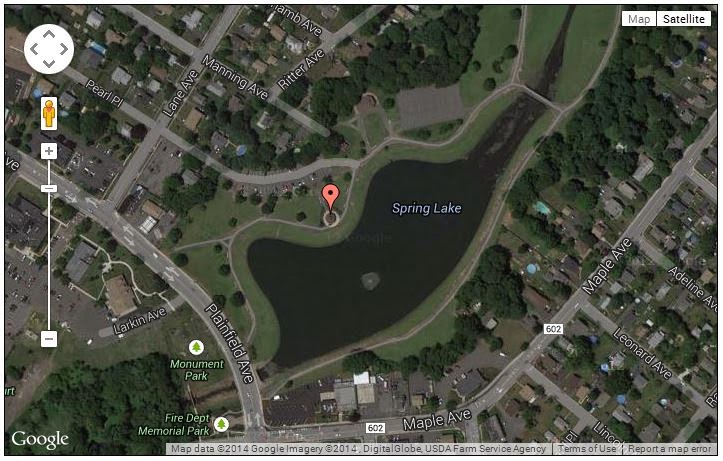
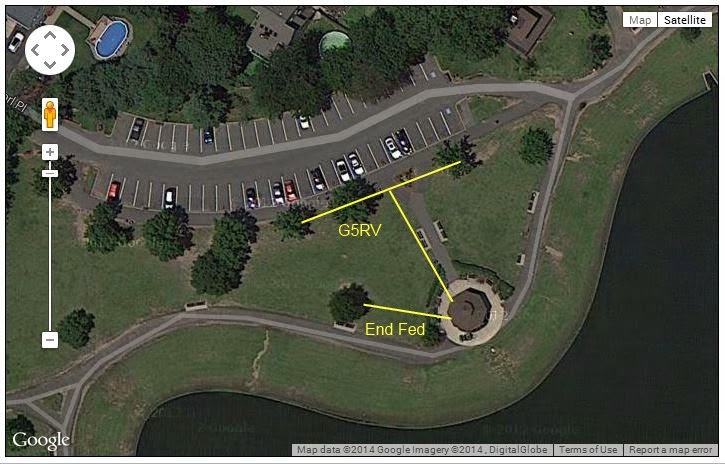
Here is an aerial view of the park:
Larry Makoski, W2LJ, is a regular contributor to AmateurRadio.com and writes from New Jersey, USA. Contact him at [email protected].
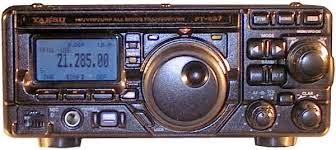
The Yaesu FT-897 is coming to it’s end
Mike Weir, VE9KK, is a regular contributor to AmateurRadio.com and writes from New Brunswick, Canada. Contact him at [email protected].
ARRL Centennial Paddle
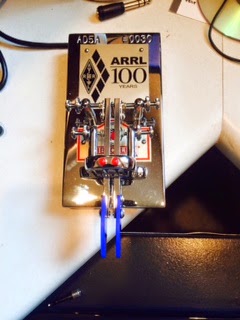
Mike Crownover, AD5A, is a regular contributor to AmateurRadio.com and writes from Texas, USA. Contact him at [email protected].
Radio propagation and space weather course
As the propagation columnist for several amateur radio magazines, I hear from a diverse group of interested people that find space weather and the propagation of radio waves fascinating. I admit: I am a space weather and radio propagation nut, and it is always good to correspond or meet with other interested folks. This is an aspect of our hobby that never grows old, as there is so much that we don’t yet know–we communicators are in a perfect space to make discovery and to make improvements to our understanding of this science. Over the years, I’ve heard a lot from readers of my columns, expressing their fascination with the science of radio and solar phenomenon.
Are you interested in learning about the Sun and the Sun-Earth connection (space weather), including topics of sunspots, solar flares, coronal mass ejections, and so on? Do you want to delve deeper into topics including the ionosphere, the magnetosphere, and how radio waves propagate from transmitter to receiver?

The critical frequency (foF2) for mornings during June 2014.
You might consider a time-proven “course”–material that is very comprehensive–that you can self-study, to become well-versed in this information. The course (one that has been used in professional disciplines) is offered either stand-alone, or bundled with the ray-tracing PropLab PRO software.
Some may say, “But, I like the magic of just getting on the air and trying my luck! If I learn all this stuff, then it becomes science, and not a hobby.” It is true that there’s a joy at being dazzled with the magic of radio; buy a super cool transceiver, and a factory-made antenna with coax already fitted with connectors, adding the necessary accessories to make it come alive, then begin exploring the shortwave frequencies. Magical, indeed! But, there are many in the hobby that wish to learn how all of that works. Some even begin learning how to build antennas, radio kits, and discover the joy of the “science” of radio. A few eventually take the step with gained “scientific” knowledge of electronics, and they design and build equipment for their hobby. The course is part of that mix: learning how the Sun affects getting a radio signal from point A to point B, and how to leverage their time and efforts, is a joy, indeed.
Interested? Here’s the web page: http://hfradio.org/swp_course/

PropLab PRO creates ray-traced radio wave analysis
If any disclosure is necessary, here you go: The proceeds from a purchase of this course go to the funds I use to keep cw.HFRadio.org, swl.HFRadio.org, and other resources at HFRadio.org, plus http://SunSpotWatch.com up and running. There are monthly fees, yearly fees, and software licensing to cover, as well as the purchase of hardware from time to time. These operating and maintenance funds are mostly covered by me, Tomas, NW7US, out of my personal funds. Any donations and sales helps out. Haters and Hecklers can send their comments to the bit bucket.
73 de NW7US
Visit, subscribe: NW7US Radio Communications and Propagation YouTube Channel
Evening Es on 6m
Just CN8LI (2113km) at 1724z at -6dB S/N this evening via 6m Es. Otherwise very quiet on 6m. Most spots were by G4IKZ (18km) who has been spotting me all day. A few spots from G4KPX (14km) too.

Roger Lapthorn, G3XBM, is a regular contributor to AmateurRadio.com and writes from Cambridge, England.
It’s radio time but no one is there!
 |
| Me and my son 22 years ago |
Mike Weir, VE9KK, is a regular contributor to AmateurRadio.com and writes from New Brunswick, Canada. Contact him at [email protected].
Why I like WSPR
These are some of the reasons I like WSPR mode:
- About 100 stations (or more) can co-habit in a 200Hz wide WSPR sub-band on each band, time and frequency sharing. In reality, usually far fewer stations on worldwide per band.
- Low power is all you need 1mW to 5W is quite fine. I tend to use 1-2W, but have been spotted at DX distances with a few mW. Some even use uW power levels!
- If there is an opening everyone has a fair chance (anyone can be spotted at great ranges)
- Simple antennas work. No need for beams on HF.
- Can monitor activity (your own and that of others) in the lounge by visiting website www.WSPRnet.org on any PC or tablet.
- Speaking not needed (saves my stroke damaged voice).
- Highly sensitive (12-14dB better than 12wpm CW?).
- Can do other things whilst WSPRing.
- Automatic – requires no manual intervention once running.
- Ideal for accurate comparative measurements (e.g antennas, rigs).
- Ideal for propagation experiments.
- About QRSS10 equivalent.
- Works from VLF to UHF (watch stability on higher bands).
- A QRP man’s dream mode.
- For 2-way QSOs use JT9-1 (about 2dB worse than WSPR).
Disadvantages:
- Needs accurate timing (usually sync’d to internet time).
- Need good frequency accuracy.
- Usually needs a PC (not always e.g Hans Summers Ultimate 3 and similar kits).
- Needs careful interfacing to rig to avoid loops and 50, 100Hz sidebands.
Download WSPR software at http://physics.princeton.edu/pulsar/K1JT/wspr.html .

Roger Lapthorn, G3XBM, is a regular contributor to AmateurRadio.com and writes from Cambridge, England.
 Ham Radio Deluxe |
 W5SWL Electronics |
 Ham Radio Prep |
 KB3IFH QSL Cards  Hip Ham Shirts  HamRadioAuctions HamRadioAuctions Reliance Antennas Reliance Antennas Enigma Shop Enigma Shop |  morseDX  Ni4L Antennas  R&L Electronics R&L Electronics antennas.us antennas.us QRV QRV |
- Matt W1MST, Managing Editor
