 |
 G4DAY on 10m WSPR – GDX
 16 June 2014 | by
 G4DAY (142km) was again spotted at 1104z. It seems this sort of range is possible on 10m GDX. Doppler was a very large (4Hz) suggesting aircraft reflection or even back scatter?
G4DAY is using 10W and that may help. He was -24dB S/N with me, suggesting my signal (2W) would be buried in the noise at his end. WSPR usually decodes down to about -30dB S/N.

Roger Lapthorn, G3XBM, is a regular contributor to AmateurRadio.com and writes from Cambridge, England.
10m Es, F2 and GDX
On 10m G4DAY (142km) was copied twice in the early morning and again at 0940z.
Es has been plentiful this morning. Looking at the WSPR screen earlier there was lots of MS about with several traces of intermittent (non decoding) signals on 10m WSPR, presumably UK or EU signals reflecting off meteor trails. Es so far includes DL6UG, DL6NL, EB3EPR, EA5CYA, LB9YE and HB9JOI.
Also spotted FR1GZ (9724km) by F2 propagation at 1038z, 1122z and again at 1128z.
10m is a far more productive band than 6m. Interestingly, G4DAY (10W) was being spotted by Es several times in the night suggesting Es propagation was there but not good enough to allow my 2W to be decoded. For some Es and GDX it seems 10W helps.

Roger Lapthorn, G3XBM, is a regular contributor to AmateurRadio.com and writes from Cambridge, England.
Father’s Day Bike Ride to Hill
Judy and I made a quick Father’s Day bicycle excursion to Old Hill Village. It was a glorious day. Blue sky, windy, as clear as a day could be. I worked Italy, Slovak Rep., W1AW/0 in MN, Scotland, and Belarus… all on 17 meters.
We parked on the south end and rode our bikes north through the woods. A thrush sang a remarkable song as we passed a beautiful cove on the river. We stopped in a field about a mile in, and I tossed a wire into an old butternut tree. It’s a place I’ve stopped many times before.

I set up the KX3 at 5W to a 33 foot wire over the branch. I heard Fabio IZ8JFL in Italy right away. We exchanged quick 599s and I tuned around.

I sat in the grass right at the edge of the old road. There was enough wind to keep the mosquitoes away!
Here’s my log:
15 Jun-14 1940 18.080 IZ8JFL CW 599 599 Italy
15 Jun-14 1950 18.068 OM5XX CW 579 599 Slovak Rep
15 Jun-14 1953 14.030 W1AW/0 CW 599 599 MN
15 Jun-14 1956 18.080 GA3WUX CW 569 599 Glasgow
15 Jun-14 2003 18.086 EW1HI CW 599 599 Belarus
The view from my operating position was great. I gazed across a field on this side of the river toward Knox Mountain in Sanbornton where I often operate.


We stayed about a half an hour soaking in the sunshine and then headed home. Judy made a strawberry shortcake for Father’s Day!
Jim Cluett, W1PID, is a regular contributor to AmateurRadio.com and writes from New Hampshire, USA. Contact him at [email protected].
Back to 10m (from 6m)
In the last few minutes I have moved back to 10m WSPR from 6m. On 6m I was still getting GDX spots but no Es. On 10m there is still Es about and already I have been spotted by SA6BSS (1059km) and am spotting LB9YE (1533km), decent DX across Europe.
I have reset the clock on internet time and will leave 10m running through the night. We’ll see how early the first 10m Es and F2 start appearing, as long as the PC does not crash!
Sunspot count was 159 today (pretty good) with 20-30MHz propagation “normal”. Let us hope tomorrow will be similar and we get some F2 propagation on 10m.

Roger Lapthorn, G3XBM, is a regular contributor to AmateurRadio.com and writes from Cambridge, England.
144MHz Backpackers Contest
The Backpacker (3B) section and the concurrent Practical Wireless 144MHz QRP Contest are limited to just 3W. Normally the FT857 can only be lowered to 5W but by applying a negative voltage to the transceivers ALC line via the accessory socket the transmitters output can be lowered. This method is detailed here it is a simple circuit and I will make one up in due course, I didn't have the parts to make one in time.
Anyway I digress, firstly I had to find a suitable hill top that wasn't too far from home. I wanted somewhere quiet and minimised the risk of any confrontation with societies undesirables. A quick look on the local Ordnance Survey map and I spotted a viewpoint symbol.
 |
| 1:50,000 |
 | |
| 1:25,000 |
 |
| The viewpoint |
 | ||
| The information plate on the viewpoint |
 |
| battery wedged behind drivers seat |
 |
| Parasol stand and painter's telescopic pole |
 |
| Operating from the passenger seat, FT857 on dashboard |
 |
| Antenna up |
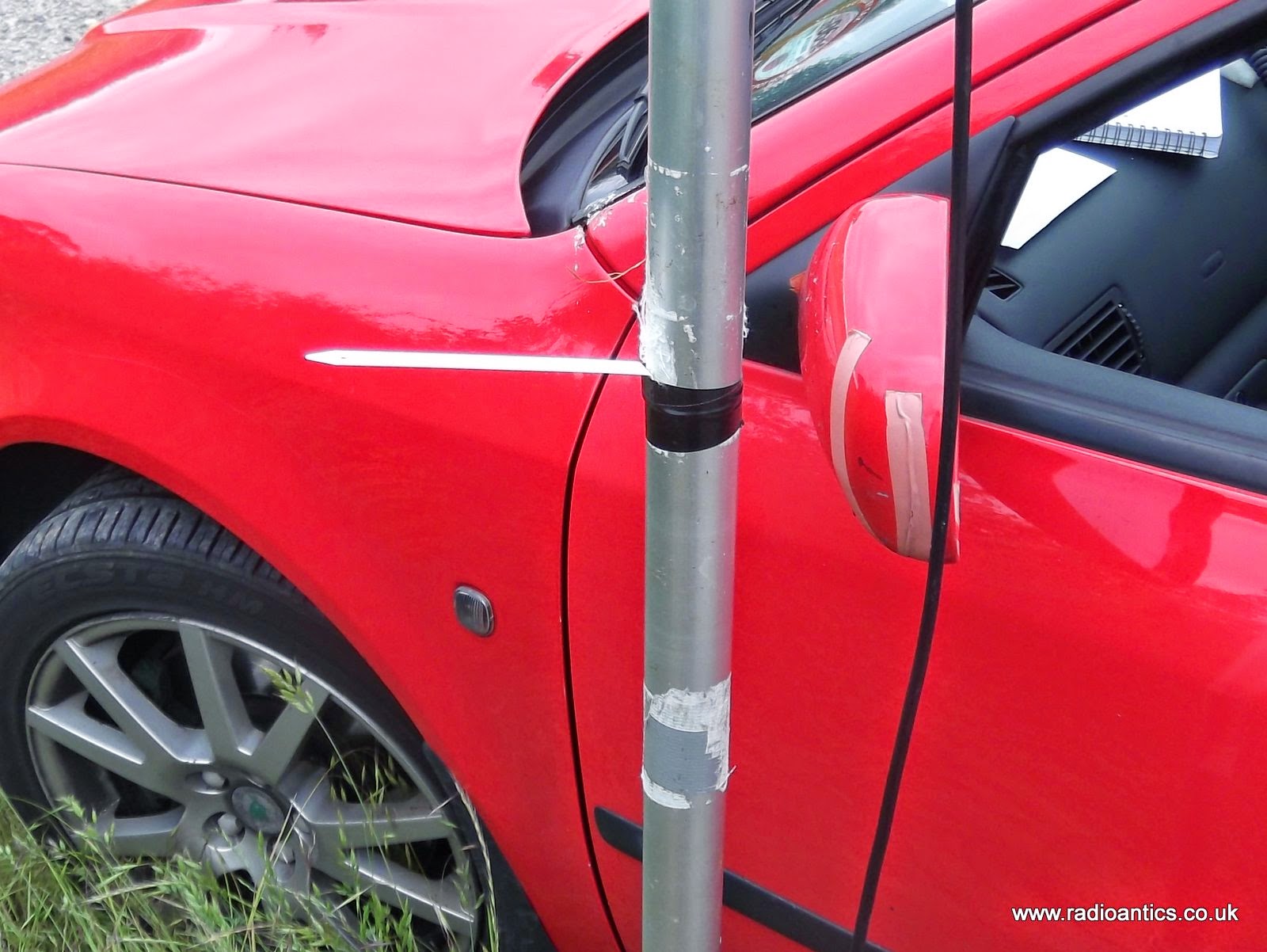
I was initially quite nervous setting up as it turned out the road was actually quite busy and I was getting a lot of quizzical looks from passersby, but once I got going I just ignored them and enjoyed the contest a lot. A number of walkers asked what I was up to and it seemed the viewpoint was a stop off on a MG owner's outing this morning.
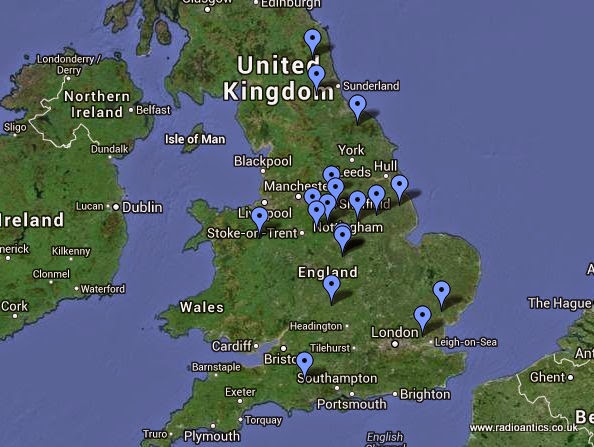
I made a reasonable amount of contacts, given most people were operating QRP with some decent distances. I did suffer one brain fade and missed another potential locator square when the other station repeated my report back and I blindly wrote it down and then lost them before I was able to correct it.
At one point I thought I would have to pack up as I was getting huge static crackles and pops which were due I think to some nearby high tension electricity pylons and what appeared to be a gathering storm, there was some brief rain but it quickly dissipated.
Next month I am looking forward to the VHF National Field Day and the 3rd Backpackers Contest as a number of members of the South Kestevan ARS are keen to have a serious attempt.
Andrew Garratt, MØNRD, is a regular contributor to AmateurRadio.com and writes from East Midlands, England. Contact him at [email protected].
Shack in a bed
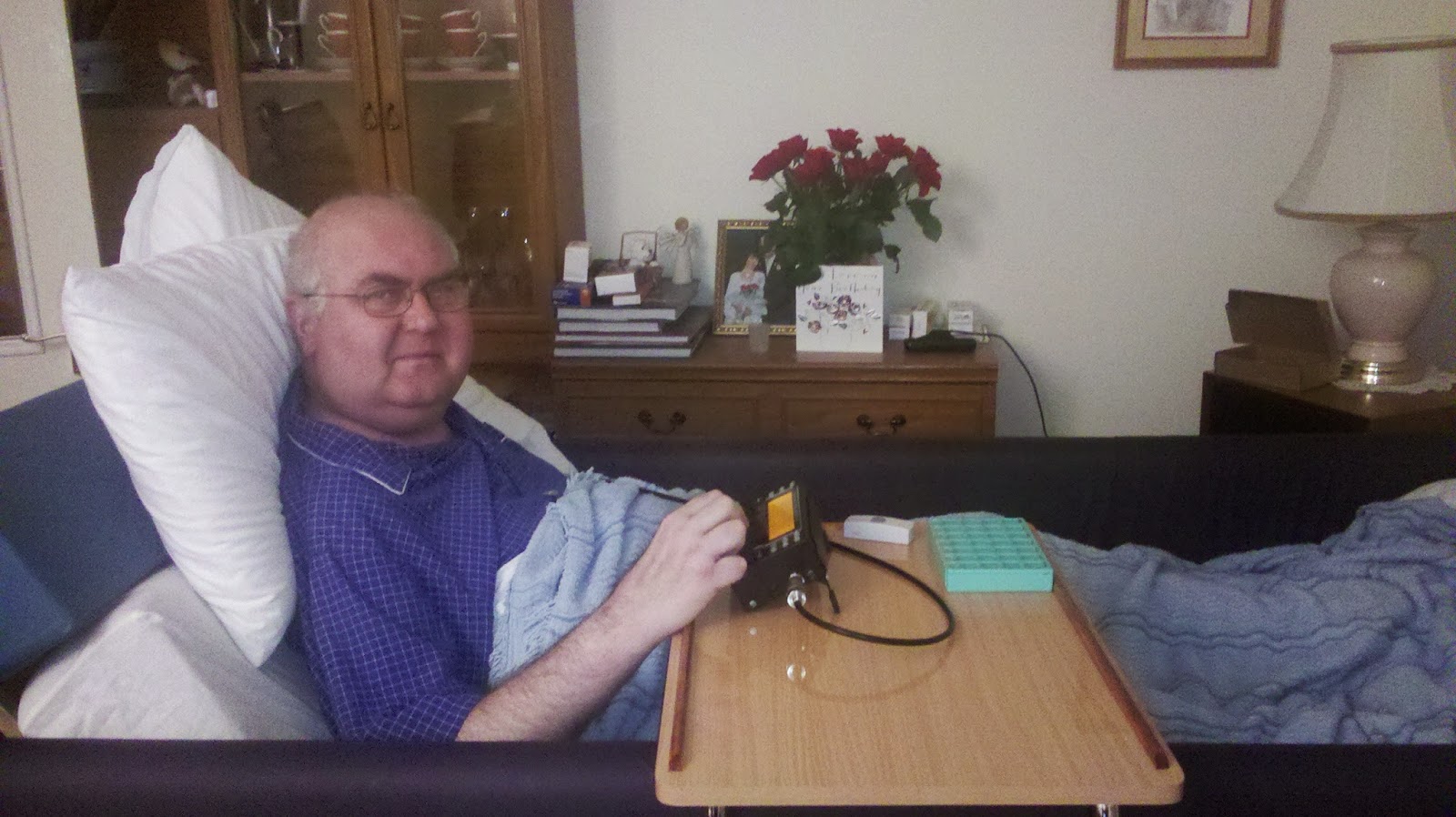
The Elekraft KX3 has become my shack in the bed. It is connected to the antenna using 10 m cable from eBay. Olga takes radio upstairs to charge batteries. I wish the charger had a tricle charge so we could leave radio connected to power continuously.
Julian Moss, G4ILO, is a regular contributor to AmateurRadio.com and writes from Cumbria, England. Contact him at [email protected].
In praise of the FT817(ND) and QRP
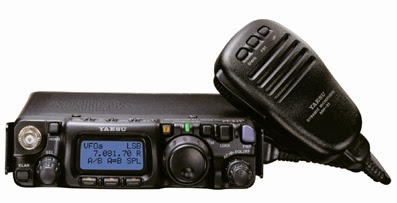 |
| FT817ND QRP transceiver |
I have owned an FT817 practically since it was first released in the UK back in 2000. The FT817ND was bought this spring as a second QRP rig along with a Z817 auto-ATU. The transceivers are mostly used at home. They are ideal for digital modes.
In my view, the FT817ND is the very best rig available. My FT817ND was just under 500 pounds for cash, brand new with 2 yrs warranty. The nearest rig (about 5 times larger!) was the FT7 10W radio which did not cover WARC bands, much of 10m , 6m, 2m or 70cm.
The FT817ND could be further improved in several ways but if 5W (or less) is all you need, then this is an excellent radio. The KX3 is no doubt a better radio but is far more expensive (here in the UK) and is less suited for home use in my view. For the price of one fully loaded KX3 you can buy two FT817ND’s in the UK.
If you have never owned an FT817ND you don’t know what you’ve been missing.
As a plug for QRP, going from 100W to 5W is about 2-3 S-points. So if 100W would have been 59 you’d still be 56 at least with 5W. What’s all the fuss about high power? I have worked THE WORLD on SSB with just 2.5W to simple wire antennas (no beams!).
My FT817’s have been used on VLF, LF and MF with home-brew transverters and on all HF and VHF bands working some impressive DX.
There is a myth that QRP is “hard”. Let me tell you that is rubbish. Sometimes power helps, but that is rare. Mostly QRP is just plain good fun – making the hobby all new again. The most I use these days is 5W, and more often far less. QRP is great fun.
Go for it!

Roger Lapthorn, G3XBM, is a regular contributor to AmateurRadio.com and writes from Cambridge, England.
 Ham Radio Deluxe |
 W5SWL Electronics |
 Ham Radio Prep |
 KB3IFH QSL Cards  Hip Ham Shirts  HamRadioAuctions HamRadioAuctions Reliance Antennas Reliance Antennas Enigma Shop Enigma Shop |  morseDX  Ni4L Antennas  R&L Electronics R&L Electronics antennas.us antennas.us QRV QRV |
- Matt W1MST, Managing Editor
