 |
 Summer – a reminder!
 16 June 2014 | by
 Summer 2014 starts this coming Saturday at 6:51 EDT. After this dreadfully long Winter that seems to have lasted into Spring, I just can’t wait! At that bleary eyed time of the morning, I will be busy, helping out at the annual Raritan Valley Radio Club W2QW Hamfest.
But Saturday, being the first day of Summer, is also the day that I will entertain requests for Skeeter Hunt numbers for 2014. So please feel free to send e-mails to [email protected], and as soon as I can, I will get back to you with your official NJQRP Skeeter Hunt number!

And I can tell you one thing that is 100% certain. With the Winter of 2013/2014 still vividly fresh in the ol’ memory banks of W2LJ ….. no matter how hot or how humid it might be for this year’s Skeeter Hunt, I for one, will not complain!
72 de Larry W2LJ
Larry Makoski, W2LJ, is a regular contributor to AmateurRadio.com and writes from New Jersey, USA. Contact him at [email protected].
10m Es – more and more
It is now 2015z and on 10m the Es keeps on coming. This is a good, solid and widespread Es opening.
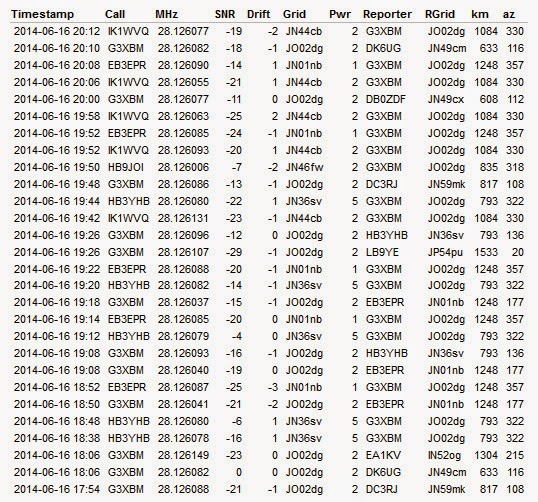 |
| Recent 10m WSPR spots this evening |
UPDATE 2110z: 10m Es still going strong a few minutes ago.
UPDATE 2145z: Es seemed to have stopped (here) at about 2100z. Oh no it didn’t! IK1WVQ was spotted at 2134z and 2142z.. HB9JOI spotted me at 2138z. The Es is still going strong.
UPDATE 2220z: Although Es has been good on 10m all day and F2 was good to FR1GZ earlier, there has been no F2 to South America on 10m WSPR at least not yet. This was surprising. EB3EPR is still spotting me at 2218z.
UPDATE 2232z: Bed time, but 10m WSPR still running overnight, unless the PC does an update and closes the software again!

Roger Lapthorn, G3XBM, is a regular contributor to AmateurRadio.com and writes from Cambridge, England.
DK6UG, DC3RJ and EA1KV by Es on 10m WSPR
As teatime continues, yet more Es 10m propagation is evident.
DC3RJ (817km) is the latest who spotted me at 1754z. Earlier EB3EPR (1248km) spotted me twice. Now EA1KV (1304km) and DK6UG are spotting me at 1806z.
Some weeks ago I was questioning the propagation to a GM reporter on 6m, but realise now the distance is comparable with parts of Germany, so an easy Es single hop.
UPDATE 1840Z: HB3YHB (793km) was spotted at 1838z on 10m WSPR.

Roger Lapthorn, G3XBM, is a regular contributor to AmateurRadio.com and writes from Cambridge, England.
More 10m GDX, Es and F2
During the afternoon G4FFC (45km) and M0BOB (74km) were both copied on 10m WSPR. These are both outside local range and I would class these as GDX (just). Both show some Doppler so may be helped by aircraft reflection.
On F2 FR1GZ (9724km, Reunion Is) was being copied until 1512z, so good F2 propagation. I wonder if we’ll see South Americans later?
Es disappeared (here) at 1404z but may return this teatime.
UPDATE 1740z: EB3EPR (1248km) spotted me at 1736z and 1746z so Es is back (it is teatime!).

Roger Lapthorn, G3XBM, is a regular contributor to AmateurRadio.com and writes from Cambridge, England.
10m F2
FR1GZ (9734km, on Reunion Is, south Indian Ocean) is still coming through here on 10m WSPR at -27dB S/N at 1444z and again at 1504z at -25dB S/N. F2 propagation N-S is still there when HF conditions are good.
Sunspot count today is “only” 80 – a year from now this will sound amazingly high – although 20-30MHz conditions are forecast to be “good”.
F2 on 6m is very rare except at high sunspot peaks and in latitudes nearer the equator. TEP involving F2 over the equator is more common, but it requires stations to be in the right places to work. On 6m the paths from CN8 to FR1 were open by TEP this spring. Also 4X to FR1 and VK to JA.
On 10m TEP should be more frequent. Sometimes F2 links with Es further from the equator, allowing TEP to be extended to stations in higher latitudes.

Roger Lapthorn, G3XBM, is a regular contributor to AmateurRadio.com and writes from Cambridge, England.
Still struggling to hear….or am I?
I still think something is just not quite right with my setup. If you remember from a few posts back I installed a 66′ ladder fed dipole in the attic. I thought this would increase my reception ability, but now I am not to sure.
Maybe I am just spoiled by the low noise floor when operating portable in the park, but across multiple weekends and multiple evenings I am beginning to think I just don’t hear as well with the attic antenna.
Sure the noise floor is higher, about S5 – which can be helped with the NR and the ATT, but I just don’t hear signals like I think I should.
For example, typical weeknight on 40 meter CW about 11:00 pm local time. I hear maybe 2 or 3 QSO’s. During the weekend days, I have scanned 30 meters thru 10 meters – CW and SSB portions of the band, and hear nothing – may one or two QSO’s but that is it.
I read about others working DX and plenty of local stations with an attic mounted dipole.
I have worked people on PSK31 on 20 meters in the evenings – even some DX to South America – but overall the signals in general seem very weak.
It just seems like it is more than the higher noise floor that is impacting my operating.
The thing that has me most confused is that when I don’t hear anyone, and then decided to call CQ, I almost always make a contact.
I have not gotten on during a contest, even a QRP sprint, which might be a better way to gauge what I am hearing – I suppose I need to do this.
Am I just expecting more activity than there actually is?
Burke Jones, NØHYD, is a regular contributor to AmateurRadio.com and writes from Kansas, USA. Contact him at [email protected].
Radio operators ‘vital’ to emergency response
Living in Florida we all talk about being prepared, we have special nets for hurricanes, we have gear that is ready for the storms. There is only so much you could be ready for, but we do our best. Florida Ham take the responsibility serious and it’s great to see it recognized by the local news:
http://nicktoday.com/radio-operators-vital-emergency-response/
Nick Palomba, N1IC, is a regular contributor to AmateurRadio.com and writes from Florida, USA. Contact him at [email protected].
 Ham Radio Deluxe |
 W5SWL Electronics |
 Ham Radio Prep |
 KB3IFH QSL Cards  Hip Ham Shirts  HamRadioAuctions HamRadioAuctions Reliance Antennas Reliance Antennas Enigma Shop Enigma Shop |  morseDX  Ni4L Antennas  R&L Electronics R&L Electronics antennas.us antennas.us QRV QRV |
- Matt W1MST, Managing Editor
