 |
 10m rigs
 2 July 2014 | by
  |
| http://images.nevadaradio.co.uk/large/banners/Liberty-bannerV3.jpg |
For WSPR, 5W or less is quite enough on 10m, even with my “compromise” 3 band PAR antenna. In the quiet years ahead, a bit more power would be helpful on SSB, AM, CW and FM.
I am now getting very tempted to buy a Lincoln President II (version 3) which can run up to 31W pep on SSB. Probably it would run far less most of the time. Nevada have reduced their price by £10 to £249.95, I hope that includes free delivery for cash.
This is a dedicated 10m radio, although it can also cover CB bands with a simple (but illegal) internal wire cut. If I bought one, I would only use it on 10m only: I have no interest in CB. I think the latest mods turn this into a good rig. On my original Lincoln President – sold years ago – some impressive DX was worked in quieter years even from the car on SSB.
Yes, it is a glorified CB rig, but with some very useful features for amateur use and about half the price of the lowest cost amateur radio transceivers. There are other contenders too but these seem to have fewer useful features.
As my main interest (outside the 6m Es season) is 10m, this may be a wise buy.

Roger Lapthorn, G3XBM, is a regular contributor to AmateurRadio.com and writes from Cambridge, England.
Grantham ARC HAB Talk
This follows on from the South Kesteven ARS (SKARS) and the Spalding and District ARS (SDARS) talks I gave in May
It was very well attended with a large number of GARC members turning out. It was a case of everyone going in at the same time once the venues key holder turned up and I initially got a little stressed as I hurriedly tried to get everything set up while everyone sat patiently waiting.
 |
| Picture by Kevin Burton |
The first issue I had was the projector seemed to be limited to just 800x600 pixels, which was fine for the PowerPoint presentation but for demonstrating reception using a RTL-SDR with SDRSharp and decoding using DL-FLDIGI and the UKHAS Habitat tracking system spacenear.us/tracker the lack of screen space was a problem, DL-FLDIGI couldn't be shrunk down to fit, so there was a lot of scrolling about!
The second issue was the venues wi-fi connection, my laptop stubbornly refused to connect to it (I wished I'd taken a ThinkPad laptop I have instead of the one I did as it has a better wi-fi adapter) so was forced to use my mobile phone as a tethered hotspot - while it worked the connection was painfully slow.
Despite these issues I was able to give the presentation about the HAB community and the technology. It contains a lot of information to digest but there is some light relief with its videos of Felix Baumgartner, Dave Akerman’s Babbage Teddy Bear free fall and wacky chef Heston Blumenthal's ‘Spud-in-space’ feature from his recent television program.
I demonstrated Project Hab's VAYU-NTX tracker and thanks again to Steve Smith (G0TDJ) for its loan.
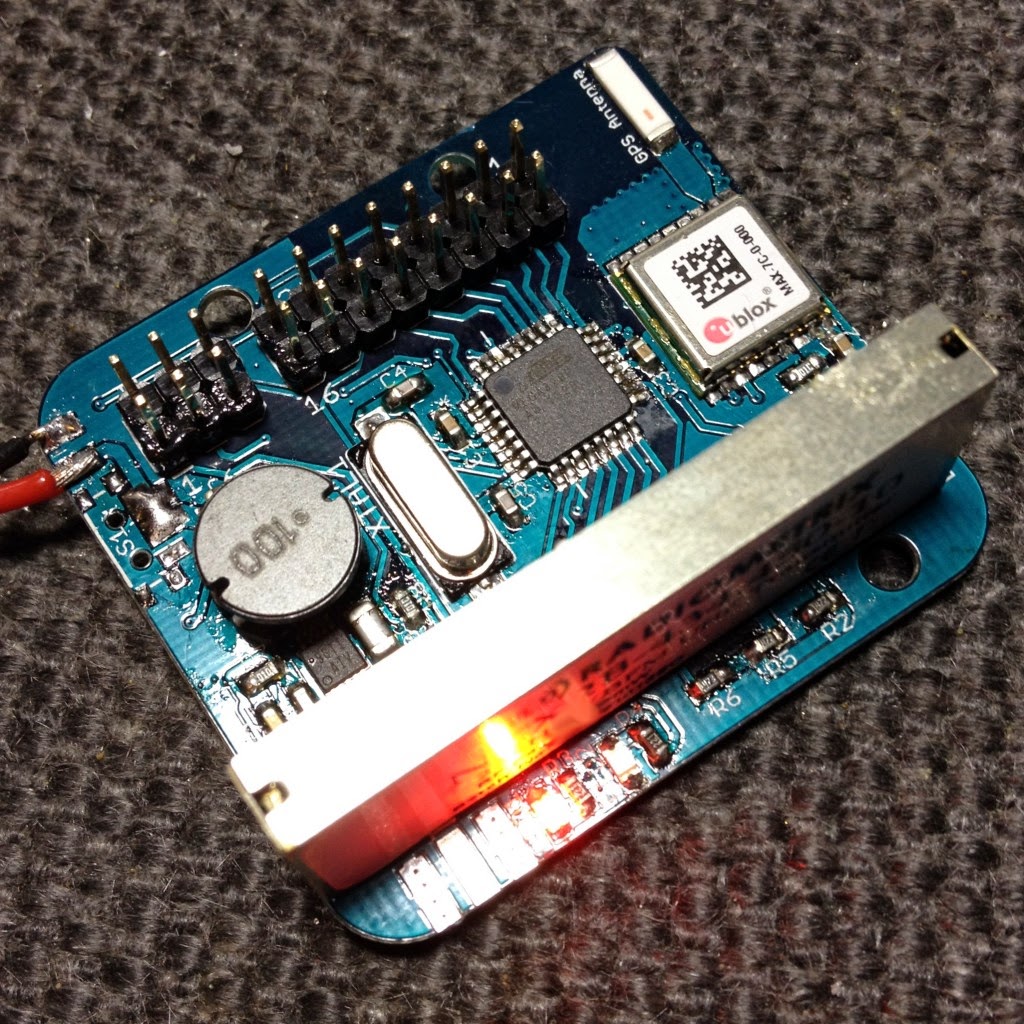
I ran my own prototype tracker (NERDTEST) which I had updated to simulate a local flight, the transmission, reception, decoding and uploading to the UKHAS Habitat system was completely genuine, both using SDR and a traditional radio (Alinco DX-10) hooked up to the sound card. The only thing fictitious were the GPS coordinates and altitude. (A programming error in the first version of this simulator had the balloon travelling at near 10km/s, thankfully I had corrected it to something more realistic)
The poor internet connection cause issues with spacenear.us/tracker but was able to use Phil Crump's (M0DNY) version at at habmap.philcrump.co.uk to demonstrate the real time map tracking.
Checking the spacenear.us map this morning and the receiver station at the club house and the demo flight could still be seen - it was programmed to take off from a nearby high point!
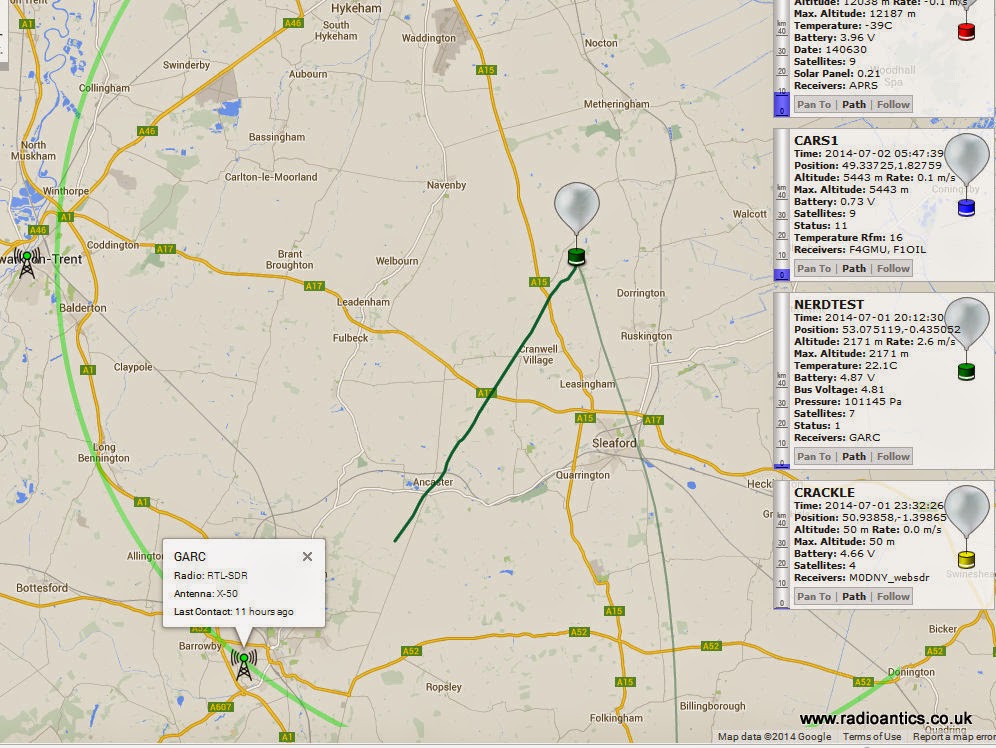
By lucky coincidence Chris Stubbs (M6EDF) had launched a balloon CARS-1 from the Chelmsford Amateur Radio Society meeting at Oaklands Museum where he was giving a talk and demonstration at the same time as my talk, so I was able to show how multiple receiver stations were tracking a real flight.
I was also able to demonstrate SSDV image decoding using some recorded SDR files of the HiPi flight
I thought I had overloaded the attendees with too much information, lots of references to Arduino, Raspberry PIs, SDR, dongles, GPS could be quite daunting to the uninitiated but again feedback has been very positive. Grantham Amateur Radio Club on Facebook
Now I just to sort out doing a proper flight!
Andrew Garratt, MØNRD, is a regular contributor to AmateurRadio.com and writes from East Midlands, England. Contact him at [email protected].
Happy Canada Day!

We always celebrate Canada Day with a large block party in our front yard by the beach, every July 1st.....pot-luck and lots of good food. The normal attendance is around seventy people but this year we may have a few less as it falls on an odd day. We have done this for the past 23 years and so far have never had rain. Today the weather is perfect once again here on Mayne Island.
Steve McDonald, VE7SL, is a regular contributor to AmateurRadio.com and writes from British Columbia, Canada. Contact him at [email protected].
The Spectrum Monitor – July, 2014

Here are the featured stories from our July, 2014 issue:
Monitoring NATO War Games
by Tony Roper
Twice each year the United Kingdom hosts NATO’s Operation “Joint Warrior,” a combined military exercise that includes major European countries as well as the US, Canada and often non-NATO countries such as Australia, New Zealand and Brazil. For monitors who follow such exercises closely, it’s a chance to tune in via HF, VHF and UHF to monitor some fairly exotic modes. It also offers some dramatic photo opportunities for those lucky enough to be close by. Longtime military monitor, Tony Roper, tells us how it’s done, where to listen and what you’ll hear. (Pg. 9)
From Plane Spotter to Air Traffic Controller
by Tony Roper
You might think that growing up just four miles from runway 10R at London’s Heathrow airport, it would be mandatory for a kid to be interested in aircraft communications. But it wasn’t until a teenage Tony Roper was given an analog VHF radio that featured the aviation band, that he connected those countless flights overhead with what he heard on that radio. It sent him on a 25-year career path as both a Royal Air Force and civilian air traffic controller. He also became a writer and photographer specializing in military monitoring. (Pg. 16)
Moonbounce: Earth-Moon-Earth Basics
by Bob DeVarney W1ICW
As with most space-related communications, bouncing radio signals off the surface of the Moon, a distance of almost a quarter-million miles, has usually been the domain of NASA, the military, or a few of the world’s most well-heeled hams. But, thanks to inexpensive, high-powered computers, exceedingly capable software and relatively cheap antennas, Earth Moon-Earth (EME) transmissions are now possible for average hams. Bob DeVarney W1ICW traces the origins of EME and his own efforts that have netted him 53 DXCC entities and counting! (Pg. 20)
Monitoring the Chesapeake Bay by Sea and Air
by Dave Kelly
America’s Chesapeake Bay is the world’s largest estuary, with a watershed that encompasses 64,000 square miles. It’s also home to nearly constant state, local, federal and military communications on an amazing assortment of frequencies. It’s also home to Wallops Island Flight Center, Virginia’s own spaceport. From Navy Seal training in the Bay’s backwaters to the thunder of rocket launches on the shore, the Chesapeake Bay offers an abundance of radio monitoring and the best crab cakes you’ll ever eat. (Pg. 25)
Dixon, California: America’s Shortwave Mecca
by John Schneider W9FGH
The incredibly flat land around Dixon, California, was not only good for raising crops out to the horizon, it also proved a great launching point for shortwave signals that went thousands of miles beyond that same horizon. Radio historian and former Monitoring Times feature writer, John Schneider W9FGH, relates the amazing story of the rise and fall of this legendary West Coast shortwave city. (Pg. 29)
The Spectrum Monitor is available in PDF format which can be read on any desktop, laptop, iPad®, Kindle® Fire, or other device capable of opening a PDF file. Annual subscription (12 issues, beginning with the January 2014 issue) is $24. Individual monthly issues are available for $3 each.
Ken Reitz, KS4ZR, is publisher and managing editor of The Spectrum Monitor. Contact him at [email protected].
Sporadic E
2014 Es is gettig ander way. I will be keeping an eye on 6m and 10m bands. Now is the time for WSPR. This requires a computer. I’ve managed to get the WSPR software running on the shack computer using Windows remote desctop which allow me to see whole screen on the laptop. This is more useful than I expexted. Olga discovered the shack computer keyboard is broken. It prints one letter from the next column. The funny thing is I sought it was my brain broken not the computer.
I had hoped to be using one of Hans Summers Ultimate kits I purchased several weeks ago. But I think it is beyond my ability to buibd this. Shame there isn’t a bild and tested version.
Julian Moss, G4ILO, is a regular contributor to AmateurRadio.com and writes from Cumbria, England. Contact him at [email protected].
NPR: Celebrating 100 Years of Ham Radio

To be able to go out to a park somewhere and literally throw a length of wire into a tree and sit down and talk with somebody in, say, Italy, is endlessly thrilling to me. – Sean Kutzko, KX9X
A recent NPR story with a visit to W1AW. Check it out here.
I’m a little envious of Sean Kutzko’s visit to W1AW.
I think this is a great characterization of the hobby that always inspires the imagination (well, at least mine)
…he’s contacted others all across the globe – coral atolls in the South Pacific, even a research station in Antarctica.
Makes me want to spark up the rig and see what I can find.
Scott Hedberg, NØZB, is a regular contributor to AmateurRadio.com and writes from Kansas, USA. Contact him at [email protected].
Field Day 2014 – Wow!
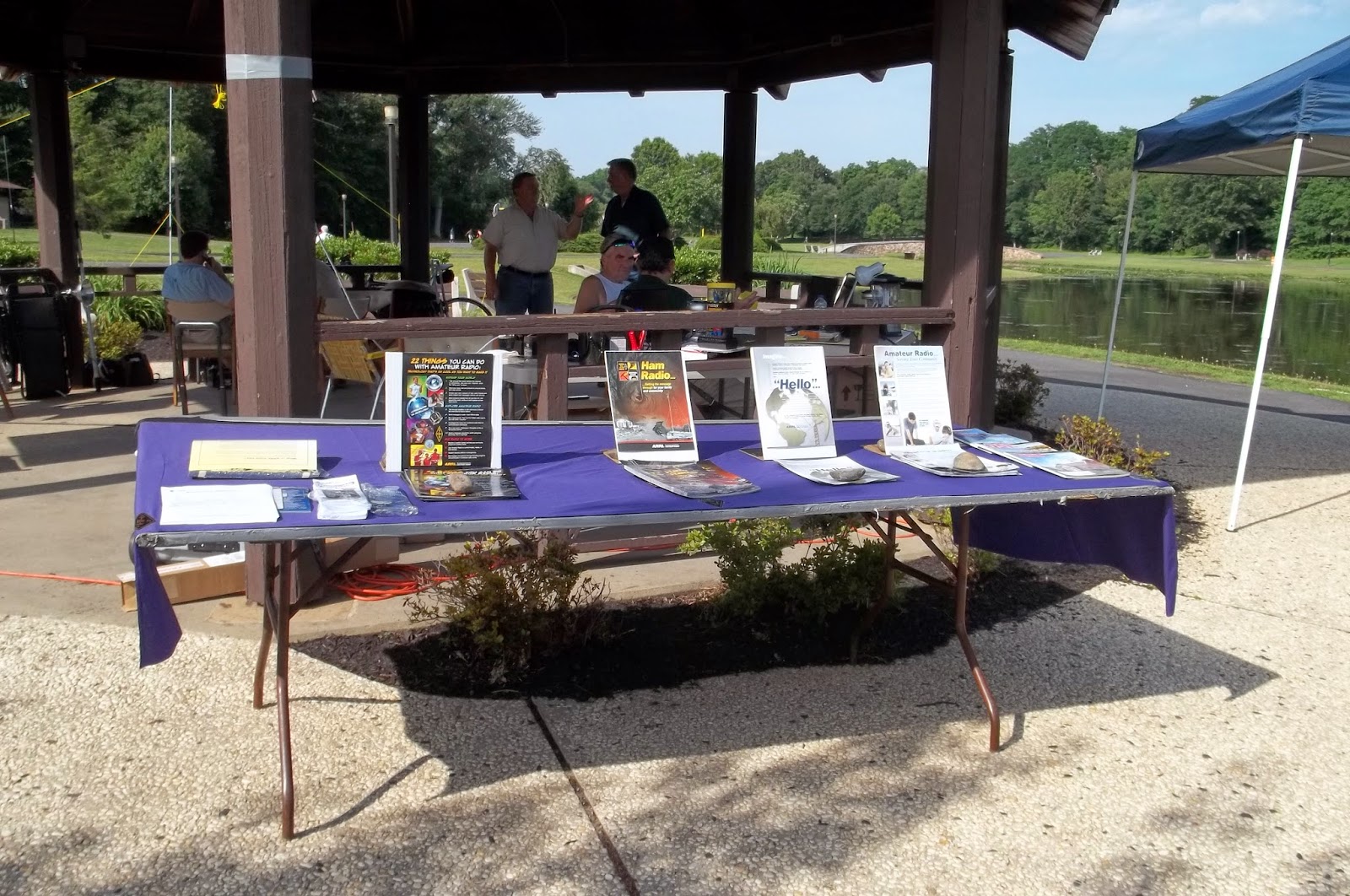
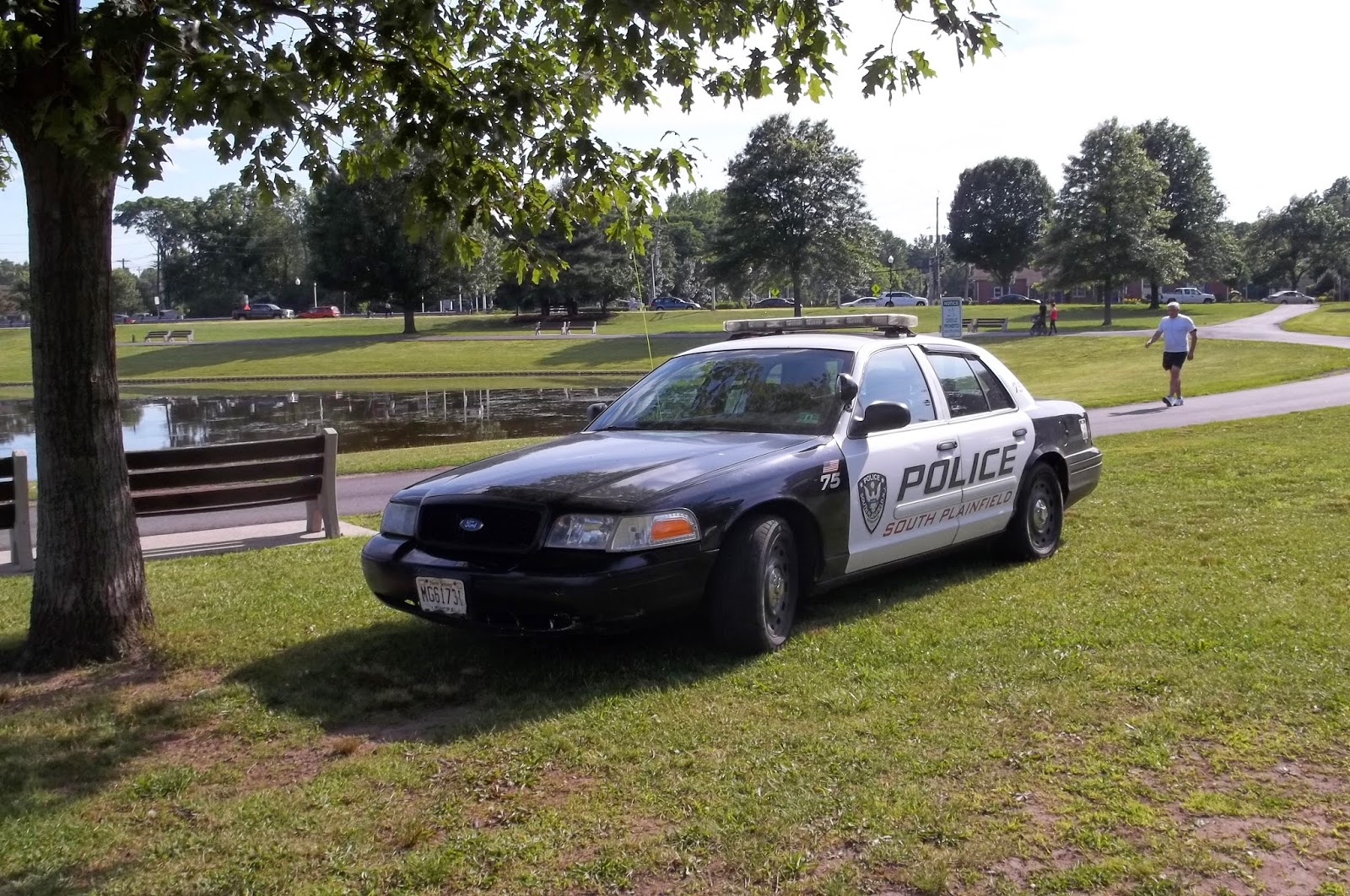
That’s all I can say – wow! A magnificent time was had at the first Field Day for the South Plainfield Radio Club. I posted the following to QRP-L, and I’ll insert some other thoughts at the end.
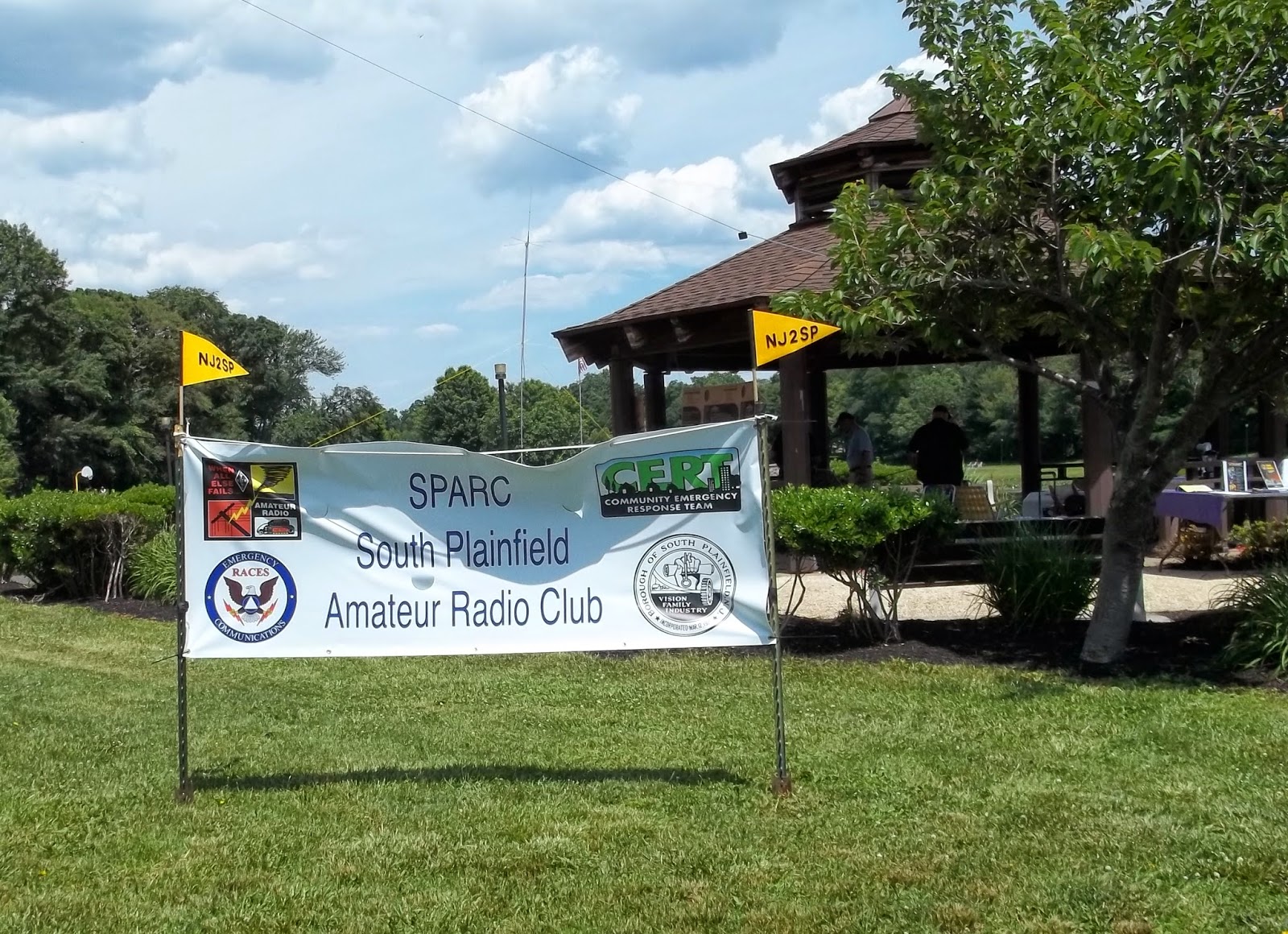
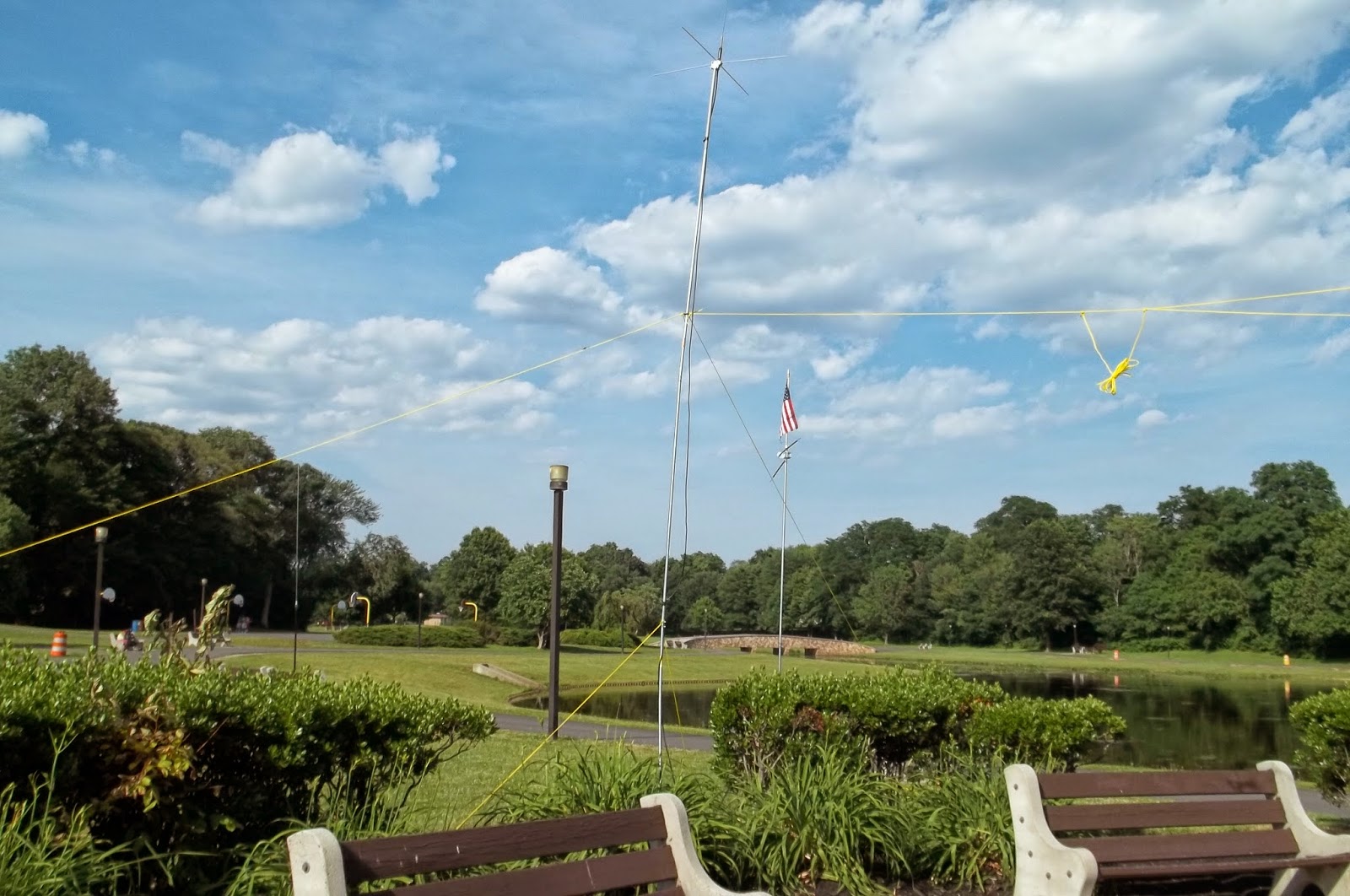
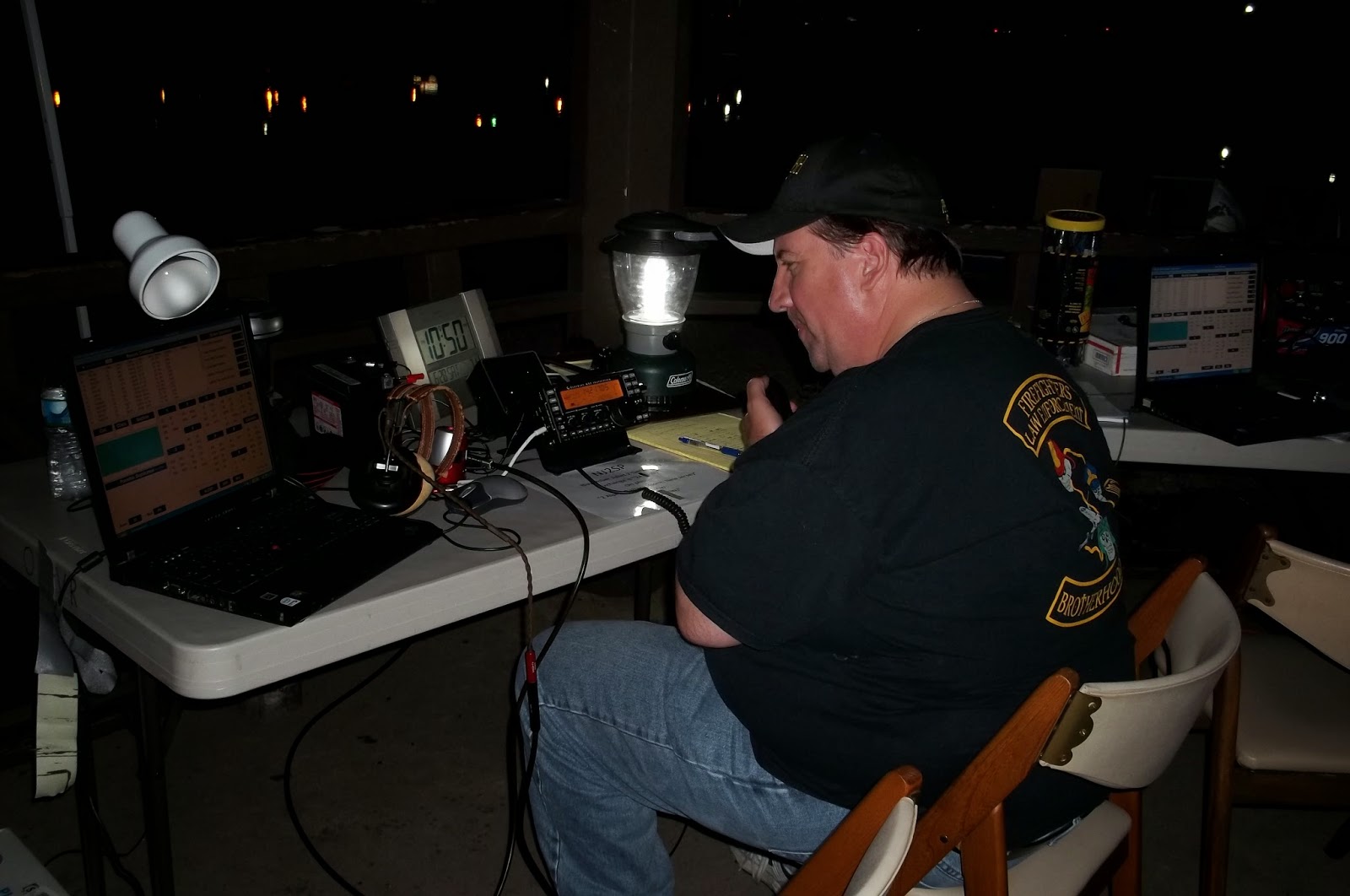
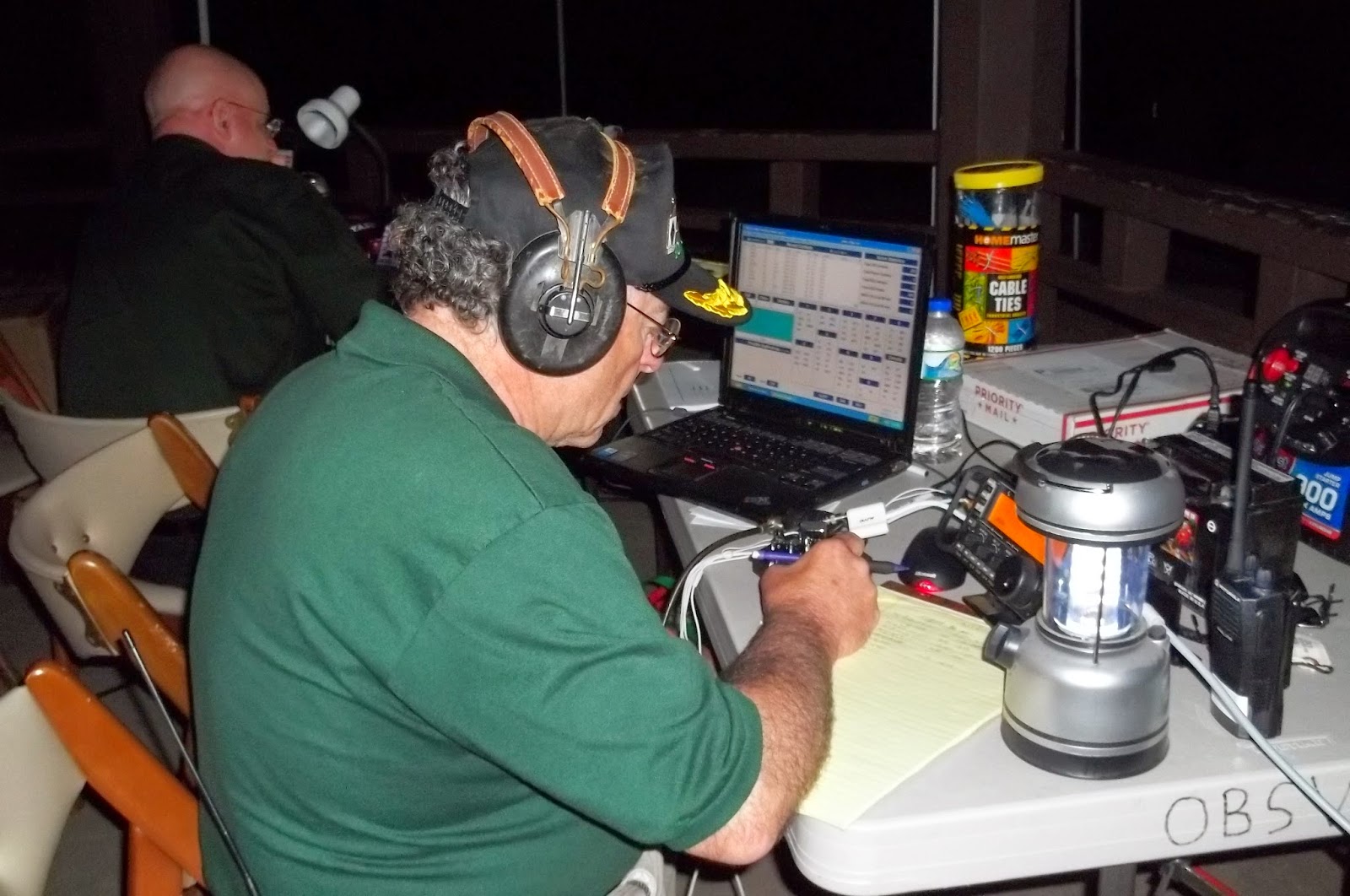
The South Plainfield Amateur Radio Club operated Field Day in Spring Lake Park in South Plainfield, NJ. We used Club call NJ2SP, and ran as 2A (Battery). The “2A” were two Elecraft KX3s. The CW station ran to a EARCHI antenna (53 foot radiator, 9:1 UNUN, 25 foot length of coax). The elevated end of the EARCHI was about 30-35 foot up in a tree. The SSB station used a G5RV, about the same height between two trees.
And if you look closely (click on the picture for a bigger image) you can see the EARCHI antenna sloping upward and away towards the tree it was anchored in.
The EARCHI antenna was a resounding success. The KX3’s internal tuner handled it exceedingly well on all bands. We made just a tad over 270 CW QSOs, with our best DX being Hawaii, Puerto Rico, the US Virgin Islands and the Cayman Islands.
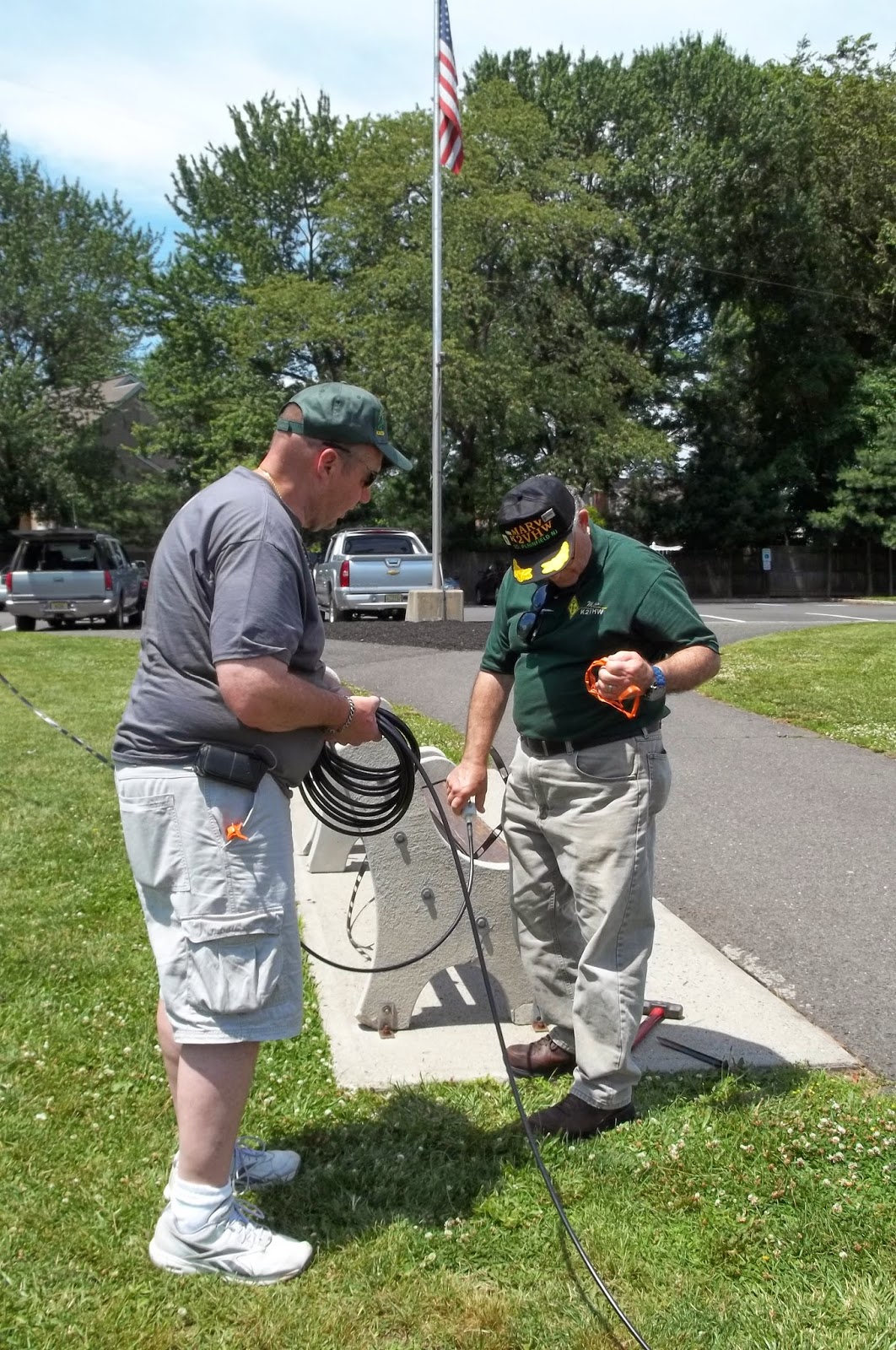
The G5RV worked exceeding well, also. The KX3 again tuned without a hiccup. The SSB team completed just over 100 SSB QSOs – these guys are all QRO ops and they were skeptical about completing even a single QRP SSB QSO. They ended up surprising themselves, and they ended up being quite amazed at what they were able to accomplish. Yes, it was not as easy as using 100W rigs, but even in keeping with the ARRL’s 5 Watt limit for the battery category, they were quite pleased.
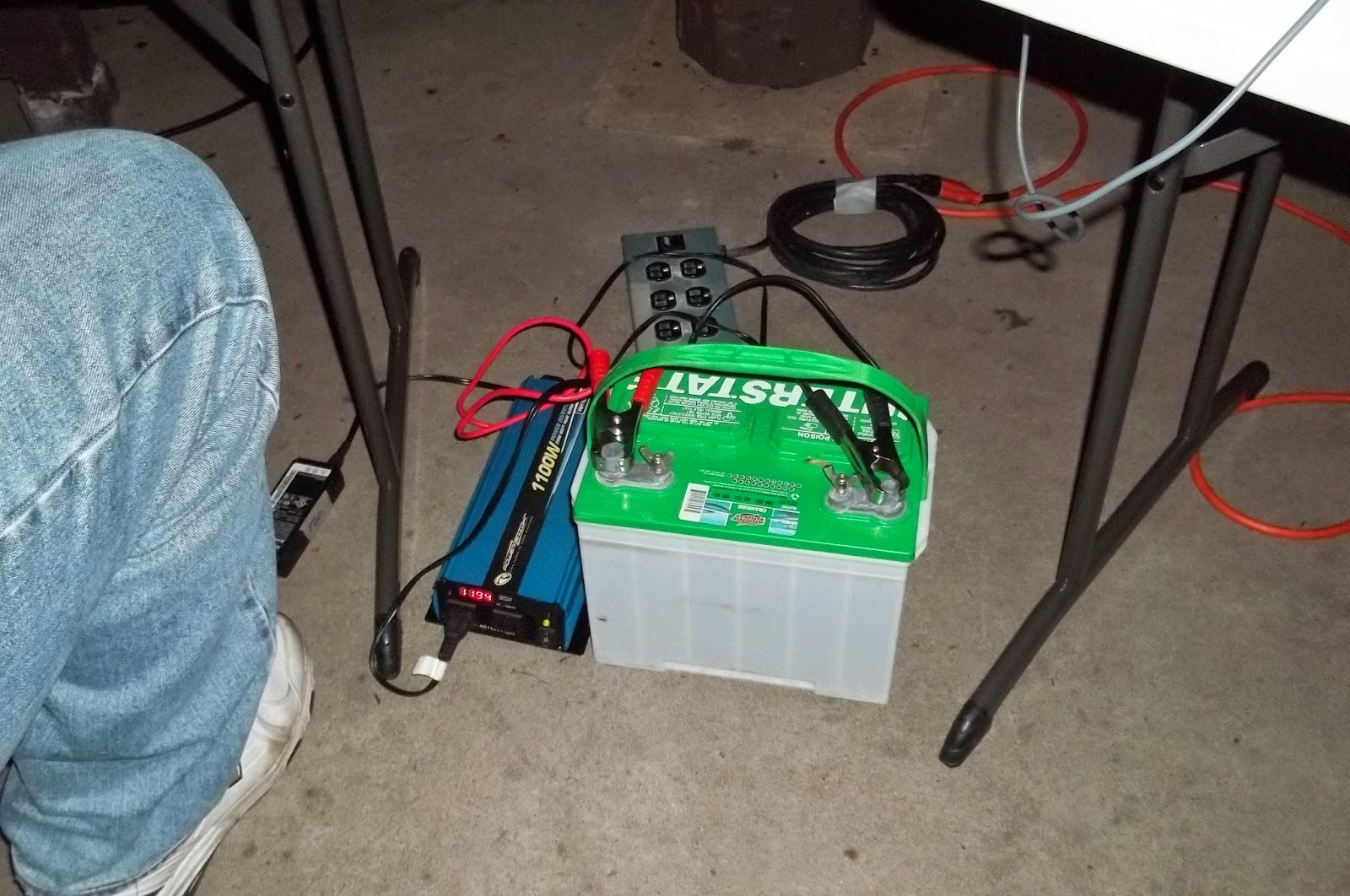
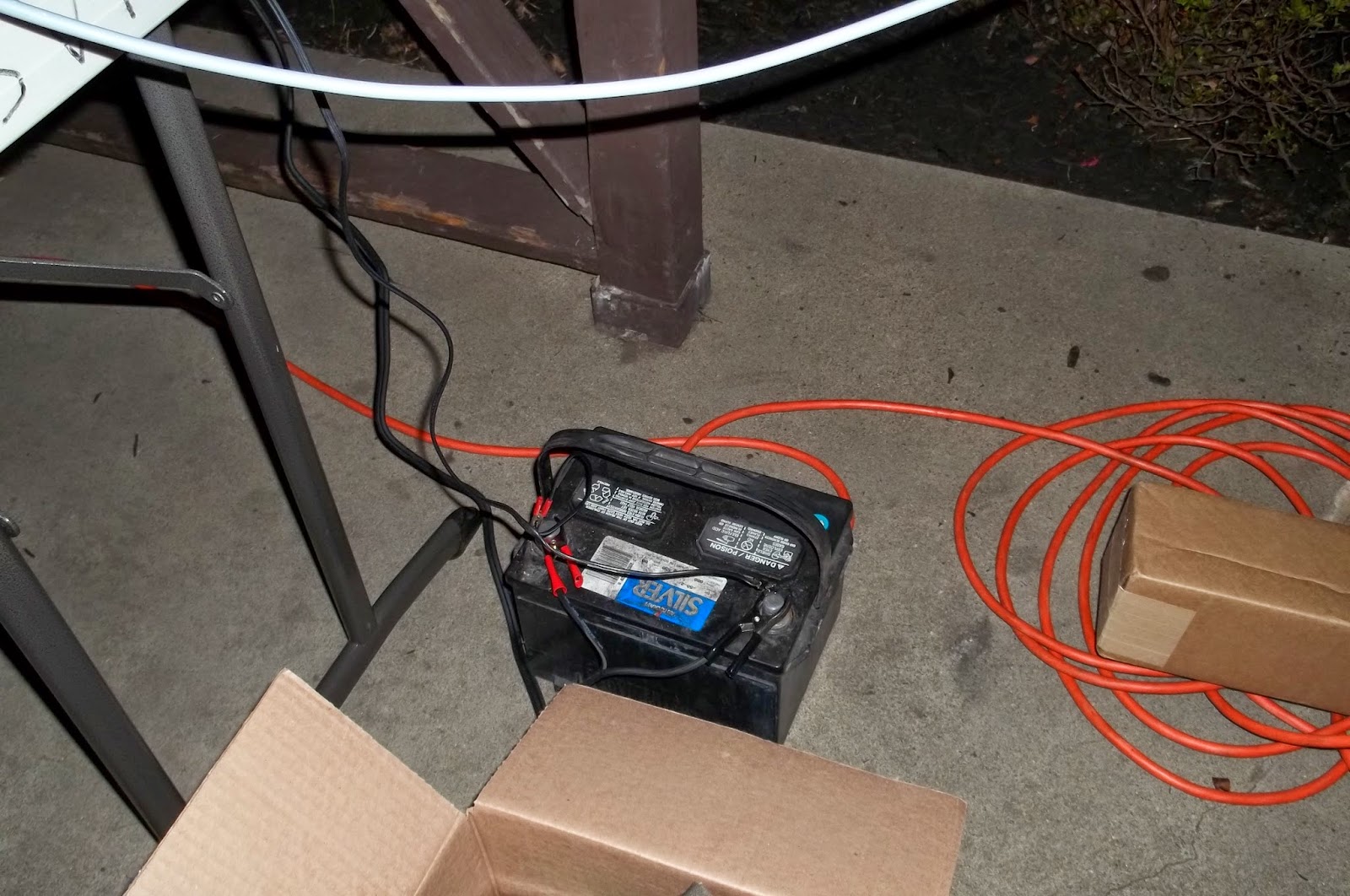
We operated on solar charged batteries all weekend without a hitch. The energy hogs for the weekend were the two laptops that we used for logging. The Field Day rules state that since we were not using the laptops for rig control, we could have powered them from mains (which we did not have) or a generator (which we had, but didn’t use). In keeping with our self imposed “severe emergency capability” theme in order to make this a drill as much as possible, we also powered them off a deep cycle battery using an inverter. We needed to switch the laptops over to a fresh battery somewhere in the mid morning hours, Sunday.
SPARC’s first Field day was an outstanding and unqualified success, and I think we ‘busted’ the myth that Field Day has to be QRO to be fun.
The EARCHI worked great and way better than I dared hope for. With less exceptions than I can count on one hand, I was able to work everyone that I tried to. Being on an energy budget because of the batteries and wanting them to last all weekend if possible, I didn’t try calling CQ or running a frequency (it was S&P all weekend). I will reserve that for FOBB and the Skeeter Hunt, which are only four hour events. I can afford to be a little “battery foolish” during those, and I expect the EARCHI to work just as well during those two events.
The other Godsend of the weekend? That Joplin ARC antenna launcher kit that I purchased and built up. We were able to place antenna lines pretty much exactly where we wanted with hardly any effort at all. That thing is one of the greatest things since sliced bread! One or two of the guys were skeptical about being able to place an antenna line so easily and accurately with such little effort. The old saying is “That seeing is believing”. They’re believers now!

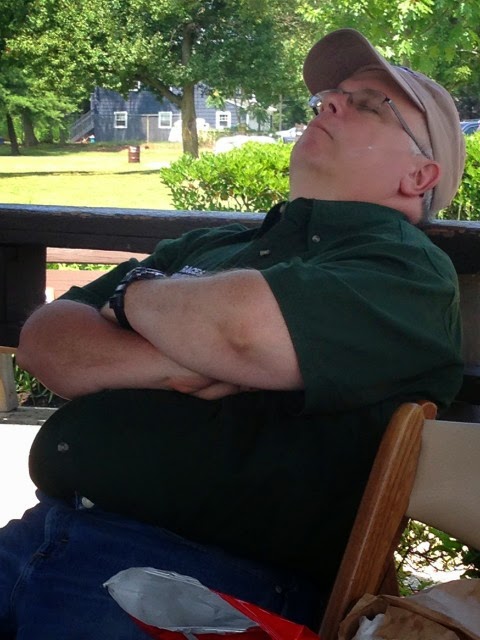
After being awake for 24+ hours, I fell asleep while waiting for the Mayor to show up late Sunday morning. I woke up in time for his visit, though!

In closing, I’ll answer a question that was posed to me by a member of the visiting public, the way I wanted to answer it. A woman asked me if it was a bit extreme staying awake throughout the 24 hours of Field Day. Of course, I gave her the answer of “In the event of an emergency or a natural disaster, sleep may very well be a luxury, …….” Yadda, yadda, yadda.
What I wanted to say was any of the following:
1) It’s Field Day! Sleep is overrated!
2) Heck no Lady! Field Day is fun!
Or I could’ve gotten all Clint Eastwood and said:
3) Ma’am? I’ll sleep when I’m dead!
One final, last added mention. Last year, Marv K2VHW introduced me to Deep Woods Off moist towelettes. They are a must for the Field Day Go Package. They worked extremely well, and I was not bothered by a single “Skeeter” (pesky little fellows, I should have had them pound brass!) all night long.
Larry Makoski, W2LJ, is a regular contributor to AmateurRadio.com and writes from New Jersey, USA. Contact him at [email protected].
 Ham Radio Deluxe |
 W5SWL Electronics |
 Ham Radio Prep |
 KB3IFH QSL Cards  Hip Ham Shirts  HamRadioAuctions HamRadioAuctions Reliance Antennas Reliance Antennas Enigma Shop Enigma Shop |  morseDX  Ni4L Antennas  R&L Electronics R&L Electronics antennas.us antennas.us QRV QRV |
- Matt W1MST, Managing Editor
