 |
 What is This? Digital Modes on KX3
 21 July 2014 | by
 I have been having a blast lately with digital modes like PSK-31 and JT-65/JT-9. My little KX3 is doing a great job even without having run the temperature compensation. Of course I am keeping my power to 2 or 3 watts – which helps a lot.
I have noticed a strange thing for a while, but I am just now getting around to asking about it.
When I look at the waterfall there is an area that is basically blanked out – for lack of a better term.
Here is a screen shot of the waterfall in WSJTX (JT-65). You will notice the black area on the left.
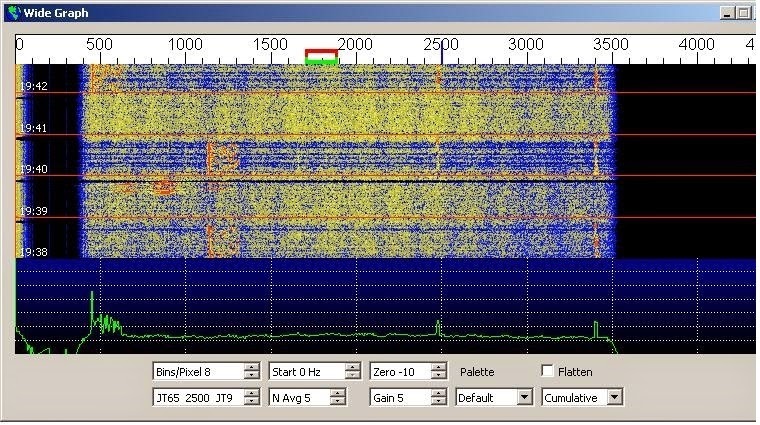 |
| Waterfall of WSJTX – What is “black” on left edge? |
As you can see there is an area on the left that is in the frequency range, but it is “blacked out”. I wonder how many signals are in this area?
Those if you with a KX3 or those of you that might know what this is – please let me know! If you know how to fix this, please let me know that as well!
I am looking forward to hearing the responses – I appreciate the help!
Burke Jones, NØHYD, is a regular contributor to AmateurRadio.com and writes from Kansas, USA. Contact him at [email protected].
News in Brief
SICK
After coming back from a tour of eastern Taiwan my leg felt very strange, I started to have a fever and began to vomit. In the hospital they diagnosed it as cellulitis and they kept me on an IV-drip for a week. Back home now and feeling a bit better, but I still need a lots of rest and take quite some meds to make sure it doesn’t resurface again.
OLD FRIEND
On our trip to eastern Taiwan I visited BX8AAD – Gene – in Taitung. I hadn’t seen him in over 17 years, so it was a happy reunion. Back in the 90s we were both avid shortwave DXers, now we’re both hams. Funny how things turned out the same for both of us.
DXCC
Opening my post office box I found 30 QSL cards, which brings my total confirmed DXCC entities to 100. Not that I want to apply for a certificate, because I don’t need another piece of wallpaper; but it is nice to know that I have reached this milestone.
OSTRICH
Now for some sad news. The curious, radial loving ostrich is no longer. He died of unknown causes, but most probably due to something that shouldn’t have been eaten by him. Despite him messing up my gear I did like the big bird and he will be missed.

ILLW
And lastly, on August 16 and 17 I will activate the Baishajia lighthouse here in Taoyuan for the International Lighthouse and Lightship weekend. This is the first time I will do something like this, so it will be fun to see how it works out. I just hope the sun cooperates and sparkles us with some spots.
That concludes the news brief for today. I hope to be back soon with more adventurous adventures. 73
Hans "Fong" van den Boogert, BX2ABT, is a regular contributor to AmateurRadio.com and writes from Taiwan. Contact him at [email protected].
Shut down two days in a row!
 |
| A foggy view of Toronto from my setup |
 |
| Trail on the way there. |
 |
| Small river on my way home. |
 |
| One of the many beaches |
Mike Weir, VE9KK, is a regular contributor to AmateurRadio.com and writes from New Brunswick, Canada. Contact him at [email protected].
Solar activity
See http://www.solen.info/solar/ .
Looking at the data on this excellent page, it now looks pretty certain that we have started on the downwards part of the current cycle. This does NOT mean an end to decent HF conditions. For several years to come there will be good days and 15,12 and 10m will still support DX but far less easily than around the sunspot maximum years.
Even in the depths of the last minimum N-S DX was still there to be worked on QRP SSB, so expect some decent openings. This is really where regular WSPR operation will help, by seeing just how often 10m opens up. As I have said before, operating on the weaker parts of the solar cycle are, in many ways, more challenging and interesting. When 10m is wide open it becomes too easy.
Also, don’t forget Es (sporadic-E) which can produce some spectacular DX at the right time of the year – in the northern hemisphere this is usually May, Jun, July and August but Es can occur (more fleetingly) at other times times of the year. This is why regular WSPR operation will help.

Roger Lapthorn, G3XBM, is a regular contributor to AmateurRadio.com and writes from Cambridge, England.
Perturbation

There is good news in the blogosphere! Jeff Davis, KE9V (ex-N9AVG, WD9GCT), has re-established a blog and is now posting regularly. There is no doubt I am an avid fan of Jeff and it is always interesting to watch his online permutations. For a very long time he had a well established blog at ke9v.net. Yes, he frequently rebooted the blog and Jeff is not an online pack-rat. His blog reboots always cleaned away old posts to make room for the new. I encountered many of his short stories, ham radio based. From time to time, he would post the stories on his blog or put them into a post. 1,000 Marbles is the only one that I know of that is published as a book. I also believe that many of his stories were translated into Japanese by Leo, JJ8KGZ. I hope that with this reboot Jeff might again share some of these stories, or perhaps a new one? Or, I would ask him to publish his stories as a collection. I am sure many hams, like myself, would purchase a copy.
 Jeff also has been prodigious in producing engaging podcasts. Starting in ~2005, Long Delayed Echos featured over fifty episodes that delved deeply into the roots and history of amateur radio. Cornbread Road was another of Jeff’s podcasts. This 13 episode podcast (and an additional epliogue) not only highlighted Jeff’s talent in crafting ham radio based fiction, but also his storytelling abilities.
Jeff always pushes the capabilities of social media. He regularly uses twitter. After dabbling with Google+, Jeff took the plunge. He discontinued his blog and used Google+ to make frequent posts. Then, not that long ago, came Quintessence, a weekly email. Archives are available here (http://tinyletter.com/ke9v/archive). I personally believe this would make for a great, weekly RTTY bulletin. Far more interesting than the ARRL’s. Perturbation is the name of the latest reincarnation of his blog. He always manages to select interesting titles for each of his blog’s incarnations.
per·tur·ba·tion – a deviation of a system, moving object, or process from its regular or normal state of path, caused by an outside influence.
Bottom line – I am glad to see Jeff’s blog back up and hope it continues for some time. But, as Heraclitus of Ephesus says, “Everything changes and nothing stands still.”
Scott Hedberg, NØZB, is a regular contributor to AmateurRadio.com and writes from Kansas, USA. Contact him at [email protected].
New Ideas for Hollywood Blockbusters
Following up on my previous post about how amateur radio is typically portrayed in movies, I thought I’d float a couple suggestions for the silver screen that include ham radio, without the need for an apocalypse…
I’ll bet not even a single director in Hollywood is aware that radio amateurs have built and launched our very own communication satellites. And not just a few — we have an entire fleet — with more heading to low earth orbit almost every month. These are frequently designed, financed, and constructed by radio amateurs with a keen interest in space communication.
And many of those who harbor that specific interest are radio hams by night and NASA employees by day. And some of those who aren’t direct employees of NASA are employed in other areas of the space industry. This insider link provides amateur radio with an unparalleled, intimate knowledge of the “business” and is responsible for much of the success we’ve obtained in this highly technical and specialized endeavor.
Well right there’s a dozen waiting story lines. Hams at NASA collude to hijack high-value satellites for amateur radio communication by hacking the system from the ground. It doesn’t take a fertile imagination to see many possible angles here, none of which would strain credulity.
But let’s dig deeper and find higher adventure.
Let’s say that a group of radio amateurs in New Zealand (better scenery to work with) built an amateur radio payload for launch. One that included onboard propulsion. That would be somewhat rare these days as we’ve taken to hand tossing payloads out of the ISS or ejecting them using powerful springs from a disposable ring that may carry dozens of small satellites with one launch. But in the halcyon days of ham radio in space, we built much larger satellites, equipped them with fuel and engines, and launched them to much higher, transfer orbits.
Say this group does the same thing.
After launch they maneuver it very near the path of some super expensive, military spy satellite and then we discover that the payload includes explosives. This group then extorts millions of dollars from governments or large corporations in exchange for not blowing up those satellites.
(If the notion of sneaking explosives onto a launch vehicle seems too far-fetched, the “amateur radio” payload could simply be maneuvered directly into the orbital path of another vehicle and kinetic energy could do the dirty work).
I’d pay to see that movie, wouldn’t you?
But there’s one other premise that seems more interesting, and one that just might tickle the fancy of a filmmaker.
Say a group of radio hams work for a company like Space-X. Intent on building and launching resupply ships to the International Space Station. And let’s suppose that a couple of them decide to ride in that supply vessel. Upon arrival, they board the station where they proceed to whip out handguns and order the current crew to evacuate back to Earth. Once they are alone on the station, they weld the other hatches permanently closed. They just “stole” the International Space Station. The biggest heist in history. Mostly for kicks but maybe to use as the premier low-earth platform for ham radio communications.
Or maybe it’s about money. Hollywood loves a good extortion plot. They could offer to abandon the stolen station for a billion dollars. Or de-orbit it over a populated region if they don’t get the money. It’s fiction, anything could happen!
And it would be nice if the leading actors had names like Clooney, Reynolds, Bullock, and Cooper…
Filed under: Ham Radio Tagged: hollywood, hr, ideas, movies


Jeff Davis, KE9V, is a regular contributor to AmateurRadio.com and writes from Indiana, USA.
VO-52 satellite missing in action
It’s been a busy couple of weeks here, all good, but busy. Last weekend, a visit to the shack coincided with a pass of VO-52 according to GPREDICT. I listened and listened and didn’t hear a thing. Being somewhat new to satellites, I always assume that if I don’t hear anything, it’s my fault (it usually is!). I checked the TLEs I was using in GPREDICT and all was ok. I checked the 145Mhz receiver – all ok. Very odd.
I didn’t have a chance to think about it again until yesterday afternoon when I was in the shack working on a review of the Wouxun UV-8D for Practical Wireless and I noticed that VO-52 was due again. Once again, I heard nothing. Again I checked my receiver and the TLEs. I was now starting to think that perhaps it wasn’t me.
On Twitter, I asked my satellite friends if there was any news about VO-52 that I had missed. Ricardo EA4GMZ kindly replied saying that it had been out of order for some days and included two useful links, one satellite status page and secondly to the threads on the AMSAT message board, where if you page down, you will find some messages relating to VO-52.
VO-52 had very quickly become one of my favourite satellites once I got going with it earlier in the year. I hope we shall hear from it again.
Tim Kirby, G4VXE, is a regular contributor to AmateurRadio.com and writes from Oxfordshire, England. Contact him at [email protected].
 Ham Radio Deluxe |
 W5SWL Electronics |
 Ham Radio Prep |
 KB3IFH QSL Cards  Hip Ham Shirts  HamRadioAuctions HamRadioAuctions Reliance Antennas Reliance Antennas Enigma Shop Enigma Shop |  morseDX  Ni4L Antennas  R&L Electronics R&L Electronics antennas.us antennas.us QRV QRV |
- Matt W1MST, Managing Editor
