 |
 Skye Activations? Remember the 7 Ps!
 16 July 2014 | by
 Last year we went back to the Isle of Skye after our first visit over a decade ago. We rented a self catering cottage near Dunvegan and a great time. The scenery (and the whisky) is spectacular and the dogs loved it, so we decided to go back this year.
 |
| The cottage |
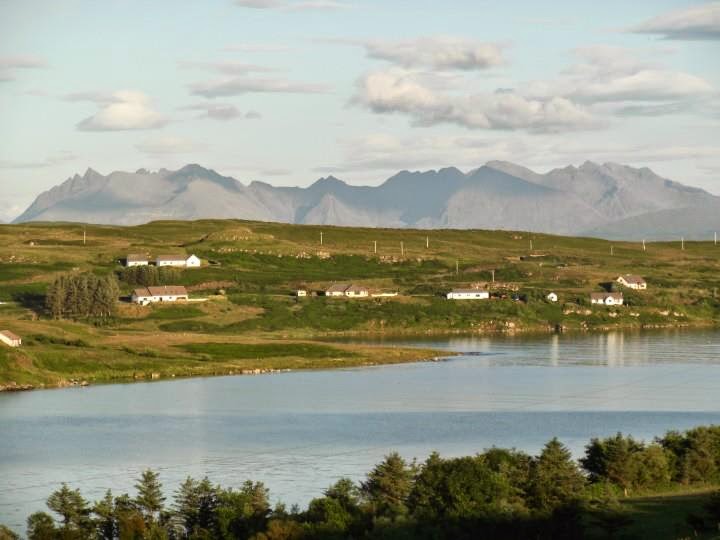 |
| The view from the cottage |
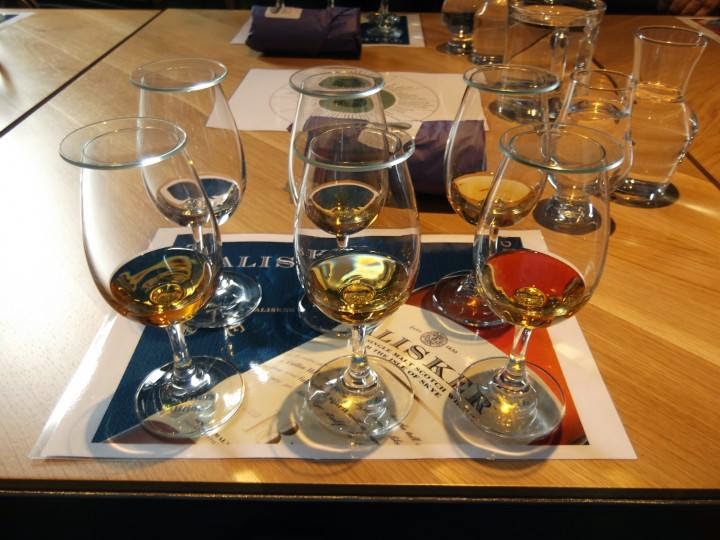 |
| The tasting experience at the Talisker Whisky Distillery |
The holiday coincides with the 50MHz/6 Meter UKAC contest and the opportunity to operate from the rare IO67 locator square was something I was looking forward to, I was totally realistic as to my chances given my set up, the terrain and power restrictions.
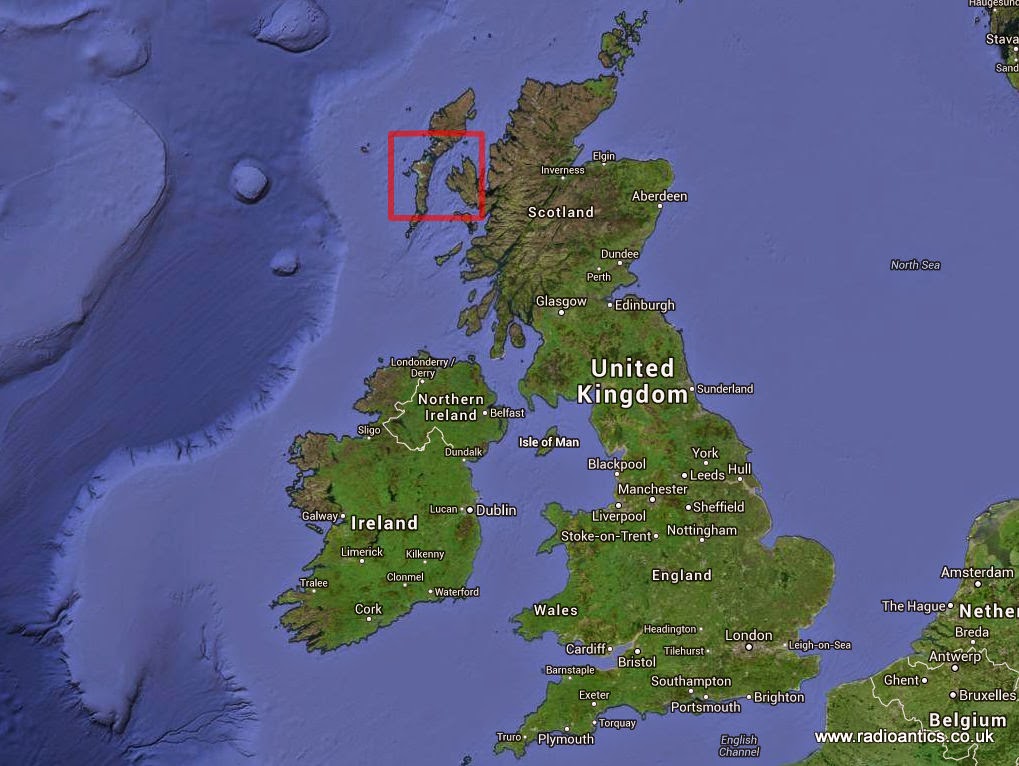 |
| IO67 Locator Square |
I abandoning the idea of a multi-element quad beam once I realised the sheer size it would be and the lack of space in the car and so opted to make a manageable two element quad.
I modelled up the antenna in MMANA-GAL to check the dimensions, made a nice short wooden boom, and cut the fibreglass pole for the spreaders, initially cutting them all to the wrong length! Cue expletives!
So I cut another set to the correct length and made the wire loop elements and tried to put it all together. Unfortunately the fibreglass spreaders are far too thin and bend and sag under the weight of the wire! Cue even more colourful expletives!
Plan-B is now just a simple tuned dipole and all I can hope for is some Sporadic-E on Tuesday evening!
I am packing the HF antennas a Magitenna and the HW-20HP from Nigel at M0CVO Antennas. I haven't done a great deal on HF finding the operating a little intimidating however I will endeavour to be on air during the week having realised in the last couple of days that I can 'activate' the island and some 'rare-ish' grid squares for the Worked All Britain (W.A.B) scheme, as well as 'activating' for the Island On The Air (IOTA) scheme. I might convince the wife to let me take the rig portable on a planned trip across to the Isle of Raasay for another activation.
With just 48 hours left I am rapidly reading up on what I need to do... as my wife pointed out I have had weeks/months to prepare for this... the 7Ps indeed!
If I do get on the air as 2M0NRD/A or 2M0NRD/P during the week please be patient and treat me gently! I will be on voice and maybe JT65 and PSK. The cottage has wi-fi so will post updates on my twitter feed @nerdsville.
Andrew Garratt, MØNRD, is a regular contributor to AmateurRadio.com and writes from East Midlands, England. Contact him at [email protected].
Sailing into a DX Sunset
The Cass Award encourages DXpeditions to maximize the number of DXers worked with a $1000 prize for the single-operator that works the most unique call signs within a specified interval. This award honors the wisdom and spirit of Cass, WA6AUD (SK), whose stories in the West Coast DX Bulletin taught a generation of DXers that DX IS!
It rewards simplicity in DX operations and ironically, had the award existed back in the early 1960’s, one particular fellow might have won it several years in a row…
Don Miller, ex-W9WNV and now AE6IY was in Dayton this year and spent time pressing the flesh at the DX Banquet and making noise about returning to Thailand for one final, grand, DX operation. That bit of news has gone mostly unreported — at least I’ve not seen anything about it.
Maybe he wasn’t serious, but I doubt it. I think he’s making plans to go…
Miller came along during a golden age for DXpeditioning. In those halcyon days, a fellow might get into a small sailboat and circumnavigate the globe with amateur radio along for the ride. Compare sailing into a Pacific sunset on a small skiff with a modern DX operation where 100 tons of equipment are delivered by helicopter on some island location while a team of twenty operators set it all up and run the show from an air-conditioned quonset hut. I think you get my point…
By all accounts, Don Miller was a phenomenal operator, capable of sending CW with one hand and logging with the other – using pencil and paper. A sharp mind, keen memory, and wizard-like skills with the radio made him a legend.
But W9WNV took a few shortcuts on certain operations and may not actually have operated from all the places he claimed. And he may have legitimately operated from some locations that were not legal places for him to be. This was in the days before the DXCC rules had been made rigid like they are today — mostly thanks to Don Miller.
The ARRL defamed him, he sued them and they settled out of court. It became an ugly season for amateur radio. Miller might have made a comeback and fixed his reputation with time and trust me, you hand out Q’s from a rare one, and the DX community would rally in support. But a few years later Miller was accused of hiring someone to kill his wife and he ended up doing more than twenty years in prison.
He became ham radio’s “bad boy” who cheated on DX and took a sizable chunk of League money in the settlement. Unable to defend himself from a prison cell, his reputation tanked. When he finally got out in the early part of the 21st century, his first move was to take, and pass, the Extra class exam. He was issued the call AE6IY. That same year he visited the Dayton Hamvention where he offered an apology to the DX Community at one of the most popular DX forums.
I was there. I saw it happen.
Now Don Miller is a decade older and has entered the “winter” of his life. Who knows if he will actually be able to mount one last notable operation. But he wants to try. And who are we to hold back the dreams of a legend?
There’s a whole lot more to the W9WNV story, way more than I could ever relate here. Fortunately, he was interviewed soon after his release from prison and those recordings tell his story, in his own words and voice better than anyone else ever could. You really should download them and have a listen someday when the bands are quiet and your mind is still. It’s a compelling tale of ham radio adventure unlike any other and it deserves to be heard.
Filed under: Ham Radio Tagged: dx, w9wnv 


Jeff Davis, KE9V, is a regular contributor to AmateurRadio.com and writes from Indiana, USA.
FT817 – wrong setting!
Just realised that I had my FT817ND set to USB and not DIG, so I was not sending any modulation on WSPR TX! This has now been corrected, so I am hopeful of some spots this evening. This is the second time I have made this mistake. It remains to be seen if this was the reason for no spots earlier.
UPDATE 1820z: Still no 10m spots! Must be conditions. Will leave the rig on 10m this evening to see if things improve.

Roger Lapthorn, G3XBM, is a regular contributor to AmateurRadio.com and writes from Cambridge, England.
Capricious Cycle 24
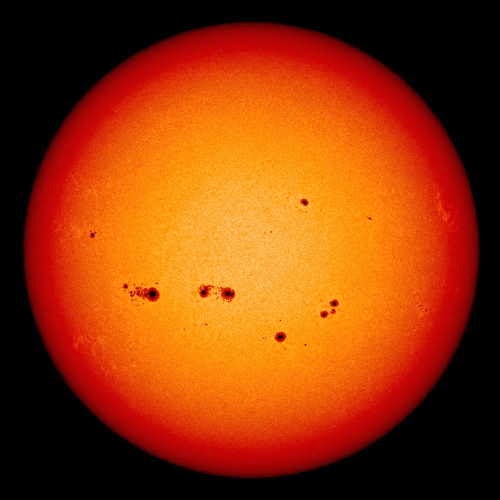 |
| July 6th - Courtesy: nasa.gov |
 |
| Sun Today - Courtesy: nasa.gov |
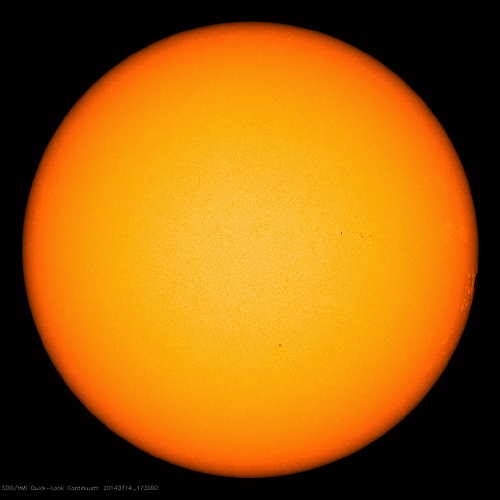
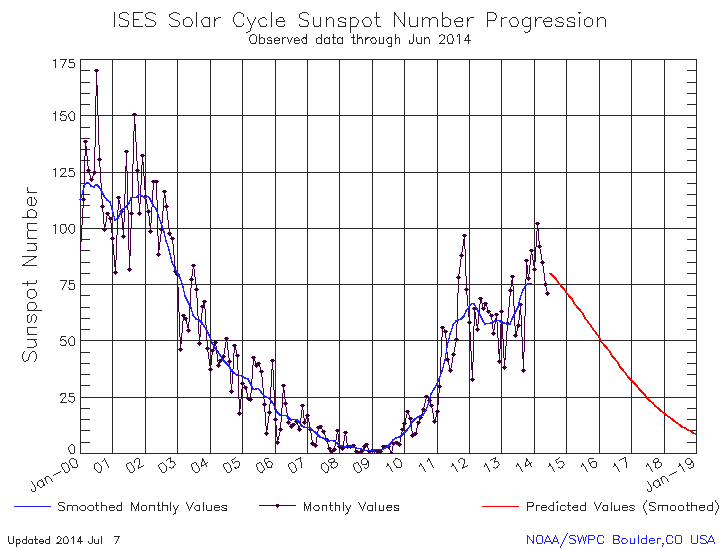
What a difference a week can make, even on something the size of the sun! Boasting an SFI of just over 200 on July 6th, today's numbers have fallen to 109 along with the disappearance of most sunspot activity.
 |
| Courtesy: http://www.swpc.noaa.gov/SolarCycle/ |
I'm hoping, and somehow suspect, that this isn't the last hurrah for what has generally been a most unusual solar cycle.
Steve McDonald, VE7SL, is a regular contributor to AmateurRadio.com and writes from British Columbia, Canada. Contact him at [email protected].
Results from the SKCC Weekend Sprintathon
I had low expectations for the July SKCC Weekend Sprint and I lived up to them. I usually try to get 2-4 hours in the chair during the 36 hour period but my only real shot at that this go round was on Saturday. And on that day, the thunder rolled from start to finish. I did manage to squeeze in an hour on Sunday morning that resulted in 10 contacts searching and pouncing.
Of those ten contacts, nine were in unique states. Two were with Senators and six with Tribunes. Four of those states, GA, SC, MD, and PA, qualified for a 25 point ’13 colonies’ bonus each. When you put it all together, it totaled a measly 280 points.
But hey, I enjoyed it. I always enjoy these sprints. They’re so much more casual than the real contests.
And I like pounding brass with a real key…
This may sound silly, but using a straight key is, to me, like using a manual transmission. The automatic is much easier and much more comfortable, but I feel more engaged, more connected to the machine with a manual transmission. Same thing with the straight key.
See you next month in the Weekend Sprintathon?
Filed under: Ham Radio Tagged: cw, skcc, wes


Jeff Davis, KE9V, is a regular contributor to AmateurRadio.com and writes from Indiana, USA.
Ultimate 3 kit – offers of help
Our community in Amateur Radio is truly wonderful.
Already, I have had three kind and generous offers to build and test my Ultimate-3 beacon kit, which is currently beyond my building skills because of my brain injury. I still hope to build this myself, but may wait a few more months until I’m less wobbly and clumsy.
This is not the first time I have been touched by the genuine kindness of others. It restores one’s faith in humankind: there are some truly kind people around. Thank you all.
Sometimes we hear about all the bad things in this world. Believe me, the world has very many kind and caring people in it.

Roger Lapthorn, G3XBM, is a regular contributor to AmateurRadio.com and writes from Cambridge, England.
Solder fumes
Mention Health and safety and its likely you think of some Muppet decides that children need a suit of armour to play conkers (for those not lucky enough to have tried to make a horse chestnut seed the hardest material known to man, have a look here). Back to the point. I’m talking about looking after yourself in your hobby.
Ham radio has some pretty high hazard activities. High voltages, antenna’s on towers, climbing on roofs etc. Recently I’ve been soldering a bit more. Whilst its not likely to be particularly harmful to occasionally sniff in some fumes its probably not going to do me much good either. So I might benefit from a solder fume extractor.
I understand that the technical terms (and we all love a technical term) is local exhaust ventilation or LEV. Still doesn’t sound too complex and thankfully it doesn’t need to be. A fan that sucks and a filter is pretty much all you need, it seems. So do I really need an industrial scale extractor? probably not. So as an experiment I’ve bought a £5 extractor from eBay.
Its an mdf laser cut body with a 12v (computer?) fan. It takes 5 minutes assemble and may or may not need some PVA to hold it all together. I say might as mine was a good tight fit so probably won’t need it in the short term but as it gets bashed about on the workbench it might need some help to stay together.
The extractor is basic (what do you expect for £5) and didn’t come with any filter media. So a suitably sized filter will be needed. Perhaps the same activated carbon you get for cooker hoods would suffice, will need to be sourced. I dare say just sucking it from one place to blow to another isn’t really helping matters.
I could measure flow, compare against standards, determine filter abatement. I say could, because clearly this hasn’t been designed with that in mind and how would that really help? The video below shows you how effective it actually is.
So the conclusion. The hazard associated with occasional solder fumes is probably quite low and the risk is also probably quite low. But a simple device, like this, has the opportunity to remove the fumes from the workbench and at the very least stop them going in your eyes. That can’t be bad.
Here it is in action. Distance between tip and fan is approximately 10cm.
p.s. If you’re really lucky you can hear my daughter homebrewing in the background (what she is homebrewing is anyone’s guess)
Alex Hill, G7KSE, is a regular contributor to AmateurRadio.com and writes from Cumbria, UK. Contact him at [email protected].
 Ham Radio Deluxe |
 W5SWL Electronics |
 Ham Radio Prep |
 KB3IFH QSL Cards  Hip Ham Shirts  HamRadioAuctions HamRadioAuctions Reliance Antennas Reliance Antennas Enigma Shop Enigma Shop |  morseDX  Ni4L Antennas  R&L Electronics R&L Electronics antennas.us antennas.us QRV QRV |
- Matt W1MST, Managing Editor
