 |
 Reflections on the passing of VO-52
 22 July 2014 | by
 Unfortunately, our concerns were well-founded. Yesterday, on the AMSAT bulletin board, the official news of VO-52’s passing was announced.
The loss of VO-52 leaves quite a gap. What I enjoyed about it particularly, was that it was the one of the linear transponders that could be used with very simple antennas. My V2000 vertical worked very well for a variety of contacts. I just wish I had started using it earlier.
VO-52 had a great downlink signal and was always in transponder mode (AO-73 is great, but I rarely hear it in transponder mode, or if I do, it’s usually brief, as it switches over to telemetry). So, hopefully the new generation of satellites which will be coming on stream soon – some already in orbit doing other things, waiting to be activated into their amateur radio roles – others waiting to be launched.
A good time to remember to support AMSAT (a VO-52 lookalike would work very well, thank you…)
Tim Kirby, G4VXE, is a regular contributor to AmateurRadio.com and writes from Oxfordshire, England. Contact him at [email protected].
Reflections on the passing of VO-52
Unfortunately, our concerns were well-founded. Yesterday, on the AMSAT bulletin board, the official news of VO-52’s passing was announced.
The loss of VO-52 leaves quite a gap. What I enjoyed about it particularly, was that it was the one of the linear transponders that could be used with very simple antennas. My V2000 vertical worked very well for a variety of contacts. I just wish I had started using it earlier.
VO-52 had a great downlink signal and was always in transponder mode (AO-73 is great, but I rarely hear it in transponder mode, or if I do, it’s usually brief, as it switches over to telemetry). So, hopefully the new generation of satellites which will be coming on stream soon – some already in orbit doing other things, waiting to be activated into their amateur radio roles – others waiting to be launched.
A good time to remember to support AMSAT (a VO-52 lookalike would work very well, thank you…)
Tim Kirby, G4VXE, is a regular contributor to AmateurRadio.com and writes from Oxfordshire, England. Contact him at [email protected].
A New 3.5 GHz CB Radio Band?
[gview file=”https://dl.dropboxusercontent.com/u/15763538/Bennett_Kobb_HOPE2014.pdf”]
Is a new “CB” allocation of 100-200 MHz in the 3.5 GHz microwave band just around the corner? Possibly, according to Bennett Kobb, AK4AV. Not “Citizens Band” but “Citizens Broadband Radio Service.” Scroll through the embedded presentation above. Quite interesting.
Source: Hackaday
Matt Thomas, W1MST, is the managing editor of AmateurRadio.com. Contact him at [email protected].
The bands are slipping
Band conditions seem to have vastly deteriorated from what they were just a few months ago. It’s not that propagation is non-existent, it’s just that it seems to have left us in a bigger hurry than I would have thought.
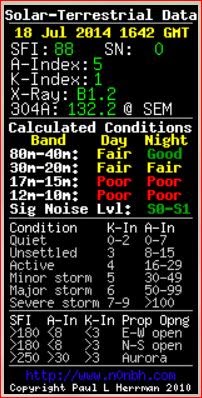
I went out at lunchtime today (around 1730Z) to find activity on 15 Meters to be nil. A quick scan of 17 Meters revealed not so much. Just a few months ago, both these bands were hopping with all kinds of DX. It wasn’t all that rare to hear Europe, South America and Asia all at the same time! It wasn’t all that rare to hear a good amount of activity on 12 and 10 Meters just a few short months ago.
Since 15 and 17 seemed inactive, I went to 14.061 MHz and called CQ after QRLing to make sure the frequency was dead. I was answered by fellow New Jerseyan, QRPer and blogger, Chris KQ2RP who gave me a 559 from Maine.
After that, I worked fellow Polar Bear, Ken WA8REI who is having a hard time enduring the heat and humidity in Michigan. It’s hard to put up with the Temperature Humidity Index when you have so much fur! 😉 Ken was a good solid 579 here when the QSB wasn’t wreaking havoc. We had a nice little chat and then it was time for Ken to go, and my available lunchtime minutes were growing short, too.
Before heading in, I decided to check out 17 Meters one more time. There, blasting in at 599+ was GA14CG, the Special Event Station for the 2014 Commonwealth Games in Scotland. There was a bit of a pileup, but he was so loud that I figured that I could work him, if only I could place myself correctly.

With time running short, I was able to eventually find the right spot. GA14CG was using the ol’ racetrack pattern scheme. Start at a frequency, move a bit higher after each call, reach a high point and then continue to work stations, moving a bit lower after each QSO until arriving at starting point and starting the process all over again. Essentially, he was doing laps, which I guess was appropriate considering it’s the Commonwealth Games. I placed myself correctly on the return trip home and got into the log. They’re on the air until August 3rd, so you have plenty of time to work them.
72 de Larry W2LJ
QRP – When you care to send the very least!
Larry Makoski, W2LJ, is a regular contributor to AmateurRadio.com and writes from New Jersey, USA. Contact him at [email protected].
Cycle 24 ….Not Really
 |
| Courtesy: STCE Newsletter |
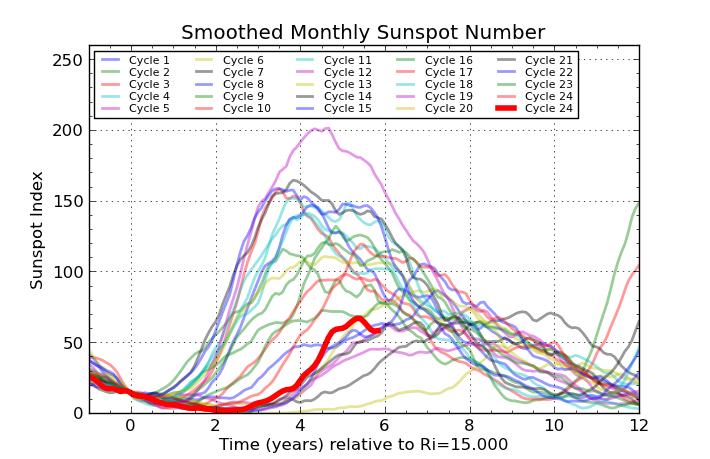
My recent postings of Cycle 24's performance has made me wonder about previous cycles. I'm still hunting for the source, but I recall reading of Cycle 19's F2 MUF actually peaking out at over 70MHz on several days of that monster cycle! Knowing just how rare (and difficult) it is to get the F2 MUF to even approach 50MHz, reaching 70MHz is just further testimony to Cycle 19's unheralded performance. I can only imagine how exciting 6m must have sounded at those times, with intercontinental signals of bone-crushing strength.
Although Cycle 19 may be the largest in recorded history, our documentation of solar activity only began in 1759, or Cycle 1. We know that our sun is roughly 7.5 billion years old and in relative terms, evolved rather quickly into something close to what we see today as a main-sequence star. Assuming an 11 year cycle, that's roughly 409 million solar cycles or half that number if you consider the 22-year pole-reversal cycle. Either way you look at it, that's a lot of cycles! I'd be willing to wager that several thousands of these cycles, if not hundreds of thousands, would have made Cycle 19 look pretty wimpy by comparison.
Such cycles make me wonder...just how high could the F2 MUF reach during those cycles?....would it reach 2m or even beyond? It's hard to imagine world-wide F2 propagation on 2m or higher, but why not?
With the Sun almost half-way through its life, there is no question that there are many more gigantic cycles yet to play out. With the existence of radio and human life being just a momentary flash in time, I wonder if any of them will ever be enjoyed by radio amateurs?
Steve McDonald, VE7SL, is a regular contributor to AmateurRadio.com and writes from British Columbia, Canada. Contact him at [email protected].
LHS Episode #132: Interview with Ben Schram
 Hello, everyone! In this, our last episode before our scheduled time off and retooling session, we interview Indiegogo donor Ben Schram from Perth, Western Australia. Ben is an avid listener, contributor to many crowd funding campaigns, Linux enthusiast and soon-to-be amateur radio operator. We discuss everything in this episode from high-speed rail systems to FCC Part 97 rules changes to the great AMC television series The Walking Dead. See you in September!
73 de The LHS Guys
Russ Woodman, K5TUX, co-hosts the Linux in the Ham Shack podcast which is available for download in both MP3 and OGG audio format. Contact him at [email protected].
After 25 Years
As a teenager my cousin exposed me to shortwave listening. As many of us will say, it was magic to be able to sit in my bedroom and hear signals from around the world. I was mesmerized. I couldn't wait for the mailman each day to see if a QSL card might arrive. However, there were no local hams, learning morse code seemed impossilble, so I never pursued my ham license until years later, when I came across a Gordon West course in the local Radio Shack. The course cover proclaimed that a novice license was good for 10 years and you could talk on 10 meters. I bought the course, my 12 year son listened along as I did, we learned the code together.
So fast forward 25 years, what has changed? I supposed in many ways things have changed a lot. Things like:
- Internet
- Enhanced Digital Modes
- Online Confirmations
- Equipment functionality
I'm sure I'm missing a few things, but the efficient access to information is much easier now. QSL routes used to be one of the great mysteries of the world, in fact, INDEXA used to have a net on 14.236 that dipensed the lastest QSL route news. Setting schedules required weeks/months of letter writing. Increasing your DXCC count meant turning the dial, find the pile-ups and then back down to figure out the split, find which DX station might be on and then jumping into the fray . Logging was manual and data mining your log for forgotten contacts was a laborious task, but just as rewarding. DXing news came in weekly newletters not daily emails.
But there are some things that haven't changed:
- The concern over how to fund expensive expeditions
- Frequency cops
- QRMer's
- Complaining about the cost of getting a real QSL card
- The thrill of receiving that QSL card
- The excitement of a new one
- The magic of wirelessly communicating around the world
- Dayton, Friedrichshafen, DXCC, IOTA, WABA, etc....
Like some many things, the more things change, the more they stay the same.
Here is a toast to the next 25 years, God willing.
Mike Crownover, AD5A, is a regular contributor to AmateurRadio.com and writes from Texas, USA. Contact him at [email protected].
 Ham Radio Deluxe |
 W5SWL Electronics |
 Ham Radio Prep |
 KB3IFH QSL Cards  Hip Ham Shirts  HamRadioAuctions HamRadioAuctions Reliance Antennas Reliance Antennas Enigma Shop Enigma Shop |  morseDX  Ni4L Antennas  R&L Electronics R&L Electronics antennas.us antennas.us QRV QRV |
- Matt W1MST, Managing Editor
